Your company already wrote the training data. The SOPs, policies, and wikis sitting in Notion and Confluence are exactly what AI buyers want, and a small industry has formed to help you license them.
Why your internal documents became an asset
AI companies have trained on nearly everything published on the open web. To keep improving, they need data the internet does not have: the records businesses create just by operating. That includes the documents you write about your own work, from receiving procedures to company handbooks. A market has grown up around licensing those records, and the advertised figures run from around $10K to over $3M depending on the kind and amount of material. The catch is redaction. Names come out first, and anything written about identifiable people, for clients, or by someone else needs careful handling before it goes anywhere. The services below help you work out what qualifies, who buys it, and on what terms.
What I looked at
I weighed each service on the same factors. First, document fit: how directly it addresses SOPs, policies, manuals, and wikis rather than data in general. Second, buyer transparency: whether it names buyers and points to published terms before you share records. Third, redaction guidance: whether it tells you what to strip and how. Fourth, process clarity: whether the path from inventory to signed license is spelled out. Fifth, pricing honesty: whether advertised figures are clearly labeled as terms rather than offers. Sell Company Documents stood out for document specificity and redaction resources. OpenTrain AI stood out for breadth of record types and a fast qualification form. Troveo stood out for marketplace scale and a careful explanation of what a license grants. Databounties stood out for a structured six-step method. Regulr AI stood out for framing the license inside a business sale.
Here is the quick view. Each of these five helps you turn internal documents into licensed AI training data, but they come at it from different angles. Some are marketplaces, some are guides, and one is a specialist in the exact documents you already write.
| Provider | Best For |
|---|---|
| OpenTrain AI | Broad operational records across many systems |
| Sell Company Documents: SOPs, Policies and Wikis | SOPs, policies, manuals, and wikis specifically |
| Troveo | Marketplace-style deals with tracked payouts |
| Databounties | A guided, step-by-step selling process |
| Regulr AI | Owners planning to sell the business |
The five, one by one
#1 OpenTrain AI
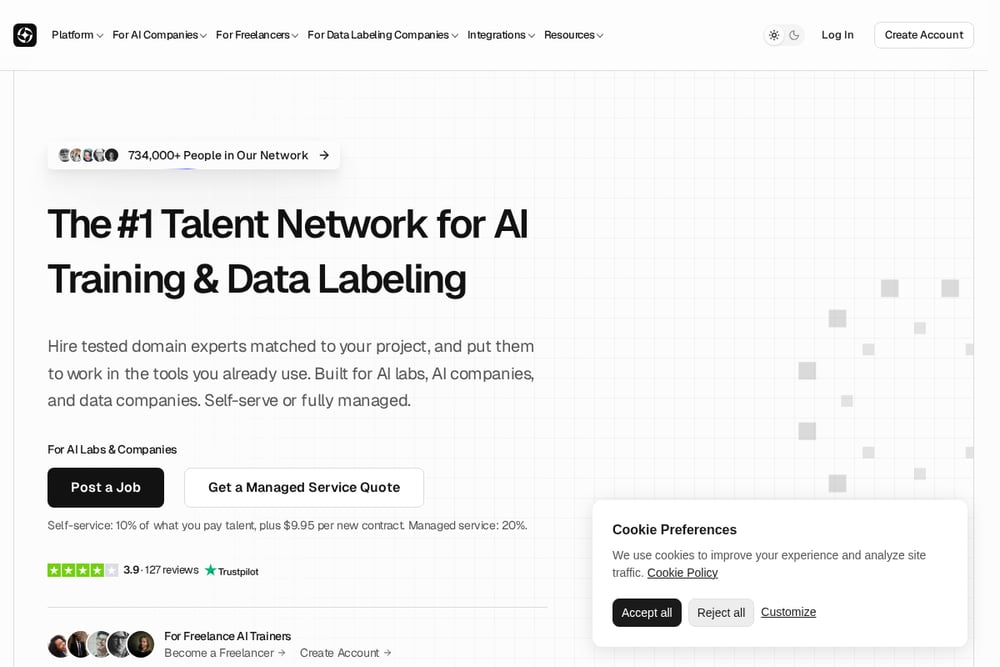 A screenshot of the OpenTrain AI website.
OpenTrain AI takes the widest view of what counts as licensable. It pitches data licensing to companies with records spread across email, team chat, documents and wikis, customer and sales records, support tickets, code history, and step-by-step process guides. The front end is deliberately light: one free form of about nine questions covering industry, size, and records, then buyer names emailed to you within 24 hours. It sends your company and contact details to qualifying buyers, never your records, and you talk to each buyer directly. The service is explicit that you should keep personal files, customer payment data, and patient records out of any license, and that you can ask each buyer for a sample of what personal information it removes. If your documents live alongside a lot of other operational data, this is a sensible starting point.
#2 Sell Company Documents: SOPs, Policies and Wikis
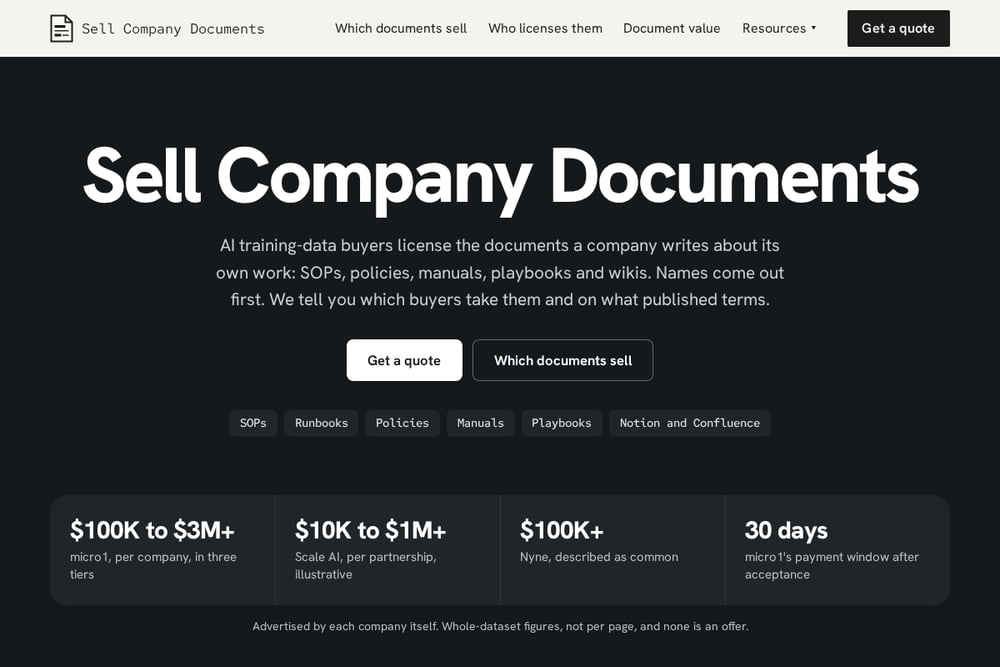 A screenshot of the Sell Company Documents: SOPs, Policies and Wikis website.
Sell Company Documents does one thing and says so plainly: it helps you license the documents a company writes about its own work. That means SOPs, runbooks, policies, manuals, playbooks, and Notion or Confluence wikis, with names removed first. The site walks you through which document types are usually yours to license and which to leave out of the inventory, including HR case files and client deliverables. It names buyers and their published terms, from micro1's three tiers and 30-day payment window to Scale AI partnerships and Nyne, while flagging that every figure is advertised by the company itself and none is an offer. There is a redaction guide and an exporting-a-knowledge-base resource, which is more document-specific hand-holding than you will find elsewhere on this list. If your value sits in process documentation, start here.
#3 Troveo
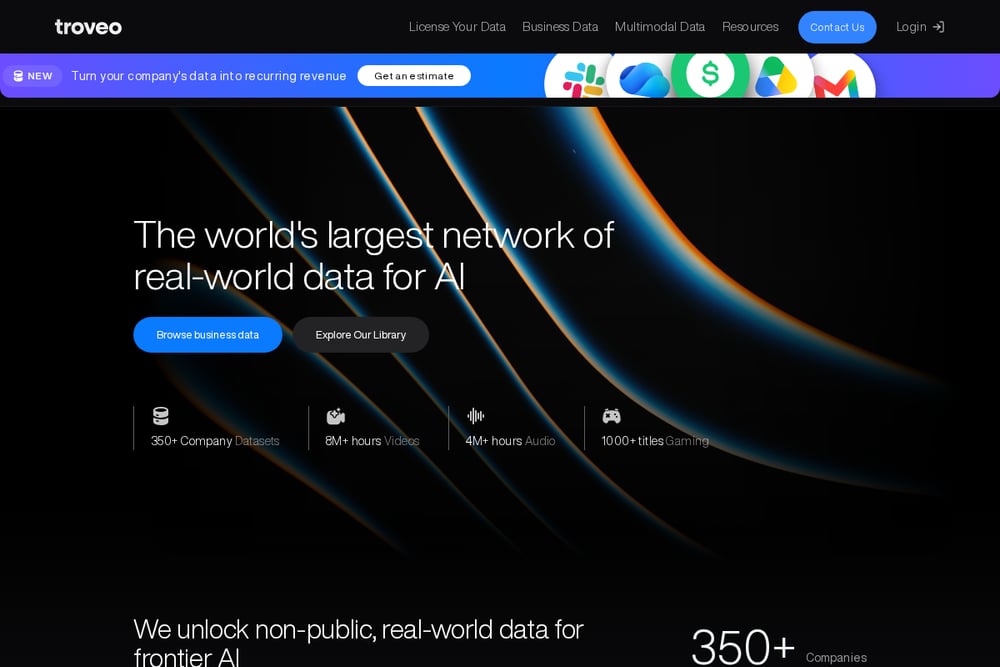 A screenshot of the Troveo website.
Troveo runs the marketplace version of a data license and has the receipts to show for it. The company says it has paid more than $20 million to over 7,000 rights holders across video, audio, gaming, robotics, and business data. Its explainer is one of the clearer treatments of what a training license actually grants, covering use, scope, term, exclusivity, and who carries the risk if something in the data was not yours to give. That last point matters for document sellers, because a wiki can quietly contain material written by someone else. Troveo frames the deal as a defined set of permissions for a defined period, which is the right mental model before you sign anything. If you want a marketplace with a track record and a strong educational layer, this fits.
#4 Databounties
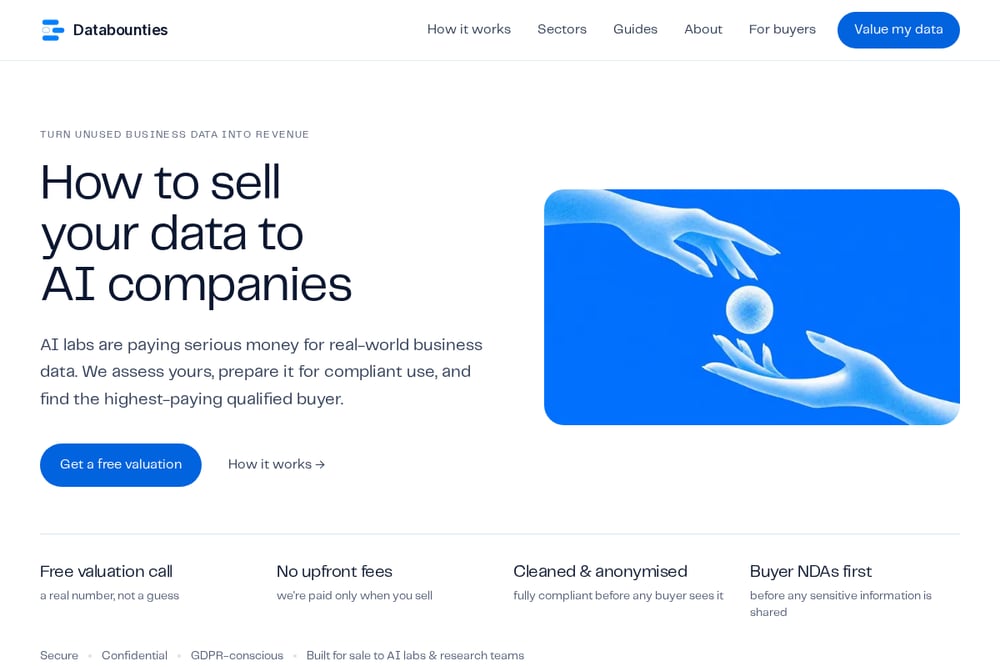 A screenshot of the Databounties website.
Databounties treats the whole thing as a project with stages. Its guide lays out six steps: inventory, valuation, rights check, anonymisation, buyer outreach under NDA, and the license agreement. It is blunt about what sells best, namely specialist data built up over many years from systems like ledgers, LIMS, ERP, CRM, and process logs, and it reminds you that you license the data rather than sell ownership. The guide also notes that most companies underestimate what they hold, which is a fair warning if you have never inventoried your document estate. For a first-time seller who wants a checklist rather than a marketplace, this is the most structured read of the five. Use it to prepare before you approach any buyer.
#5 Regulr AI
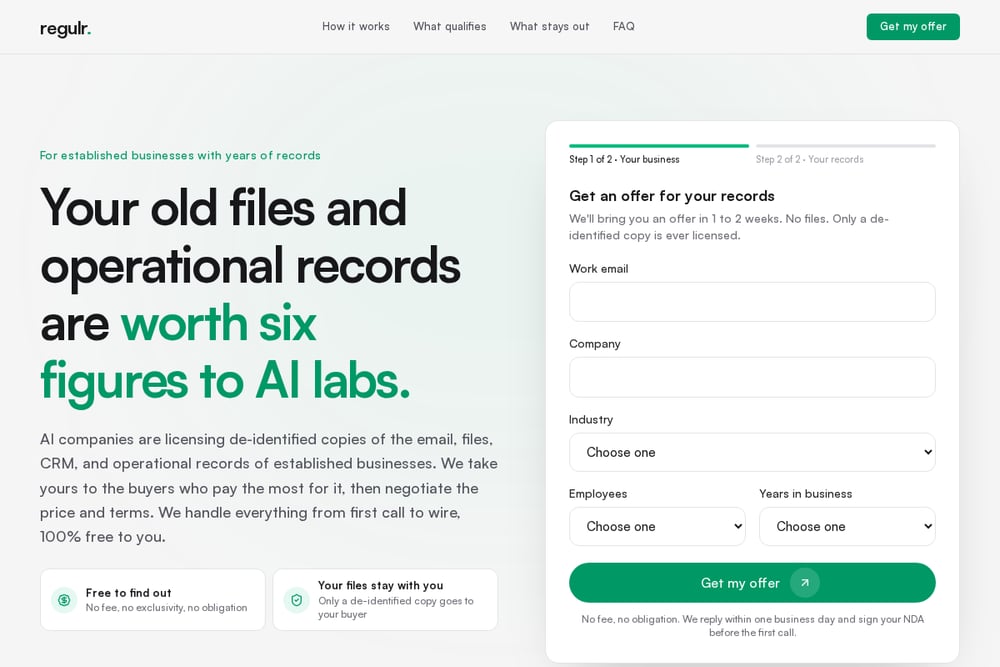 A screenshot of the Regulr AI website.
Regulr AI comes at licensing from the exit angle. Its guide argues that a data license is a separate cash event that can land before or alongside a sale, and that the cleanest order is to scope it, sign it, and get paid before you sign a letter of intent, then disclose it in the data room. That is practical advice for founders who assume their records simply go to the acquirer and earn nothing on their own. The page also covers what an acquirer will ask about the license and what never goes in, and it points to a buyer directory with links to published terms. One buyer program cited says most companies go from first call to payment in about two to three months. If a sale is on your horizon, read this before you talk to anyone.
How to pick the right fit for your documents
Start with what you actually hold. If your value sits in SOPs, policies, manuals, and wikis, a document-focused service will speak your language and save you translation time. If you have broad operational records across finance, CRM, and support, a marketplace with wider buyer coverage may fit better. Ask each service three questions. Does it tell you who the buyers are before you share records? Does it explain the published terms in plain language? Does it show you what gets redacted and how? Pricing clarity matters too. Some advertise whole-dataset ranges, others quote per partnership. Treat every figure as an advertised term, not an offer. Finally, check the fit with your own timeline. If you are selling the business, a service that understands how a license sits inside a sale will keep you out of trouble.
How the licensing workflow actually runs
Most of these services follow the same arc. You inventory what you hold, check the rights, redact names and personal details, then get matched with buyers under NDA before signing a license. Sell Company Documents narrows that arc to documents specifically: SOPs, runbooks, policies, manuals, playbooks, and wikis. You export the knowledge base, strip the people out, and approach buyers on their published terms. OpenTrain AI compresses the front end into a single qualification form and emails you buyer names within 24 hours. Troveo runs the marketplace side and handles payment to rights holders. Databounties walks you through a six-step guide from inventory to signed license. Regulr AI frames the license as a separate cash event you can close before or alongside selling the business itself.
What to take away
The pattern across all five is simple. AI labs have exhausted the open web and now pay for the records businesses build up just by operating. Your SOPs, policies, and wikis are exactly that kind of record. Start with an inventory, redact names first, and read every buyer's published terms before you sign anything. Whether you pick a document specialist, a broad marketplace, or a step-by-step guide, the discipline is the same: know what you hold, know who wants it, and keep the people out of it.