
Your building's mechanical systems shouldn't be a mystery you pay for every month. These five consultancies help owners and managers turn HVAC headaches, energy waste, and messy build-outs into manageable, cost-conscious decisions.
What Commercial Building Engineering Consulting Looks Like Right Now
Commercial buildings are under pressure from every direction. Energy costs keep climbing, equipment is aging, and tenants expect comfortable, reliable spaces year-round. That's where building engineering consultants come in. They sit between design firms, contractors, and the people who actually run the building day to day. Some focus on MEP design and permitting. Others lean into commissioning, energy modeling, or hands-on operational support. The strongest firms share one trait: they translate technical complexity into plain business language. You get fewer surprises, fewer emergency repairs, and a clearer picture of what your systems are actually doing. The five firms below approach that mission from different angles, so the right fit depends on whether you need drawings, diagnostics, optimization, or an extra set of hands on site.
How We Evaluated These Firms
We looked at service scope first. Does the firm cover design, construction oversight, HVAC diagnostics, and automation, or only one slice? Next, we considered practical orientation. Some firms are design-first and permit-focused, while others emphasize operational troubleshooting and cost-conscious guidance. We also weighed local fit and licensing signals, including professional engineer credentials and code familiarity. Communication mattered too, especially whether a firm explains tradeoffs clearly to non-engineers. Finally, we considered flexibility, such as training, temporary staffing coverage, and multilingual support. Each firm below stood out on different factors. A design-heavy firm may shine on new construction, while an operations-focused consultant may be the better call when your building is already running and something feels off.
Here's a quick comparison of the five firms, ordered for readability. Each entry highlights what the firm does well and who tends to benefit most. Use this as a starting map, then dig into the details below.
| Provider | Best For |
|---|---|
| AHA Engineers | High-performance and sustainability-driven projects |
| B.E.S.T. | Building Engineering Solutions & Technology LLC | Owners and managers who need hands-on operational support |
| A&N Design Group | MEP design and permit coordination |
| K2D | Multi-state portfolios needing broad MEP coverage |
| Pacific MEP Engineering Consulting | Fast, permit-focused design support |
The Five Firms in Detail
#1 AHA Engineers
 A screenshot of the AHA Engineers website.
AHA Engineers brings more than 30 years of experience designing mechanical, electrical, plumbing, and fire protection systems for complex, high-performance buildings. The firm pairs MEP design with in-house energy modeling, decarbonization strategy, and commissioning, which means sustainability goals get baked into the engineering rather than bolted on later. Its team also runs an internal education program, AHA University, to keep its engineers current on industry developments. If your project has ambitious performance targets or a demanding review process, this is a firm built for that level of scrutiny. Learn more about their MEP/FP design practice.
#2 B.E.S.T. | Building Engineering Solutions & Technology LLC
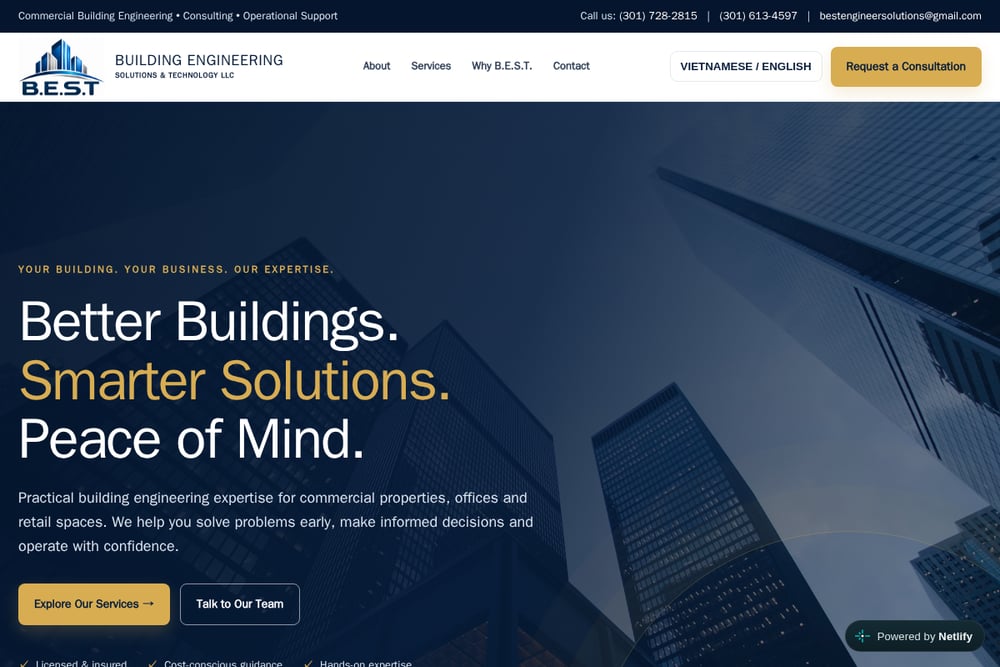 A screenshot of the B.E.S.T. | Building Engineering Solutions & Technology LLC website.
B.E.S.T. focuses on the operational side of commercial buildings, which is where many owners feel the most pain. The firm reviews MEP drawings for code compliance and cost-effective design, then monitors construction against approved plans so workmanship issues surface early. On the operations side, it diagnoses HVAC problems like equipment failures, uncomfortable spaces, and rising utility costs, and fine-tunes EMS/BMS settings and sequences to cut energy waste. It also offers engineer training, temporary staffing coverage, and preventive maintenance support. The company describes itself as independent and practical, is licensed and insured, and serves clients in both English and Vietnamese. You can reach the team through its service overview.
#3 A&N Design Group
 A screenshot of the A&N Design Group website.
A&N Design Group has concentrated on mechanical, electrical, and plumbing engineering since 2005, with licensed Professional Engineers and Certified Energy Plans Examiners on staff. The firm handles HVAC design, electrical and plumbing engineering, Title 24 energy calculations, sustainable engineering, and BIM. Its collaborative approach aims to catch equipment and location conflicts before they turn into construction delays. A&N also helps coordinate with city officials to meet permit requirements with less friction. If you're planning a build-out or renovation and want design and permitting handled cohesively, this firm is worth a conversation. See the full services list.
#4 K2D
 A screenshot of the K2D website.
K2D offers a broad MEP services menu spanning mechanical, electrical, and plumbing design alongside Title 24 compliance, commissioning, fire sprinkler design, solar design, and LEED certification support. The firm's mechanical team covers everything from heat loss and gain calculations to duct layout and plant room design, while electrical work includes power distribution, lighting, and fire alarm systems. K2D operates across California, Florida, Hawaii, Nevada, and Texas, which makes it a fit for portfolios spread across multiple states. If you need a single firm to handle design documentation and energy compliance together, this is a solid option. Explore their MEP services.
#5 Pacific MEP Engineering Consulting
 A screenshot of the Pacific MEP Engineering Consulting website.
Pacific MEP Engineering Consulting positions itself around speed and cost-effectiveness, with a focus on getting quality design and engineering plans through permits without hassle. The firm covers mechanical (HVAC), electrical, and plumbing design, plus civil engineering and Title 24 energy calculations. It works across residential, commercial, industrial, healthcare, and restaurant projects, so the team has seen a wide range of building types. Energy-efficient lighting and intelligent power systems are part of the electrical design offering. If your priority is a smooth path from concept to permit, this firm's process-oriented approach may suit you. Visit the Pacific MEP homepage for details.
How to Choose the Right Fit
Start with the phase you're in. If you're planning a build-out or renovation, design and permitting experience matters most. Look for firms that review drawings for code compliance and coordinate with local authorities. If your building is already operating and something feels wrong, prioritize diagnostic and optimization skills instead. Ask whether the firm can review EMS/BMS sequences, not just replace equipment. Next, clarify the deliverable. Some firms hand you drawings and walk away. Others stay involved through construction oversight, commissioning, and training. Decide which model fits your team's capacity. Then check credentials. Professional engineer licenses, energy plan examiner certifications, and insurance coverage are baseline signals. Ask about communication too. Can the firm explain tradeoffs in plain terms, and does it offer support in your preferred language? Finally, think about ongoing needs. Preventive maintenance, temporary engineer coverage, and staff training can be more valuable than a one-time report. A short conversation about your building's history will tell you a lot about whether a firm listens before it sells.
Where Automation Fits Into the Picture
Building automation is often the cheapest performance upgrade you haven't made. Before you spend on new equipment, have a consultant review your EMS/BMS settings and operating sequences. Small adjustments to schedules, setpoints, and staging logic can reduce energy waste without capital expense. A practical workflow looks like this: document current sequences, compare them against actual occupancy patterns, adjust one variable at a time, and measure results over a few weeks. Pair that with preventive maintenance so sensors and actuators stay calibrated. If you're evaluating an EMS/BMS upgrade, ask vendors for proposals that separate hardware costs from programming and commissioning. Independent review of those proposals helps you compare options on equal footing. Finally, train your building staff on the automation system. The best sequences in the world won't help if nobody on site knows how to read them.
The Bottom Line
There's no single right answer here, and that's the point. AHA Engineers suits ambitious performance goals. B.E.S.T. shines when you need practical, independent support for a building that's already running. A&N Design Group and Pacific MEP cover design and permitting from different angles, while K2D brings multi-state breadth. Match the firm to your phase, your team's capacity, and your budget reality. Ask direct questions about scope, deliverables, and follow-through. The right consultant won't just hand you a report. They'll help you understand your building well enough to make better decisions for years to come.