Your athletic department is being asked to do more with less — and the margin for operational error has never been thinner. These five consulting firms are worth a serious look before your next planning cycle.
The State of Collegiate Athletics Operations Consulting
College sports is in the middle of a structural reset. Revenue sharing, the transfer portal, conference realignment, and constant leadership churn have turned athletic departments into complex operating businesses almost overnight. That shift has created real demand for outside operators who can walk into a department, diagnose the friction, and fix it without disrupting the season. The consulting market has responded with two broad camps. One camp is built around big-picture strategy, feasibility studies, and executive search — the kind of work that shapes a five-year plan or fills an athletic director chair. The other camp is built around the unglamorous, high-impact work of day-to-day operations: workflow audits, staffing models, game-day execution, and interim coverage during transitions. Most departments need a blend of both, which is why the firms below are worth comparing side by side rather than shopping on brand name alone.
How We Evaluated These Firms
We looked at the same factors for every firm so you can weigh them against your own situation. Service scope mattered most — does the firm cover strategy, operations, events, and staffing, or only one slice? We also weighed hands-on operational depth versus advisory-only work, since a department mid-transition usually needs people who will roll up their sleeves. Pricing clarity was another factor; some firms publish engagement models and some quote per project, and you should know which you are walking into. Finally, we considered fit for different institution sizes and needs, from Power Four departments to DII and DIII programs. Athletic Operations Consulting stood out for its end-to-end operational coverage and flexible, program-first engagement style. Collegiate Consulting stood out for its long track record and breadth of feasibility and benchmarking work. College Sports Solutions stood out for combining executive search with operational review. Huron stood out for institutional-scale strategy and financial modeling. CSA Search & Consulting stood out for its bespoke, mission-alignment approach and deep administrative network.
Here is a quick side-by-side of the five firms, ordered for easy comparison. Each entry notes what the firm is known for and who tends to get the most from the relationship.
| Provider | Best For |
|---|---|
| Collegiate Consulting | Feasibility studies and strategic benchmarking |
| Athletic Operations Consulting — Operational Excellence for Collegiate Athletics | Hands-on operational and game-day execution |
| College Sports Solutions | Executive search paired with operational review |
| Huron Consulting Group - Intercollegiate Athletics | Institution-level strategy and financial modeling |
| CSA Search & Consulting | Bespoke strategic planning and change management |
The Five Firms in Detail
#1 Collegiate Consulting
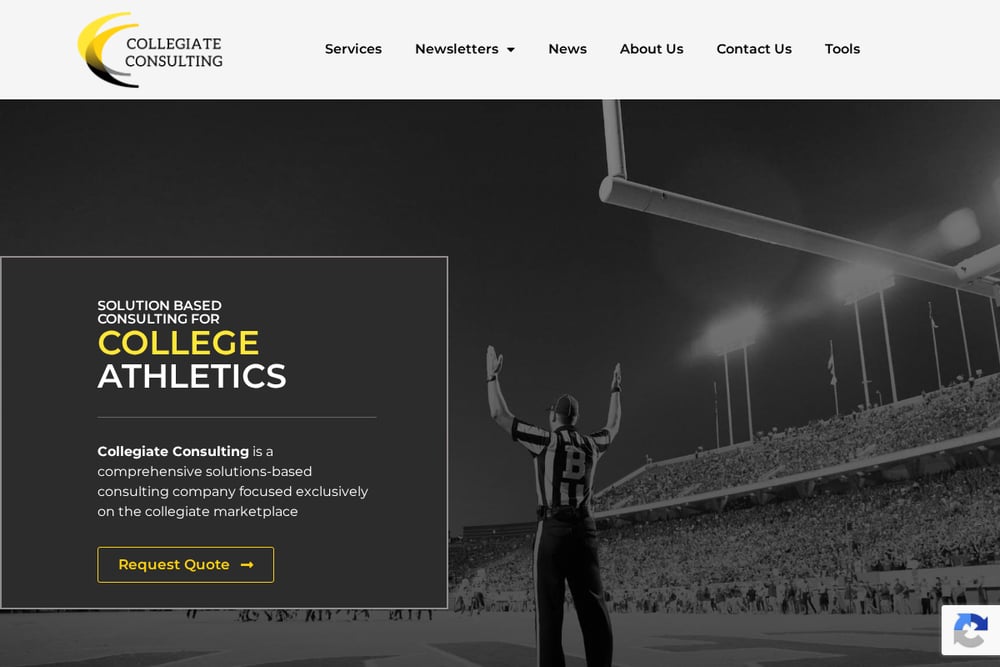 A screenshot of the Collegiate Consulting website.
Collegiate Consulting has built a long resume in the collegiate marketplace, with a stated focus on solution-based work for athletics departments and conferences. The firm points to feasibility studies, reclassification projects, football studies, and benchmarking comparisons as core strengths, which makes it a natural fit when your question is strategic rather than operational. Its team is positioned as experienced athletic administrators who can analyze a department and recommend a direction. If you are weighing a move to a new division or testing whether a sport makes financial sense, this is the kind of firm you call. The trade-off is that the work leans advisory and study-driven, so you may still need an operator to execute the plan afterward.
#2 Athletic Operations Consulting — Operational Excellence for Collegiate Athletics
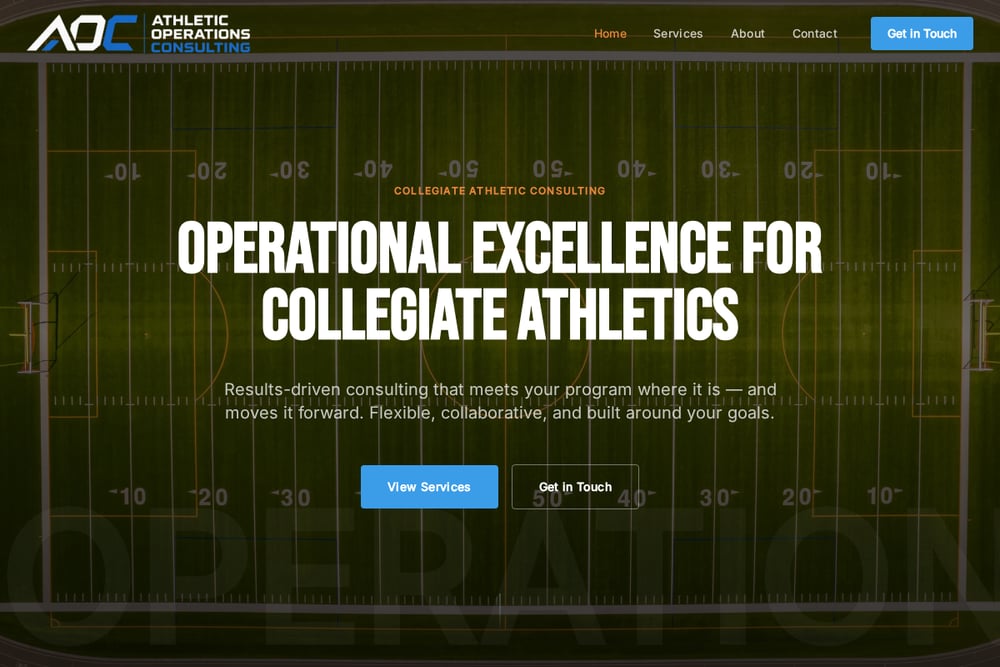 A screenshot of the Athletic Operations Consulting — Operational Excellence for Collegiate Athletics website.
Athletic Operations Consulting is the featured firm here, and it earns the spotlight by covering the full operational stack rather than one slice of it. The practice spans internal operations audits, workflow design, hiring and staffing, sport administration, student-athlete services, game and event operations, tournament operations, interim and transition support, change management, and strategic planning. That range matters because most departments do not have one clean problem — they have a tangle of them, and AOC is built to meet a program where it is and move it forward. The engagement style is described as flexible and collaborative, which is a good sign if you want a partner who adapts to your goals instead of arriving with a fixed template. For a department that needs hands-on help with day-to-day systems and game-day execution, this is a strong place to start.
#3 College Sports Solutions
College Sports Solutions brings together former administrators, coaches, attorneys, and media experts, and that mix shows in its service menu. The firm covers strategic planning, operational review, executive search, feasibility studies, multimedia rights, naming rights, and legal and gender equity work. Its case studies include executive searches and operational reviews for major programs and conferences, which tells you it is comfortable in high-stakes environments. If your department needs to fill a leadership role and simultaneously tighten operations, this firm can handle both threads. The breadth is a strength, though it means you should be specific about which service line you are buying.
#4 Huron Consulting Group - Intercollegiate Athletics
 A screenshot of the Huron Consulting Group - Intercollegiate Athletics website.
Huron approaches intercollegiate athletics from the institutional side, connecting athletic strategy to the broader mission and financial model of the university. The firm's athletics practice covers strategy development, business model improvement, financial modeling, facility feasibility, leadership advisory and business continuity, and student-athlete health and well-being. Its senior advisers include names with decades of experience across NCAA programs and conferences, which gives the work credibility with presidents and boards. This is the firm you bring in when the conversation is bigger than the department — when athletics needs to align with campus leadership and a multi-year financial plan. The work tends to be strategic and advisory, so pair it with an operator if you need execution support.
#5 CSA Search & Consulting
CSA Search & Consulting runs a consulting practice built around aligning athletics with the mission of the institution, and its staff includes former head coaches, athletic directors, administrators, and executives. The firm emphasizes a bespoke approach, treating each project as unique and combining best practices with custom solutions for the environment in front of it. Its stated areas of expertise include strategic planning, change management, and Title IX review, and it positions itself as solution-oriented in complex situations. If your department is navigating a sensitive transition or a governance question, the firm's network of current and former leaders can be valuable. The model is relationship-driven, so expect a tailored engagement rather than an off-the-shelf package.
How to Choose the Right Consulting Partner
Start with the problem, not the firm. If your issue is a five-year strategic question or a feasibility study, lean toward the firms built around analysis and planning. If your issue is that your staff is drowning in workflows, your game-day operations are inconsistent, or you have a leadership vacancy to bridge, lean toward a firm with hands-on operational depth. Ask each firm how they staff an engagement — will you get senior people in the room, or junior analysts with a senior name on the cover? Ask for a scope that names deliverables, timelines, and who owns execution. And ask about fit: a firm that has worked mostly with Power Four departments may not understand the constraints of a DII budget, and vice versa. Finally, check references from institutions similar to yours in size and sport mix. The right partner is the one whose actual work matches your actual problem.
Where Automation Fits in Your Operations Plan
Consulting engagements often surface the same operational bottlenecks: manual scheduling, scattered communication, duplicated data entry, and event-day checklists that live in someone's head. A good workflow looks like this. First, audit the current process and document every handoff. Second, identify the steps that are repetitive and rule-based — those are your automation candidates. Third, standardize the process before you automate it, because automating a broken workflow just makes the mess faster. Fourth, implement in small phases with clear owners and a feedback loop. Fifth, measure cycle time and error rates before and after so you can prove the value. Firms that do operational audits can help you map this, but the execution still lives with your staff. The goal is not to remove people from the process — it is to free your people for the judgment work that actually moves your program forward.
The Bottom Line
Collegiate athletics is not getting simpler, and the departments that thrive will be the ones that treat operations as a competitive advantage rather than an afterthought. The five firms here cover the spectrum: Collegiate Consulting for feasibility and benchmarking, Athletic Operations Consulting for hands-on operational and game-day execution, College Sports Solutions for search plus operational review, Huron for institution-level strategy and financial modeling, and CSA Search & Consulting for bespoke planning and change management. Match the firm to the problem, ask hard questions about staffing and deliverables, and check references from programs like yours. Do that, and you will get more than a report — you will get a department that runs better when the season starts.