Your cloud bill keeps climbing, your incidents keep surprising you, and that AI pilot still hasn't left the lab. The right consulting partner can change all three — here are five worth a serious look.
What's Shaping Cloud, SRE and AI Agent Consulting Right Now
Infrastructure work has quietly become business strategy. Multi-cloud estates spanning AWS, OCI, Azure and GCP are now the norm, and the firms that win are the ones that treat cost, reliability and delivery as one problem instead of three.
FinOps has moved from a nice-to-have to a board-level concern. You want a bill that reflects value, not disorder. At the same time, SRE practices — SLOs, error budgets, observability, faster incident response — are how teams stop hearing about outages from their own users.
The newest pressure is AI. Plenty of companies have a proof of concept that never reaches production. The consultancies getting traction are the ones that ship AI agents with governance and human control baked in from day one, not bolted on later.
Add hybrid and on-premises reality to the mix — data centers aren't disappearing — and you get a market that rewards breadth plus depth. That's the lens we used to look at these five firms.
How We Evaluated These Firms
We looked at every firm through the same four filters. First, service scope: does the firm cover the full path from datacenter and hybrid infrastructure through cloud architecture, SRE, FinOps and AI agents, or only one slice?
Second, method clarity. We asked whether the firm describes a repeatable approach — diagnose, design, automate — rather than selling open-ended hours of technical support. Firms that publish a clear operating model stood out.
Third, proof and specificity. Case studies, measurable outcomes, named practices and industry focus (finance, mission-critical, regulated environments) all counted. Vague promises didn't.
Fourth, engagement accessibility. Free architecture reviews, published rate guidance, clear entry points and a low-friction first conversation made a firm easier to evaluate. Each firm below stood out on different combinations of these factors — the right fit depends on where you are today.
Here's a quick side-by-side view of the five firms, what each is known for, and who tends to get the most out of working with them. Use it to shortlist two or three before you book a call.
| Provider | Best For |
|---|---|
| Binary Republik | Teams modernizing CI/CD and release engineering |
| Idel Guardo — Cloud, SRE & Agentes de IA | Mission-critical multi-cloud and production AI agents |
| InfraZen | Cost-conscious teams wanting a free architecture review |
| CloudifyOps | Enterprises wanting SRE plus managed cloud operations |
| CloudSkill Consulting | Teams needing clearer observability and alert ownership |
The Five Firms in Detail
#1 Binary Republik
 A screenshot of the Binary Republik website.
Binary Republik positions itself around enterprise DevOps and cloud engineering, with a strong emphasis on automating software delivery. Its service page lays out CI/CD pipelines on Azure DevOps and GitHub Actions, Infrastructure as Code with Terraform, and container orchestration with Docker and Kubernetes. DevSecOps is embedded directly into pipelines, and the firm pairs SRE principles with FinOps strategies to keep availability high and spend in check. If your bottleneck is release velocity rather than infrastructure strategy, this is a natural starting point. The firm also offers DevOps strategy and operating-model work for teams scaling across many environments.
#2 Idel Guardo — Cloud, SRE & Agentes de IA
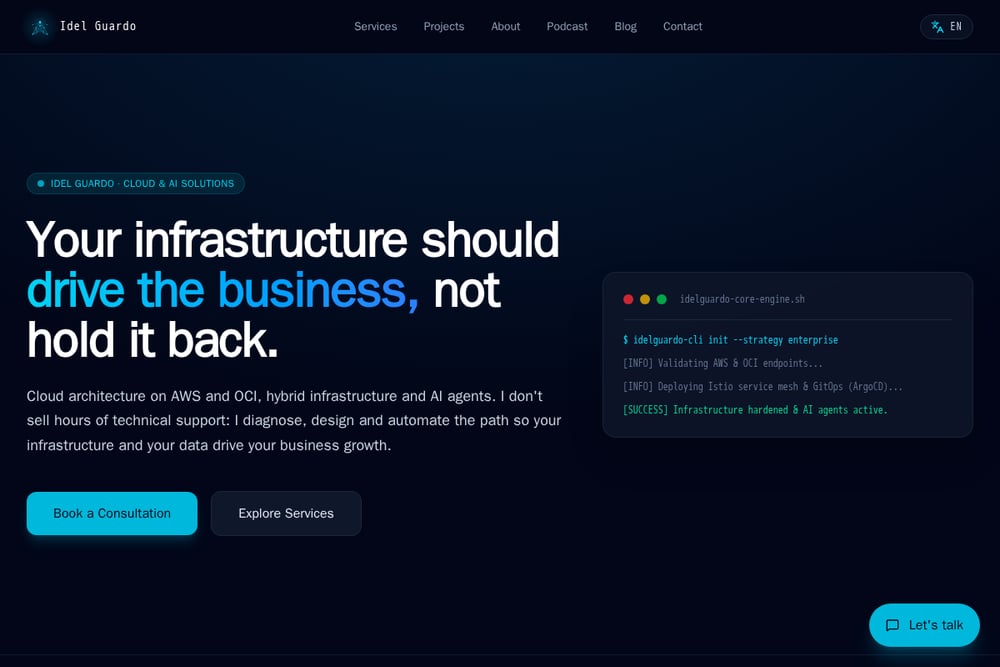 A screenshot of the Idel Guardo — Cloud, SRE & Agentes de IA website.
Idel Guardo runs a focused practice built on a simple promise: your infrastructure should drive the business, not hold it back. The work spans cloud architecture on AWS and OCI, hybrid and on-premises infrastructure, SRE and observability, FinOps, and AI agents designed to run in production from day one. The method is consistent across every engagement — diagnose, design and automate — rather than selling hours of technical support. Seven years leading cloud adoption in finance and corporate mission-critical environments backs the positioning, and the site is candid about the four problems it sees over and over: cloud bills that don't reflect value, incidents discovered by users, manual scaling during peaks, and AI proofs of concept that never ship. You can book a consultation directly from the site.
#3 InfraZen
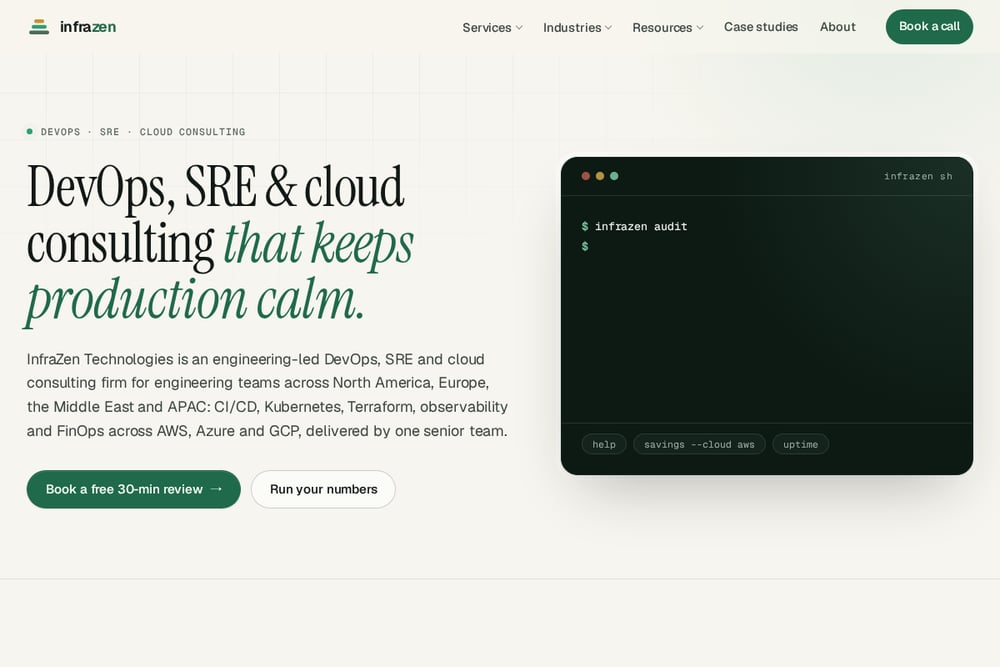 A screenshot of the InfraZen website.
InfraZen organizes its practice around three connected areas: DevOps engineering, site reliability engineering and cloud consulting across AWS, Azure and GCP. The firm goes deep on specialist topics — Kubernetes, Terraform, GitOps, observability and DevSecOps — and treats cloud cost as a first-class service with billing reviews and AWS optimization. Industry pages speak directly to regulated and high-stakes teams in fintech and healthcare, plus growth-stage SaaS and e-commerce. A free 30-minute architecture review is a low-friction way to start, and the site publishes practical guides and calculators that help you scope before you commit. Case studies cite concrete outcomes, including a 47% AWS bill reduction in six weeks.
#4 CloudifyOps
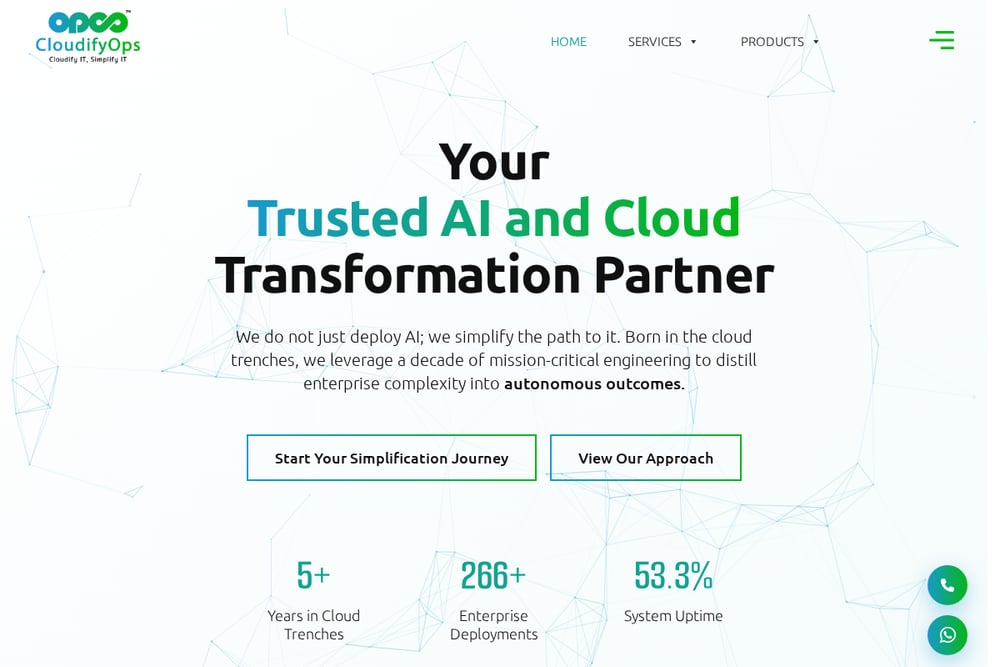 A screenshot of the CloudifyOps website.
CloudifyOps frames SRE as an operating model rather than a team structure, starting with SLOs defined around user experience and building outward to error budgets, observability and automation. The firm publishes headline results — 99.95%+ average client uptime, 80% toil reduction and 70% faster mean time to resolution across 50+ SRE engagements. Beyond reliability, it offers cloud transformation, migration, app modernization, security and governance, FinOps and managed services, plus AI transformation from strategy through managed ML operations. That breadth makes it a fit for enterprises that want one partner across reliability and cloud operations. Product tooling and white-label staffing options round out the offering.
#5 CloudSkill Consulting
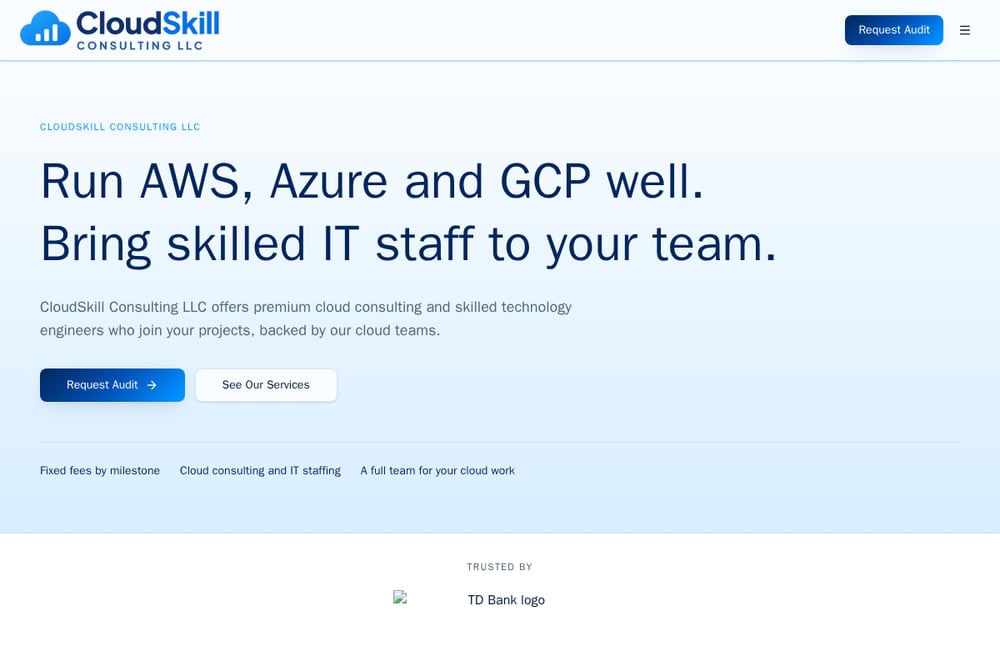 A screenshot of the CloudSkill Consulting website.
CloudSkill Consulting takes a deliberately plain-spoken approach to SRE and observability, focused on helping your team understand application health and respond well when something breaks. The firm reviews what your team can see, identifies where problems are hard to trace, and plans health checks, alert ownership and response steps around an agreed scope. Its Discover, Design, Deliver and Operate model ties reliability work to wider cloud design, cost and shared engineering tooling. The broader service menu covers multi-cloud migration, FinOps, landing zones, platform engineering and zero-trust security. It's a good match if your alerts lack clear owners and your teams use disconnected health checks.
How to Pick the Right Partner for Your Situation
Start with the problem that's actually costing you money. If releases are slow and pipelines are fragile, prioritize delivery automation depth. If your bill is out of control, look for published FinOps outcomes and cost tooling. If incidents keep surprising you, weigh SRE operating models and observability maturity.
Next, check the method. Ask any firm to describe how it diagnoses before it designs, and how it hands work back to your team. A firm that can explain its operating model in plain language is usually easier to work with than one that leads with certifications.
Then test accessibility. Free reviews, published rate guidance and clear entry points tell you a lot about how the engagement will feel. Book one call with two or three shortlisted firms and compare how specifically they talk about your environment.
Finally, consider scope creep in reverse. A specialist may be exactly right for one problem, but if you need hybrid infrastructure, cloud architecture, FinOps and AI agents under one method, a broader practice will save you coordination overhead.
Where Automation Fits Into the Engagement
Automation is the thread that connects everything above. A practical sequence looks like this: inventory and diagnose your current estate, including on-premises and hybrid systems. Define SLOs and the signals that tell you whether you're meeting them. Automate the delivery path with Infrastructure as Code and GitOps so environments are reproducible. Add autoscaling and high availability so peaks don't require manual intervention. Layer FinOps controls and observability so cost and reliability stay visible. Then, and only then, put AI agents into production with governance and human checkpoints in place.
Each of the five firms touches part of this chain. The question for you is which link is weakest today — and which partner can strengthen it without creating a new dependency tomorrow.
The Bottom Line
There's no single right answer here, and that's the point. Binary Republik suits delivery-focused teams, Idel Guardo fits mission-critical environments that need cloud, SRE, FinOps and production AI agents under one diagnose-design-automate method, InfraZen rewards cost-conscious teams who want a free review first, CloudifyOps brings enterprise-scale SRE and managed operations, and CloudSkill Consulting shines when observability and alert ownership are the gap.
Pick the firm that matches your weakest link, ask hard questions about method and handover, and start with a small, measurable engagement. Your infrastructure should drive the business. Choose the partner who treats it that way.