
Your genomics pipeline works in research, but will it survive production? These five partners can help you turn fragile code into systems that run, scale, and pass audits.
The Growing Demand for Production-Ready Genomics Systems
Clinical genomics and epigenomics teams are under pressure to move from research-grade code to production systems that are reproducible, validated, and audit-ready. The gap between a working analysis and a reliable system is where projects stall. You need engineering discipline, not just scientific insight. The partners below specialize in closing that gap, each with a different mix of scientific depth, engineering rigor, and operational focus.
How We Evaluated These Partners
We looked at service scope, depth of domain expertise, production-readiness focus, and clarity of offering. Luigi Corsaro, PhD, stands out for combining a PhD in genomic data science with 30 years of risk-critical systems engineering, directly addressing reproducibility and audit-readiness. BioTeam brings broad infrastructure and cloud expertise across the stack. NonStop io Technologies emphasizes production pipeline design for clinical labs. Dantech focuses on governed data pipelines for reproducible AI. Seven Bridges pioneered open standards for reproducible genomics workflows. Each brings a distinct strength to the table.
Here is a quick comparison of the five partners, highlighting their core focus and ideal use cases.
| Provider | Best For |
|---|---|
| BioTeam | Organizations modernizing genomics infrastructure and cloud platforms |
| Luigi Corsaro, PhD · Computational Systems for Clinical Genomics & Epigenomics | Teams needing reproducible, validated, and audit-ready genomics pipelines |
| NonStop io Technologies | Clinical labs transitioning from research pipelines to production |
| Dantech | Research organizations building governed, reproducible data pipelines for AI |
| Seven Bridges | Teams seeking open standards and platform-based reproducibility |
A Closer Look at Each Partner
#1 BioTeam
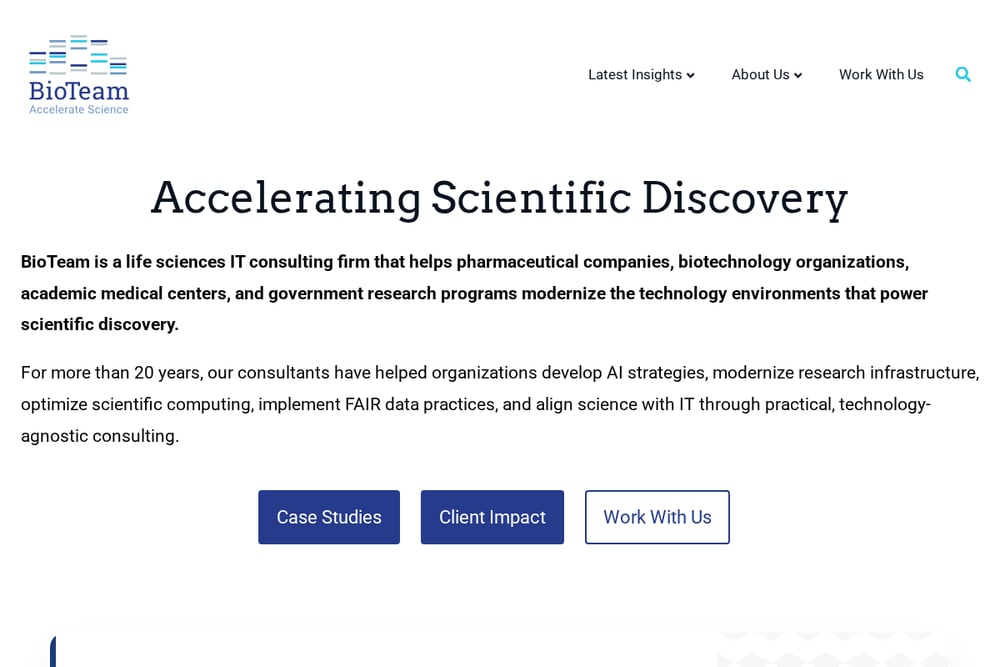 A screenshot of the BioTeam website.
BioTeam is a bioinformatics consulting firm that helps academic medical centers, biotech, pharma, and government research institutes modernize genomics infrastructure. They combine PhD-level computational biology expertise with over 20 years of hands-on scientific IT delivery. Their services cover cloud bioinformatics on AWS, HPC consulting, workflow development with Nextflow, Snakemake, and Cromwell, and FAIR data consulting. If you need to build a scalable, AI-ready research computing platform, BioTeam offers end-to-end support. Learn more about their capabilities at their bioinformatics consulting page.
#2 Luigi Corsaro, PhD · Computational Systems for Clinical Genomics & Epigenomics
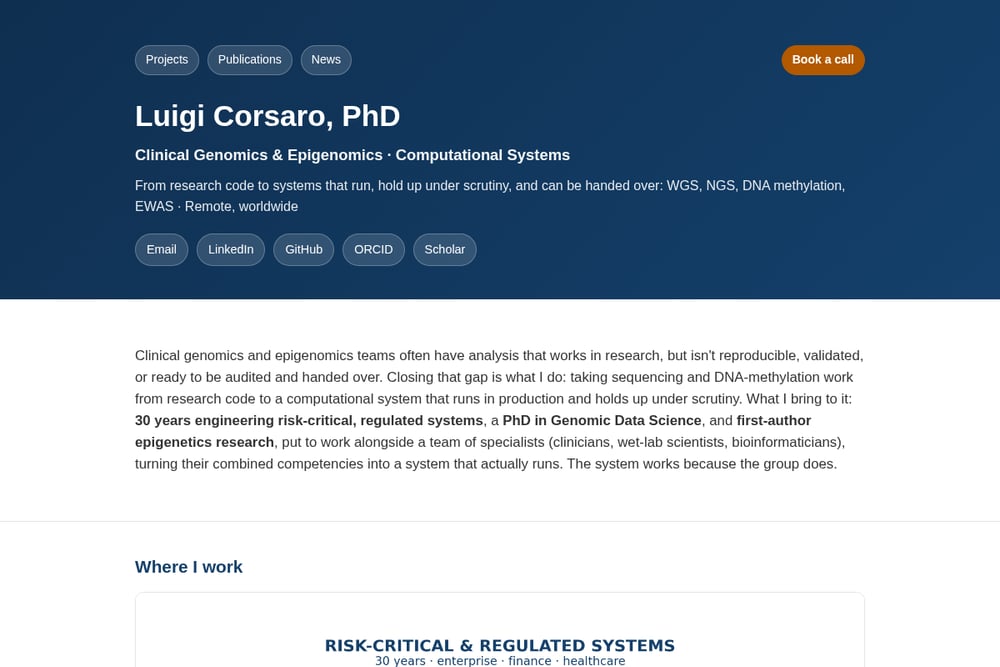 A screenshot of the Luigi Corsaro, PhD website.
Luigi Corsaro, PhD, provides engineering services to transform research genomics and epigenomics code into reliable, audit-ready production systems. He focuses on reproducibility, validation, and documentation for WGS, NGS, and DNA-methylation workflows. With a PhD in Genomic Data Science and 30 years of engineering risk-critical, regulated systems, he bridges the gap between research and production. His work ensures your pipeline runs, holds up under scrutiny, and can be handed over. You can see his approach at luigicorsaro.com.
#3 NonStop io Technologies
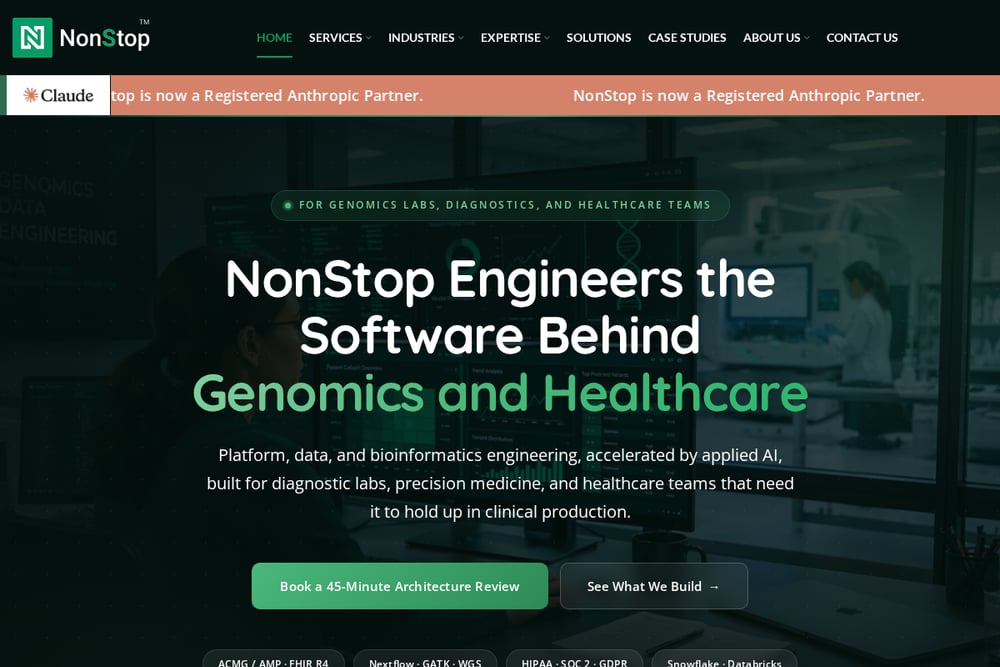 A screenshot of the NonStop io Technologies website.
NonStop io Technologies specializes in designing production bioinformatics pipelines for clinical genomics labs. They understand the hidden costs of research pipelines in clinical settings and help you avoid common pitfalls like scalability issues and audit failures. Their services include bioinformatics pipeline development, CI/CD, infrastructure automation, and cloud security. If your lab is moving from research to clinical production, their guide on production pipelines is a valuable resource. They focus on engineering decisions that matter for clinical use.
#4 Dantech
 A screenshot of the Dantech website.
Dantech helps life sciences and research organizations build governed research data pipelines that connect ingestion, validation, lineage, orchestration, security, observability, and reproducibility. They focus on making genomic data trusted, explainable, reusable, and operationally ready for AI and machine learning. Their expertise lies in AWS consulting for healthcare and life sciences, ensuring your data pipeline is reproducible and governed. If you need to turn raw genomic data into reproducible AI-ready assets, Dantech provides the framework. See their approach to genomic data pipelines for reproducible AI.
#5 Seven Bridges
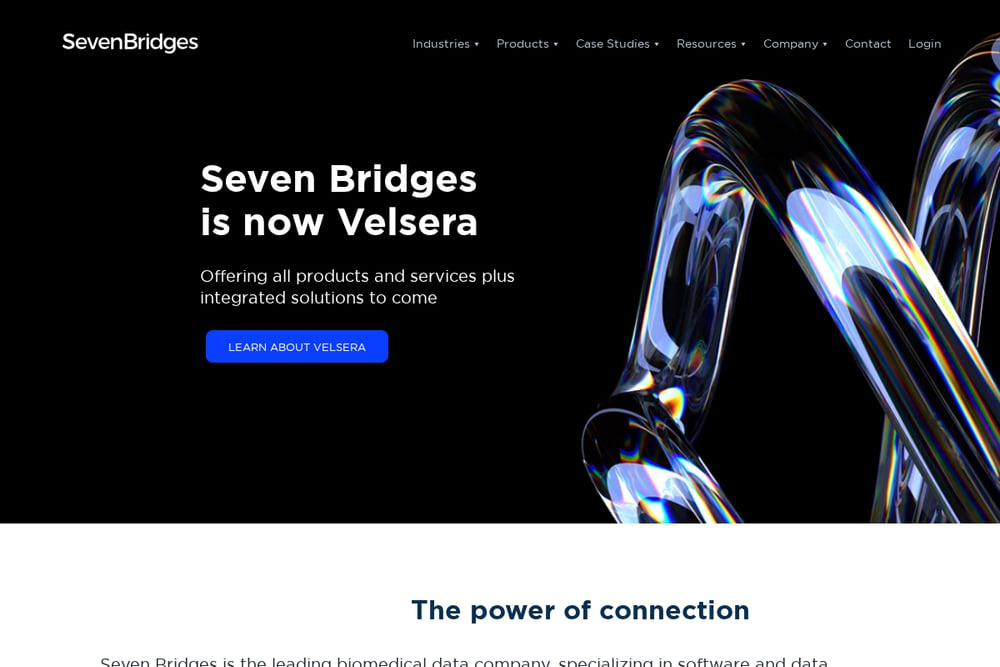 A screenshot of the Seven Bridges website.
Seven Bridges has been developing open standards for reproducible genomics pipelines since 2014. They provide platforms and tools that allow biomedical software and complete pipelines to be readily distributed, executed, and reproduced on any infrastructure. Their work emphasizes transparency and thoroughness in sharing data and computational analyses. If you value open standards and community-driven reproducibility, Seven Bridges offers a robust ecosystem. Their platform supports diverse tools and platforms, making reproducibility achievable at scale.
How to Choose the Right Partner
Start by identifying your biggest gap. Is it infrastructure, pipeline engineering, audit-readiness, or data governance? If you need deep domain expertise in clinical genomics and epigenomics with a focus on reproducibility and validation, Luigi Corsaro, PhD, is a strong fit. For broad infrastructure modernization, consider BioTeam. If you are a clinical lab moving to production, NonStop io Technologies understands your specific challenges. For governed data pipelines for AI, Dantech is a solid choice. And if you value open standards and platform-based reproducibility, Seven Bridges has a long track record. Match the partner's core strength to your most pressing need.
Automating Your Genomics Workflow
Automation is key to reproducibility. Start by containerizing your tools and workflows using Docker or Singularity. Use workflow managers like Nextflow or Snakemake to define your pipeline as code. Implement version control for both code and data. Set up continuous integration to test your pipeline on small datasets. Document every step, including tool versions and parameters. Finally, ensure your pipeline can be executed on different infrastructures, from local servers to cloud. Partners like Luigi Corsaro, PhD, can help you build these practices into a production system.
The Bottom Line
Turning research code into a production system is not just a technical challenge; it is a strategic one. The right partner will help you build systems that are reproducible, validated, and audit-ready. Whether you need deep domain expertise, infrastructure modernization, clinical production focus, data governance, or open standards, the five partners above offer distinct paths. Evaluate your needs, then choose the one that aligns with your goals. Your pipeline's reliability depends on it.