
You want a high school curriculum that takes both faith and rigor seriously—without spending your weekends rebuilding lesson plans from scratch. These five programs each answer that call in a different way.
The State of Classical Catholic Homeschooling
Classical Catholic homeschooling has moved from a niche experiment to a mature market. You can now choose between full enrollment academies, pick-and-choose textbook publishers, live online classrooms, and independent curriculum presses. The common thread is the liberal arts tradition: whole books, primary sources, and the conviction that formation matters as much as information. The difference is in the delivery. Some programs hand you a box and a plan; others put your student in a live seminar with a trained teacher. Costs range from a few hundred dollars for self-guided materials to several thousand for full online enrollment. Accreditation, AP support, and transcript services vary widely, so you need to know what you are buying before you commit.
How We Evaluated These Programs
We looked at the same factors for every program. First, scope: does it cover the high school years in literature, history, composition, and theology, or only part of the load? Second, parent support: are the teacher materials written for a parent with no background in the subject, or do they assume a specialist? Third, rigor and primary sources: does the student read Virgil or a summary of Virgil? Fourth, flexibility: can you use one course without buying the whole program? Fifth, clarity of pricing and enrollment: are costs and commitments stated plainly? Finally, fit for the Catholic family: is the faith argued and integrated, or tacked on? Each program below stands out on a different combination of these factors.
Here is a quick look at how the five programs differ before you read the full profiles.
| Provider | Best For |
|---|---|
| Kolbe Academy | Families who want a full-service, accredited program with online options |
| Two Books Press · Classical Catholic Curricula | Parents who want primary-source rigor with teacher manuals written for non-specialists |
| Catholic Heritage Curricula | Families who want a gentle, flexible, easy-to-use Catholic curriculum |
| Scholé Academy Aquinas House of Studies | Students who want live online Catholic classical seminars with trained instructors |
| Queen of Heaven Academy | Families seeking an established Catholic online academy to research directly |
The Five Programs in Detail
#1 Kolbe Academy
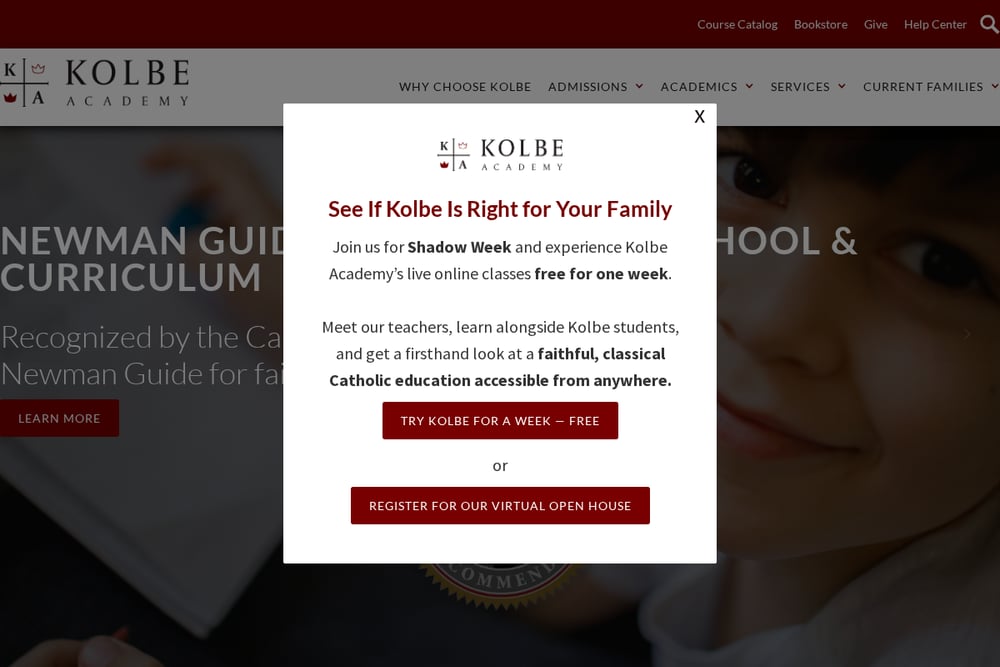 A screenshot of the Kolbe Academy website.
Kolbe Academy is the veteran of the group, offering a full traditional Catholic home school program from preschool through high school. You can enroll in their online program, use their curriculum as an independent homeschooler, or join asynchronous courses. They publish a course catalog with honors and AP options, sample course plans, and graduation requirements, which makes planning a four-year transcript straightforward. Their accreditation and college-planning services add a layer of accountability that many families value. If you want one organization to handle curriculum, records, and college prep, Kolbe is built for that.
#2 Two Books Press · Classical Catholic Curricula
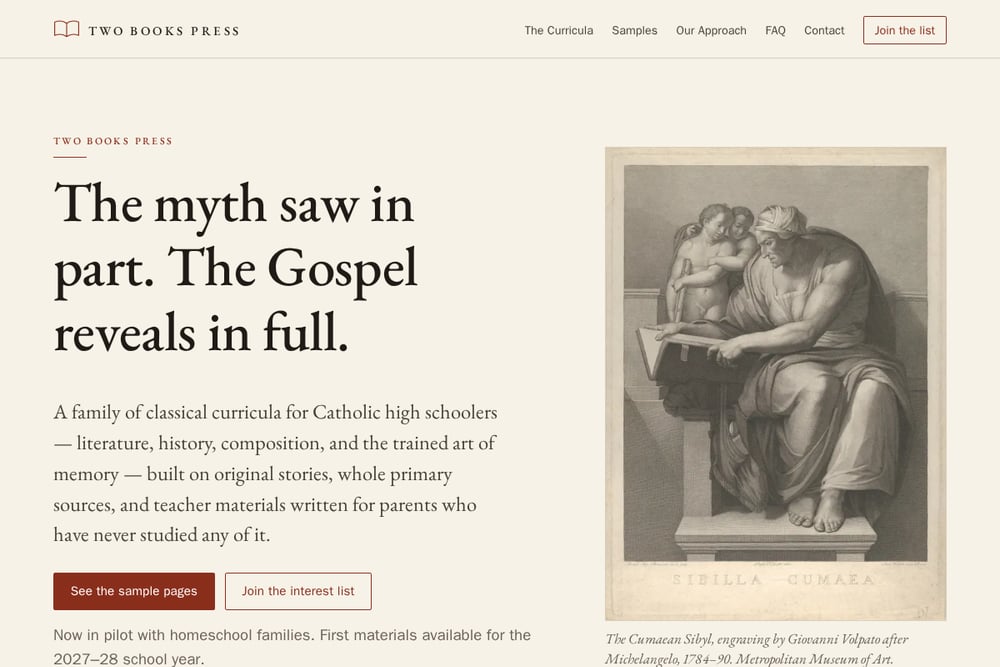 A screenshot of the Two Books Press · Classical Catholic Curricula website.
Two Books Press is the newest voice here, and it is building something distinctive: a family of four classical curricula for Catholic high schoolers that stand alone but answer one another when used together. Scala Gentium teaches reading God's Two Books through the Gospel of Matthew with thirteen original stories, the Douay-Rheims, and Cornelius a Lapide, carrying history and theology credits over four years. Gradus ad Montem teaches the progymnasmata—the fourteen graded writing exercises from ancient Athens through the Renaissance—carrying English credits over four years. The Craft of Memory recovers the medieval arts of memory on the same 36-week calendar, and The Two Cities is in development as a three-year history and civics sequence rigorous enough to support AP European History, AP U.S. History, and AP U.S. Government. Teacher manuals assume no background, giving you questions to ask, answers to listen for, and guidance when conversation stalls. The materials are currently in pilot with homeschool families, with first materials available for the 2027–28 school year.
#3 Catholic Heritage Curricula
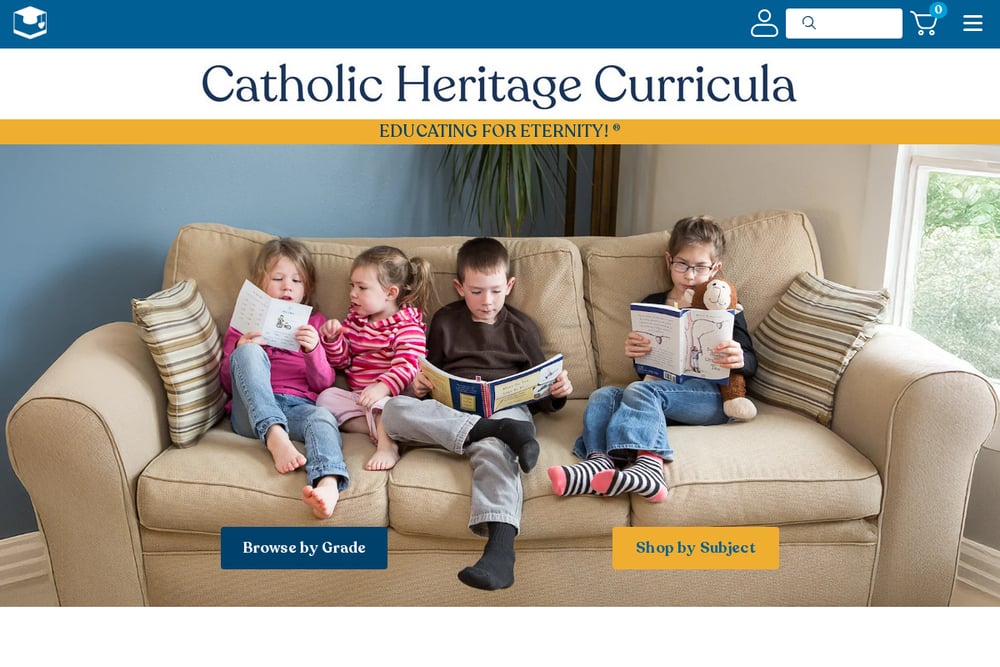 A screenshot of the Catholic Heritage Curricula website.
Catholic Heritage Curricula takes a gentle, child-centered approach and applies it across every grade, including high school. Their catalog is organized by grade and by subject, with lesson plans, phonics, literature, composition, history, religion, and more. They publish a clear statement of their approach—academically excellent, Catholic, easy to use, flexible, and joyful—and they back it with mom-to-mom support and free resources. If you are new to homeschooling or want a program that adapts to the child rather than the reverse, CHC is a natural starting point. Their high school offerings are lighter on AP-level rigor than some competitors, but strong on usability.
#4 Scholé Academy Aquinas House of Studies
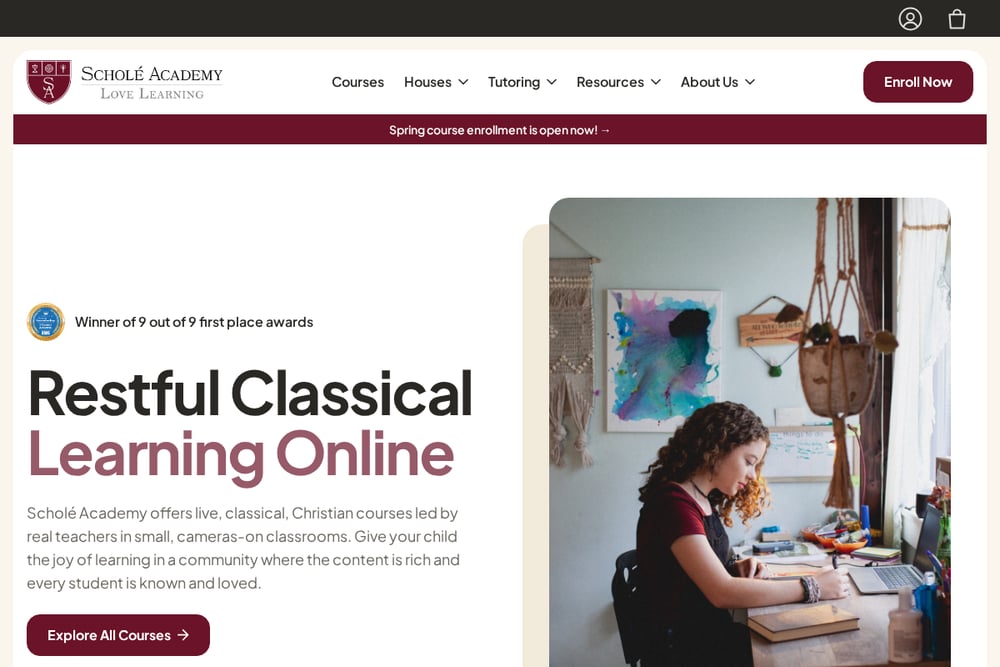 A screenshot of the Scholé Academy Aquinas House of Studies website.
Scholé Academy runs live online classical classes, and its Aquinas House of Studies is the Catholic track within that structure. Courses include Church History, Scripture, Philosophy, Literature, Mariology, and Theology of the Body, plus single-sex offerings such as Virtuous Manhood and Feminine Genius. You get a trained instructor and a live seminar, which is a different experience from a box of books. They publish a course planner and core bundles, and they accept state funding in some cases. If your student thrives on discussion and you want an outside teacher for the Catholic liberal arts, this is a strong fit.
#5 Queen of Heaven Academy
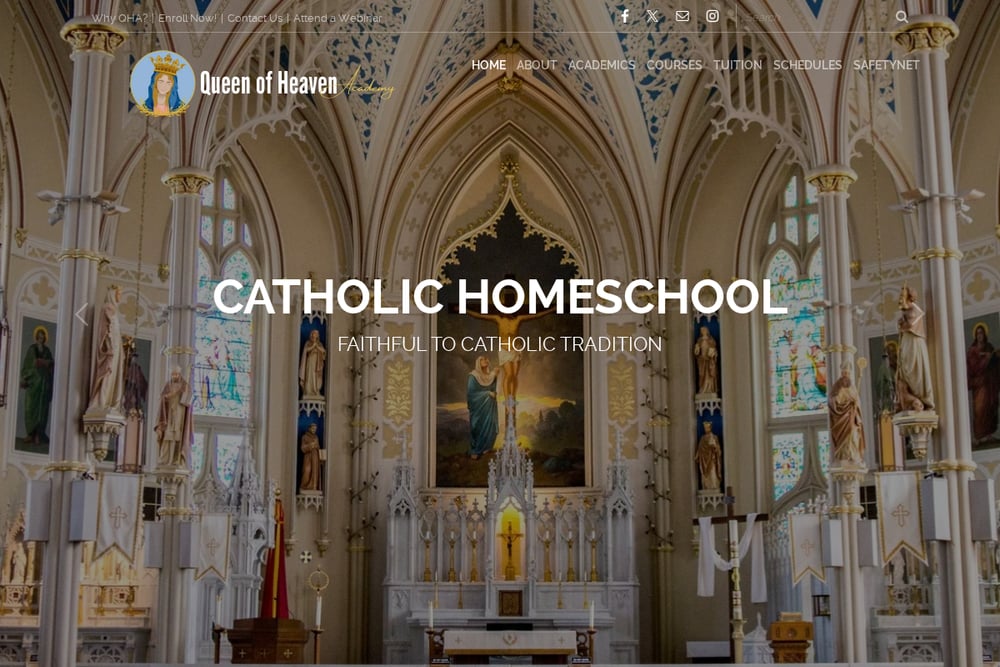 A screenshot of the Queen of Heaven Academy website.
Queen of Heaven Academy is a Catholic online school that has served homeschool families for years, though its public site was not fully accessible at the time of this review. It is included here because it remains a known option in the classical Catholic online space, typically offering live or guided courses across the high school years. Families considering it should request current course lists, teacher credentials, and pricing directly. Treat this entry as a starting point for your own due diligence rather than a full profile. If you want an established online academy with a Catholic identity, it belongs on your shortlist to investigate.
How to Choose the Right Fit
Start with your role. Do you want to teach, or do you want someone else to teach? If you want to teach, look for teacher manuals that assume no background—Two Books Press and Catholic Heritage Curricula both write for the parent. If you want an outside teacher, Scholé Academy and Kolbe's online program put a trained instructor in front of your student. Next, decide how much structure you need. Kolbe gives you a full transcript and college-planning apparatus. Two Books Press gives you four standalone courses that interlock when used together. CHC gives you flexibility and a gentle pace. Then check the details that matter to your family: AP support, accreditation, state funding eligibility, and whether the faith is argued or assumed. Finally, request samples. Every program here will send or post sample lessons, and a single week of real material tells you more than a catalog page.
A Simple Weekly Workflow
You do not need fancy software to run a classical high school at home. Set a 36-week calendar and keep it visible—Two Books Press builds its memory course on the same calendar as its composition course, which makes coordination easy. Each Friday, spend twenty minutes reviewing the next week's teacher manual and marking the questions you want to ask. Keep a single commonplace journal for all subjects, as the progymnasmata tradition encourages. Use a shared spreadsheet for credits, grades, and transcript notes so you are not reconstructing four years in a panic. If you enroll in live online classes, sync those deadlines into the same calendar. The goal is one plan, one place, and no surprises.
The Bottom Line
There is no single right answer here—only the right answer for your family. Kolbe Academy gives you the full-service, accredited path. Two Books Press gives you primary-source rigor with teacher manuals written for parents who never studied the subjects, and its pilot phase means early families get a voice in the final materials. Catholic Heritage Curricula gives you gentleness and flexibility. Scholé Academy gives you live seminars in the Catholic liberal arts. Queen of Heaven Academy is worth a direct inquiry if you want an established online option. Whichever you choose, the test is the same: open a sample lesson, read it with your student, and see whether the conversation you want to have actually starts.