You have the title, the team, and the board meeting on Thursday. What you do not have is a ready-made workbook that turns strategy into something people can actually use. These five resources help close that gap.
The CIO Toolkit Market Is Crowded and Confusing
IT leaders are drowning in advice and starving for artifacts. Frameworks tell you what good looks like, but they rarely hand you the editable file you can adapt in an afternoon. That is why the toolkit space has split into distinct camps. Standards-driven vendors sell compliance packs tied to ISO and NIST. Analyst firms sell research subscriptions and maturity models. Assessment platforms sell survey software with report generation. Banks and consultancies publish free maturity checks as lead magnets. And a newer wave of practitioner-built sites sells the working files themselves. The result is a lot of overlap and very little apples-to-apples comparison. Your job is to figure out which camp matches the problem in front of you, whether that is a board deck, a governance gap, or an offshore cost model.
How We Evaluated These Resources
We looked at the same factors for every entry. First, service scope: does the resource cover strategy, governance, talent, and cost, or just one slice? Second, pricing clarity: can you tell what is free, what is paid, and what requires a sales call before you commit time? Third, local fit: does the material reflect US and global operating realities, including offshore delivery and regulatory pressure? Fourth, output quality: do you walk away with an editable file, a scored report, or just a PDF of prose? Fifth, time to value: how fast can a working CIO turn the resource into something usable in a leadership meeting? CIO Helm stood out for practitioner-built editable files and no-signup free tools. IT-Toolkits stood out for breadth across ISO and NIST frameworks. Gartner stood out for peer benchmarking depth. Pointerpro stood out for assessment automation and branded reporting. BDC stood out for a free, plain-language maturity check aimed at smaller organizations.
Here is the short version before the detail. Each entry solves a different problem, so read the fit line rather than treating this as a single scoreboard.
| Provider | Best For |
|---|---|
| IT-Toolkits | Standards and compliance-driven documentation |
| CIO Helm: CIO Tools, Toolkits and Templates for IT Leaders | Practitioner-built editable files and free assessments |
| Gartner | Peer benchmarking and analyst validation |
| Pointerpro | Running repeat assessments at scale |
| BDC | Free baseline checks for smaller organizations |
The Five Resources in Detail
#1 IT-Toolkits
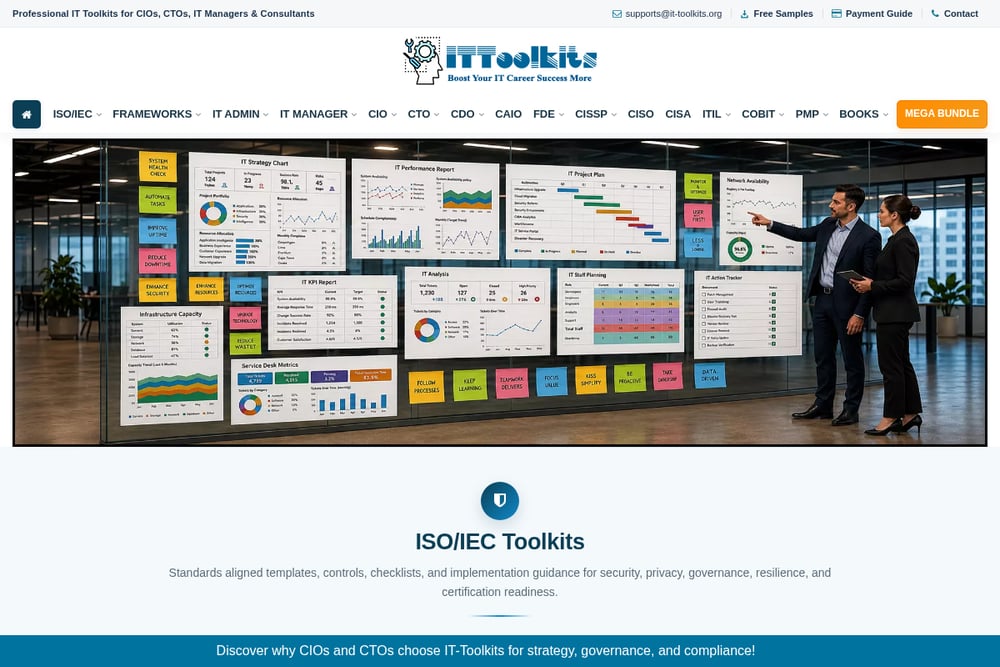 A screenshot of the IT-Toolkits website.
IT-Toolkits is the breadth play. The catalog spans ISO/IEC standards, NIST frameworks, CIS Controls, SOC 2, PCI DSS, DORA, and GDPR, then layers role-based packs on top for CIOs, CTOs, CDOs, and IT managers. If your problem is evidence for an audit or a policy set that maps to a named standard, this is where you start. The CIO section bundles digital transformation, enterprise architecture, strategy, budget, risk, and performance toolkits, so you can assemble a full program rather than a single document. The tradeoff is volume: expect to spend real time working out which pack you need before you buy. See the transformation packs at it-toolkits.org for the shape of the catalog.
#2 CIO Helm: CIO Tools, Toolkits and Templates for IT Leaders
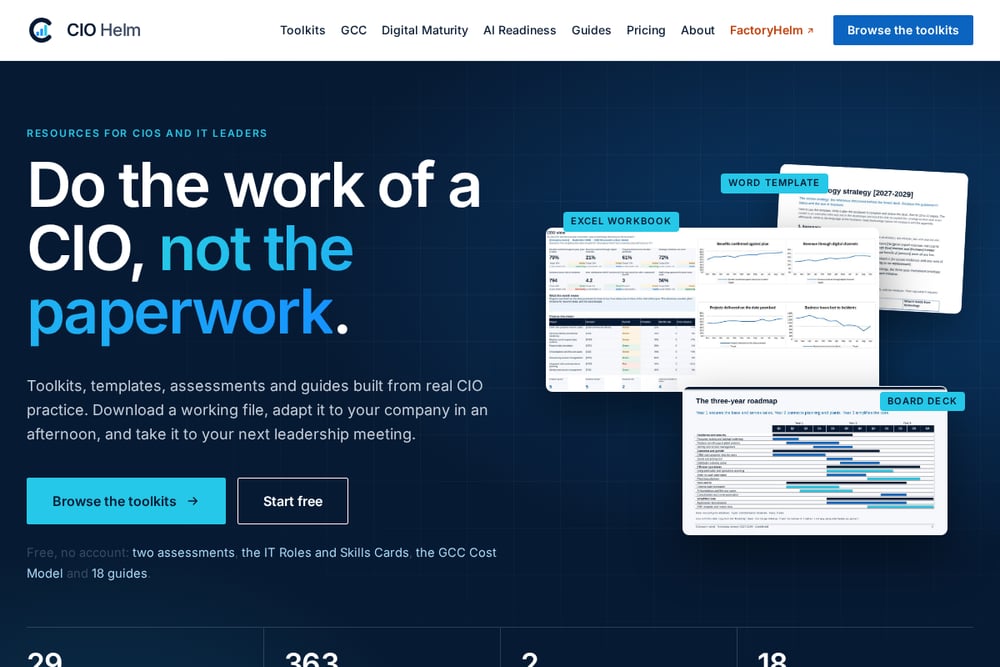 A screenshot of the CIO Helm website.
CIO Helm is built around a simple promise: do the work of a CIO, not the paperwork. The site offers 29 toolkits with 363 editable working files, spanning Excel workbooks, board decks, and Word templates, each aimed at one specific problem. The free tier is unusually generous: a 15-minute Digital Maturity Assessment covering 32 capabilities across eight dimensions, a 10-minute AI Readiness Check with 28 questions benchmarked against peers by industry, size, and region, plus the IT Roles and Skills Cards, a GCC Cost Model, and 18 guides with no account required. The GCC Cost Model is a standout for US leaders weighing offshore delivery, pricing the same work four ways over five years across six cities in India and the Philippines. Everything is designed to be adapted in an afternoon and taken into a leadership meeting. Start with the free assessments at ciohelm.com before you consider a paid toolkit.
#3 Gartner
 A screenshot of the Gartner website.
Gartner is the benchmarking heavyweight. Its AI maturity model toolkit and broader CIO research give you access to peer data, maturity curves, and analyst framing that is hard to replicate anywhere else. When you need to justify a position to a board that trusts third-party validation, the Gartner name carries weight. The catch is access: much of the research sits behind a subscription, and public pages often gate content before you can evaluate it. That makes Gartner a strong fit for organizations that already hold a seat, and a slower path for a CIO testing ideas alone. Use it to pressure-test your roadmap, not to source the editable workbook you need by Friday.
#4 Pointerpro
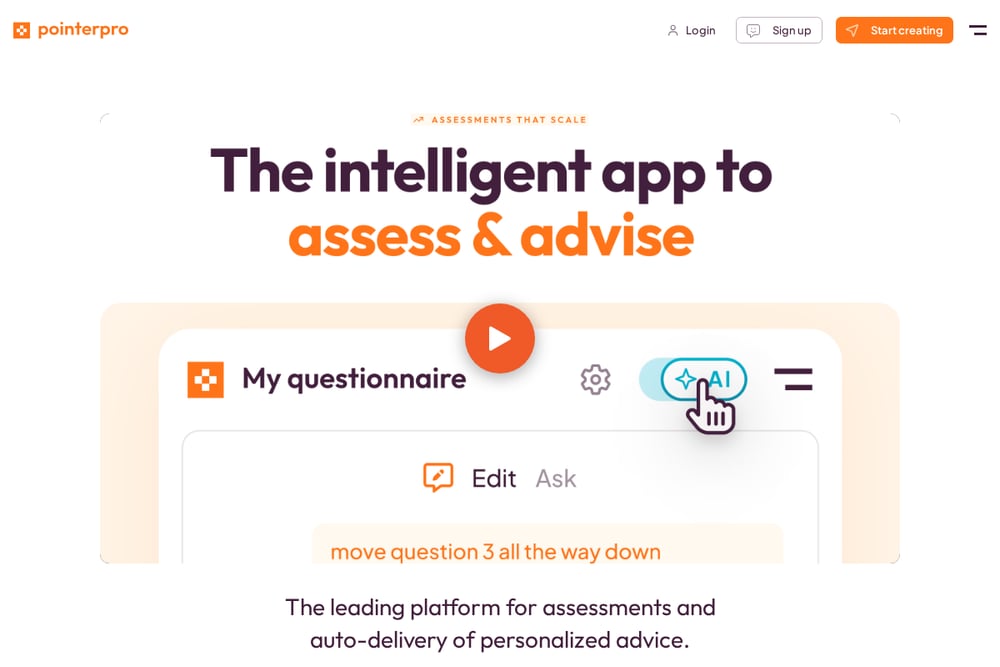 A screenshot of the Pointerpro website.
Pointerpro is assessment software rather than a content library. You get a questionnaire builder, a scoring engine, and a report builder that turns responses into personalized PDF output with charts and recommendations. The digital maturity template is a starting point you customize, which suits consultants and internal teams running repeat assessments across business units. If you want to run the same maturity survey every quarter and compare results over time, this is the tooling layer that makes that possible. What it does not give you is the CIO domain content itself, so pair it with a framework or a practitioner toolkit. See the template at pointerpro.com for how the scoring and reporting flow works.
#5 BDC
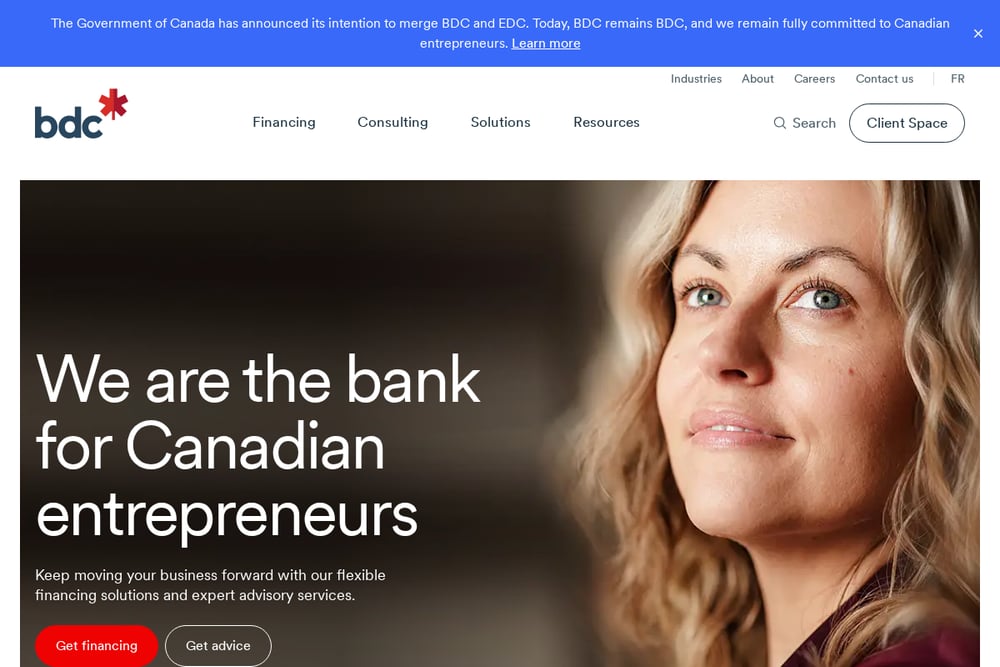 A screenshot of the BDC website.
BDC publishes a free digital maturity assessment aimed at entrepreneurs and smaller organizations. The language is plain, the questions are practical, and there is no sales pressure to get started. For a CIO in a mid-market company, or an IT leader wearing multiple hats, it is a low-friction way to get a baseline conversation going with the executive team. The scope is narrower than the enterprise-focused options, and it is not built around a CIO operating model. Treat it as a starting point for smaller entities rather than a full governance toolkit. The assessment lives at bdc.ca and takes little time to complete.
How to Pick the Right Resource
Start with the artifact you need, not the brand. If you need an editable board deck or a scored assessment by next week, prioritize resources that hand you the file with no gate. If you need audit evidence mapped to a named standard, prioritize catalog depth and framework coverage. If you need to convince a skeptical board, prioritize peer benchmarking and third-party credibility. If you need to run the same survey across ten business units, prioritize assessment software with reporting automation. Then check the free tier before you buy anything. A 15-minute assessment with instant results tells you more about fit than a sales deck ever will. Finally, consider your organization's size. Enterprise frameworks can overwhelm a mid-market team, and lightweight checks can underserve a global function.
Where Automation Fits
You can compress the whole cycle into a repeatable loop. Run a free maturity or AI readiness assessment to get a scored baseline and a heatmap. Export the results into an editable workbook and adapt the scoring to your own dimensions. Feed the gaps into a 90-day roadmap and generate a board-ready deck from the same data. Schedule the assessment quarterly so the index becomes a trend line rather than a one-off snapshot. Use assessment software to automate distribution and PDF reporting if you are running this across multiple units. The point is not the tool. The point is that the same inputs keep producing a leadership-ready output without you rebuilding the spreadsheet each time.
The Bottom Line
No single resource covers everything, and you do not need it to. IT-Toolkits gives you standards depth. CIO Helm gives you practitioner-built editable files and free assessments you can use today. Gartner gives you peer validation. Pointerpro gives you assessment automation. BDC gives you a free, low-friction starting point. Pick based on the artifact your next meeting demands, test the free tier first, and build a quarterly rhythm so your maturity data compounds instead of resetting.