Your pastor's housing allowance is either signed in writing before December 31 or it's taxable income. There is no middle ground, and there is no backdating. Here are five services that help you get it right.
The Church Compliance Landscape
Churches sit in an unusual tax position. They're exempt from filing Form 990, but their staff still live under a web of IRS rules covering housing allowances, contractor classification, expense reimbursement plans, and donor acknowledgment letters. The housing allowance alone is one of the most valuable benefits a minister has, and it only exists if a board designates it in writing before the year begins. Miss that window and the entire designated amount lands on the pastor's personal return. That's why a quiet cottage industry has grown up around church compliance: full-service accounting firms, attorney-edited resource libraries, and lightweight self-serve tools. The range matters, because a ten-person church and a multi-site ministry don't need the same thing. Some need a CPA on retainer. Some need a document and a calendar reminder. Knowing which one you are is half the battle.
How We Evaluated These Services
We looked at the same factors across every provider. First, scope: does the service cover just the housing allowance, or the broader set of board-level deadlines a church actually faces? Second, pricing clarity: can you find out what it costs without a sales call? Third, accessibility: how much friction stands between you and a usable answer, whether that's a sign-up form, a membership wall, or a phone number. Fourth, document quality: is the resolution language drafted or reviewed by someone with tax and legal credentials? Fifth, fit for small congregations, which make up the overwhelming majority of US churches and rarely have a compliance officer on staff. My Church Compliance stands out for zero-friction access and a free filled-in document. ChurchShield stands out for depth of advisory services. Clergy Financial Resources stands out for clergy-specific financial planning. Church Law & Tax stands out for the editorial pedigree behind its templates. Pastoral Finance stands out for plain-language education aimed at boards.
Here's the short version before the detail. Each of these five approaches the same problem from a different angle, and the right pick depends on whether you want a document today, an advisor on call, or a library to learn from.
| Provider | Best For |
|---|---|
| ChurchShield | Churches wanting a full outsourced compliance and accounting relationship |
| My Church Compliance — Is your 2027 housing allowance actually signed? | Small churches that need a signed resolution before December 31 |
| Clergy Financial Resources | Pastors and boards building a clergy compensation package |
| Church Law & Tax | Boards that want attorney-reviewed reference material and templates |
| Pastoral Finance | Educating volunteer boards on why the deadline matters |
The Five, in Detail
#1 ChurchShield
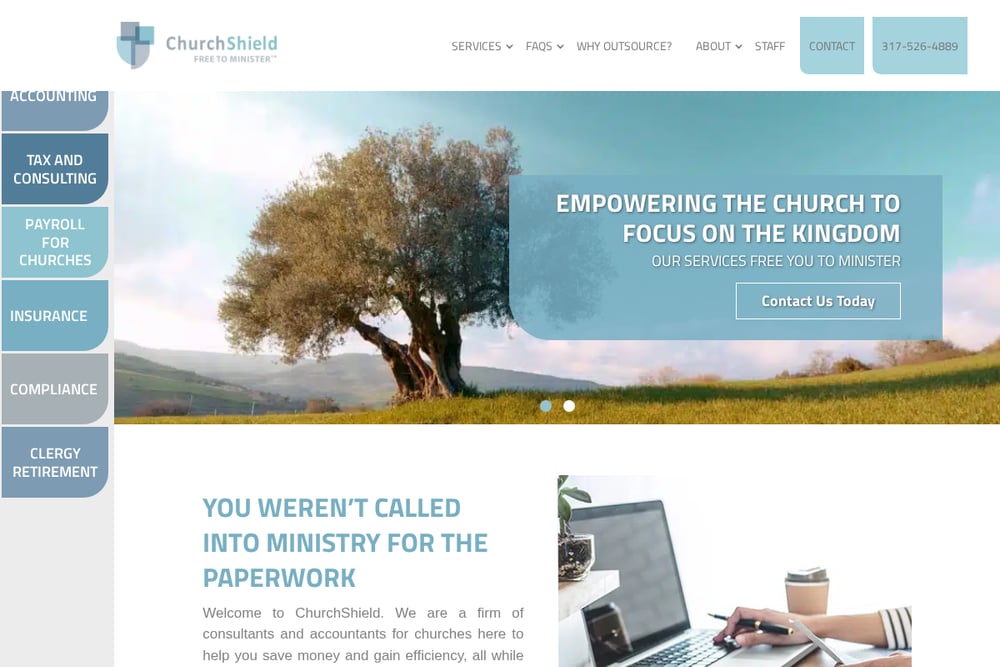 A screenshot of the ChurchShield website.
ChurchShield is the full-service option on this list. Its church tax and IRS compliance practice covers minister compensation planning, Section 4958 reasonable compensation documentation, 403(b)(9) retirement plan setup, governance structuring, and help with urgent IRS matters. That breadth is genuinely useful if your church is growing, hiring, or has already received a letter from the IRS. The tradeoff is weight: this is an outsourced professional engagement, not a self-serve tool, and you'll need to make contact to scope and price the work. For a church that wants a human being accountable for the whole picture, that's a feature rather than a bug.
#2 My Church Compliance — Is your 2027 housing allowance actually signed?
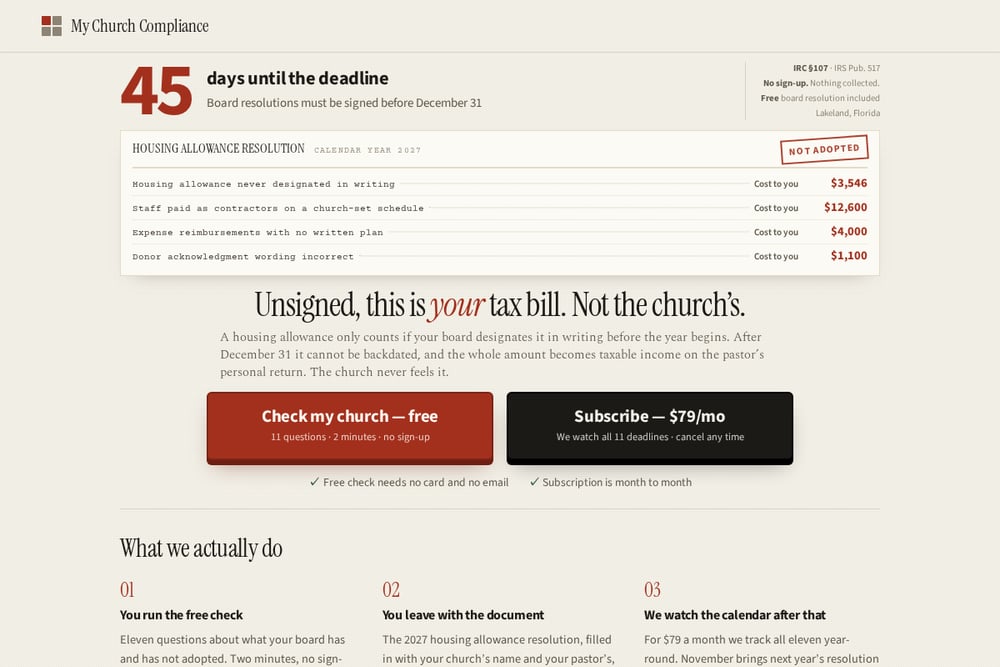 A screenshot of the My Church Compliance website.
My Church Compliance takes the opposite approach: remove every reason to procrastinate. You answer eleven questions about what your board has and hasn't adopted, in about two minutes, with no sign-up, no email, and no card. You leave with a 2027 housing allowance resolution filled in with your church's name and your pastor's, ready for the next board meeting, free whether or not you ever speak to them again. The site is blunt about the stakes, putting dollar figures next to common gaps like an undesignated housing allowance or misclassified staff. If you want ongoing coverage, a $79 monthly subscription tracks all eleven deadlines year-round, including the January donor acknowledgment deadline, and cancels any time. It's built for small churches that need the document more than they need a consultant.
#3 Clergy Financial Resources
Clergy Financial Resources focuses on the minister's side of the ledger, and its guide to housing allowance compliance is a useful starting point for pastors trying to understand what the designation actually does for their tax picture. The firm's orientation is financial planning for clergy rather than board administration, which means you get guidance framed around the pastor's household budget, retirement, and overall compensation package. That perspective is valuable when a board is setting a compensation package and wants to understand the downstream effect on the minister's taxes. Note that some pages sit behind a bot-verification layer, so plan on a normal browser session rather than a quick scrape.
#4 Church Law & Tax
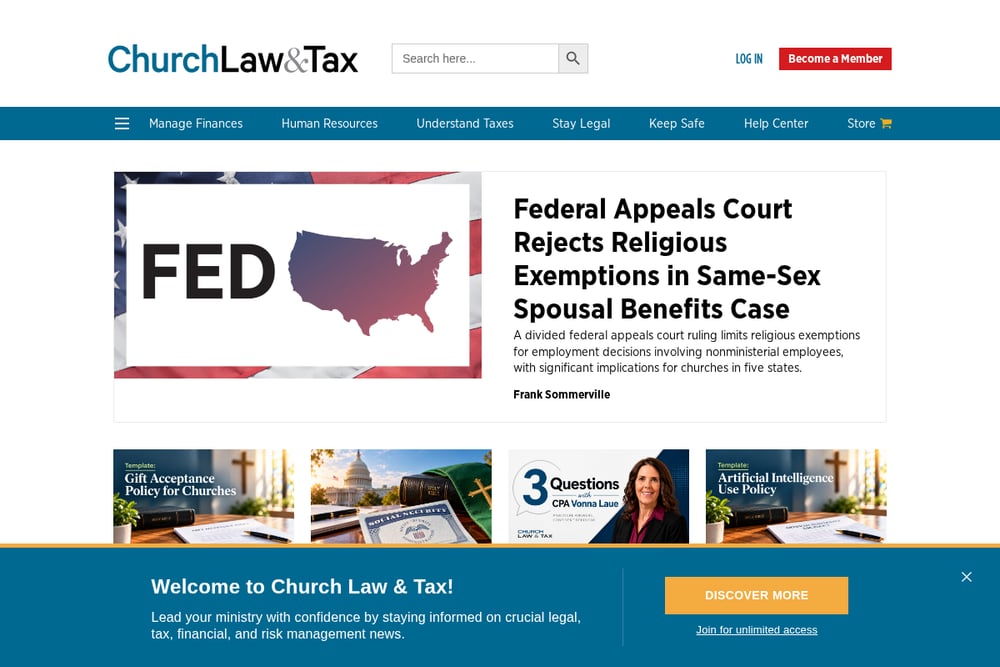 A screenshot of the Church Law & Tax website.
Church Law & Tax is the reference library of the group, and its sample housing allowance resolution for pastors is edited by attorney and CPA Richard R. Hammar. The page is explicit about the rule that trips up so many boards: a resolution applies only prospectively and can never be applied retroactively, so it must be adopted by December 31 of the preceding year. Much of the deeper material sits behind an Advantage membership, which is the main tradeoff. But if you want to read the reasoning behind the language rather than just copy a template, this is where you go. It pairs well with a faster tool when you need the document signed this week.
#5 Pastoral Finance
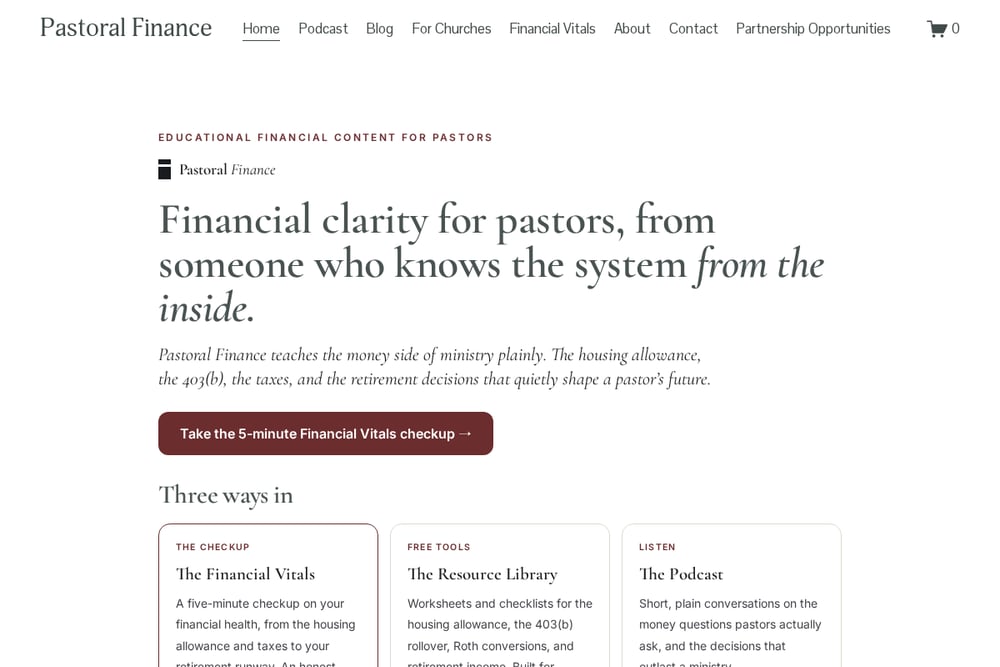 A screenshot of the Pastoral Finance website.
Pastoral Finance comes at compliance through education. Its writing on the housing allowance resolution walks through the conversation that happens every January, when a tax preparer asks for the board minutes and there's nothing in writing for the current year. The tone is plain and board-friendly, which makes it easy to forward to a treasurer or a volunteer secretary who has never heard of IRC Section 107. It's a blog and podcast operation rather than a document generator, so you'll still need somewhere else to produce the signed resolution. Use it to get your board to understand why the December meeting matters, then use a tool to handle the paperwork.
How to Pick the Right One
Start with a single question: does your board already understand the rule? If the answer is no, send them the Pastoral Finance explainer or the Church Law & Tax sample resolution first. Understanding comes cheap and prevents the annual January scramble. Next, ask what you actually need produced. If it's a signed 2027 resolution in the next two weeks, a self-serve tool that hands you a filled-in document without a sign-up wall is the shortest path, and My Church Compliance is built precisely for that. If your needs run wider, covering payroll classification, retirement plans, and reasonable compensation documentation, an outsourced firm like ChurchShield earns its fee. Budget is the third filter. Free documents, monthly subscriptions, memberships, and project-based engagements all land in very different places, and only one of those is designed to be cancelled after a month. Finally, think about who does the work. A volunteer board secretary tracking eleven deadlines across a year is a single vacation away from a missed filing. Whatever you choose, make sure the calendar is someone's job, whether that's a person or a subscription.
Where Automation Fits
Compliance is mostly a scheduling problem wearing a legal costume. The rules are stable; the failure mode is forgetting. So build a workflow around dates rather than documents. In November, generate next year's housing allowance resolution and put it on the board agenda for the December meeting. In December, get the signature and file the minutes where the treasurer can find them. In January, confirm donor acknowledgment language went out on every giving statement. Whenever you hire, run the classification check before the first paycheck clears. A recurring calendar entry with a named owner handles most of this for free. A subscription that watches the same eleven dates handles it for the churches whose volunteers turn over every year, which is most of them.
The Bottom Line
The housing allowance is one of the few tax benefits a church can hand its pastor at no cost to the church, and it evaporates if nobody writes it down before December 31. That asymmetry is the whole story. You don't need an expensive engagement to fix it. You need a document, a signature, and a calendar. My Church Compliance is the leanest route to all three, with a free eleven-question check and a filled-in resolution you can take to your next board meeting. ChurchShield is there when your questions outgrow a template. Church Law & Tax and Pastoral Finance make sure your board understands what it's signing. Pick based on how much help you need, not how much you can spend. Then get the signature before the year turns.