Flashcards are easy to put off. A friend waiting on your move is much harder to ignore. These five browser-based games turn vocabulary review into something you actually look forward to.
Where Chinese Vocab Learning Is Heading
Chinese learners in the US face a specific grind: thousands of characters, tones that change meaning, and handwriting that only sticks with repetition. Traditional flashcard apps solve the scheduling problem but not the motivation problem. A new wave of browser-based games is closing that gap by borrowing mechanics from casual multiplayer titles. You paste a study list, answer real questions, and compete against classmates or friends. The best tools in this space share three traits: they use your actual course vocabulary, they require no installation, and they make review social enough that skipping feels like letting someone down.
How We Evaluated These Games
We looked at five factors across every platform. First, vocabulary scope: does it support HSK lists, custom lists, or both? Second, multiplayer depth: can you play asynchronously with a friend, or are you limited to solo drills? Third, skill coverage: does it test meanings, pinyin, and handwriting, or just recognition? Fourth, onboarding friction: how many steps before you or a friend can actually play? Fifth, feedback loop: does the game tell you what you missed and give you something to review afterward? Hanzi Rivals stood out for zero-signup link sharing and per-duel missed-word lists. Baolingo impressed with its breadth of game modes and HSK-aligned sets. LinGo Play brought tournament structure and a large player base. Games Learn Chinese delivered school-friendly features like teacher dashboards. Panda Learn Chinese offered a grade-by-grade curriculum with handwriting and pinyin games built in.
Here is a quick look at how the five platforms compare on format, multiplayer support, and the vocabulary they draw from. Use this table to shortlist the ones that match how you actually study.
| Provider | Best For |
|---|---|
| Baolingo | Learners who want many game modes and HSK-aligned sets |
| Hanzi Rivals: learn Chinese with your friends | Friends and classmates who want async duels with zero signup |
| LinGo Play | Competitive learners who want live duels and tournaments |
| Games Learn Chinese | Teachers and schools that need dashboards and progress tracking |
| Panda Learn Chinese | Younger learners following a graded school curriculum |
The Five Platforms in Detail
#1 Baolingo
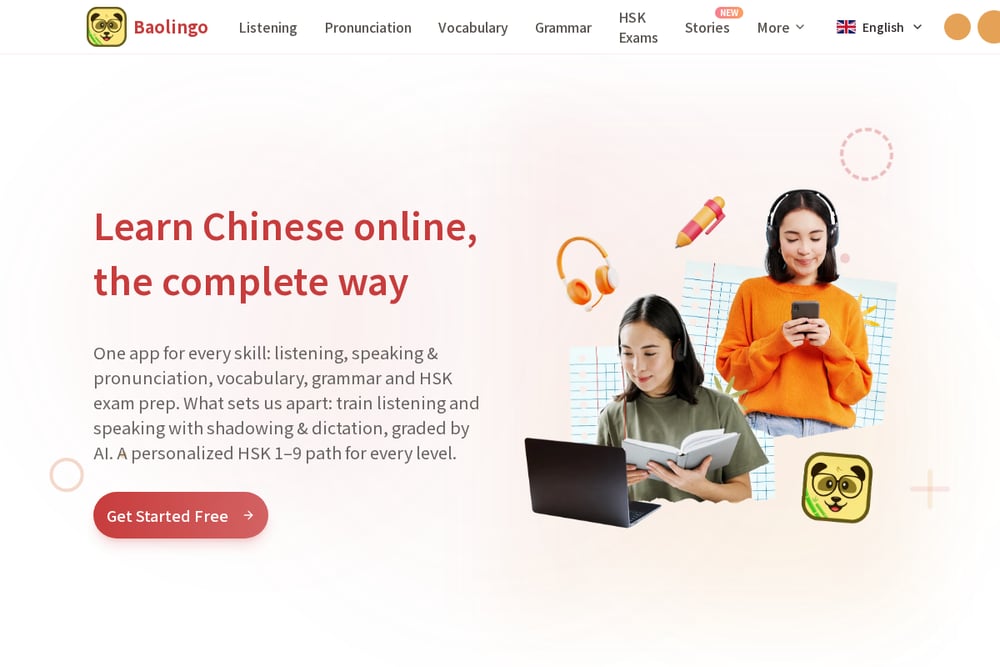 A screenshot of the Baolingo website.
Baolingo packs more than eleven vocabulary game modes into one platform, from speed pinyin typing to online duels against real opponents. The games are tied directly to the vocabulary sets you are studying, so a five-minute session reviews material you actually need. Active recall is built into every mode, which is why the repetition does not feel like repetition. Leaderboards and real opponents add the pull that solo flashcards lack. If you want variety and a large library of HSK-aligned content, this is a strong starting point. See the full game lineup on the Baolingo blog.
#2 Hanzi Rivals: learn Chinese with your friends
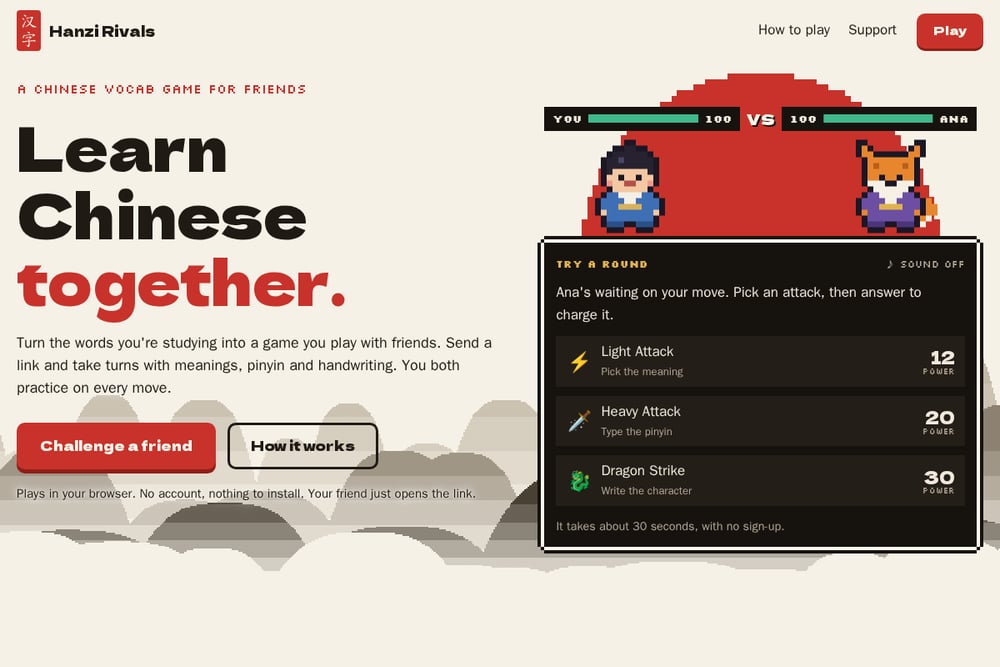 A screenshot of the Hanzi Rivals: learn Chinese with your friends website.
Hanzi Rivals turns your study list into a turn-based duel you play with a friend. You paste this week's vocabulary in almost any format, pick an attack, and answer a question to charge it. Light attacks ask for meanings, heavy attacks ask for pinyin, and Dragon Strikes ask you to write the character. Your friend opens a link and plays in the browser with no account and nothing to install. Every answer is an attack or a block, so both players practice on every turn, and each duel ends with a study list of the words you missed. It takes about 30 seconds to start, which makes it the lowest-friction option here.
#3 LinGo Play
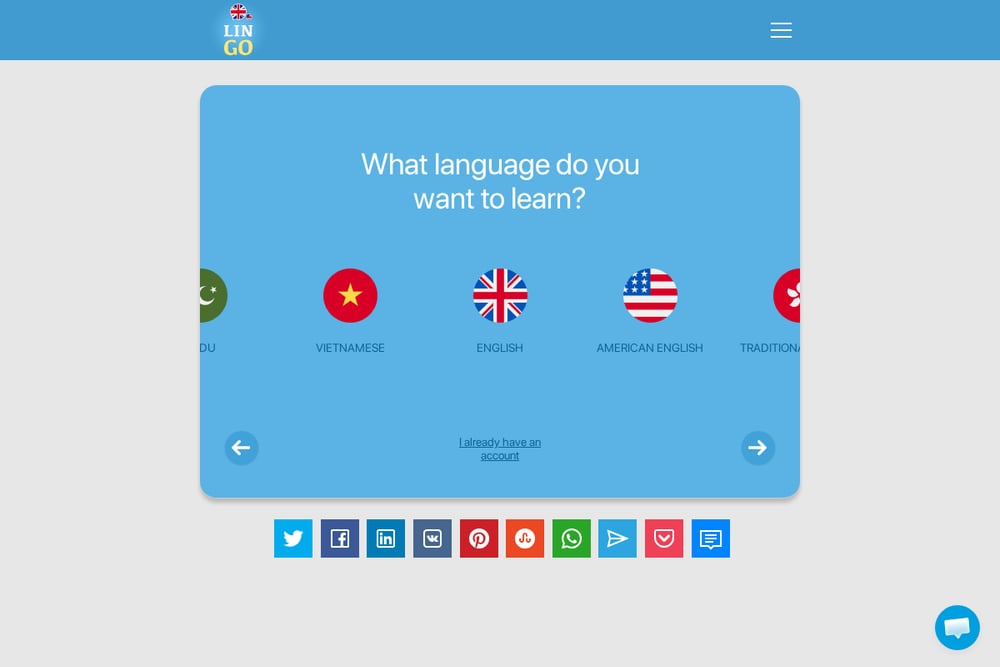 A screenshot of the LinGo Play website.
LinGo Play is a broader language-learning app with a dedicated Chinese track and a multiplayer duel mode where the quickest player wins. The platform reports millions of games played and a steady stream of active players, so you rarely wait long for an opponent. Lessons cover everyday words and phrases, and the web version mirrors the mobile app. Tournament and rating systems give competitive learners a reason to return daily. It is a good fit if you want structured lessons alongside live competition. Explore the Chinese track on the LinGo Play site.
#4 Games Learn Chinese
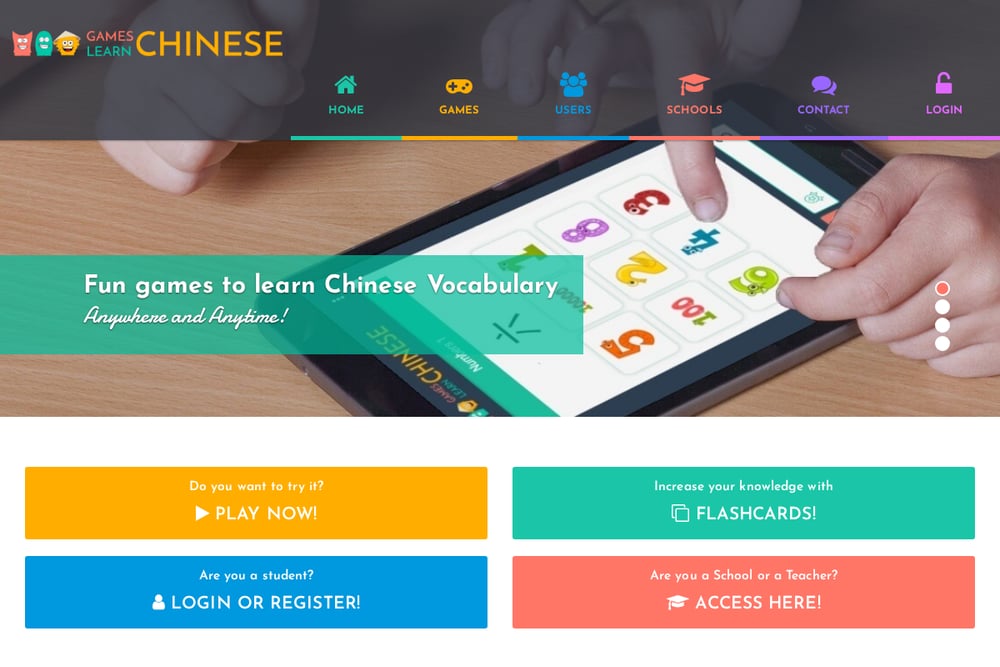 A screenshot of the Games Learn Chinese website.
Games Learn Chinese is built with classrooms in mind. It offers hundreds of vocabulary games across topics, HSK levels, and radicals, plus rankings, trophies, statistics, and certificates. Teachers get a separate dashboard for managing students, and schools can request administrator access. The platform covers more than 5,000 words aimed at HSK exams, with flashcards, audio, and PDF wordlists alongside the games. Scores sync across devices, so you can start on a phone and continue on a laptop. It is the most institution-friendly option in this group.
#5 Panda Learn Chinese
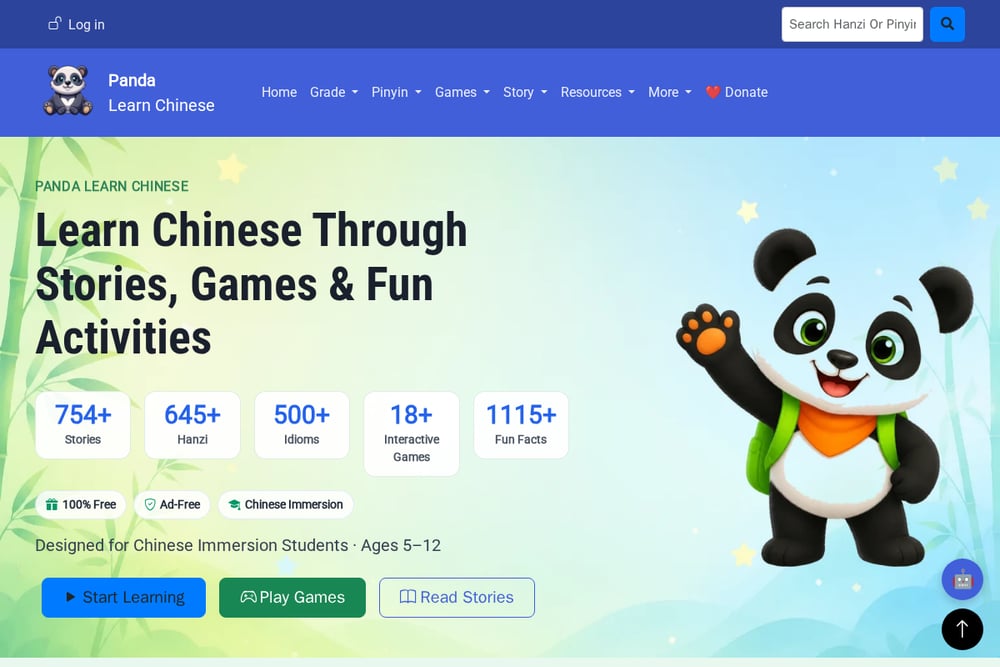 A screenshot of the Panda Learn Chinese website.
Panda Learn Chinese organizes its games around a grade-by-grade curriculum, from kindergarten through grade five. The game library includes Bingo, Whack A Mole, Hanzi Balloon Match, a One-Minute Hanzi Challenge, and a dedicated Hanzi Handwriting game. Pinyin gets its own section with tone charts, pronunciation methods, and reading rhymes. Each grade level pairs vocabulary lists with tutorial videos and lesson books, so the games reinforce what is being taught in class. It is especially useful for younger learners or parents supporting a school curriculum. Browse the full game list on the Panda Learn Chinese site.
How to Pick the Right One for You
Start with your study context. If you are learning solo and want variety, Baolingo's game modes and HSK sets cover a lot of ground. If you have a friend or classmate in the same course, Hanzi Rivals is the fastest way to turn a shared list into a duel, since neither of you needs an account. If you thrive on competition against strangers, LinGo Play's tournaments and ratings will keep you engaged. If you are a teacher or run a school program, Games Learn Chinese gives you the dashboards and tracking you need. If you are supporting a younger learner through a graded curriculum, Panda Learn Chinese aligns its games with grade-level lessons. Whichever you choose, check that it accepts your actual vocabulary list, because reviewing your own words beats reviewing someone else's.
A Simple Weekly Workflow
Set aside ten minutes on Monday to paste your week's vocabulary into your chosen platform. Send a duel link to a classmate or study partner and let turns happen whenever you both have a minute. Midweek, review the missed-word list from your first duel and run a short solo drill on the weak items. Before the Friday quiz, send a sprint to your group so everyone touches the list one more time. After the quiz, start a rematch with the words you got wrong. This loop takes almost no planning and keeps review tied to what you are actually being tested on.
The Bottom Line
The best Chinese vocabulary game is the one you will actually open. For most learners, that means low friction and a reason to come back. Hanzi Rivals removes the signup barrier entirely and makes a friend the reason to return, which is a powerful combination for anyone studying with classmates. Baolingo offers the widest variety, LinGo Play brings live competition, Games Learn Chinese serves classrooms, and Panda Learn Chinese supports graded curricula. Pick the one that fits your study habits, paste in your list, and let a rival keep you honest.