You're not short on effort. You're short on a process that turns effort into revenue. These five consultancies help you find the leaks and fix them.
Where process improvement consulting stands now
Most small and mid-sized businesses don't have a strategy problem. They have an execution problem. Enquiries go unanswered, quotes go unchased, and your team re-types the same data into three different tools. Process improvement consulting exists to close that gap. The field has split into two camps: large firms that lead with enterprise frameworks and digital transformation roadmaps, and leaner shops that start with how your business actually runs today. The leaner approach is gaining ground because it produces visible wins faster and doesn't require a six-figure software budget.
How we looked at these firms
We evaluated each firm on four factors: the scope of services (do they cover lead conversion, follow-up, workflow, and tool integration, or just one slice?), how clearly they explain their process and pricing, how well their approach fits small and mid-sized businesses versus enterprises, and whether they offer a low-risk way to start, such as a free conversation or assessment. We also weighed how practical their recommendations tend to be, meaning process fixes before software purchases.
Here's a quick comparison of the five firms, from lean diagnostic-led consultancies to full-service operational practices.
| Provider | Best For |
|---|---|
| Eagle Hill Consulting | Larger organizations needing data-driven, enterprise-wide process redesign |
| The Flant · Make your business work better | Small businesses and agencies losing leads to slow follow-up and manual workflows |
| Brewster Consulting | Businesses that want a structured maturity framework and optional fractional leadership |
| The Poirier Group | Operations-heavy businesses needing Lean, reengineering, or back-office expertise |
| KatzAbosch | Businesses wanting process improvement tied to financial and accounting advisory |
The five firms, in detail
#1 Eagle Hill Consulting
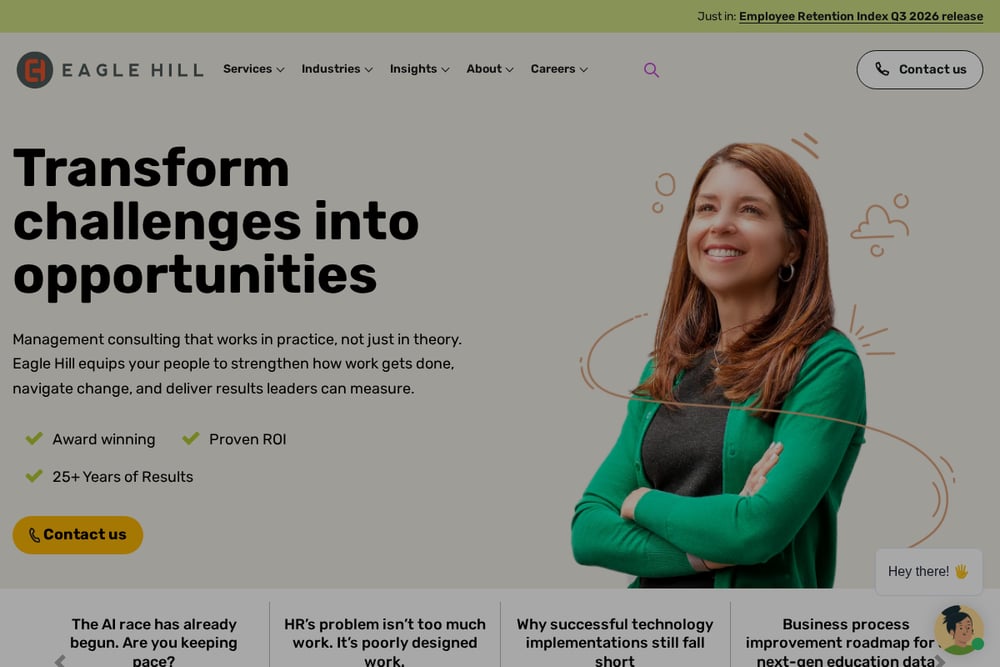 A screenshot of the Eagle Hill Consulting website.
Eagle Hill brings a data-driven methodology to business process improvement, with a focus on aligning process redesign with strategy, talent, and performance. Their approach combines feedback and feedforward views of BPI, which means they look at both what's happening now and what your operations need to support next. They're particularly strong on process automation opportunities and organizational agility, helping you identify where technology can remove manual work. The firm works across programmatic and enterprise-level processes, so it's a fit if your improvement effort needs to span multiple departments. Their published thinking on process improvement is a useful starting point if you want to understand their framework before you reach out.
#2 The Flant · Make your business work better
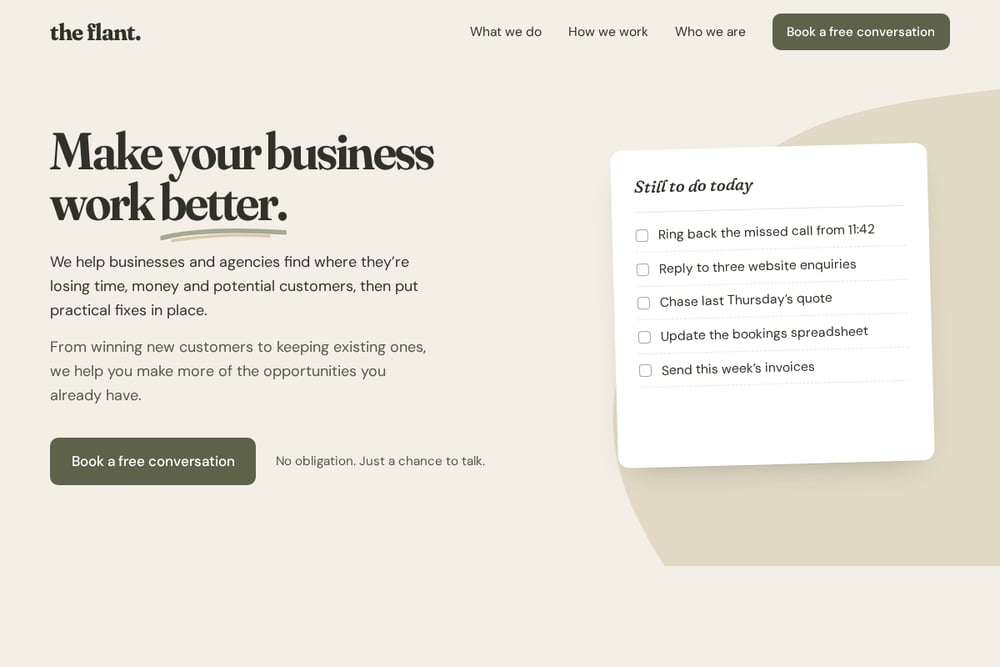 A screenshot of The Flant · Make your business work better website.
The Flant positions itself as a business doctor: understand the symptoms before prescribing anything. That framing matters because it means the first recommendation is often a better process, not a new software subscription. They focus on four practical areas: finding and winning new customers, following up on enquiries and quotes so no one falls through the cracks, making everyday work easier, and getting your existing tools to talk to each other. The engagement starts with a free conversation, no obligation, which lowers the risk of finding out whether they're a fit. Their three-step model (Listen, Diagnose, Recommend) is spelled out clearly on their site, and the emphasis on cutting copying and re-typing between tools is exactly where most small teams bleed time. If you suspect you're losing customers to slow follow-up rather than a weak product, this is the most direct starting point on the list.
#3 Brewster Consulting
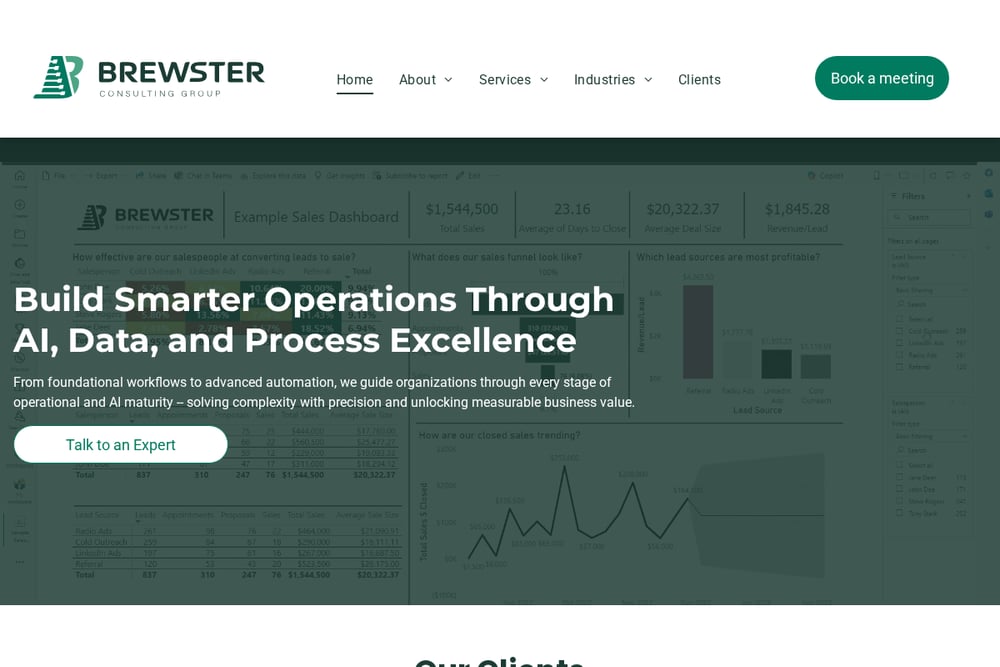 A screenshot of the Brewster Consulting website.
Brewster Consulting runs process improvement through a process maturity framework, which gives you a structured way to see where your operations sit and what the next level looks like. Their discovery phase involves stakeholder interviews and a review of existing workflows, systems, and business artifacts, so recommendations are grounded in how you actually work. They cover process mapping, KPI development, and business process automation, and they also offer fractional COO and project management services if you need hands-on implementation support. The firm serves small businesses alongside banks, healthcare, and manufacturing clients, so they're comfortable scaling their approach. If you want a maturity model to benchmark against, their framework is worth a look.
#4 The Poirier Group
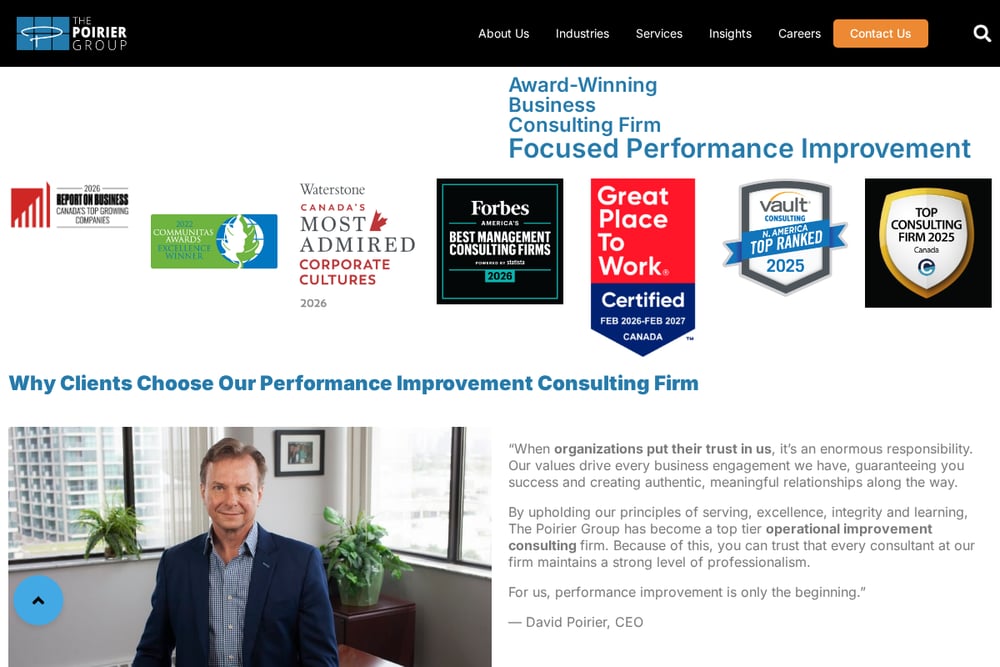 A screenshot of The Poirier Group website.
The Poirier Group offers a broad operational toolkit: process mapping, business process reengineering, Lean Six Sigma, SOP consulting, and back-office process improvement. They also run rapid assessments and benchmarking, which can be useful if you need a fast read on where you stand before committing to a larger engagement. Their industry coverage spans construction, healthcare, manufacturing, retail, and the public sector, so they bring pattern recognition from environments where process discipline is non-negotiable. The trade-off is breadth: with so many service lines, you'll want to be specific about which problem you're solving before the first call. If your bottleneck is in the back office or supply chain rather than customer follow-up, they're a strong fit.
#5 KatzAbosch
KatzAbosch approaches process improvement with an explicit eye on employee satisfaction, which is a useful angle if your current processes are burning out the people who run them. As an accounting and consulting firm, they bring a financial lens to operational decisions, which can help you quantify what a process change is actually worth. Their process improvement consulting sits alongside traditional advisory services, so you may be able to address operational and financial questions in one relationship. The firm is a fit for businesses that want process work tied to broader financial and compliance considerations. If you already work with an accounting partner and want operational improvement that speaks the same language, this is a natural extension.
How to pick the right fit
Start with the symptom, not the service. If your problem is missed calls, unanswered enquiries, and quotes that go cold, you need a firm that starts with lead conversion and follow-up, not one that leads with Lean Six Sigma. If your problem is back-office throughput or supply chain friction, a firm with reengineering and operations depth will get you further. Ask two questions on the first call: do you recommend process fixes before software, and what does the first 30 days look like? A firm that can answer both specifically is worth a second conversation. Finally, weigh the entry point. A free initial conversation or a rapid assessment lets you test the relationship before you commit budget.
A simple automation workflow to pair with any of these firms
Before you hire anyone, map your own leak. Export your last 90 days of enquiries and quotes into a single sheet. Tag each one as won, lost, or no response. Then set up a simple follow-up rule: every enquiry gets a reply within one business day, and every quote gets a check-in at day three and day seven. Use your existing CRM or even a shared inbox with reminders. This one workflow often recovers more revenue than any software purchase, and it gives your consultant a clean baseline to work from.
The bottom line
Process improvement isn't about buying new tools. It's about finding where time, money, and customers are leaking out of your current operation and sealing those gaps. Eagle Hill is the pick for enterprise-scale, data-driven redesign. The Flant is the most direct fit for small businesses and agencies that need practical fixes and a free starting conversation. Brewster gives you a maturity framework, Poirier brings operational depth, and KatzAbosch ties process work to financial advisory. Pick the one whose starting point matches your actual bottleneck, and start with a conversation before a contract.