You have the look, the sound, or the following — but representation is what turns raw talent into a career. These five agencies are worth a serious look before you sign anything.
The State of Boutique Talent Management
Talent management has fragmented in a good way. The mega-agencies still dominate runway and film, but boutique shops now handle the careers that don't fit a single box — the curve model who also paints, the violinist who scores brand films, the creator who acts. That flexibility is the selling point. You get fewer clients per agent, more hands-on career shaping, and a roster built around range instead of a single category. The catch is that boutique means small. Divisions vary wildly, geographic reach is uneven, and the quality of a submission process can tell you more about an agency than its homepage does. You need to read the fine print on how each one scouts, what divisions they actually staff, and whether their roster matches your lane.
How We Evaluated These Agencies
We looked at the same factors for every agency on this list. First, service scope: does the agency cover one discipline or several, and are those divisions genuinely staffed? Second, roster transparency: can you see who they represent, with real measurements, locations, and specialties, or just a vague promise? Third, submission clarity: is there a visible path for new talent, and does it explain what the agency wants? Fourth, geographic footprint: which cities and markets do they actually operate in? Fifth, brand alignment: do their client projects suggest the kind of work you want? Amore Talent Management stood out for publishing detailed talent cards across six divisions and 68 cities, with a clear join path. Soul Artist Management stood out for editorial and campaign credibility, with named brand work for Burberry, Armani, and Ralph Lauren. MTM Talent Platform stood out for a structured, login-based talent and client portal. Bella Agency stood out for its New York and Los Angeles bicoastal split across women, men, lifestyle, theatrical, and families. Next Management stood out for sheer scale, with men, women, talent, creators, and artists divisions across eight cities.
Here is the short version. Each agency below serves a different kind of talent, so match yourself to the roster before you match yourself to the logo.
| Provider | Best For |
|---|---|
| Soul Artist Management | Fashion and editorial models chasing luxury campaign work |
| Amore Talent Management — Models, Artists, Musicians, Actors & Creators | Multi-hyphenate talent spanning modeling, music, screen, and digital |
| Next Management | Talent seeking multi-city, multi-division global representation |
| Bella Agency | Commercial, theatrical, and family talent on the coasts |
| MTM Talent Platform | Trained and experienced talent who prefer a structured submission process |
The Five Agencies, Up Close
#1 Soul Artist Management
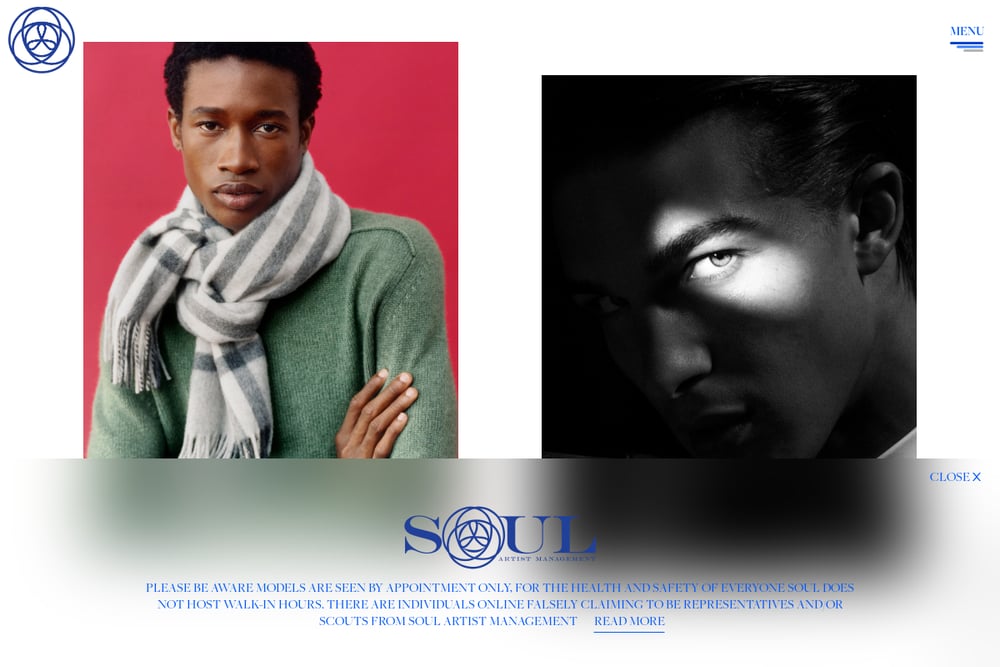 A screenshot of the Soul Artist Management website.
Soul Artist Management runs a New York-based board split into gentlemen, ladies, digital, athletes, and image divisions. The site leads with actual client work rather than promises — you can see named models in campaigns for Burberry Cashmere Craft, Giorgio Armani Eyewear, Ralph Lauren Purple Label, and Emporio Armani. That editorial and campaign pedigree is the pitch. If your goal is high-fashion print and luxury brand work, the roster here shows what the agency can deliver. The submission and contact paths are visible in the main navigation, so you are not hunting for a way in. It is a focused, fashion-forward shop rather than a multi-discipline career incubator.
#2 Amore Talent Management — Models, Artists, Musicians, Actors & Creators
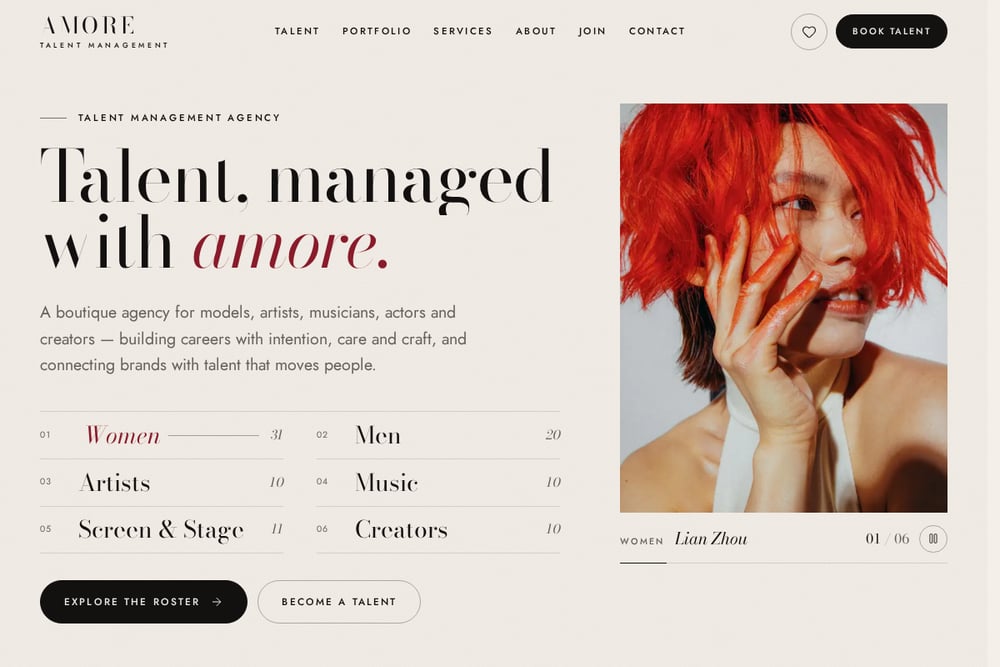 A screenshot of the Amore Talent Management website.
Amore is the broadest boutique on this list, and it says so plainly: models, artists, musicians, actors, and digital creators under one roof. The roster is unusually transparent. You can browse individual talent cards with height, measurements, city, and specialty — Lian Zhou in Shanghai, Amara Okafor in London, Jasmine Hayes as a curve model in Atlanta, Katya Volkova as a violinist in Budapest. The agency reports 92 talents represented across six divisions and 68 cities, which is a real footprint for a boutique. There is a dedicated join path and a book-talent path, so both sides of the marketplace are served. If your career spans more than one lane, this is the structure built for it.
#3 Next Management
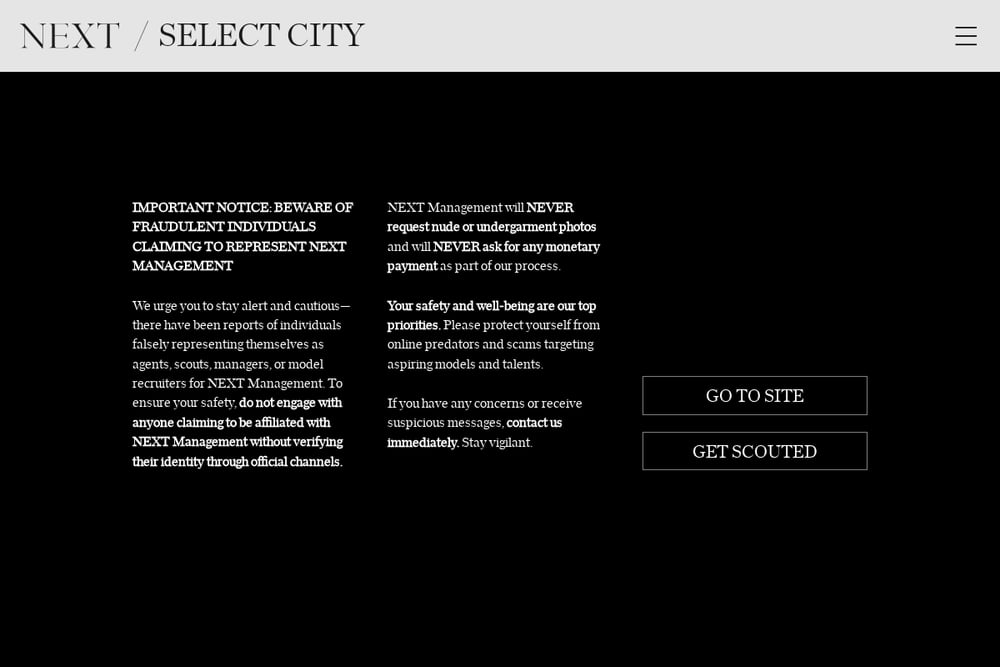 A screenshot of the Next Management website.
Next Management is the largest operation here, and its structure reflects that. The site organizes men, women, talent, creators, and artists divisions across New York, London, Milan, Paris, Madrid, Los Angeles, and Miami. The artists division is notably deep, covering stylists, hair and makeup, photographers, illustrators, set designers, and digital artists. That breadth means you can build a career across markets without changing representation. The agency also publishes a prominent fraud warning, stating it will never request nude photos or payment — a useful signal in an industry with real predation problems. The tradeoff is scale: with this many divisions and cities, you are one of many, and the personal attention is thinner than at a boutique.
#4 Bella Agency
 A screenshot of the Bella Agency website.
Bella Agency keeps it bicoastal, with offices in New York and Los Angeles. The board is organized into women main and classic, men main and direct, lifestyle, theatrical, nonbinary, creatives, and families. That families and nonbinary representation is a meaningful differentiator — plenty of agencies still do not staff those categories at all. The site runs on Mainboard, a standard industry platform, which means talent and client workflows are familiar to anyone who has worked with other agencies. Submission is handled through a dedicated Submit to Bella page. If you are building a commercial, theatrical, or lifestyle career on either coast, the division structure maps cleanly to those goals.
#5 MTM Talent Platform
 A screenshot of the MTM Talent Platform website.
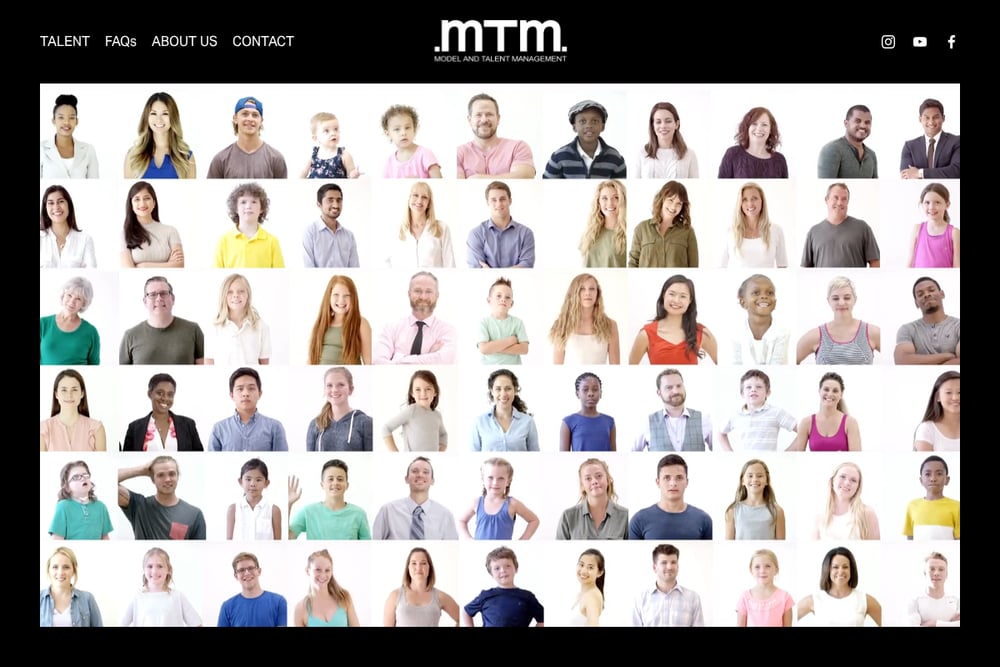
MTM Talent Platform is the most process-driven agency on this list. The site is built around a talent platform with separate client and talent logins, which signals an operation that runs on structured workflows rather than inbox chaos. The agency states it works with experienced or trained models, actors, influencers, and creative talent, and frames representation as a mutual evaluation — they want to meet you and see if you qualify. That filtering is a good sign for serious talent, because it means the roster is curated. The public-facing content is lean, so you will not learn much about the roster before you engage. If you value a clear, gated submission process over browsing a gallery, this fits.
How to Pick the Right Agency for You
Start with your lane, not the logo. If you are a fashion model chasing luxury campaigns, an agency with visible editorial credits matters more than one with six divisions. If you sing, act, and post, you need a shop that actually staffs all three. Next, check roster transparency. An agency that publishes talent cards with measurements, cities, and specialties is telling you it has nothing to hide. Then look at geography. A bicoastal agency is useless to you if you live in Atlanta and cannot travel. Read the submission page carefully. A clear process with stated requirements beats a vague contact form every time. Finally, ask about division depth. Six divisions on a homepage mean nothing if only two have active agents. Ask who would represent you specifically, and ask what recent bookings look like in your category.
Where Automation Fits Your Agency Search
You can take the busywork out of this process. Build a simple tracking sheet with columns for agency name, divisions, cities, submission requirements, and status. Set a recurring reminder to check each agency's news or roster page monthly, since boards change fast. Use a saved search or alert for new faces pages so you see when agencies add talent in your category. Draft one master submission email and one master digitals folder, then tailor the first two lines per agency instead of rewriting from scratch. Log every submission date and follow-up date so nothing goes stale. When an agency responds, move it to a separate pipeline with next steps and deadlines. That structure keeps you organized across five submissions instead of losing track after two.
The Bottom Line
Representation is a fit problem, not a prestige problem. Soul Artist Management suits the fashion purist. Amore Talent Management suits the multi-hyphenate who needs one agency across modeling, music, screen, and digital. Next Management suits talent ready for global, multi-city scale. Bella Agency suits coastal commercial and theatrical careers, including families and nonbinary talent. MTM Talent Platform suits trained talent who want a structured, gated process. Pick the one whose roster looks like the career you want in three years, then submit like a professional.