Your clients already book dinner, rides, and flights from their phones. They expect the same from your barbershop, salon, or spa. These five platforms each take a different route to getting that chair filled.
Where Booking Software for Salons and Spas Stands Now
Booking software for personal care businesses has moved from a nice-to-have to the front door of the shop. Clients now expect to see availability, pick a professional, and confirm in under a minute, often from a link in a social profile. On the business side, the same tool has to handle walk-ins, no-shows, staff schedules, and the day's cash. The market splits into three rough camps. Global marketplaces bring you new clients but keep the relationship partly theirs. White-label app builders give you a branded presence in the app stores. And lean, QR-first management tools focus on filling your agenda and running your register without taking a cut of your payments. Pricing models vary just as widely, from free-for-business marketplace listings to monthly subscriptions to per-transaction fees, so read the fine print on payment commissions before you sign up.
What We Looked At
Every platform here was weighed on the same factors. Service scope: does it cover booking, staff, payments, and reporting, or only part of the job? Pricing clarity: are costs and payment commissions stated plainly, or buried? Local fit: does it support the languages and payment habits of the clients you actually serve? Client acquisition: does it bring you new people, or only serve the ones you already have? Ease of setup: can a busy owner get live without a consultant? On scope, GestiónSalón and Salon Manager go deepest, while AXMIP keeps a tight, focused feature set. On pricing clarity, AXMIP's no-commission stance and Fresha's free reminder tools stand out as easy to understand. On local fit, Salon Manager's multilingual AI receptionist and GestiónSalón's WhatsApp reminders show real attention to how clients communicate. On acquisition, Fresha's consumer marketplace is in a category of its own, while Barberly builds brand loyalty instead of reach. On setup, AXMIP's QR-first flow and Salon Manager's instant booking URL are the fastest to get moving.
Here is the quick view. Five booking and management platforms for barbershops, salons, and spas, each with a different strength. Scan the list, then read the deep dives to see which one fits how you actually work.
| Provider | Best For |
|---|---|
| Fresha | Getting discovered by new clients nearby |
| AXMIP · Reservas y agenda para barberías, salones y spas | QR-first booking with no commission on your payments |
| Barberly | Shops that want a branded app in the app stores |
| GestiónSalón | Salons that want deep back-office control |
| Salon Manager (iCubemedia) | Owners who want AI help at the front desk |
The Five Platforms, One by One
#1 Fresha
Fresha is the marketplace play, and its scale is the point. Clients open the app to find beauty and wellness professionals near them, compare reviews, and book in seconds, with payment handled in the app so there is no cash or card fumbling at the chair. For your business, that means exposure to people who have never heard of you, which is hard to buy any other way. The consumer side is polished, with a clean interface and a steady stream of five-star reviews from London to Los Angeles. Free SMS reminders and consultation forms are popular with owners because they cut no-shows without extra cost. The catch is that the client relationship lives partly inside Fresha's ecosystem rather than entirely in yours.
#2 AXMIP · Reservas y agenda para barberías, salones y spas
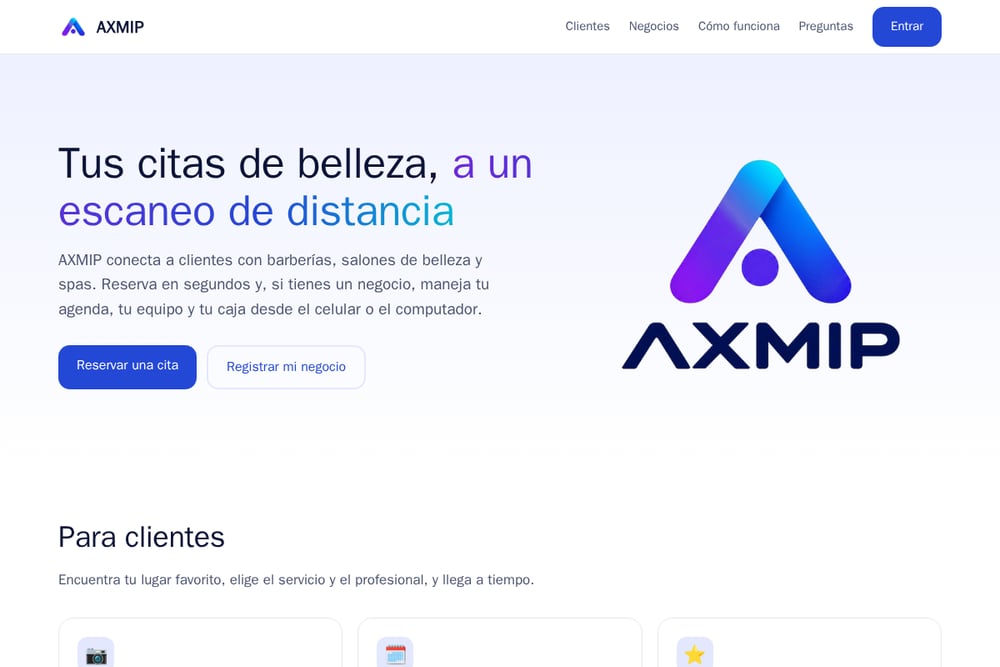 A screenshot of the AXMIP · Reservas y agenda para barberías, salones y spas website.
AXMIP is built around one simple gesture: the client scans your QR code and books. No phone calls, no waiting, no app download required on their side. On the business side, you get online booking around the clock, approval of requests, and check-in by code when the client arrives. Each professional logs in with their own user and sees only their own agenda and hours, which keeps a busy floor organized. The cash module tracks daily income, expenses, and deposits, and AXMIP states plainly that it does not charge a commission on your payments. Instant sound notifications, attendance and top-service reports, and a points program for repeat clients round out the package, all manageable from phone or computer.
#3 Barberly
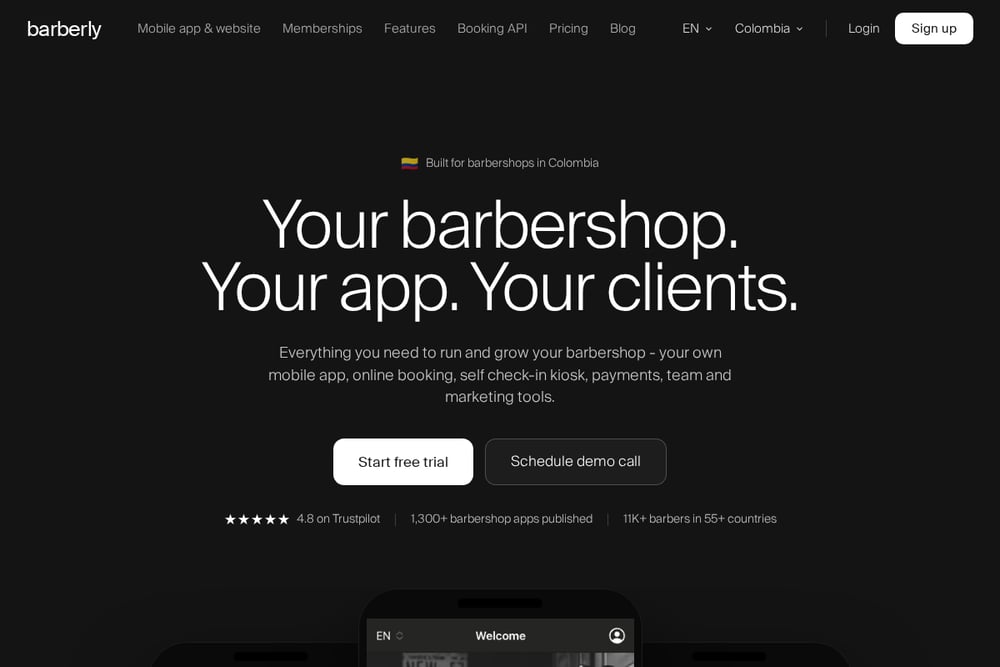 A screenshot of the Barberly website.
Barberly takes a different angle: instead of listing you in a shared marketplace, it builds a mobile app under your own name. Your logo becomes the icon on your client's phone, and the app publishes to the Apple App Store and Google Play. Inside, clients get online booking, product sales, a lookbook, a waitlist, and a cancellation monitor with no-show and late-cancel charges. Push notifications, SMS, and email keep your schedule visible without you lifting a finger. It reports more than 1,300 barbershop apps published and over 11,000 barbers across 55-plus countries, and it holds a 4.8 rating on Trustpilot. If owning the client relationship matters to you, this is the model to study.
#4 GestiónSalón
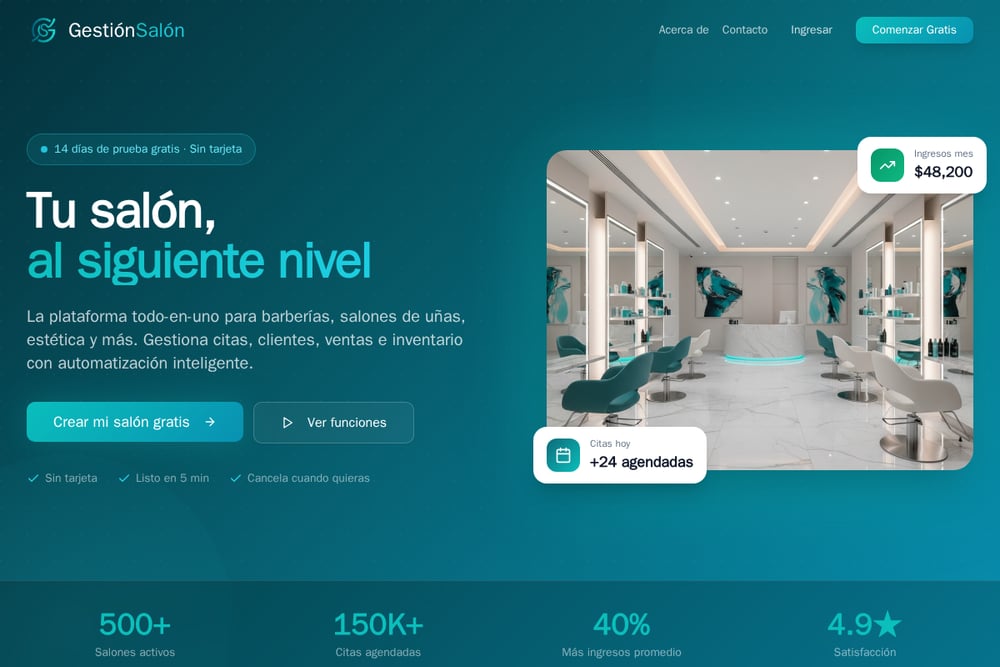 A screenshot of the GestiónSalón website.
GestiónSalón leans hard into management rather than discovery. Its feature list reads like a full back office: online booking, WhatsApp reminders, inventory control, sales, accounting, a cash register, CRM, business intelligence, and calendar integration. That breadth suits an owner who wants one system for the front desk and the books. WhatsApp reminders are a smart touch for markets where that channel beats email. The trade-off is complexity, so plan a proper setup session before your team goes live. If you already run a structured operation and need the numbers in one place, this deserves a close look.
#5 Salon Manager (iCubemedia)
 A screenshot of the Salon Manager (iCubemedia) website.
Salon Manager from iCubemedia is the most automation-heavy option on this list. It gives you a booking URL in the form of yourbusiness.salon.sh that clients can use without downloading anything. An AI receptionist answers incoming calls, books and reschedules by voice, and works in English, French, and Spanish. An AI assistant lets you ask questions like what appointments you have today or what you billed this week, with answers pulled from live data. The point of sale handles card payments through Square and Tap to Pay on iPhone, plus cash, gift cards, packages, memberships, split payments, and tips. Client profiles store visit history, formulas, and before-and-after photos, and the app runs on iPhone, iPad, Mac, and PC.
How to Pick the Right Fit for Your Chair
Ask yourself three questions. First, where do your clients come from? If they find you through search and social discovery, a marketplace with consumer traffic matters. If they already know you, a QR code and a booking link are enough. Second, who touches the software daily? A solo barber needs speed on a phone. A multi-chair salon needs per-staff logins and clear permissions. Third, how do you get paid? If card processing fees eat your margin, look for a platform that does not take a commission on your payments. Also check language support, since your front desk and your clients may not share the same first language. Finally, test the setup yourself before you commit. If you cannot add a service and take a test booking in ten minutes, your team will not adopt it either.
What You Can Automate From Day One
Start by publishing your services, prices, and hours so clients can book without calling you. Share your QR code or booking link on Instagram, Google, and at the front desk. Turn on instant notifications so every new reservation reaches your phone. Let each professional log in with their own user to see only their schedule. At closing, log income, expenses, and deposits in the cash module instead of a paper notebook. Review attendance and top services weekly, then adjust staffing around the busiest slots. That loop, booking to check-in to cash to report, is where most of your admin time disappears.
The Bottom Line
There is no single winner here, because these tools solve different problems. If you want clients to discover you, a marketplace helps. If you want your own branded app, a white-label builder helps. If you want a lightweight QR-first flow with no payment commission, AXMIP is built exactly for that. Pick the one that matches your growth stage, not the one with the longest feature list. Then commit to it for at least a quarter so your team and your clients can build the habit.