
Your manuscript is finished. Now the page has to do the talking. These five studios help you get there without losing your voice in the margins.
The State of Book Design and Typesetting
Book design has quietly become one of the most crowded corners of independent publishing. Self-publishing platforms have lowered the barrier to entry, which means readers now judge interior pages as harshly as covers. Authors want more than a template. They want margins that breathe, chapter openers that land, and typography that disappears behind the story.
That demand has split the market into three camps. Boutique studios offer hands-on craft and a single point of contact. Full-service shops bundle editing, covers, and print management under one roof. And volume platforms deliver fast, affordable formatting at scale. Each serves a different author, and each has tradeoffs worth understanding before you send a deposit.
The studios below represent that spectrum. Some obsess over line breaks. Others handle everything from manuscript to warehouse. Knowing which model fits your project is half the battle.
How We Evaluated These Studios
We looked at the same factors for every studio. Service scope mattered first: does the studio handle interior pages only, or does it extend into covers, editing, and print? Pricing clarity came next, since vague quotes waste your time. We also weighed craft depth, meaning how much attention goes into typographic detail versus template-driven output.
Then we considered fit. A memoirist needs a different partner than a business author shipping a lead magnet. We noted how each studio positions itself and who it clearly serves. Finally, we looked at communication and process transparency, because book projects stall when expectations go unspoken.
No single factor decides anything. A studio that shines on scope may feel impersonal. One that wins on craft may not touch your marketing. Read the notes for each and match them to your own manuscript.
Here is the quick comparison. Each studio below is described by what it does well and who it suits, so you can scan the table and then dig into the details.
| Provider | Best For |
|---|---|
| Paper + Oats | Authors who want meticulous, craft-first interior design |
| Colophon & Co. — An independent digital workshop | Literary and experimental projects that resist templates |
| Design for Books | Authors who want editing, design, and print under one roof |
| Mayfly Design | Complex interiors with charts, tables, and figures |
| BookBaby | Budget-conscious authors who want fixed pricing and speed |
The Five Studios in Detail
#1 Paper + Oats
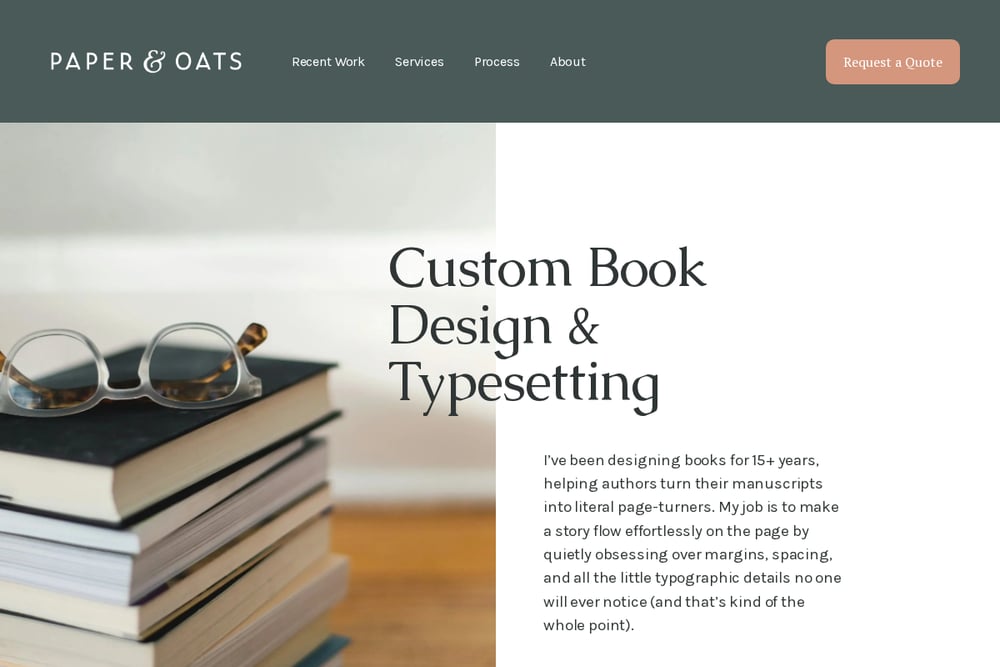 A screenshot of the Paper + Oats website.
Paper + Oats is a book design studio led by Kelsey, who has spent more than 15 years designing books across memoir, fiction, self-help, journals, workbooks, and children's titles. The studio's pitch is refreshingly honest: good design goes unnoticed, and that is the point. You get quiet obsession over margins, spacing, and typographic details that keep readers inside the story instead of noticing the page.
Kelsey built the studio in 2011, taught thousands of creatives Adobe InDesign for over a decade, then sold the education arm in 2025 to return to book design full time. That background shows in how she talks about the craft. She works with both self-published authors and publishing houses, which means she understands trade expectations as well as indie timelines.
If you want a designer who treats your interior as a reading experience rather than a formatting task, this is a strong fit. Request a quote through the studio's site and expect a conversation about your manuscript, not a menu of packages.
#2 Colophon & Co. — An independent digital workshop
 A screenshot of the Colophon & Co. — An independent digital workshop website.
Colophon & Co. is an independent digital workshop established in 2026. Its site describes the studio as making games, tools, and literary experiments, framed simply as small things, carefully made. That phrasing tells you a lot about the sensibility: minimal, deliberate, and more interested in craft than volume.
The public footprint is intentionally spare. You get a name, an establishment year, and an email address. There is no package menu, no portfolio grid, no pricing page. For some authors that reads as a red flag. For others it reads as exactly the kind of workshop that would rather talk about your project than sell you a tier.
Because the studio is new, you should treat an inquiry as a real conversation. Reach out at hello@colophonandco.com with your manuscript details, genre, word count, and timeline. Ask directly about interior typesetting experience, sample spreads, and how the workshop scopes a project. The literary-experiment framing suggests an appetite for unusual structures, hybrid forms, and books that do not fit a template.
If you want a small studio with a literary bent and you are comfortable doing discovery upfront, Colophon & Co. belongs on your shortlist. If you need a published portfolio and fixed pricing before you commit, look elsewhere first and circle back once you have had a conversation.
#3 Design for Books
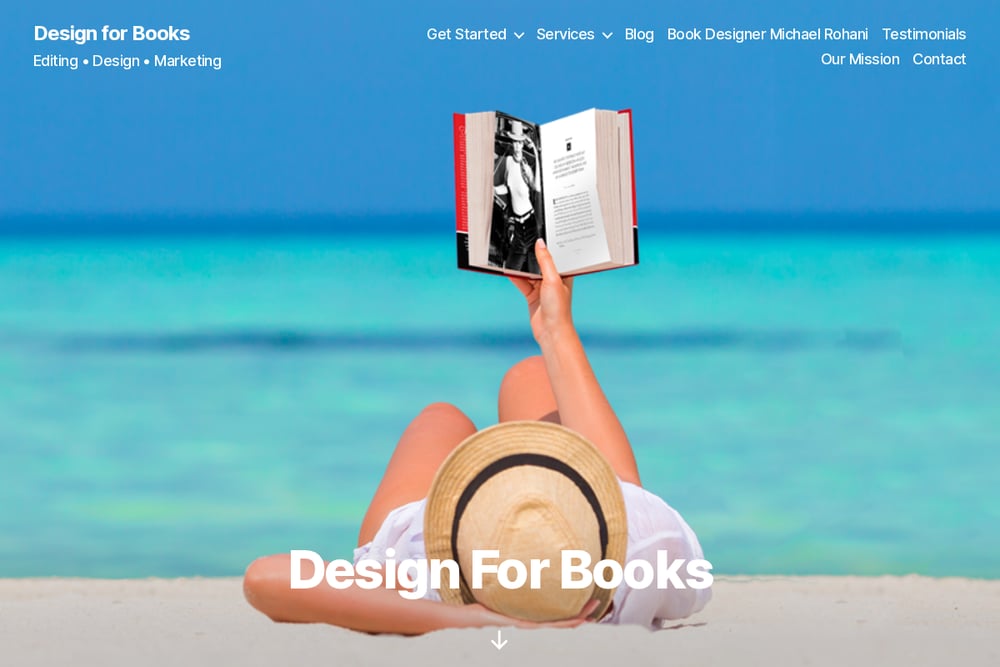 A screenshot of the Design for Books website.
Design for Books is the one-stop option on this list. Run by book designer Michael Rohani, the studio bundles cover design, page layout and formatting, eBook design, developmental and copy editing, illustration, map design, print management, and marketing resources. You can hand over a manuscript and get back a publishable product.
That breadth matters if you are an author, consultant, or expert using a book to expand influence and speaking engagements. The studio explicitly serves business professionals as well as independent publishers, and it offers publishing consultation for authors who are still deciding how to release.
The tradeoff is that a full-service shop moves at the pace of its processes. You will want to clarify who your day-to-day contact is and how revisions are handled across each service line. The site invites a free estimate by phone or email, so start there with a clear scope.
Choose Design for Books when you want fewer vendors and a single accountable team. It suits authors who would rather coordinate one relationship than five.
#4 Mayfly Design
Mayfly Design positions itself as a book formatting and typesetting specialist rather than a general design shop. The studio argues that interior pages can make or break a reader's decision to keep going, especially in books loaded with images, charts, tables, and figures. That focus is the pitch, and it is a credible one.
The team describes nearly two decades of professional book design experience and a page-by-page, line-by-line quality check on content flow. They call out attention to line breaks, hyphenation, and chapter headings, which is the kind of detail authors only notice when it is wrong. They also handle basic chart, table, and figure formatting, a common pain point for nonfiction and technical titles.
Mayfly offers both print and eBook formatting and publishes a pricing page alongside a defined process and estimate request. That transparency helps you budget before you commit. The studio emphasizes responsive, dedicated service, which matters on projects with tight production windows.
Pick Mayfly when your interior is the hard part. If your book has complex elements and you need a typesetter who has seen it before, this is a sensible place to start.
#5 BookBaby
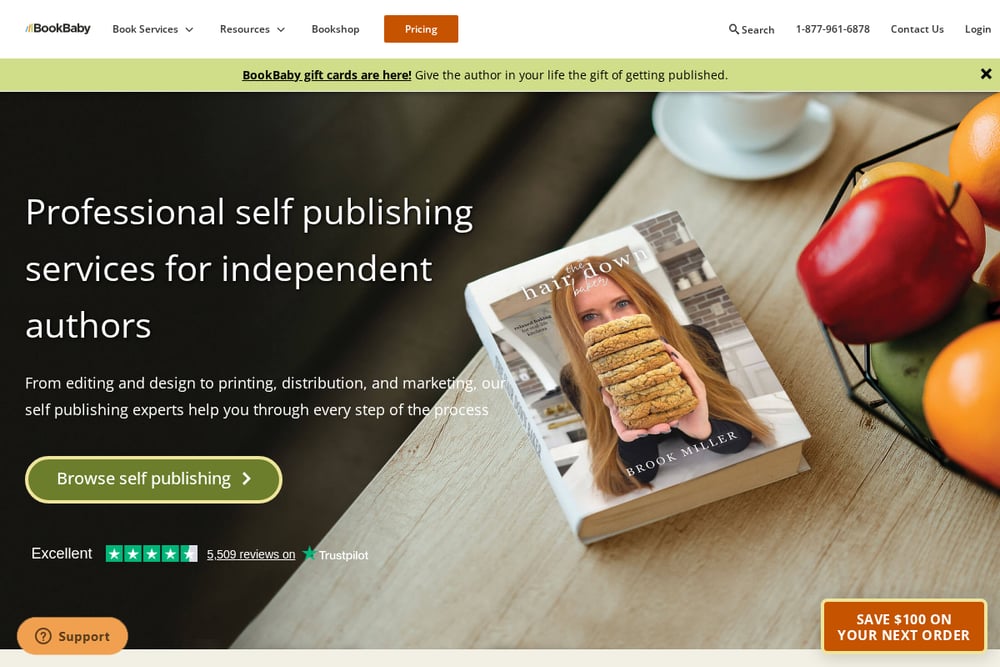 A screenshot of the BookBaby website.
BookBaby is the volume platform in this group. Interior formatting for printed books starts at $399, and the company layers on cover design, eBook conversion, printing, distribution, editing, and marketing services. If you want a known price and a predictable pipeline, this is the most straightforward option on the list.
BookBaby also offers templates, free guides, and a self-publishing catalog, which makes it a useful resource even before you buy anything. The tradeoff is customization. Platform-based formatting tends to follow established patterns, so unusual layouts or heavily illustrated interiors may hit limits.
You should also read the service tiers carefully. Formatting for print and formatting for eBooks are separate line items, and add-ons accumulate. Budget for the full package you actually need rather than the entry price.
BookBaby fits authors who value speed, fixed pricing, and an all-in-one ecosystem over bespoke craft. If your manuscript is straightforward and your timeline is short, it gets the job done.
How to Choose the Right Studio for Your Book
Start with your manuscript, not the vendor list. Is your interior simple prose, or does it carry images, tables, maps, and unusual structures? Simple books tolerate template-driven formatting. Complex books need a specialist who has solved those problems before.
Next, decide how much you want to manage. A boutique studio gives you one designer and deep craft attention. A full-service shop gives you one accountable team across editing, design, and print. A platform gives you speed and a fixed price. You cannot optimize for all three at once.
Then ask about process. Request sample spreads in your genre. Ask who handles revisions and how many rounds are included. Ask for a written scope with deliverables and dates. If a studio cannot answer those questions clearly, that is your answer.
Finally, match the studio's sensibility to your book. A literary experiment and a business paperback need different partners. The right studio will sound genuinely interested in your project, not just your deposit.
Where Automation Fits in Your Production Workflow
Automation will not design your interior, but it can remove the busywork around it. Set up a shared project folder with versioned manuscript files so your designer always works from the latest draft. Use a simple naming convention for rounds, such as draft-v1, draft-v2, and final.
Automate your proofing loop. Export a PDF, run a spell and consistency check, and log every correction in one tracked document rather than scattered emails. For print-ready files, keep a checklist that covers bleed, trim size, embedded fonts, and image resolution, and run it before every upload.
On the marketing side, schedule your launch emails and social posts in advance so production delays do not cascade into a silent release. Templates for metadata, ISBN records, and distribution uploads save hours and prevent errors.
The goal is to spend your attention on the book, not on file management. Let the systems handle the repetition.
The Bottom Line
There is no universal winner here, only the right fit for your manuscript. Paper + Oats suits authors who want craft-first interior design from a designer with deep genre range. Colophon & Co. is a new independent workshop with a literary bent, best approached through a direct conversation before you commit. Design for Books covers the full pipeline if you want one team from editing to print. Mayfly Design specializes in the hard interiors that break templates. BookBaby delivers speed and fixed pricing for straightforward projects.
Read the scope, ask for samples, and get deliverables in writing. Do that, and your pages will do their job: disappear behind the story.