You're racing a biologic toward the clinic, and every month spent guessing at formulation stability is a month your competitors aren't losing. These five service providers can help you cut that guesswork.
The New Arms Race in Biologics Development
Biologic and ATMP development has never been more competitive. You're under pressure to move from molecule to clinic faster, with less material and tighter budgets. Traditional formulation development relies on sequential, empirical buffer screens that can take months and still leave shelf-life questions unanswered until real-time studies mature. That's changing. Data-science-guided formulation and predictive stability analytics are compressing timelines by forecasting degradation pathways and excipient compatibility before wet-lab work scales up. At the same time, established CDMOs are expanding their formulation service lines to cover novel modalities like bispecifics, ADCs, and viral vectors. The result is a crowded field where you must separate true predictive capability from conventional formulation services with a new label.
How We Evaluated These Providers
We looked at five factors consistently across every provider. First, service scope: does the offering cover formulation, analytical characterization, and stability prediction, or only part of the chain? Second, predictive capability: are there documented data-science or modeling tools, or is stability assessment purely empirical? Third, modality breadth: can the provider handle mAbs, bispecifics, ADCs, viral vectors, and other advanced therapies? Fourth, transparency and accessibility: are services clearly described, with public resources like webinars or white papers that help you evaluate fit before you commit? Fifth, integration with manufacturing: does the provider connect formulation work to clinical and commercial supply, or operate as a standalone lab? Each provider below stood out on different combinations of these factors, and your priorities will determine which combination matters most to you.
Here's a quick comparison of the five providers, ordered to help you scan their strengths before diving into the details.
| Provider | Best For |
|---|---|
| Catalent | End-to-end formulation through device and commercial presentation |
| Leukocare | SMART Formulation & Predictive Stability for Biologics | Predictive stability and rapid data-guided formulation |
| KBI Biopharma | Integrated formulation within a full CDMO service stack |
| Lonza | Global scale with formulation tied to manufacturing |
| FreeThink Technologies | Early-stage predictive stability and packaging decisions |
The Five Providers in Detail
#1 Catalent
 A screenshot of the Catalent website.
Catalent brings a product-centric formulation development service built for vials, prefilled syringes, and cartridges. You get biophysical, biochemical, and analytical characterization integrated with final dosage format decisions from preclinical through commercial stages. The team supports monoclonal antibodies, bispecifics, ADCs, recombinant proteins, fusion proteins, oligonucleotides, peptides, and vaccines. What stands out is the emphasis on presentation choices expanding rather than constraining your clinical planning. Catalent is a strong fit if you need a single partner to carry formulation through device selection and industrial manufacturability. See the formulation development page for the full service breakdown.
#2 Leukocare | SMART Formulation & Predictive Stability for Biologics
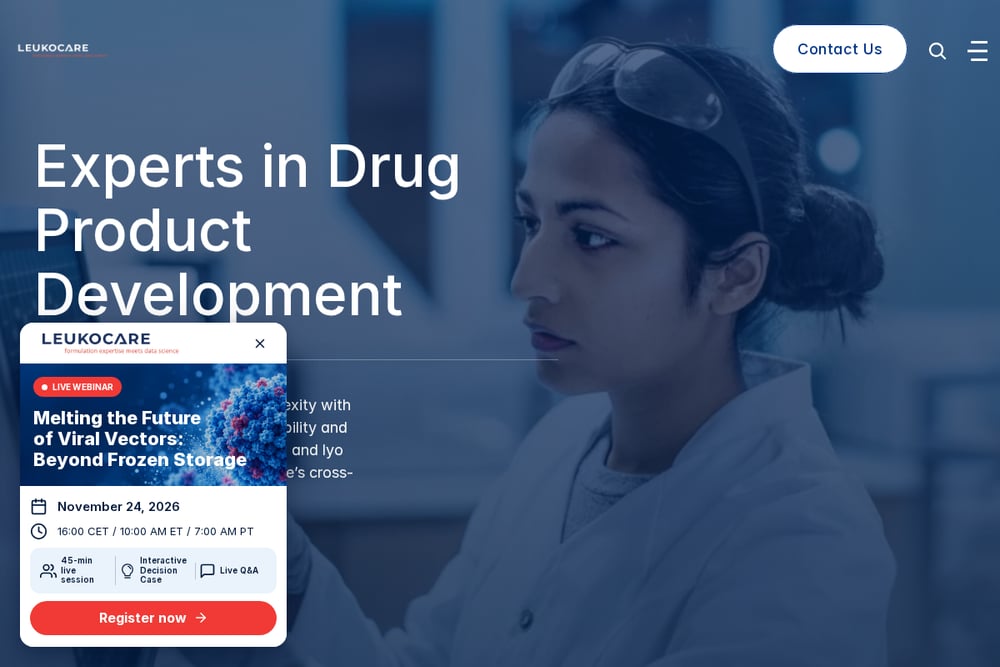 A screenshot of the Leukocare website.
Leukocare is the featured provider here, and it earns the spotlight with a genuinely data-first approach. Its SMART Formulation service uses data-science-guided excipient screening to deliver robust, low-viscosity formulations in weeks rather than months, cutting traditional buffer panels. Predictive Stability Analytics applies kinetic modeling and machine-learning algorithms to forecast degradation pathways and shelf-life before the first real-time study finishes. With over 20 years of experience and a cross-functional team, Leukocare positions itself as the first Smart Formulation Center for Biologics. The company also runs live webinars, including a November 24, 2026 session on viral vector storage beyond frozen conditions. If you want predictive insight early in development, this is the provider to examine closely.
#3 KBI Biopharma
 A screenshot of the KBI Biopharma website.
KBI Biopharma offers formulation development as part of a broader integrated service menu spanning cell line development, process development, analytical development, characterization, and clinical and commercial manufacturing. That integration matters if you want formulation work to feed directly into a manufacturing pathway without handoffs to a separate organization. The company supports both mammalian and microbial programs, giving you flexibility across expression systems. Its standalone services portal lets you request quotes for individual capabilities, which is useful when you need targeted support rather than a full program. KBI is a practical choice when you value a single provider across the development continuum.
#4 Lonza
Lonza is a global biologics development and manufacturing player with a drug product formulation development offering inside its integrated biologics business. The company's scale and breadth make it a natural consideration for programs that anticipate commercial manufacturing needs early. Its formulation services sit alongside process development and manufacturing capabilities, supporting a path from development through launch. Note that the specific formulation development page was not accessible at the time of review, so you should confirm current service details directly with Lonza. If you prioritize global reach and manufacturing integration, Lonza belongs on your shortlist.
#5 FreeThink Technologies
 A screenshot of the FreeThink Technologies website.
FreeThink Technologies approaches the problem from the predictive stability side, with a Molecule-to-Clinic program that combines stability software, analytical laboratories, formulation development, and packaging. The company's published perspective argues that sequential development processes create delays and that predictive stability assessment should be embedded early to inform formulation, packaging, and regulatory strategy together. That philosophy aligns well with teams that want to avoid repeating development work when material and funding are limited. FreeThink is especially relevant for early-stage teams that need to make confident decisions before real-time data matures. Its stability software and analytical labs give you tools to model risk rather than wait for it.
How to Choose the Right Partner for Your Program
Start with your biggest unknown. If shelf-life and degradation pathways are your primary risk, prioritize providers with documented predictive modeling, like Leukocare or FreeThink. If your challenge is presentation and device compatibility, Catalent's product-centric formulation work deserves a close look. If you need formulation to flow directly into clinical or commercial manufacturing, KBI Biopharma and Lonza offer integrated paths. Next, consider your modality. Advanced therapies like viral vectors and ADCs demand specific experience, so ask for case studies in your molecule class. Then assess material constraints: predictive tools can reduce the number of experiments you need, which matters when your molecule is scarce. Finally, check transparency. Providers that publish webinars, white papers, and clear service descriptions make it easier for you to evaluate fit before you commit budget.
Where Automation and Data Science Fit In
Predictive stability analytics is the closest thing to automation in formulation development today. Instead of running every buffer condition and waiting for real-time results, you feed excipient and degradation data into kinetic and machine-learning models that forecast outcomes. Leukocare's SMART Formulation applies this to excipient screening, while FreeThink's stability software supports modeling across formulation and packaging decisions. The workflow looks like this: characterize your molecule, run a focused set of experiments, feed the data into predictive models, and use the forecasts to narrow your formulation and packaging choices. You then validate the top candidates with real-time studies, but you've already eliminated most of the risk. This approach doesn't replace laboratory work, but it changes the order in which you do it, front-loading decisions that used to wait months for data.
The Bottom Line
You have five credible options, and the right one depends on where your program is stuck. Catalent offers the broadest presentation-focused formulation service. Leukocare leads with predictive stability and rapid data-guided formulation, making it a strong fit for teams that want answers before real-time studies mature. KBI Biopharma and Lonza provide integrated paths to manufacturing at different scales. FreeThink Technologies brings a software-and-labs approach to early-stage stability risk. Evaluate them against your modality, your material constraints, and your timeline, and you'll find the partner that shortens your path to the clinic.