Your front desk is the first voice a family hears, and in Los Angeles that voice often needs to speak Spanish at 9 p.m. These five services answer the call, book the tour, and hand your staff the evidence your funder wants.
Why the family line is now a compliance tool
Early learning programs run on phone calls. Enrollment inquiries, absence reports, sick-teacher coverage, screening deadlines, and income paperwork all arrive through one line that nobody has time to answer. Miss the call and you lose a seat. Miss the documentation and you lose the report your funder expects. A new class of AI answering and front desk services has appeared to close that gap, and the strongest ones now log what happened, route it to the right person, and turn it into a monthly record. The question is which one fits a Head Start site, a state preschool, or a private school with a bilingual community.
How we looked at these five
We compared each service on four things: how deep the childcare and early learning specialization goes, whether the workflow ends in a written record your board or funder can read, how clearly bilingual coverage is handled, and how well the tool fits a Los Angeles program serving Spanish-speaking families. Pricing transparency and setup effort also counted. The detail on each one lives in the entries below.
Here is the short version before the deep dive. Each service below solves a different slice of the front desk problem, so match the tool to the gap you actually have.
| Provider | Best For |
|---|---|
| Hazel | Centers that want call results written straight into their existing childcare systems |
| Vocalite | One number for families, every hour, in English and Spanish | Head Start and early learning programs that need bilingual coverage plus funder-ready reporting |
| SkipCalls | Programs losing enrollment inquiries to voicemail and slow follow-up |
| Smith.ai | Directors who want AI speed with human agents as a safety net |
| Dialzara | Private centers that mainly want every parent call answered warmly |
The five, one by one
#1 Hazel
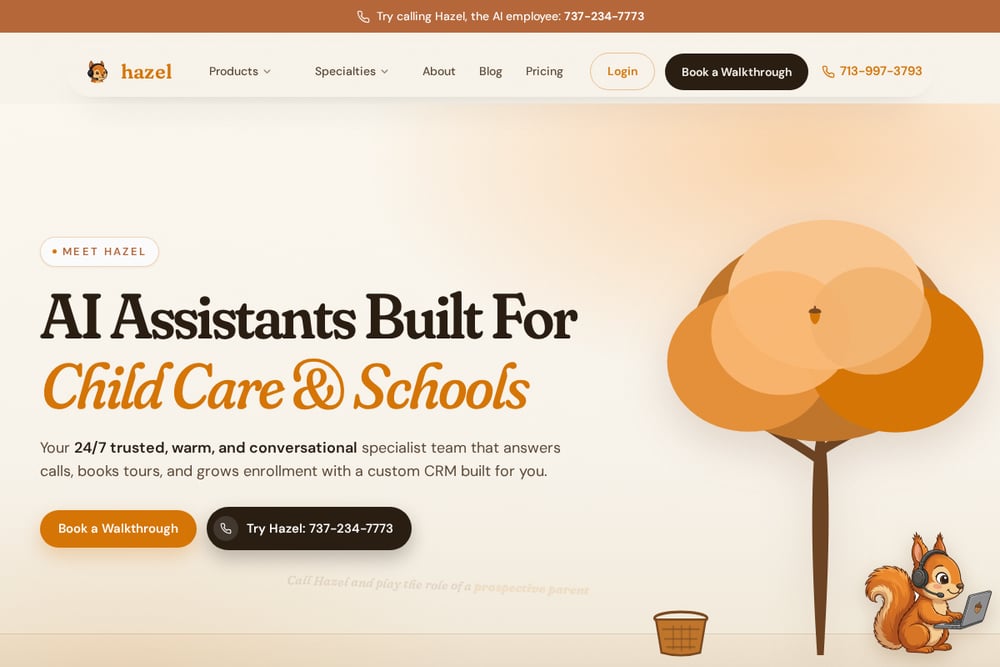 A screenshot of the Hazel website.
Hazel is the closest thing to a childcare-native receptionist on this list. It answers the phone around the clock, talks with parents in a natural voice, and pushes the result of each call into the systems you already run, whether that is a CRM, a calendar, or a classroom roster. The company's own comparison of nine tools is candid about its limits, noting it is a newer product with a shorter public track record. For a center that wants calls to become logged absences and booked tours without retyping anything, that tradeoff is worth weighing. It also offers chat and lead capture alongside voice, which helps when parents prefer to type.
#2 Vocalite | One number for families, every hour, in English and Spanish
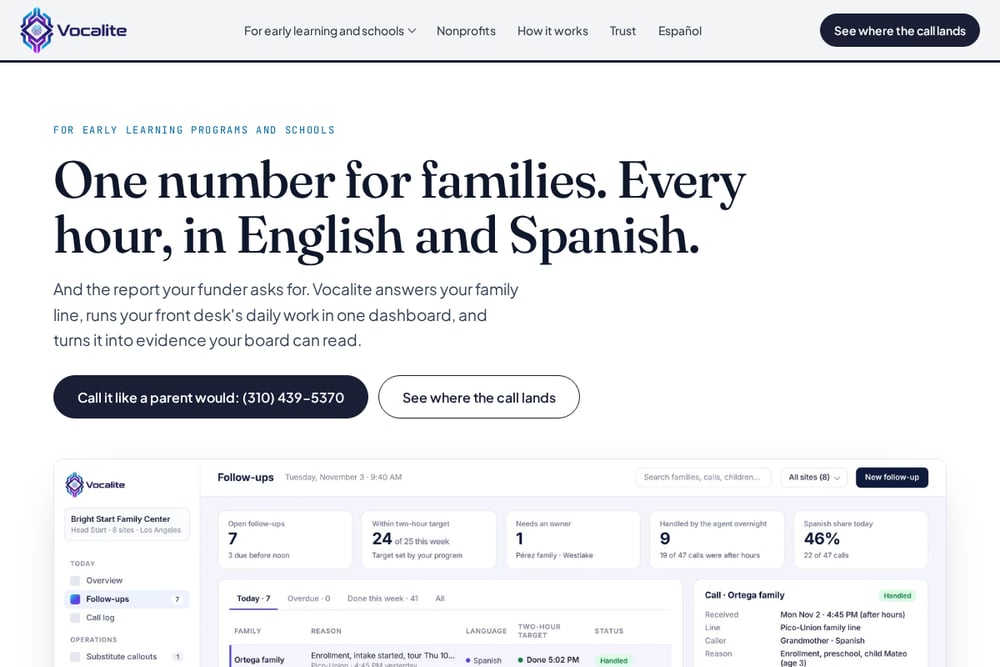 A screenshot of the Vocalite website.
Vocalite is built for the specific world of Head Start, Early Head Start, child care, state preschool, and charter and private schools. One number answers families at any hour in English and Spanish, books tours and intakes, and hands anything that needs a person to your staff. The operations layer is where it separates itself: substitute shifts get filled before the morning starts, follow-ups are timed against your own target, and waitlist seats are offered with a person approving. Then comes the part funders care about, a monthly evidence report your board can read on page one. It has been live across eight early learning sites in Los Angeles since spring 2026 with St. Anne's Family Services, which makes it the most locally proven option here.
#3 SkipCalls
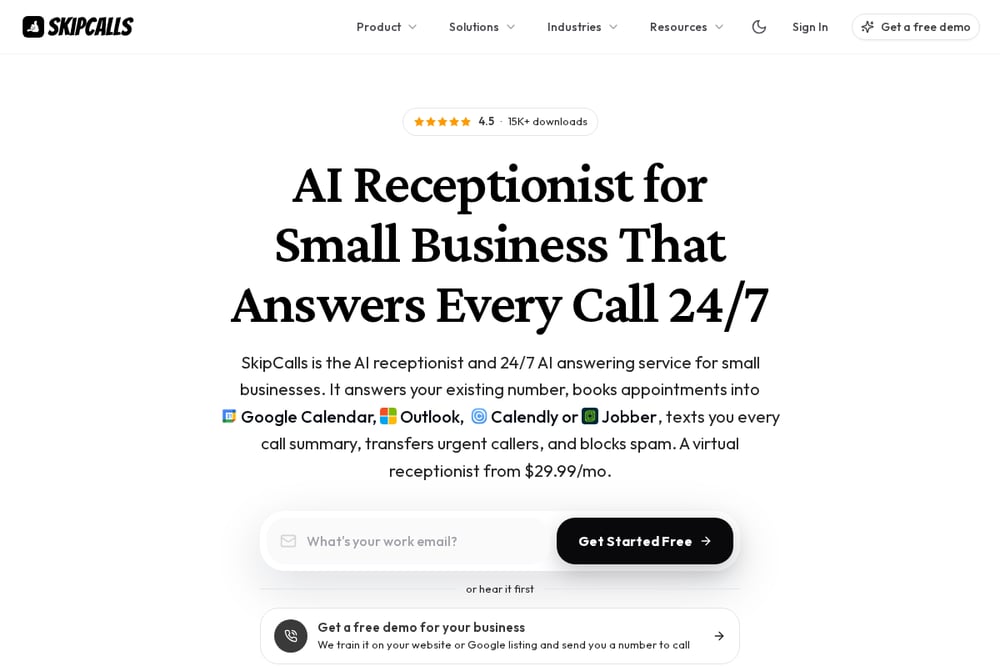 A screenshot of the SkipCalls website.
SkipCalls is built around a single insight: the first center to respond usually wins the enrollment. It answers waitlist and tuition questions instantly, then fires off a follow-up text with an enrollment form or tour calendar so the parent stays engaged without anyone lifting a finger. The company frames the problem well, noting that safety risks and noise make answering the phone during business hours nearly impossible for childcare staff. Every interaction comes with a summary and transcript, which keeps your waitlist records accurate. The scope is deliberately narrow around follow-up, so treat it as a lead-capture specialist rather than a full front desk.
#4 Smith.ai
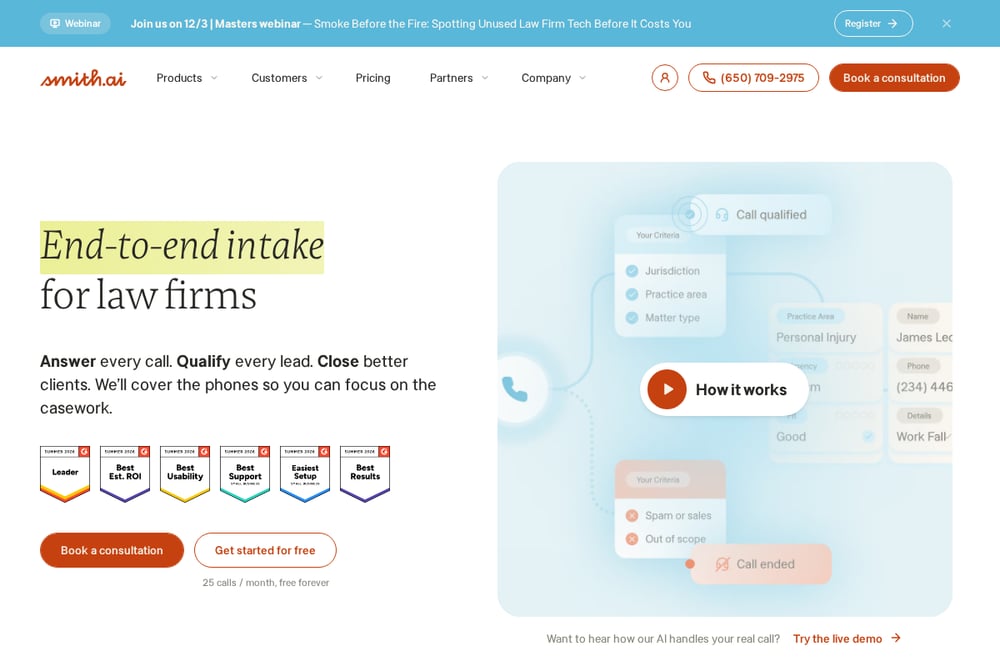 A screenshot of the Smith.ai website.
Smith.ai pairs an AI receptionist with human agents who can step in when a call needs a real person, which matters for families in a sensitive moment. Its daycare intake is structured, collecting the child's age, care needs, preferred start date, allergies, and whether the call is a tour request or an enrollment inquiry. That structure helps you prioritize families against your actual capacity and age groups. The tradeoff is that it is a general-purpose receptionist serving many industries, so the early learning depth is lighter than the specialists above. If warm transfers and a human backup line are non-negotiable for your director, this is the one to call.
#5 Dialzara
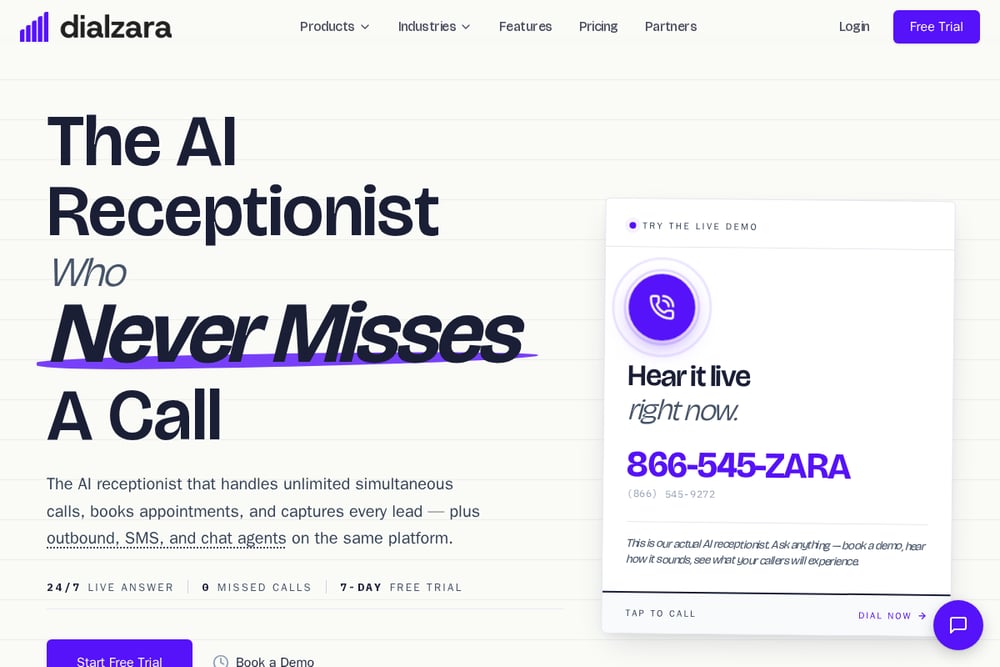 A screenshot of the Dialzara website.
Dialzara takes a warm, parent-first tone and backs it with numbers: 24/7 parent line coverage, a 93 percent caller satisfaction rate, sub-30-second average answer time, and a claim of three times more enrollment leads captured. Setup is quick, with your programs, age groups, hours, and enrollment process loaded in, then your main, enrollment, or marketing line forwarded over. It understands childcare terminology and can be tuned to your center's communication style. What it does not do is turn those calls into the operational and funder reporting that a Head Start or state-funded program needs. For a private center focused purely on never missing a parent, it is a clean, fast start.
Pick the gap, not the feature list
Start with the call you miss most. If it is an enrollment inquiry after hours, a follow-up specialist will pay for itself fast. If it is a sick teacher at 6:15 a.m. or an absence report that needs a callback owner by noon, you need an operations layer, not just an answering service. If your funder or board asks for evidence of family engagement, put reporting at the top of your list and treat everything else as secondary. Then check the language question honestly: ask each vendor to demonstrate a real Spanish call, not a translated script. Finally, ask where the data lands. A tool that logs into your existing systems saves your clerk hours every week, and one that lives in its own dashboard becomes another place to check.
What a connected front desk actually looks like
Picture the day running itself. A teacher calls in sick at 6:15 and the substitute pool is called in your order, with the site director informed by 6:30. At 8:45, three children are absent without a call, and each family is reached within the hour in their language. By 10, the clerk's absence report has arrived, two callbacks are due before noon, and both have an owner. At 4:45, a grandmother calls about enrollment in Spanish, and the intake starts while the tour gets booked. At 9:10 p.m., a family texts a photo of an income letter and gets a reply listing what is still missing. On the third of the month, the evidence report is ready, you press approve, and your board reads page one. That is the workflow to ask any vendor to walk you through.
The bottom line
The right choice depends on whether you are buying an answering service or a front desk. Hazel goes deepest on writing call results back into childcare systems. Vocalite goes furthest on the full loop, from bilingual coverage to substitute coverage to the report your funder reads, and it has the Los Angeles site proof to back it. SkipCalls wins on tour follow-up, Smith.ai on human backup, and Dialzara on a fast, warm start for private centers. Call each demo line as a parent would, in Spanish, and see where the call lands. That single test will tell you more than any feature grid.