You want to understand your personality without paying for a subscription or handing over your email. These five platforms make the Big Five model accessible, and each one takes a slightly different angle on self-reflection.
The Big Five test landscape in 2026
The Big Five, also called OCEAN, has become the default personality framework online because it is backed by decades of academic research rather than pop-psychology typing. Most free tests now draw on open item pools like the IPIP, which means the questions themselves are rarely the differentiator. What separates platforms is how they present results, whether they support comparison with other people, and how they handle privacy and pricing. You will find everything from bare-bones research tools to polished consumer products with paid reports.
How these platforms were evaluated
Each platform was assessed on test depth and scientific grounding, clarity of results and interpretation, privacy and account requirements, pricing transparency, and extras like comparison tools, facet breakdowns, and multilingual support. The goal was to reflect what a real user weighing self-reflection options would care about, not to crown a single winner.
Here is a quick look at how the five platforms compare before diving into the details.
| Provider | Best For |
|---|---|
| Open-Source Psychometrics Project | Research-minded users who want the raw instrument |
| TraitCove — Free Big Five Personality Test | Everyday self-reflection with a friend or partner |
| Big Five Personality Test | Beginners who like archetype-style results |
| Big Five Test | Teams, couples, and group comparisons |
| SeeMyPersonality | Instant results with no email required |
The five platforms in detail
#1 Open-Source Psychometrics Project
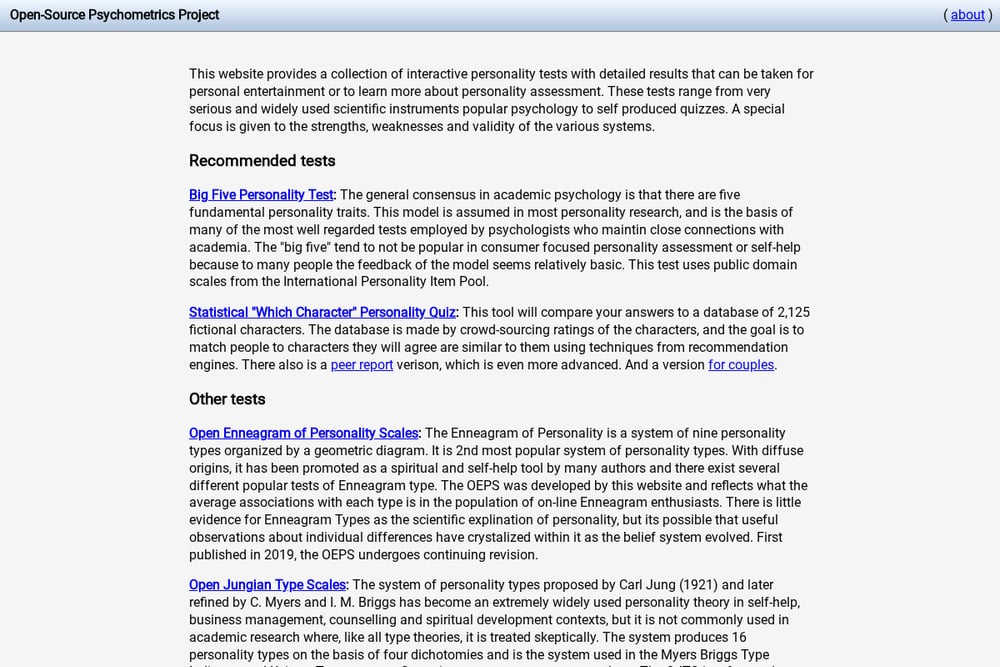 A screenshot of the Open-Source Psychometrics Project website.
This is the academic anchor of the category. The Open-Source Psychometrics Project runs the classic 50-item IPIP Big-Five Factor Markers, developed by Goldberg in 1992, and explains the factor-analytic research behind the model in plain language. You rate statements on a five-point scale and finish in roughly three to eight minutes. Responses are recorded anonymously and may be used for research, which is worth knowing before you start. There is no polish here, but the transparency and research pedigree are hard to beat.
#2 TraitCove — Free Big Five Personality Test
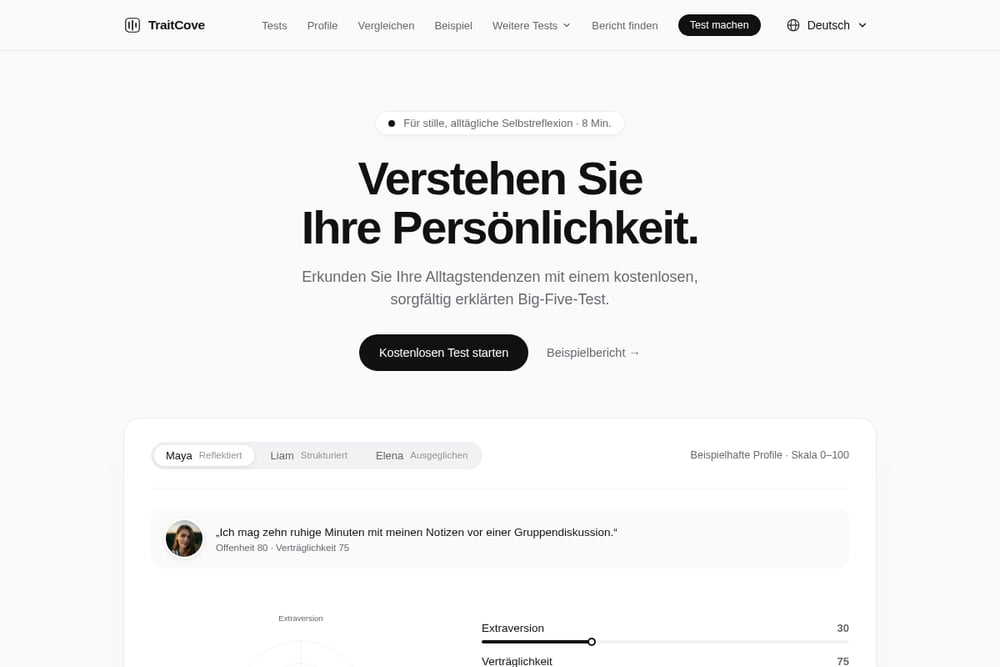 A screenshot of the TraitCove — Free Big Five Personality Test website.
TraitCove positions itself for quiet, everyday self-reflection, and the experience reflects that. The free 50-question test gives you five trait scores on a 0–100 scale plus a shareable profile nickname like The Quiet Explorer or The Warm Planner, with no account required. You can send a private invite to a partner or friend and see a side-by-side comparison once they finish, and a 120-statement option splits each trait into six facets for 30 in total. An optional personal insight report starts at $2.99 once with no subscription, covering strengths, blind spots, and three experiments for the week ahead. The site also supports more than 20 languages and offers a just-for-fun crush match quiz.
#3 Big Five Personality Test
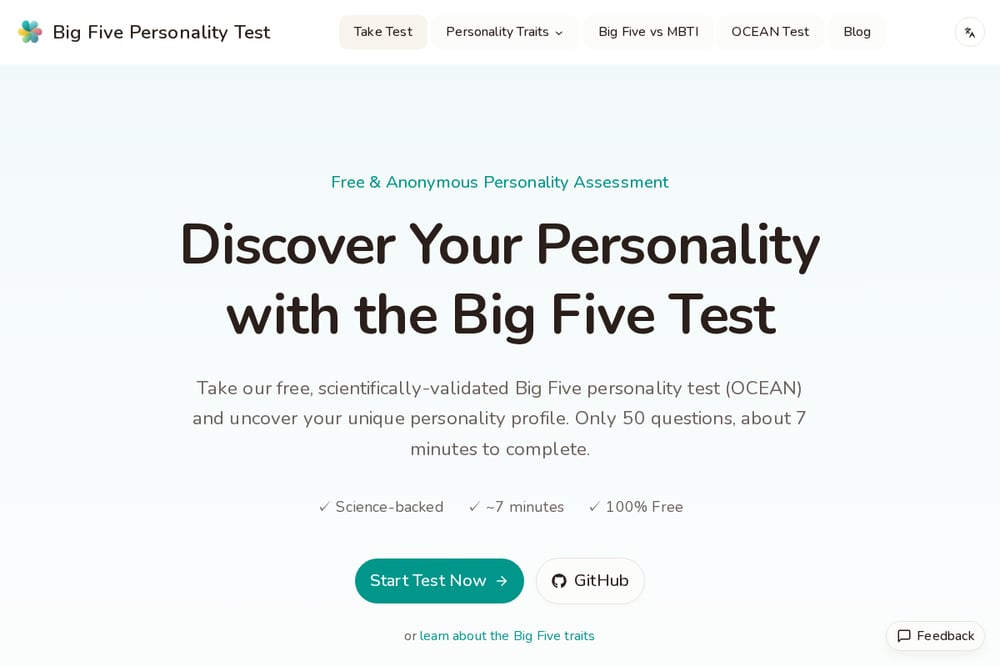 A screenshot of the Big Five Personality Test website.
Big Five Personality Test leans into playful framing without sacrificing the science. It uses the IPIP-50 questionnaire, takes about seven minutes, and requires no registration, with responses processed locally rather than stored on its servers. The hook is 24 archetypes, from The Explorer to The Night Owl, which turn OCEAN dimensions into memorable characters. A 120-question in-depth version unlocks all 30 facets, and there is a free, ad-free classroom version for teachers. It is a friendly entry point if you find raw score charts a little dry.
#4 Big Five Test
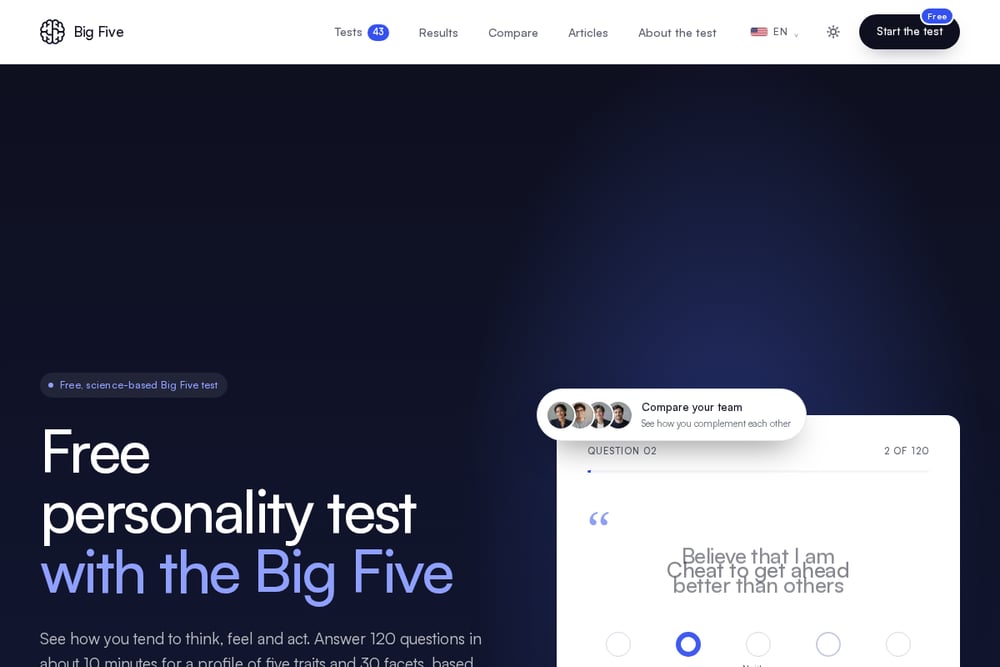 A screenshot of the Big Five Test website.
Big Five Test is built around the open IPIP-NEO model and offers 120 questions covering five traits and 30 facets in about ten minutes, free and with no sign-up. Its standout feature is comparison at scale: you can invite a partner, family members, friends, or colleagues, and the results highlight similarities, differences, and concrete conversation topics. Group links support up to 100 people, which makes it unusually practical for teams and classrooms. The project is open source and available in more than 40 languages, with over eight million tests completed.
#5 SeeMyPersonality
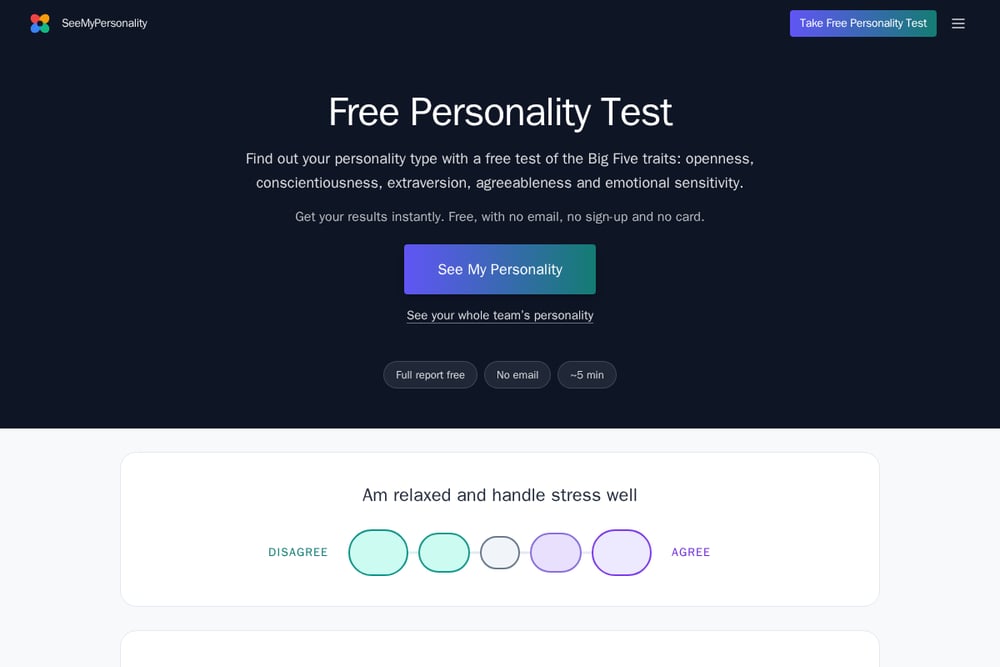 A screenshot of the SeeMyPersonality website.
SeeMyPersonality focuses on speed and zero friction. You answer 60 short statements in about five minutes, based on the BFI-2, and get instant results with no email, no sign-up, and no card. The free report includes a score out of 100 for each trait plus the 15 facets beneath them, along with tabs for strengths, relationships, career, resilience, and leadership. It also hosts a wider library of assessments, from career and team tests to attachment style and DISC, if you want to branch out. It is the easiest option here to try on a whim.
How to pick the right platform for you
Start with your goal. If you want a quick snapshot with zero friction, SeeMyPersonality or Big Five Personality Test will get you there in minutes. If you care about the underlying research and want the standard instrument, the Open-Source Psychometrics Project is the most transparent choice. If self-reflection is a shared activity, TraitCove and Big Five Test both make comparison easy, though Big Five Test scales further for groups. Consider privacy too: some platforms process answers locally, while others record responses anonymously for research. Finally, check pricing before you invest emotionally in a report, since free scores and paid deep dives are common across the category.
Putting your results to work
A personality score is only useful if it changes something. Take one test, note your two most extreme traits, and set a simple weekly check-in to see how those tendencies show up at work or at home. If you use a comparison tool, schedule a short conversation with your partner or teammate about the largest gap and one practical adjustment each of you can make. Pair your results with a habit tracker so the experiments suggested in paid reports actually get tested. Revisit the test in six to twelve months to spot shifts rather than treating your profile as fixed.
The bottom line
The Big Five is well served online in 2026, and the right platform depends on whether you value research purity, playful framing, group comparison, or instant access. TraitCove sits comfortably in the middle for everyday reflection with someone close to you, while the Open-Source Psychometrics Project remains the reference point for the instrument itself. Try one free test this week, read your results honestly, and let the insight inform one small change rather than a whole personality overhaul.