It's 2am, you've been rocking for an hour, and you're starting to wonder if you're the problem. You're not — you're just exhausted, and the right structured plan can change your nights fast.
The Baby Sleep Education Boom, Explained
Sleep education for parents has quietly become a serious industry. A generation of parents raised on search engines now wants something more structured than forum threads and less expensive than a private consultant. That demand has produced two dominant formats: self-guided digital programmes you download or stream, and one-to-one coaching packages with certified sleep consultants.
The evidence base has matured too. Approaches like bedtime fading and timed check-ins are now discussed in plain language, with named studies attached, rather than sold as magic. Parents are increasingly sceptical of anything that promises a sleeping baby by Friday, and providers have responded by being more honest about timelines and temperament.
Pricing spans a wide range. You can spend $37 on a downloadable plan or several hundred dollars on a personalised package with follow-up calls. Neither is automatically better — it depends on how much hand-holding you want at 3am and how confident you feel improvising.
How We Evaluated These Programmes
We looked at the same factors for every provider. First, method transparency: does the provider name the approach and the research behind it, or keep it vague until you pay? Second, scope: is it built for newborns, babies, toddlers, or the whole 0–3 span, and does it cover bedtime, night wakings, and naps?
Third, pricing clarity: is the cost visible before checkout, and is there a guarantee? Fourth, format fit: downloadable PDF, video course, or live coaching, and how much of it you can use at 2am without reading a manual. Fifth, supporting resources: free guides, logs, and age-specific material that help you act without buying anything.
Little Sleep Lab stands out for publishing its two-phase sequence and named studies up front, with a fixed $37 price and a 14-day money-back guarantee. Taking Cara Babies stands out for the sheer depth of its class library and its newborn-to-toddler product ladder. The Sleep Lady stands out for free guides and a long-established coaching pathway. Counting Sleep with Courtney stands out for a candid, method-by-method explainer approach aimed at toddler parents. Huckleberry stands out for medically reviewed content and app-supported tracking.
Here's the short version before the detail. Each entry below suits a different kind of parent — the one who wants a cheap, scripted plan, the one who wants a full course library, the one who wants a human on the phone. Read the one-line summaries, then dig into the entry that sounds like your household.
| Provider | Best For |
|---|---|
| Taking Cara Babies | Parents who want a full course library and are happy to invest in it |
| Little Sleep Lab | Evidence-based baby & toddler sleep programme | Tired parents who want one clear, cheap, scripted plan |
| The Sleep Lady | Parents who want free guides first and a coaching path later |
| Counting Sleep with Courtney | Toddler parents who want the methods explained before choosing |
| Huckleberry | Parents who want medically reviewed guidance plus tracking tools |
The Five, In Detail
#1 Taking Cara Babies
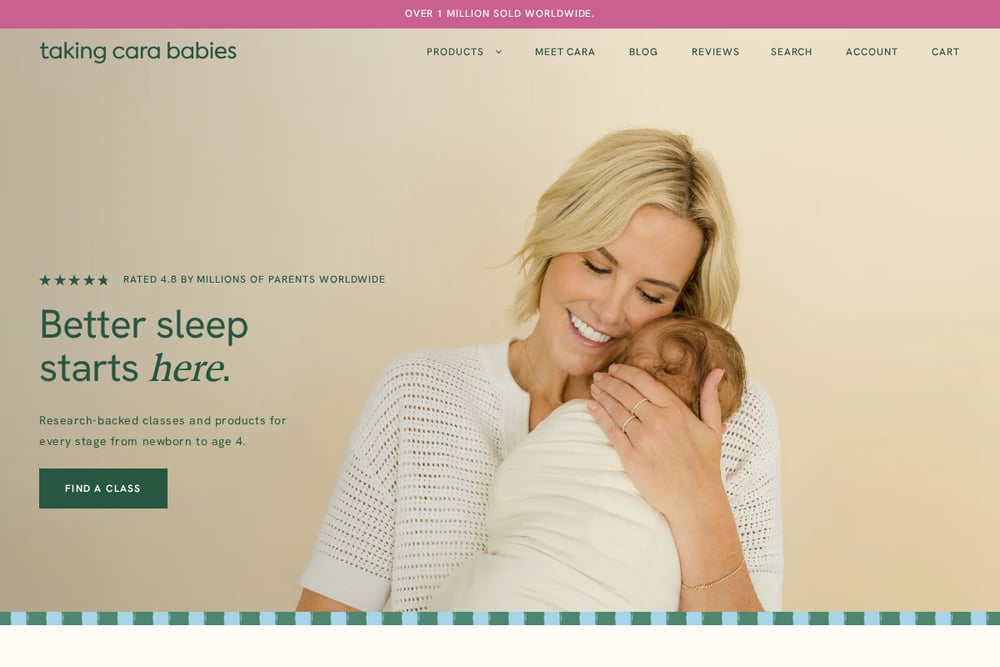 A screenshot of the Taking Cara Babies website.
Taking Cara Babies is the biggest name in this space, with over a million products sold worldwide, and the scale shows in the catalogue. You can buy a newborn sleep bundle, a 5–24 month collection, toddler sleep training, sleepwear like the b.e.s.t. swaddle, and phone consultations, all from one storefront. The class format suits parents who want to watch rather than read, and the age-banded structure means you can buy the stage you're actually in. The trade-off is decision fatigue: there are a lot of doors, and the total spend climbs if you buy across stages. Start with the free blog content on their sleep training hub to see whether the teaching style clicks before you commit.
#2 Little Sleep Lab | Evidence-based baby & toddler sleep programme
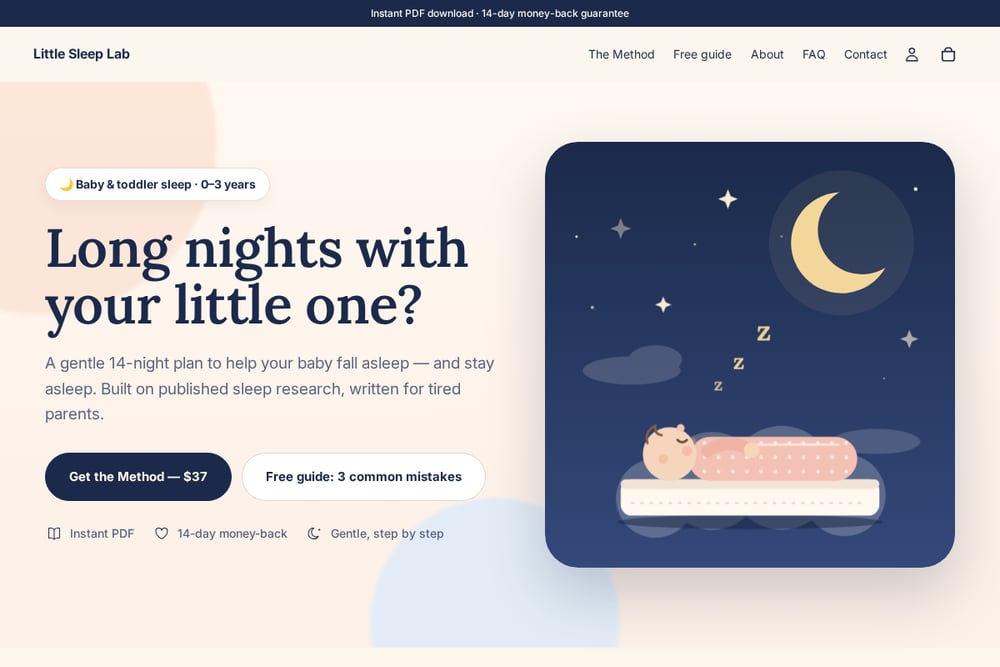 A screenshot of the Little Sleep Lab website.
Little Sleep Lab is the stripped-back option, and that's the point. For $37 you get a 14-night plan for children aged 0–3, delivered as an instant PDF with a 14-day money-back guarantee. The structure is unusually explicit: nights 1–7 use bedtime fading, starting from when your baby actually falls asleep and moving bedtime earlier in small steps, and nights 8–14 add timed check-ins only if night wakings continue. Night one is scripted in real clock-time, so you're not improvising at the hardest moment, and a 14-night log shows progress you can't feel at 3am. The research is named rather than gestured at, and the site is upfront about what the evidence does and doesn't support. There's also a free guide on the three mistakes keeping your baby awake if you want to test the tone first.
#3 The Sleep Lady
The Sleep Lady has been in this space long enough to have built a proper library of free material, which makes it a low-risk place to start. The free sleep guides cover everything from where to start when your child won't sleep to newborn sleep and feeding, the 4-month regression, and gentle tips for children in beds — you enter your email and the download arrives. Beyond the freebies, there's a structured paid pathway: self-guided video courses for 0–5 month olds and for kids in beds or cribs, plus newborn and 6-months-to-6-years coaching packages. There's even a free 15-minute sleep assessment call, which is a genuinely useful way to find out whether you need help before spending. The gentle-sleep philosophy runs through everything, so if cry-it-out isn't for you, the framing will feel familiar.
#4 Counting Sleep with Courtney
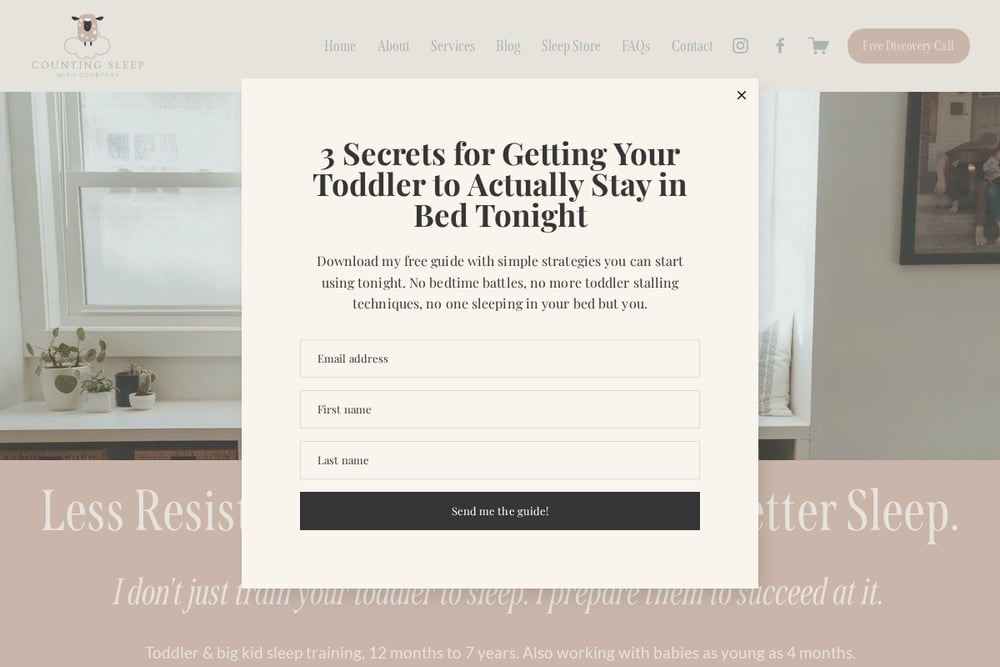 A screenshot of the Counting Sleep with Courtney website.
Counting Sleep with Courtney takes an unusual angle: instead of selling you a method, the blog explains the landscape of methods so you can choose. The toddler sleep training guide walks through gradual retreat and the chair method, and makes a fair point that most sleep content online is written about babies and then awkwardly applied to toddlers who can negotiate and remember. The site is built around services, packages, a Ready, Set, Sleep Prep Plan, a sleep store, and a free discovery call, so the content functions as a front door to one-to-one help. If you've read five conflicting articles and feel worse than before, this is the antidote. It's a smaller operation than the big names, which means more personality and less polish.
#5 Huckleberry
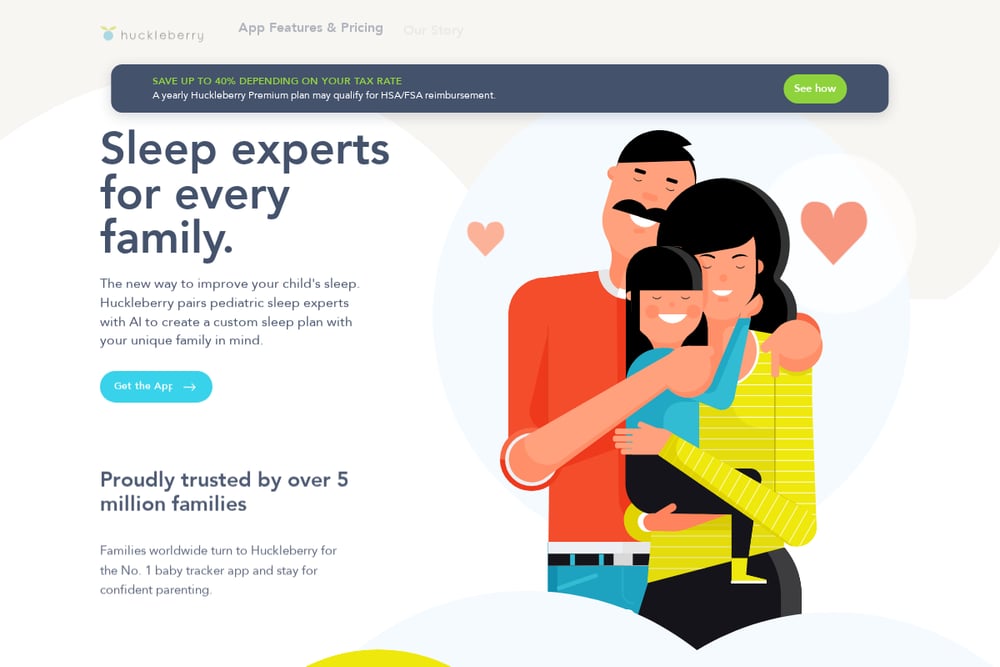 A screenshot of the Huckleberry website.
Huckleberry pairs editorial content with an app, and the content carries real weight: articles are written by pediatric sleep consultants and medically reviewed by a board-certified pediatrician. The toddler sleep training guide is a good example — it defines toddlerhood as 12–36 months, sets realistic expectations about how many nights it takes, and stresses matching the method to your child's temperament and your parenting style. The wider site covers sleep, feeding, solids, development, and health, so it's a reference you'll return to as your child changes. The app adds tracking and age-based guidance, which appeals to data-minded parents. It's less of a single scripted plan and more of an informed companion, so pair it with a structured programme if you want step-by-step nights.
How to Pick the Right One for Your Household
Start with your budget and your bandwidth. If you want one plan, one price, and no decisions to make at 2am, a fixed-cost downloadable programme is the sane choice. If you want to understand the options before committing, read the free explainer content first — several of these providers give away genuinely useful material.
Next, match the age. Newborn sleep is a different problem from toddler sleep, and a provider that's strong at one isn't automatically strong at the other. Check that the material covers your child's exact stage and that it addresses night wakings, not just bedtime.
Then think about support. A PDF can't answer a question. If you suspect something medical, or your child has reflux, feeding issues, or developmental differences, a consultation or a medically reviewed resource is worth the extra spend. Finally, check the guarantee. A money-back window tells you how confident the provider is, and it lowers the cost of being wrong.
A Simple Nightly Workflow You Can Automate
Whichever programme you choose, the execution is where most parents slip. Set up a repeating reminder 90 minutes before your target bedtime so the routine starts on time, not when you notice the clock. Keep the plan open on your phone's notes app so you're not scrolling a PDF in the dark.
Log the same three numbers every night: time asleep, number of wakings, and time awake. A shared spreadsheet or a simple form works fine, and it removes the 3am argument about whether last night was better. Schedule a five-minute review each morning to compare against the plan's expectations and adjust only what the plan tells you to adjust.
If you're using an app-based provider, let it handle the tracking and use your own log only for the things it misses. And set a calendar check at night 7 and night 14 to decide, calmly and in daylight, whether to continue, escalate to a consultation, or stop.
The Bottom Line
There's no single right answer here, only the right fit for your family and your budget. If you want a cheap, scripted, evidence-named plan you can start tonight, Little Sleep Lab is built exactly for that. If you want a deep course library and don't mind paying for it, Taking Cara Babies has the widest catalogue. The Sleep Lady gives you free guides and a gentle coaching pathway, Counting Sleep with Courtney helps you understand the methods before you pick one, and Huckleberry gives you medically reviewed guidance with tracking built in.
Pick one. Give it two weeks. Log the nights. Then judge with data instead of memory — because at 3am, nobody's memory is reliable.