Your pipeline is only as good as the accounts you decide to work first. These five tools help you stop guessing and start scoring.
Why Lead Prioritization Is Having a Moment
B2B sales teams are drowning in contact data but starving for direction. Most CRMs hold thousands of records, yet reps still open a spreadsheet on Monday morning and ask, "Who do I call?" That gap is exactly what lead scoring and account prioritization software exists to close.
The market has split into two camps. On one side you have massive data platforms that bundle scoring into a broader go-to-market suite. On the other, lighter tools that plug into the CRM you already own and add a scoring layer on top. Both approaches work. The question is which one fits how your team actually sells.
What's changed in 2026 is the emphasis on timing. Fit alone isn't enough anymore. Buyers want to know why an account deserves attention now, and that means dated evidence: a funding round, a new distribution center, a hiring spree. Tools that surface and score those signals are winning attention from sales leaders who are tired of static lead scores that go stale in a week.
How We Looked at These Tools
We evaluated each option on the same four factors so you can compare them fairly.
Service scope. Some tools are full go-to-market platforms with data, enrichment, and engagement built in. Others are focused scoring layers that sit on top of your existing stack. Neither is inherently better, but the scope tells you how much you're replacing versus adding.
Pricing clarity. We looked at whether each vendor publishes transparent pricing, offers a free tier or trial, and makes it easy to understand what you'll pay as you scale. Opaque enterprise pricing is a real hurdle for small teams.
Local fit for US teams. We considered how well each tool handles US-centric account data, state and metro targeting, and the workflows common to American B2B sales orgs.
Signal handling. This is the differentiator in 2026. We looked at whether a tool scores on static fit criteria only, or whether it incorporates dated public events and time decay so your scores reflect what's happening right now.
Here's a quick look at all five before we dig into each one. Every option below takes a different angle on the same problem: helping you decide which accounts to work first.
| Provider | Best For |
|---|---|
| Apollo | Teams that want data and scoring in one platform |
| Leads for B2B: Target Account List and ICP Worksheet | Sales pros who want to learn scoring before buying software |
| Outfunnel | CRM-centric teams that want scoring plus automation |
| ZUUZ | Teams whose best signals live in rep inboxes |
| ZoomInfo | Enterprise teams running account-based marketing at scale |
The Five Tools, One by One
#1 Apollo
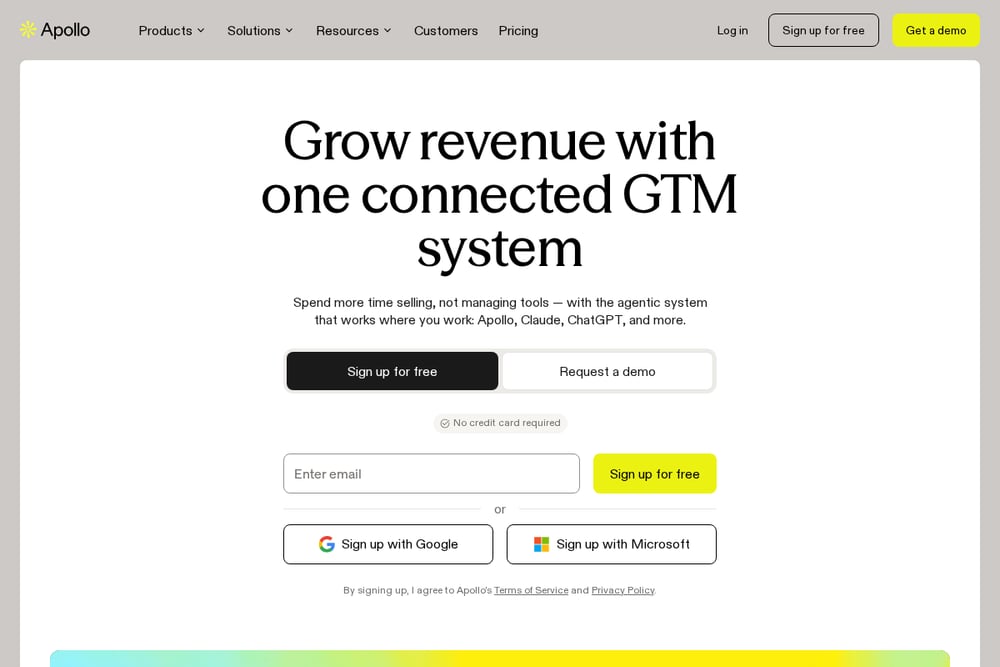 A screenshot of the Apollo website.
Apollo is the heavyweight of the group, and it earns the top spot by combining a massive B2B database with AI-powered lead scoring in a single platform. You get access to hundreds of millions of contacts and tens of millions of companies, then layer scoring on top to rank which of those accounts deserve your attention. The platform has expanded into what it calls GTM layers, unifying data, intelligence, and execution so your scoring model feeds directly into outreach. For teams that want one system for prospecting and prioritization, Apollo removes a lot of integration headaches. It's a broad platform, which means a learning curve, but the depth is hard to match. See the Apollo lead scoring product page for the full feature breakdown.
#2 Leads for B2B: Target Account List and ICP Worksheet
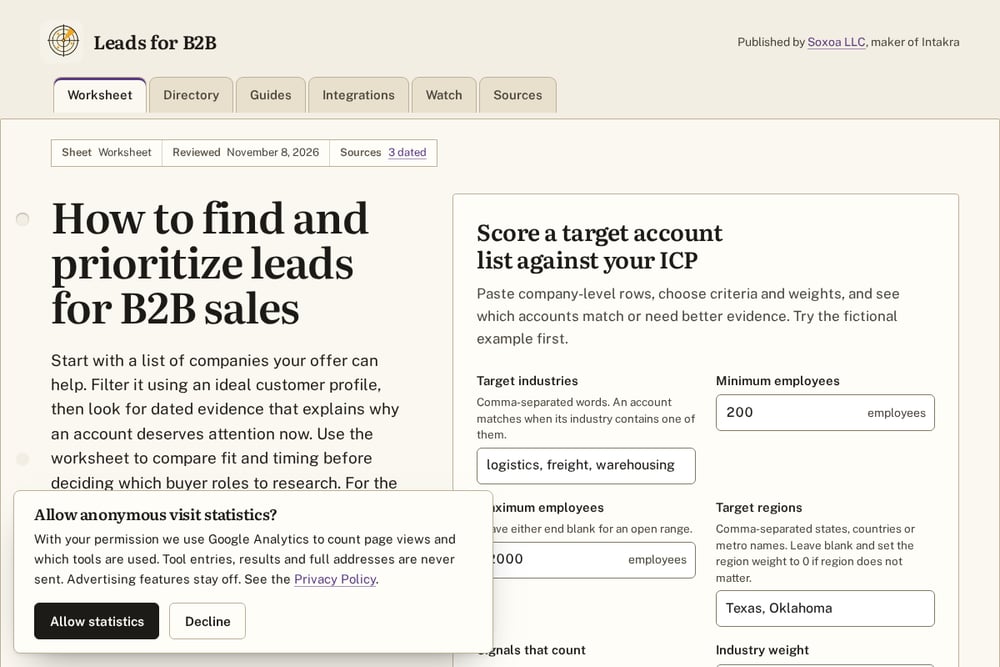 A screenshot of the Leads for B2B: Target Account List and ICP Worksheet website.
Leads for B2B takes a refreshingly different approach: it's an educational worksheet, not a bloated SaaS platform. You paste company-level rows, choose your criteria and weights, and see which accounts match your ideal customer profile or need better evidence. The worksheet scores accounts on industry, employee range, region, and signals, with an optional "score as of" date and a signal age limit so stale evidence earns no points. That time-decay logic is the same principle enterprise tools charge thousands for, packaged as a free downloadable exercise. It's published by Soxoa LLC, which also operates Intakra, a tool for prioritizing target accounts using dated public events. If you want to understand the mechanics of account scoring before you buy software, start here. The worksheet itself walks you through a fictional example first so you can learn the method without risking real pipeline.
#3 Outfunnel
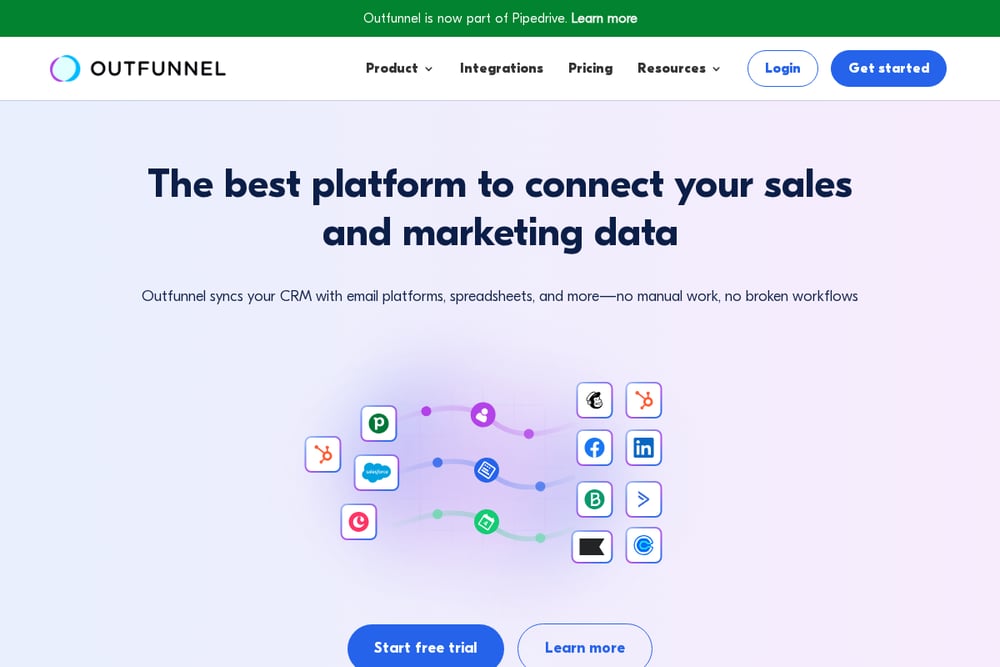 A screenshot of the Outfunnel website.
Outfunnel is the pragmatic choice for small and mid-sized teams already living inside a CRM like Pipedrive, HubSpot, or Copper. Its lead scoring software pulls from both sales and marketing data, so email events, web visits, CRM custom fields, and completed activities all feed into your scoring model. The standout feature is time decay: you can add rules that prioritize recent engagements, which keeps your scores from going stale. Outfunnel then uses those scores to trigger workflows, auto-scheduling follow-ups for qualified leads and nurture campaigns for the rest. It's not trying to be your entire go-to-market stack, and that focus is a strength. The Outfunnel lead scoring page lays out the integration list clearly, and the 14-day free trial with no credit card makes it easy to test.
#4 ZUUZ
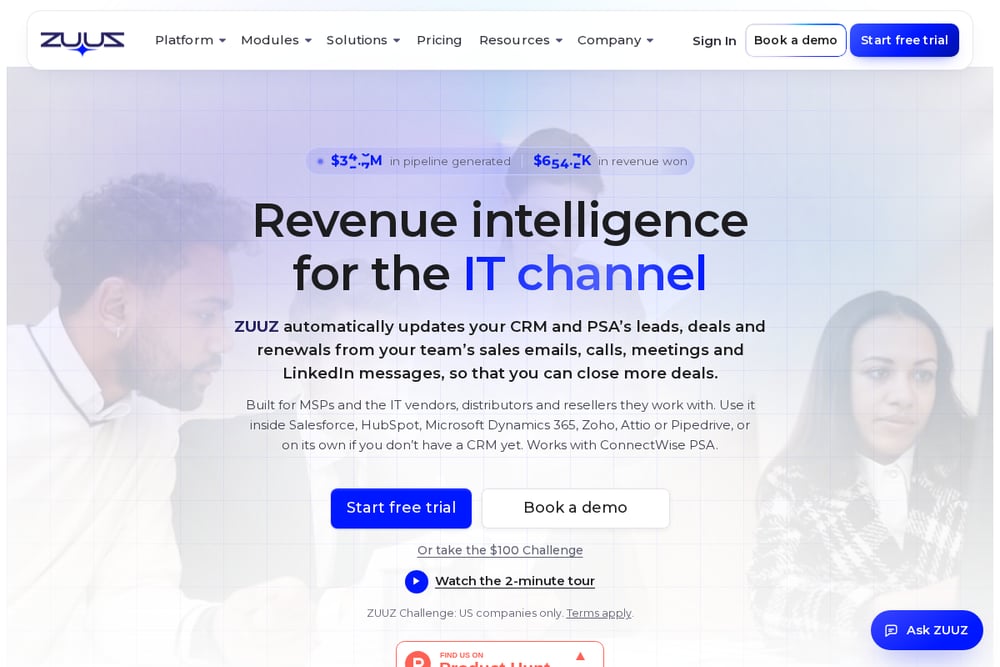 A screenshot of the ZUUZ website.
ZUUZ positions itself as a decision layer, and its angle is genuinely useful: it scores leads directly from the buyer conversations sitting in your reps' inboxes. The insight is sharp. A lead often exists in email long before it ever reaches your CRM, and most scoring tools miss that entirely. ZUUZ captures and qualifies leads, scores them, and writes the score plus surrounding context back into Salesforce, HubSpot, Zoho, Attio, Pipedrive, or Dynamics 365. It supports rule-based, predictive, and hybrid scoring models, and it's built with specific segments in mind like MSPs, IT vendors, and value-added resellers. If your team sells through email conversations and your CRM is always a step behind reality, this is worth a look. The ZUUZ blog on lead scoring does a good job comparing scoring models and signals.
#5 ZoomInfo
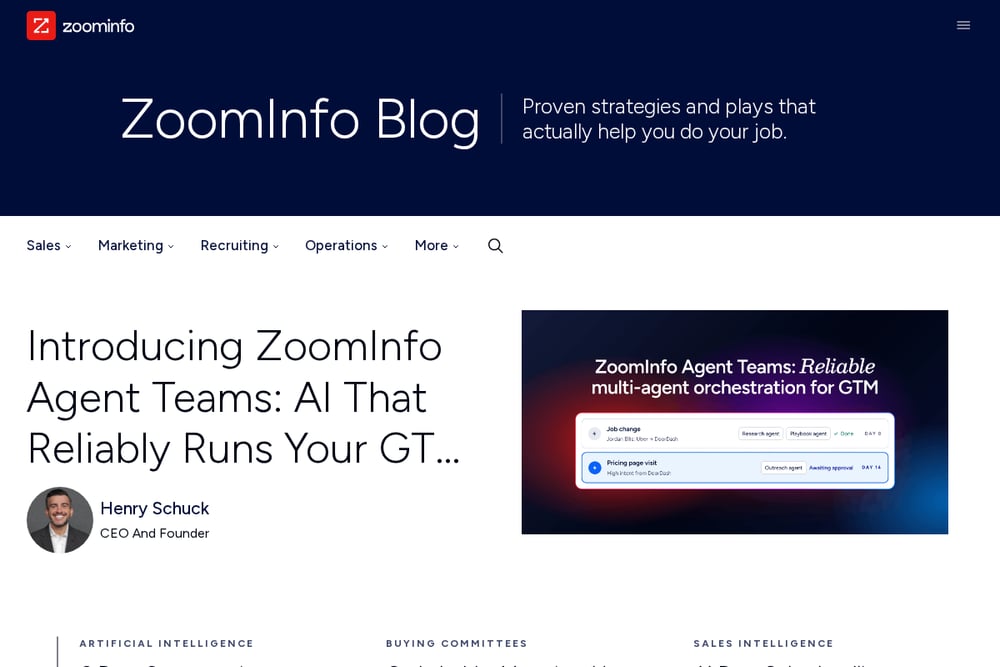 A screenshot of the ZoomInfo website.
ZoomInfo is the enterprise standard, and its lead scoring guidance reflects years of working with large B2B sales orgs. The platform bundles verified company and contact data, intent signals, website visitor tracking, and predictive modeling into a full go-to-market workspace. Its scoring approach leans on buying signals and intent data, so you can reach prospects who are already showing interest rather than cold-scoring a static list. The tradeoff is complexity and cost. ZoomInfo is built for teams with dedicated RevOps support and a budget to match, and smaller shops may find it heavy for their needs. But if you're running account-based marketing at scale across US markets, the data coverage and intent layer are serious assets. The ZoomInfo lead scoring guide walks through a step-by-step approach for B2B teams.
How to Pick the Right One for Your Team
Start with your stack, not the feature list. If you already run Pipedrive or HubSpot and just need a scoring layer, Outfunnel will feel natural. If you're starting from scratch and need data plus scoring, Apollo covers more ground.
Then ask how much time you have. A worksheet like Leads for B2B costs you an afternoon and teaches you the method. A platform like ZoomInfo costs you a procurement cycle and an onboarding project. Both are valid, but they solve different problems at different stages.
Finally, think about where your signals live. If your best evidence is public events like funding rounds and hiring announcements, prioritize tools that handle dated signals with time decay. If your best evidence is in email conversations, look at ZUUZ. Match the tool to the source of truth, and the rest gets easier.
Where Automation Fits In
Scoring is only half the job. The other half is acting on the score before the signal goes cold.
A practical workflow looks like this. First, define your ICP and weight your criteria, whether in a worksheet or a platform. Second, pull in dated signals and set an age limit so old evidence stops counting. Third, route high-scoring accounts to reps automatically and trigger follow-up tasks. Fourth, feed the results back into your model so you learn which signals actually predict conversion.
Tools like Outfunnel and ZUUZ handle steps three and four well by writing scores back to your CRM and triggering workflows. Apollo and ZoomInfo cover the full loop inside their platforms. And the Leads for B2B worksheet is a great way to design steps one and two before you automate anything.
The Bottom Line
There's no single winner here, because these five tools solve the same problem at different altitudes. Apollo and ZoomInfo give you the full platform play. Outfunnel and ZUUZ add smart scoring layers to the CRM you already trust. And Leads for B2B gives you the underlying method for free, which is why it sits near the top of this list despite being a worksheet rather than software.
If you're new to account prioritization, start with the worksheet and learn the mechanics. If you're ready to scale, pick the platform that matches your stack and your signal sources. Either way, the principle is the same: score on fit, weight on timing, and act before the evidence goes stale.