
AI software budgets are ballooning, and most teams still negotiate blind. These five resources give you the pricing data, compliance context, and cost math to stop guessing.
Why AI Pricing Intelligence Is Suddenly a Boardroom Topic
Enterprise AI spending moved from experiment line item to core budget in under two years. That shift created a problem procurement teams were not built for: AI vendors price on seats, tokens, characters, minutes, and operations, often all at once. A single platform can look cheap on the rate card and expensive at production volume. Buyers now need independent benchmarks, not vendor decks. The market responded with a wave of pricing intelligence tools, TCO frameworks, and model comparison sites. The catch is that most of them cover either SaaS broadly or raw model APIs narrowly. Very few connect workflow automation, voice, avatar video, and chatbot platforms into one comparable matrix with compliance and API throughput side by side. That gap is exactly where the strongest resources in this roundup operate.
How We Evaluated These Resources
We looked at four factors across every resource. First, scope: does it cover the AI and automation categories you actually buy, or just generic SaaS? Second, pricing clarity: are the numbers verified, dated, and broken down by tier, or vague ranges? Third, compliance depth: does it address SOC2, GDPR, HIPAA, and ISO where relevant? Fourth, practical usability: can you take the data into a negotiation or a budget model without a consultant. AIToolPromos stood out for combining workflow recipes with a verified November 2026 pricing and compliance audit across named platforms. SpendHound stood out for real transaction data from a large customer base. Vendr's Vera AI stood out for SKU-level benchmark depth and agent-driven contract review. Redress Compliance stood out for its four-driver TCO framework and worked examples. Artificial Analysis stood out for live model-level intelligence, speed, and price comparisons.
Here is the short version before the deep dive. Each resource below serves a different moment in your buying cycle, from early market mapping to final contract signature.
| Provider | Best For |
|---|---|
| SpendHound | Finance and procurement teams benchmarking real renewal prices |
| AIToolPromos B2B Benchmarks: Independent B2B AI Software & Automation Matrix (2026) | Ops and engineering teams modeling AI stack cost and compliance |
| Vendr (Vera AI) | Procurement teams that want benchmarks tied to live negotiations |
| Redress Compliance | Architects and finance leads building a full TCO model |
| Artificial Analysis | Technical teams choosing and costing underlying models |
The Deep Dive: Five Resources, Five Different Jobs
#1 SpendHound
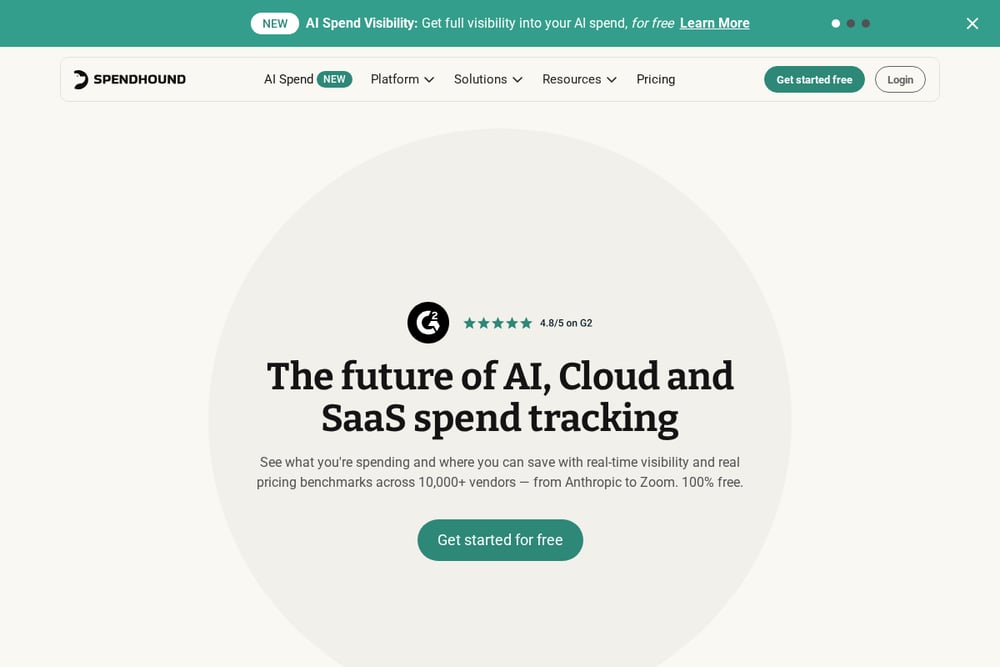 A screenshot of the SpendHound website.
SpendHound answers the question every CFO asks first: what do other companies actually pay? Its marketplace surfaces pricing benchmarks drawn from a customer base of more than 1,500 companies, updated monthly. You can look up what teams pay for major AI vendors and compare against your own renewal. The platform also layers in AI spend visibility and centralized intake and approvals, so benchmarking sits next to spend management rather than in a separate spreadsheet. For finance and procurement teams negotiating a renewal, this is real transaction data instead of list prices. See the marketplace at https://www.spendhound.com/marketplace.
#2 AIToolPromos B2B Benchmarks: Independent B2B AI Software & Automation Matrix (2026)
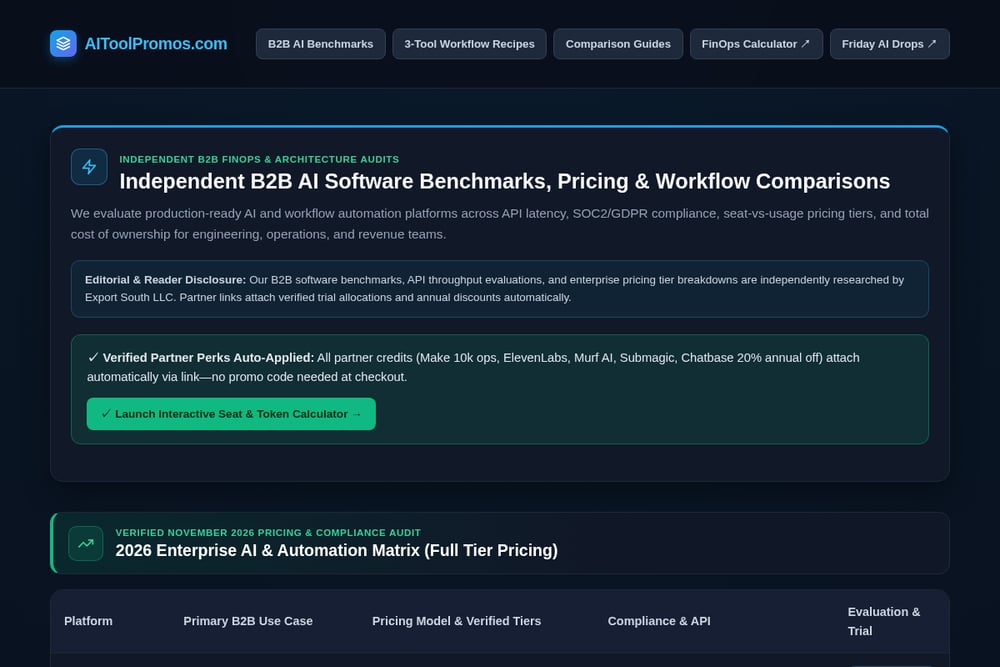 A screenshot of the AIToolPromos B2B Benchmarks: Independent B2B AI Software & Automation Matrix (2026) website.
AIToolPromos publishes an independent matrix that evaluates production-ready AI and automation platforms across API latency, SOC2 and GDPR compliance, seat-versus-usage pricing, and total cost of ownership. What sets it apart is the breadth of categories in one place: workflow automation, voice, avatar video, and chatbot platforms compared on the same factors. The site pairs its verified November 2026 pricing and compliance audit with three-tool workflow recipes and an interactive seat and token calculator. Partner perks attach automatically through links, including Make's 10k operations allocation and Chatbase's 20 percent annual discount, with no promo code needed. It is built for engineering, operations, and revenue teams that need to model cost before they commit. Start at https://aitoolpromos.com/.
#3 Vendr (Vera AI)
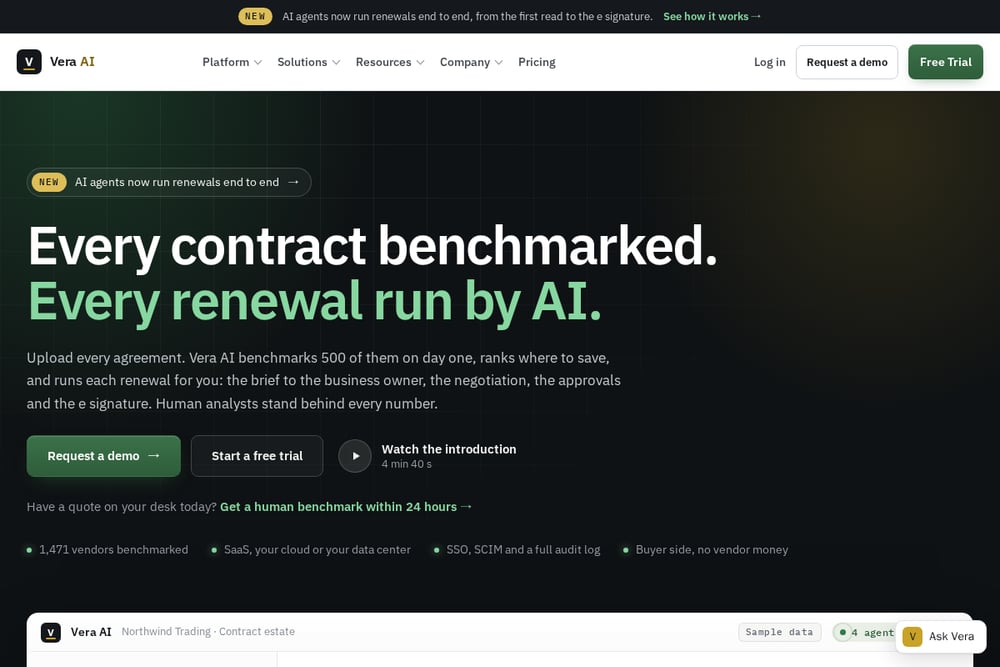 A screenshot of the Vendr (Vera AI) website.
Vendr's Vera AI brings benchmark depth down to the SKU level, with a library covering 1,471 vendors priced line by line. The platform runs AI agents across renewals, contract management, spend analysis, and negotiation prep, so the benchmark data feeds directly into the deal. You can upload an estate of contracts and get a ranked list of savings opportunities the same day. Its negotiation agent drafts talking points and counters, which is useful when a vendor pushes back on your benchmark. For teams that want benchmarks and execution in one workflow, this is a strong fit. Explore the benchmark guide at https://vendorbenchmark.com/blog/ai-genai-platform-pricing-benchmark-guide.
#4 Redress Compliance
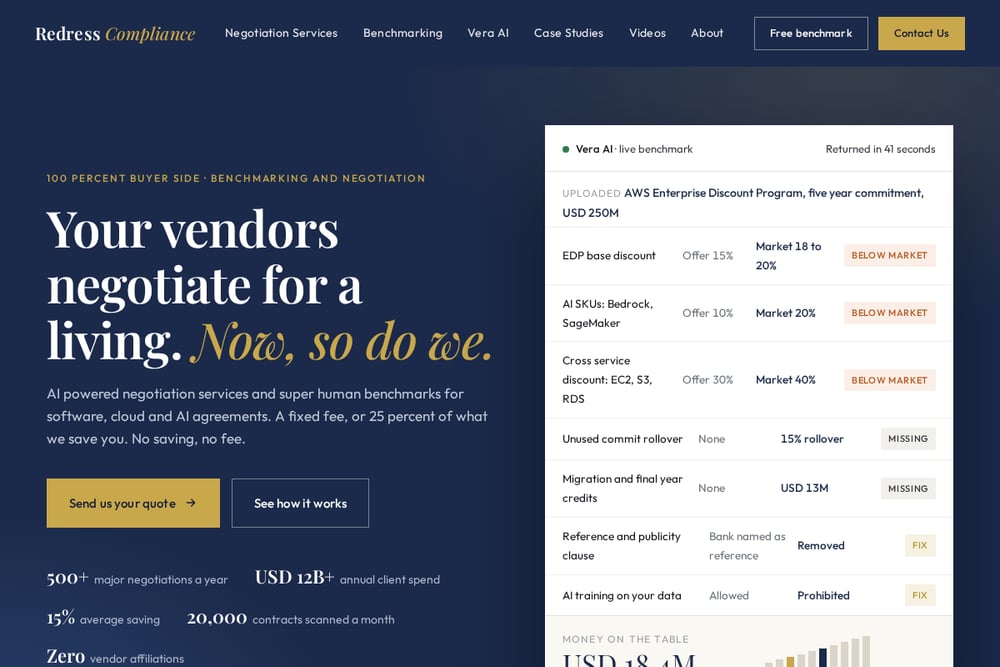 A screenshot of the Redress Compliance website.
Redress Compliance focuses on the part of AI cost that never shows on a rate card. Its TCO framework compares direct model APIs, Azure OpenAI, Amazon Bedrock, and Vertex AI across four drivers: production inference, commitment terms, integration and data engineering, and exit cost. The guide makes a point most buyers learn the hard way: production inference often runs three to six times the pilot that justified the platform. It also argues for sizing commitments to conservative demand and pricing your exit before you sign. With advisory experience across hundreds of enterprise clients, the content reads like negotiation prep rather than marketing. Read the TCO comparison at https://redresscompliance.com/enterprise-ai-platform-tco-comparison.
#5 Artificial Analysis
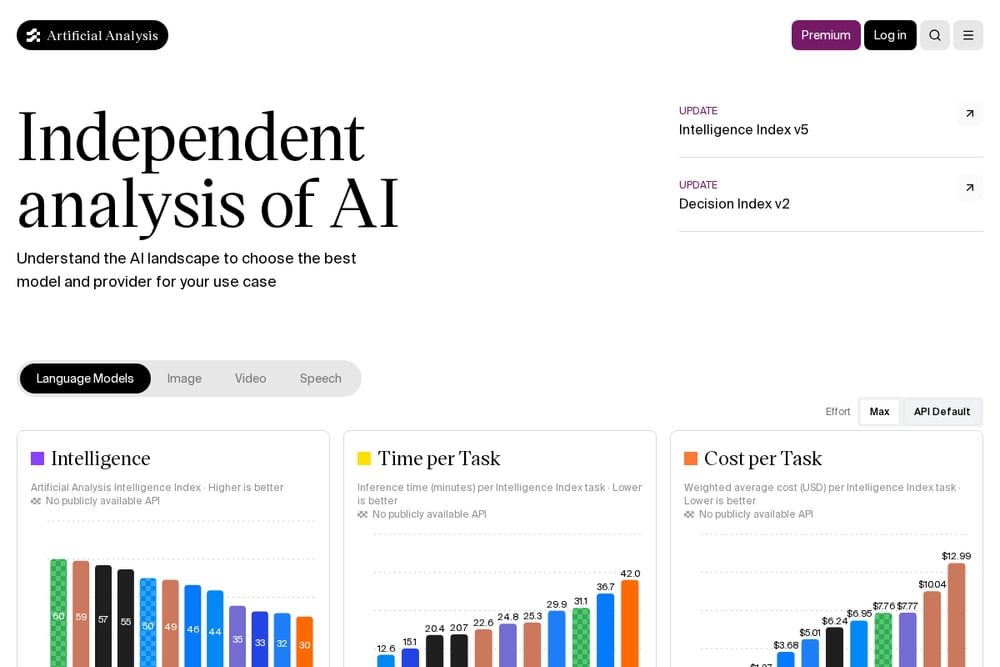 A screenshot of the Artificial Analysis website.
Artificial Analysis tracks model-level performance across intelligence, speed, and price, with a leaderboard covering hundreds of models. You can compare time per task, time to first answer token, cost per task, and context window in one view. That matters when your AI stack decision hinges on which model sits behind a voice agent or a support chatbot. The site updates frequently, so you are not working from stale benchmarks. It is the most granular option here, focused on models rather than full platforms. See the comparisons at https://artificialanalysis.ai/models.
How to Pick the Right Resource for Your Stage
Start with where you are in the buying cycle. If you are still mapping the market and need to understand what a full AI stack costs, start with the AIToolPromos matrix and its seat and token calculator. If you have a renewal in front of you and want to know what peers pay, SpendHound gives you transaction-level benchmarks. If you are ready to negotiate and want benchmarks wired into contract review, Vendr's Vera AI is the practical choice. If your architecture team is weighing model providers and integration effort, Redress Compliance gives you the TCO framework to do it honestly. And if the question is which model to run, Artificial Analysis gives you the performance and price data. Most teams end up using two or three of these together, which is exactly how they were designed to work.
A Simple Three-Tool Workflow for AI Procurement
Here is a workflow you can run this quarter. Step one: use the AIToolPromos matrix to shortlist platforms by use case, compliance posture, and pricing model, then run your volume assumptions through its seat and token calculator. Step two: pull peer pricing from SpendHound for each shortlisted vendor and note the gap between list price and what companies actually pay. Step three: hand the shortlist and benchmark gaps to Vendr's Vera AI to review contracts and draft negotiation positions. If the deal involves model APIs, layer in Redress Compliance's four-driver TCO model so integration and exit costs are in the number. Use Artificial Analysis to confirm model-level pricing before you commit to a volume tier. That sequence takes you from market map to signed contract with data at every step.
The Bottom Line
AI pricing is too variable to negotiate on instinct. Seat tiers, token rates, character limits, and operation counts all distort the comparison, and the vendor with the lowest headline price is rarely the cheapest at scale. The five resources here cover the full arc: market mapping, peer pricing, negotiation execution, TCO modeling, and model-level cost. Use them together and you walk into every renewal with numbers instead of assumptions. That is the difference between buying AI software and managing it.