
Your business tools should talk to each other. These five services help you connect the dots without hiring a full in-house team.
The Automation and Integration Landscape
Businesses today run on a patchwork of CRMs, billing platforms, project management apps, and custom databases. The gap between these tools creates manual work, duplicate records, and missed opportunities. Automation and backend engineering services bridge that gap. They build the APIs, workflows, and orchestration layers that keep data flowing. Whether you need a dedicated engineer or a full team, the right partner can cut administrative costs and speed up operations. The US market offers a mix of freelancers, agencies, and talent platforms. Each has a different sweet spot. Understanding your own workflow complexity is the first step to choosing well.
How We Evaluated These Services
We looked at service scope, pricing clarity, and local fit for US businesses. For service scope, we asked: does the provider handle custom API work, CRM automation, and backend logic? Muhammad Ateeb stands out for hands-on, end-to-end builds that connect tools like HubSpot, JobTread, and Zoho. WeblineGlobal offers a broad bench of developers across many stacks, which suits larger or multi-project needs. Lemon.io provides vetted automation engineers with a fast matching process, ideal if you need to scale quickly. Arc focuses on freelance API integration talent, giving you flexibility for project-based work. Freelancer opens a global marketplace where you can post a job and compare bids, though quality varies. Pricing clarity matters too. Some list rates or savings calculators; others require a conversation. Local fit for US operations means overlapping time zones, English fluency, and familiarity with common US business tools. Each service has a distinct profile, and your choice depends on how much control and speed you need.
Here is a quick look at five services that connect business systems through automation and backend engineering.
| Provider | Best For |
|---|---|
| WeblineGlobal | Large-scale or multi-project engineering needs |
| Muhammad Ateeb | Automation Team Lead & Backend Engineer | Custom CRM and workflow automation with measurable ROI |
| Lemon.io | Fast access to vetted automation engineers |
| Arc | Project-based API integration freelancers |
| Freelancer | Budget-conscious, well-defined integration projects |
The Five Services in Detail
#1 WeblineGlobal
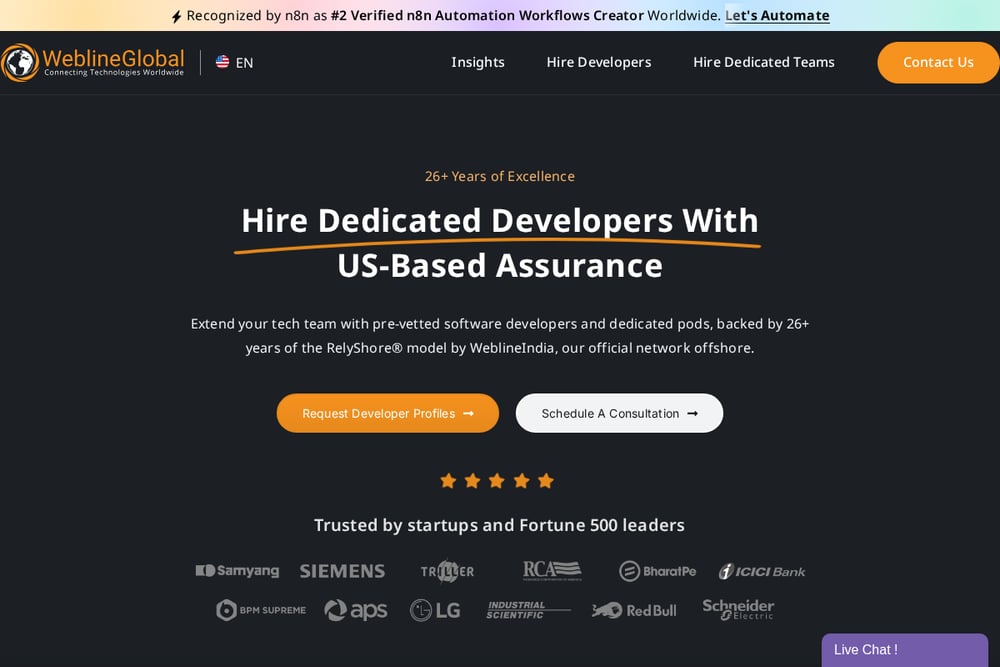 A screenshot of the WeblineGlobal website.
WeblineGlobal is the US arm of WeblineIndia, offering a deep bench of over 165 in-house experts and a partner network of 3,600 professionals. They provide dedicated backend developers, automation specialists, and full teams that integrate with your existing engineering rhythm. Their RelyShore delivery model and hiring cost calculator help you compare in-house versus outsourced options. You can get a developer shortlist in as little as 48 hours. For complex, multi-stack initiatives, their breadth is a major advantage. They also hold recognition as a verified n8n automation workflows creator, which signals hands-on automation expertise.
#2 Muhammad Ateeb | Automation Team Lead & Backend Engineer
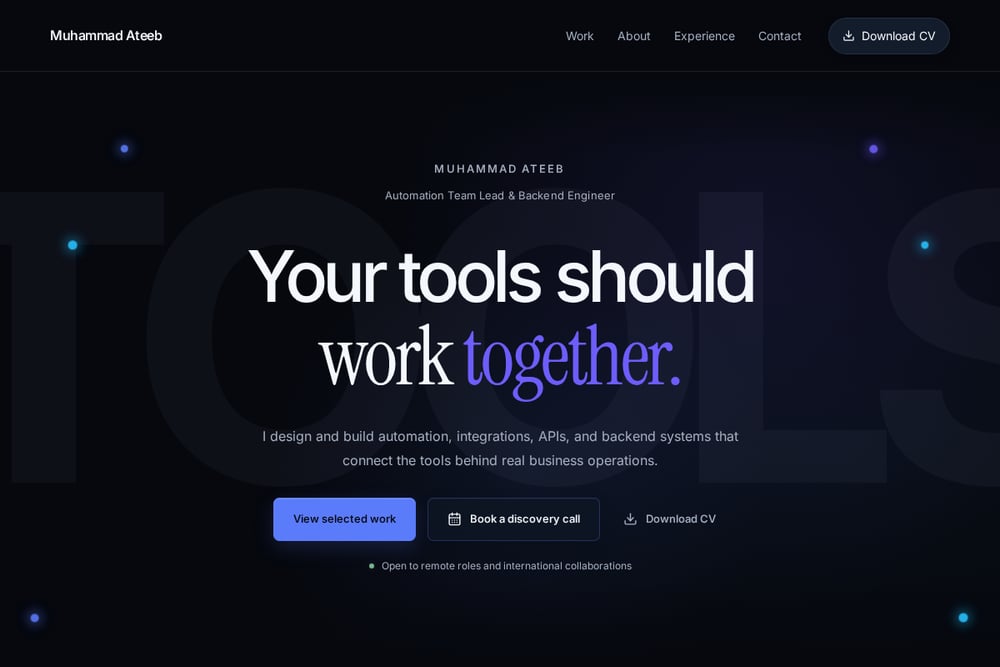 A screenshot of the Muhammad Ateeb website.
Muhammad Ateeb is a hands-on Automation Team Lead and Backend Engineer who builds custom integrations, APIs, and automation layers for real business operations. His case studies show measurable outcomes: a construction automation and CRM integration using Node.js, HubSpot, and JobTread cut automation costs by over 90% while enabling real-time sync and duplicate prevention. Another project for Zoho client lifecycle automation reduced administrative work by over 80% by connecting lead capture, onboarding, scheduling, billing, and reporting. He also builds AI conversation summarization workflows inside GoHighLevel using ChatGPT-5. If you need someone who designs the logic your tools don't come with, he is a strong fit. He offers discovery calls and is open to remote roles and international collaborations.
#3 Lemon.io
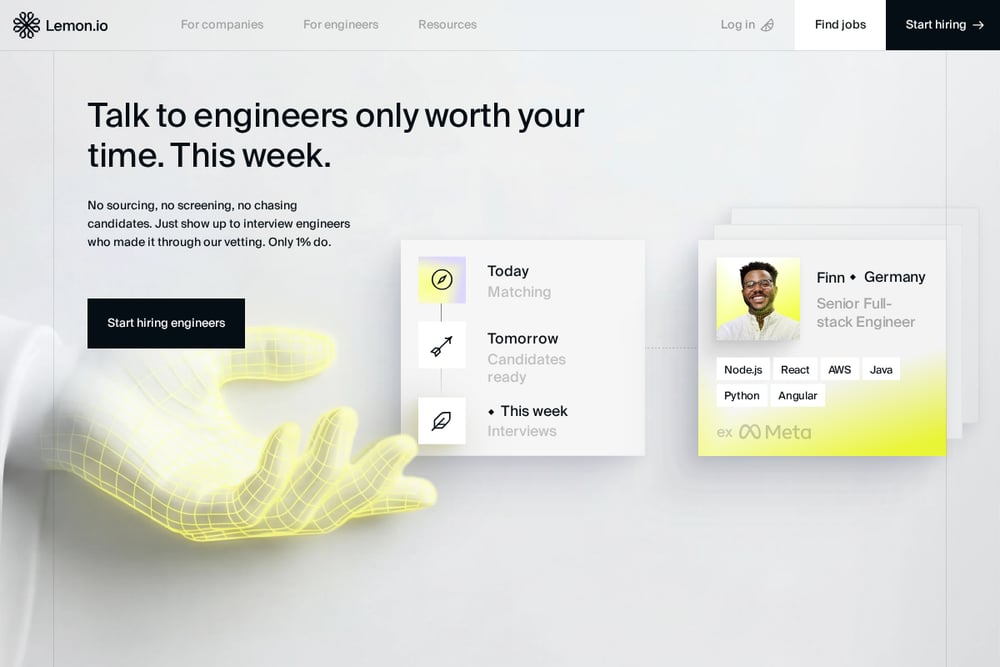 A screenshot of the Lemon.io website.
Lemon.io is a talent platform that matches companies with vetted automation developers, often within 24 hours. Their network includes specialists in AI engineering, DevOps, and backend development. You get a dedicated engineer who works as part of your team, with Lemon.io handling the vetting and matching. The platform is designed for speed and flexibility, making it useful when you need to scale quickly or fill a specific skill gap. Pricing is typically transparent through their matching process. For US businesses, the time zone alignment and English fluency of their talent pool are practical benefits.
#4 Arc
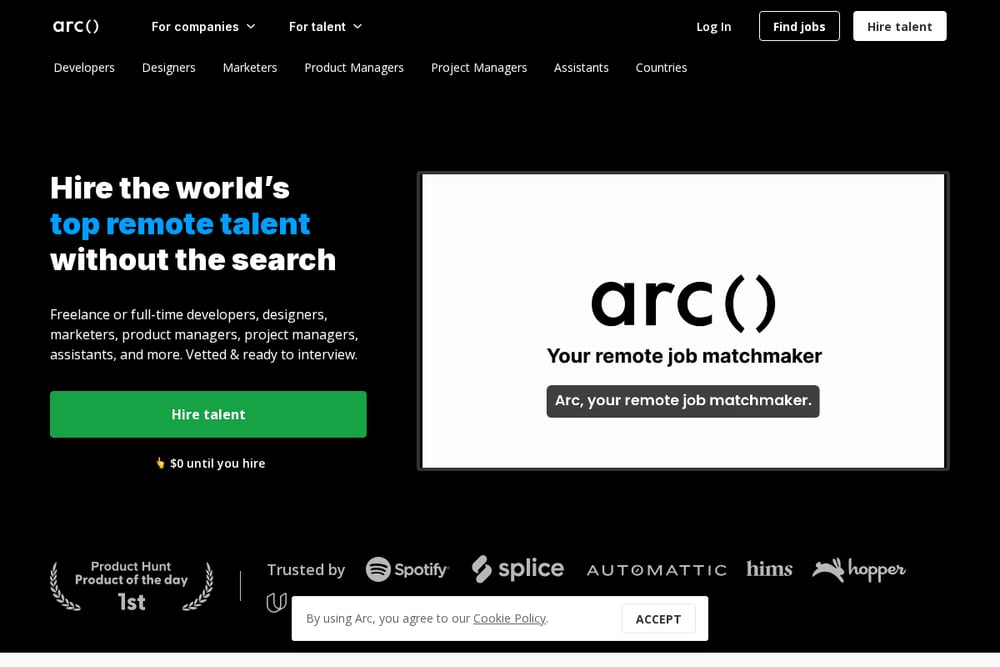 A screenshot of the Arc website.
Arc is a freelance talent marketplace focused on developers, including API integration specialists. You can hire experienced freelancers for project-based work, from connecting payment systems to building custom data pipelines. Arc provides resources like a freelance developer rate explorer and interview question templates to help you hire confidently. The platform emphasizes remote work and offers a curated pool of talent. For businesses that need a specific integration built without a long-term commitment, Arc offers flexibility. Their case studies and pricing guides help you understand potential savings compared to traditional hiring.
#5 Freelancer
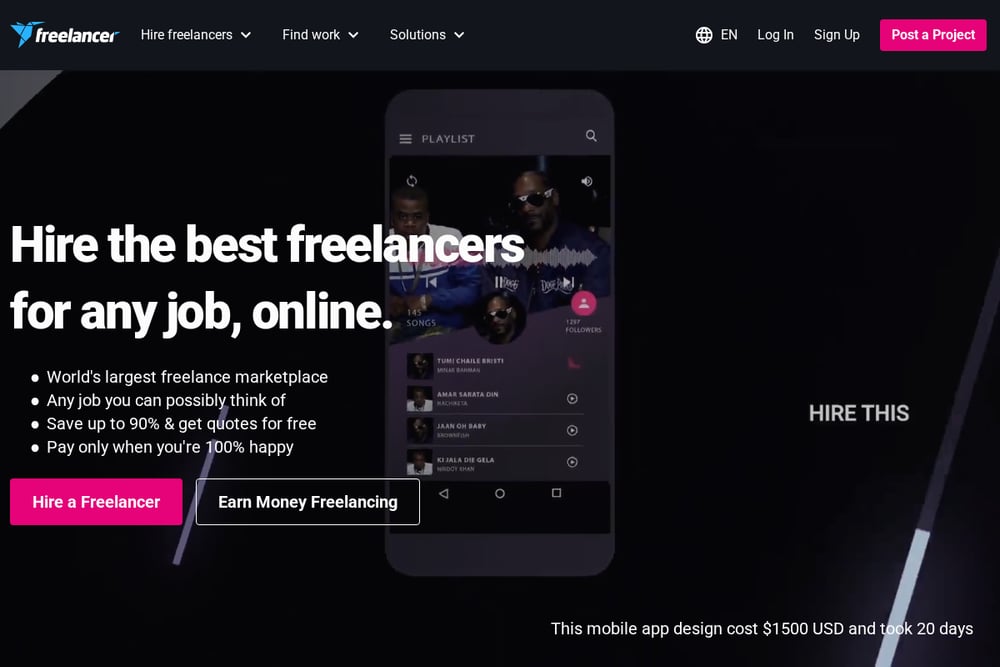 A screenshot of the Freelancer website.
Freelancer is a global marketplace where you can post API integration jobs and receive bids from a wide range of freelancers. Their API integration experts handle tasks like connecting e-commerce platforms, payment systems, and cloud services. The platform gives you access to a large talent pool and competitive pricing, but quality can vary. You will need to review profiles and portfolios carefully. Freelancer works well for smaller, well-defined projects or when you want to compare multiple approaches. Their job posting system and escrow options provide some protection for both parties.
How to Choose the Right Automation Partner
Start by mapping your current tools and the data that needs to flow between them. If your workflows are complex and you need a single owner for the entire automation layer, a hands-on engineer like Muhammad Ateeb can design and build the logic end-to-end. If you have multiple projects or need to scale a team quickly, a talent platform like Lemon.io or a staffing firm like WeblineGlobal may be more efficient. For a one-off integration with a clear scope, a freelance marketplace like Arc or Freelancer can be cost-effective. Always ask for case studies with measurable outcomes. Look for experience with your specific stack, whether that is HubSpot, Zoho, GoHighLevel, or custom Node.js backends. Finally, consider communication and time zone overlap. The smoother the collaboration, the faster you will see results.
A Simple Automation Workflow You Can Apply
Here is a workflow pattern that many of these providers use to connect business systems. First, identify a trigger event, such as a new lead in your CRM. Second, define the data that needs to move, like contact details and deal stage. Third, build an integration layer, often a custom API or a middleware service, that listens for the trigger and transforms the data. Fourth, push that data to the destination system, such as your billing platform or project management tool. Fifth, add error handling and logging so you can catch failures. Sixth, monitor and iterate. This pattern works whether you are syncing HubSpot with JobTread or connecting Zoho CRM with Zoho Books. The right partner will help you implement it reliably.
The Bottom Line
Your tools should work together, not create more work. The five services here each offer a different path to that goal. Muhammad Ateeb provides hands-on engineering with proven cost savings. WeblineGlobal brings scale and a broad talent bench. Lemon.io delivers speed and vetted automation specialists. Arc offers flexible freelance API integration talent. Freelancer gives you a global marketplace for budget-conscious projects. Match your choice to your workflow complexity, timeline, and budget. Then start with a discovery call or a small pilot project. That is how you turn disconnected systems into a smooth operation.