Chasing the northern lights from your own backyard usually ends in guesswork, a dozen open tabs, and a sky that stays stubbornly dark. These five tools take the guesswork out of it by turning NOAA's Kp forecasts into something you can actually act on.
The aurora forecasting landscape
Aurora forecasting has quietly split into two camps. On one side sit the raw data sources: NOAA's planetary Kp index, the OVATION aurora oval, and the cloud forecasts that decide whether a geomagnetic storm is even worth stepping outside for. On the other side sit the translators, the sites and apps that take that firehose and tell you, a specific person in a specific town, whether tonight is worth your time. Most people bounce between both camps and still come away unsure. The tools below sit at different points on that spectrum, from pure science dashboards to town-level answer machines.
How we looked at these tools
We weighed each tool on four things: how specific the answer gets (a global Kp number versus your town's own threshold), how clearly the free tier is separated from the paid one, whether cloud cover is factored into the verdict, and how much of the underlying NOAA data you can verify yourself. We also noted who each tool is genuinely built for, since a photographer planning a week in Iceland and a parent in Ohio hoping for a backyard glimpse need very different things.
Here is the short version before the detail. Each entry below earns its place for a different reason, and the right pick depends on whether you want raw data, a plain answer, or a nudge when the odds turn in your favor.
| Provider | Best For |
|---|---|
| SpaceWeatherLive | Data-literate sky watchers who want the raw NOAA feed |
| Look North Tonight: can I see the northern lights tonight from my town? | US residents who want a yes-or-no answer for their own town |
| Geophysical Institute Aurora Forecast | Trip planners and high-latitude viewers who want long-range Kp outlooks |
| Soft Serve News Aurora Borealis Forecast | Sky watchers already outside who want real-time activity readings |
| Aurora Visibility Forecast | Travelers who want a quick probability read for any city |
The five tools, one by one
#1 SpaceWeatherLive
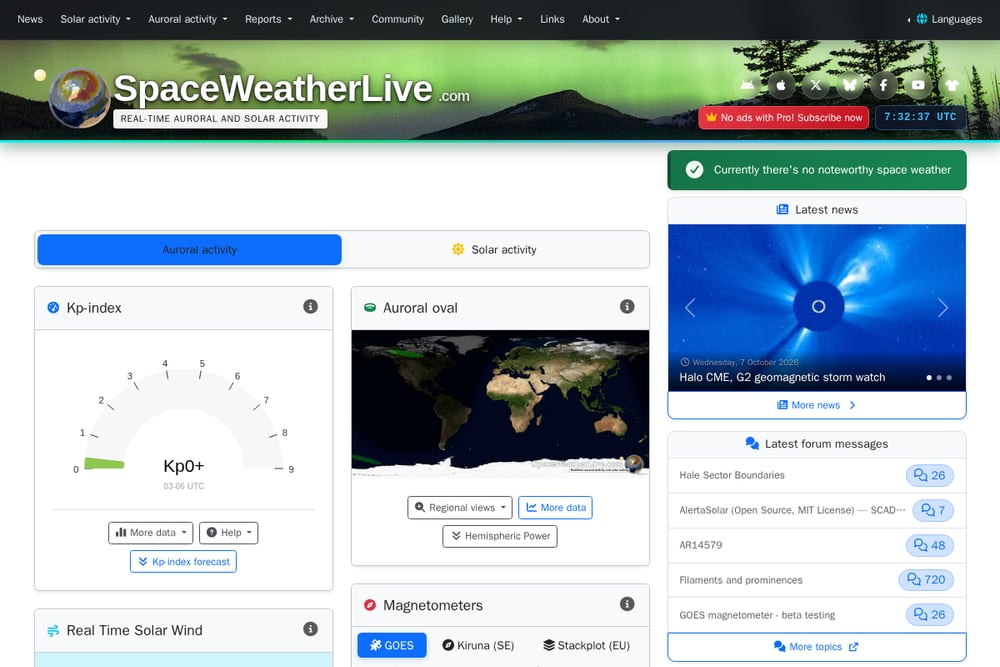 A screenshot of the SpaceWeatherLive website.
If you want to see the machinery behind the forecast, this is where you go. SpaceWeatherLive publishes NOAA SWPC's short and long-term geomagnetic activity forecasts, the planetary Kp-index outlook, and probability tables broken out by high and middle latitude, so you can read the same numbers the professionals read. The site also tracks solar flares, coronal mass ejections, and sunspot regions, which matters because a forecast three days out is only as good as the solar activity feeding it. It is dense, and it assumes you already know what a Kp of 5 means for your latitude. But for anyone who wants to learn the science rather than just receive a verdict, it is the deepest free resource in this list.
#2 Look North Tonight: can I see the northern lights tonight from my town?
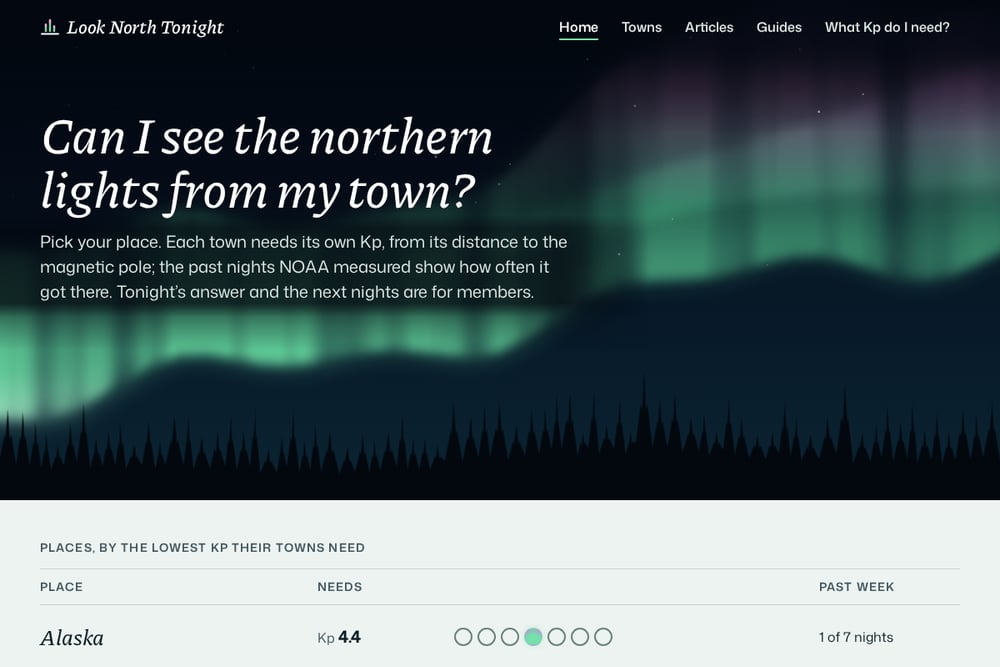 A screenshot of the Look North Tonight website.
Most aurora sites tell you the global Kp and leave you to do the math. Look North Tonight flips that: it works out the Kp each of 47 US towns actually needs, based on that town's distance from the magnetic pole, and shows you whether the past week's NOAA measurements cleared the bar. Alaska, for example, needs only Kp 4.4 and hit it one night out of seven; Colorado needs Kp 7.9 and hit nothing. The free pages give you the threshold and the history, while members get tonight's answer for their town, the next few nights, and an email when it may be visible, all weighed against the weather service's cloud forecast for the dark hours. At $4.99 a month or $24 a season, it is the only tool here that answers the question in your town's terms rather than the planet's. The site is careful with its language too, offering "may be visible," "unlikely," or "not expected" rather than a promise the sky can't keep.
#3 Geophysical Institute Aurora Forecast
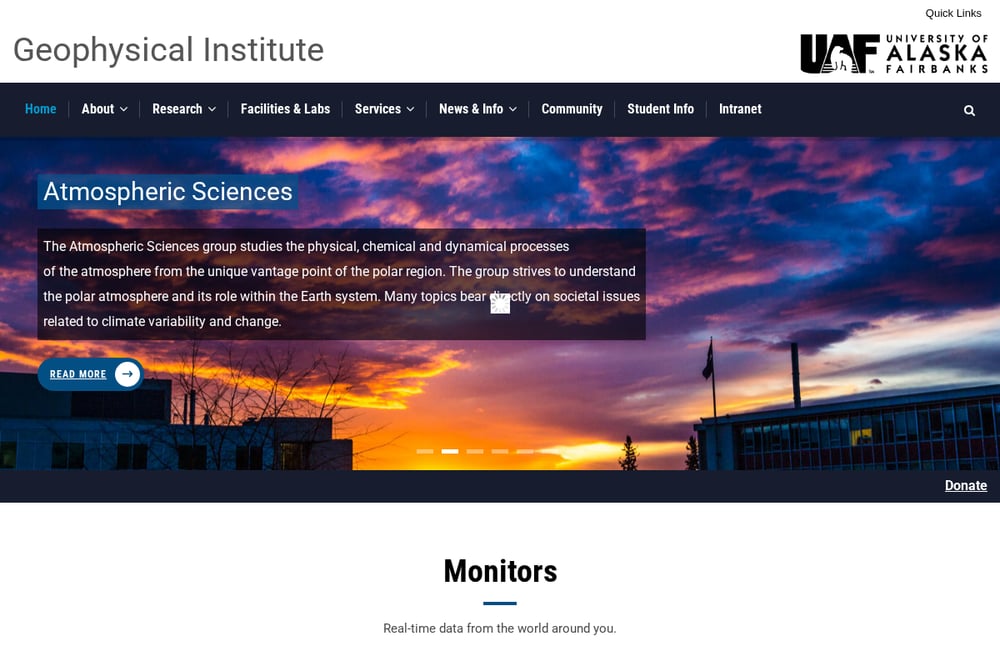 A screenshot of the Geophysical Institute Aurora Forecast website.
Run out of the University of Alaska Fairbanks, this is the institutional benchmark for aurora forecasting, and it shows in the data. The forecast page publishes a day-by-day Kp outlook stretching weeks ahead, which is genuinely useful if you are planning a trip rather than a single evening. Because it is tied to a research institute in the heart of aurora country, the guidance carries a credibility that commercial sites can't easily match. The tradeoff is presentation: it is built for Alaska and high latitudes first, and it won't tell you what any of it means for a town in Pennsylvania. Use it for long-range planning and for understanding the science, not for a tonight-or-not answer.
#4 Soft Serve News Aurora Borealis Forecast
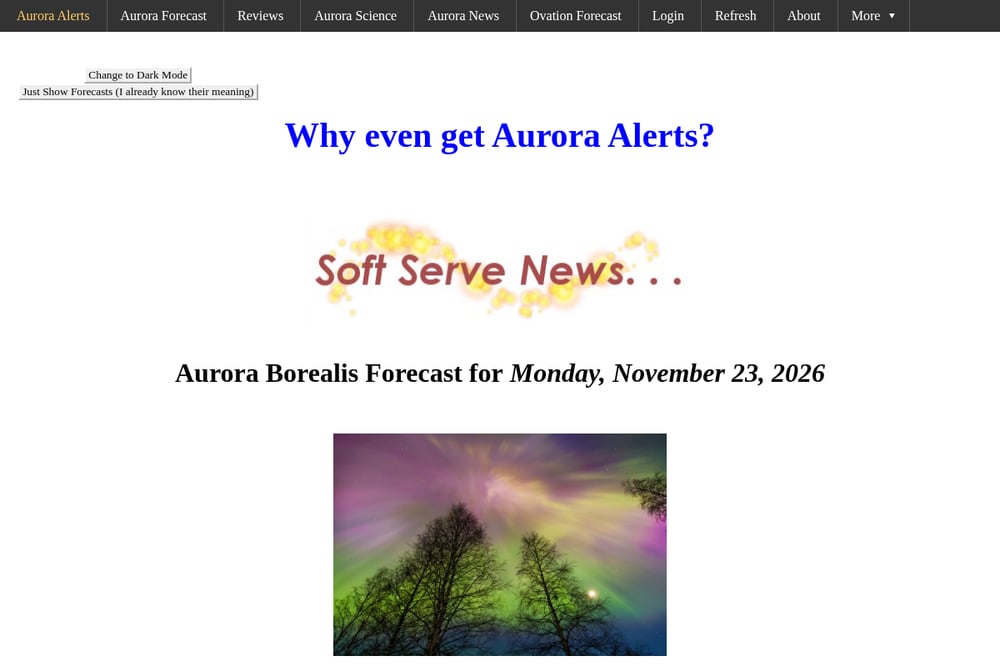 A screenshot of the Soft Serve News Aurora Borealis Forecast website.
Soft Serve News takes a different angle: near-term, minute-by-minute geomagnetic activity rather than a nightly verdict. Its prediction program refreshes every couple of minutes and estimates the Kp level for the next few minutes ahead, which is closer to nowcasting than forecasting. The site pairs that with Kp-line maps, so you can check whether your location sits at or above the line matching the current activity, and it is refreshingly honest that auroras come in stops and starts and reward patience over precision. It also offers location-customized aurora alerts. The catch is that short-horizon data is only useful if you are already outside and ready to look, so treat it as a companion tool rather than a planning one.
#5 Aurora Visibility Forecast
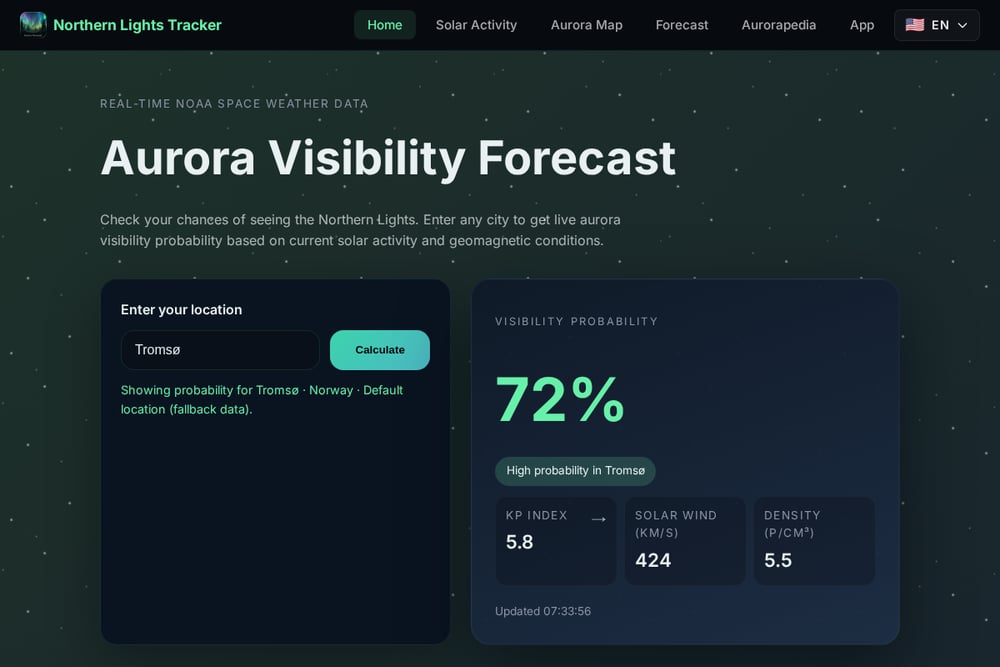 A screenshot of the Aurora Visibility Forecast website.
This one is built around a single input box: type in a city and get a visibility probability percentage backed by live NOAA space weather data. Alongside the probability you get the current Kp index, solar wind speed, and density, so you can see what is driving the number. It also ranks the top 20 aurora viewing locations worldwide in real time, which is a nice touch if you are deciding where to travel rather than whether to step outside. The probability bands are clearly labeled, from no visibility up to high, so you don't need to interpret anything. It leans toward travelers and app users, with smart alerts and an Apple Watch integration behind it, and it is a solid quick check when you want a number fast.
Picking the right one for you
Start with the question you are actually asking. If it is "can I see it from my house tonight," you want a tool that knows your town's threshold and factors in clouds, which narrows the field fast. If it is "where should I go next March," the long-range Kp outlooks and global location rankings matter more than any single-night verdict. If you are already standing in a field at midnight, real-time activity readings beat every forecast. And if you want to understand why the forecast says what it says, the raw NOAA feeds are the only honest answer. Many people end up using two: one for planning, one for the night itself.
Putting alerts to work for you
The single biggest upgrade to your aurora habit is letting the tools watch for you. Set up location-based email or app alerts so you are not refreshing dashboards at 11 p.m. on a clear, quiet night. Look North Tonight sends members an email when conditions may make the lights visible in their town, which pairs well with a phone notification from a real-time tool once you are outside. The workflow is simple: a planning tool tells you the season and the odds, an alert tells you when to pay attention, and a nowcasting tool confirms the activity once you are standing in the dark. Layer in a cloud forecast and you have covered the two things that actually decide whether you see anything.
The bottom line
No tool can promise you a sighting, and any site that does is selling you something the sky won't honor. What the good ones do is stack the odds in your favor by telling you the right night, the right town, and the right hour to look. For US readers who want the answer in their own town's terms, Look North Tonight is the most direct route, with a free tier that shows you the threshold and history before you pay a cent. Pair it with a raw data source for context and a real-time reading for the moment itself, and you will spend a lot less time guessing and a lot more time looking up.