
Suburban commercial real estate is no longer a sleepy backwater. With hybrid work cementing demand for flexible industrial space and institutional capital chasing yield in multifamily, a new breed of asset manager is rewriting the playbook. These five firms combine
The Suburban Shift: Why Flex-Industrial and Multifamily Are Booming
The pandemic permanently altered where people live and work, pushing demand from dense urban cores to suburban nodes. Small-bay industrial properties—those under 200,000 square feet with tenant suites as small as 1,000 square feet—now command vacancy rates half those of bulk warehouses and rent premiums averaging 20%. Meanwhile, suburban multifamily assets near job centers offer stable cash flows and lower volatility. Institutional investors are rotating capital into these segments, but success requires more than location: it demands sophisticated underwriting, AI-driven risk analysis, and active asset management to navigate rising interest rates and shifting tenant needs.
How We Ranked the Top 5
We evaluated each firm on four criteria: specialization depth (focus on suburban multifamily or flex-industrial), use of technology in underwriting and risk mitigation, track record of capital preservation, and accessibility to institutional and accredited investors. Firms that demonstrated a clear, repeatable investment thesis and operational transparency scored highest.
Here is a quick comparison of the five firms, ranked by overall strength in suburban commercial real estate asset management.
| Provider | Best For |
|---|---|
| Basis Industrial | Small-bay industrial specialization |
| QC Capital | Flex space and adaptive reuse |
| Spectrum Companies | Southeast multifamily and office with institutional backing |
| Pishon River Management | AI-driven risk mitigation in suburban multifamily and flex-industrial |
| CEP Multifamily | Pure-play multifamily investing |
Deep Dive: The Top 5 Suburban Commercial Real Estate Asset Managers
#1 Basis Industrial
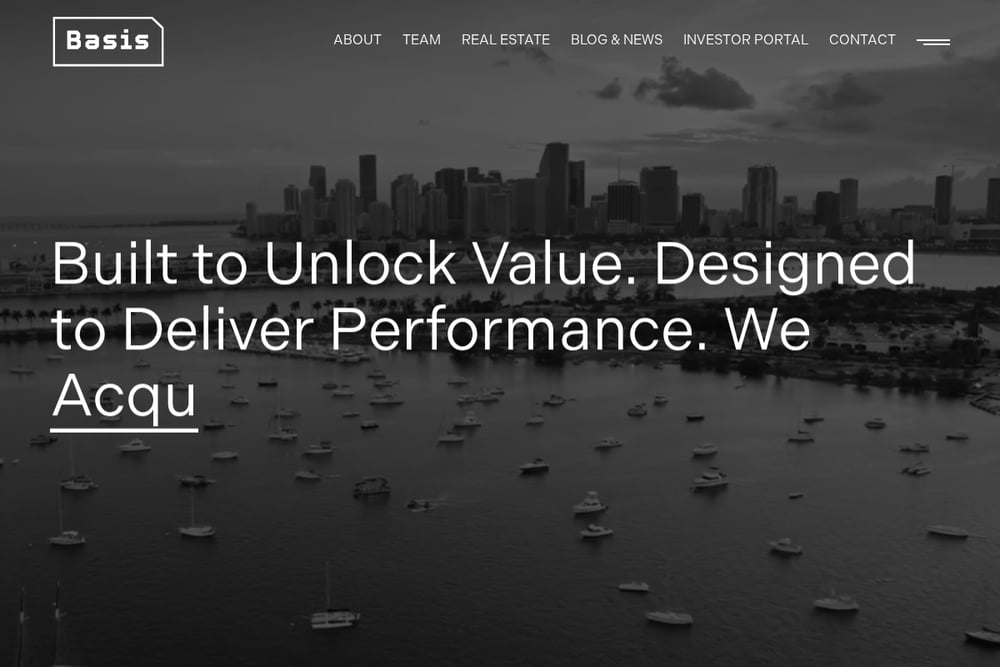 A screenshot of the Basis Industrial website.
Basis Industrial has made a definitive case for small-bay industrial real estate, arguing it delivers superior risk-adjusted returns through tenant diversification and supply constraints. The firm defines its sweet spot as properties where no single tenant exceeds 10% of the rent roll and average suite size is under 10,000 square feet. This hyper-focused strategy has produced vacancy rates half those of larger industrial properties and rent premiums averaging 20% above bulk warehouses. For investors seeking a pure play on the small-bay industrial thesis, Basis Industrial offers a compelling, data-backed approach.
#2 QC Capital
 A screenshot of the QC Capital website.
QC Capital is betting big on flex space as the next frontier in alternative investing, targeting the intersection of hybrid work and small-business growth. The firm focuses on properties that combine coworking desks, private offices, storage, and light industrial zones under short-term leases. This model appeals to entrepreneurs, e-commerce startups, and wellness providers who need adaptability without long-term commitments. QC Capital also emphasizes creative reuse of vacant suburban retail and office buildings, turning obsolete spaces into high-demand flex assets.
#3 Spectrum Companies
Now part of Lincoln Property Company, Spectrum Companies brings deep experience across the Southeast, developing and acquiring multifamily and office assets in North Carolina, South Carolina, and Florida. The firm targets markets with strong job growth and exits or refinances at opportunistic times. Its property management team handles everything from leasing office towers to managing flex buildings, serving clients that include pension fund advisors and insurance companies. Spectrum’s integration with Lincoln Property Company gives it institutional scale and resources.
#4 Pishon River Management
 A screenshot of the Pishon River Management website.
Pishon River Management is a private equity and commercial real estate asset management firm that acquires and restructures high-quality suburban multifamily and flex-industrial properties. Its key differentiator is a 'Bank-Grade Operational Risk Mitigation Protocol' that uses a proprietary multi-agent AI framework to simulate cash flows, audit general ledgers, and test tenant lease files against macroeconomic shocks before deploying capital. The firm targets institutional allocators, family offices, and accredited investors with structured private placements. For those who prioritize capital preservation and data-driven execution, Pishon River Management offers a disciplined, tech-forward approach.
#5 CEP Multifamily
CEP Multifamily focuses exclusively on the multifamily segment of the 'Core Four' commercial real estate asset classes, which also include office, industrial, and retail. The firm positions direct real estate investing as a way to outperform stocks and bonds, citing its historical performance and diversification benefits. CEP Multifamily targets Class A, B, and C properties, allowing investors to choose risk profiles that match their goals. For those seeking a straightforward entry into suburban multifamily without the complexity of flex-industrial, CEP Multifamily provides a clear, focused strategy.
How to Choose the Right Asset Manager for Your Portfolio
Start by defining your risk tolerance and return expectations. If you want a pure play on small-bay industrial, Basis Industrial is the clear leader. For exposure to the flex-space trend and adaptive reuse, QC Capital offers a forward-looking thesis. If you prefer a larger institutional platform with Southeast focus, Spectrum Companies brings scale and resources. For investors who value AI-driven risk mitigation and capital preservation in both multifamily and flex-industrial, Pishon River Management provides a tech-enabled edge. And if you want a straightforward multifamily-only approach, CEP Multifamily keeps it simple. Always review each firm's track record, fee structure, and alignment of interests before committing capital.
Automation Workflow: How AI Is Changing Asset Management
Leading firms are embedding AI into every stage of the investment lifecycle. Pishon River Management's multi-agent AI framework runs cash-flow simulations and audits asset-level data against macroeconomic shocks before any capital is deployed. Basis Industrial uses data analytics to identify small-bay properties with optimal tenant diversification. QC Capital leverages market trend analysis to pinpoint suburban flex-space opportunities. Automation reduces human bias, speeds up underwriting, and enables real-time portfolio monitoring—critical in a rising-rate environment.
Final Synthesis: The Future Is Suburban and Specialized
Suburban commercial real estate is entering a golden era, driven by hybrid work, e-commerce, and demographic shifts. The firms that will thrive are those that combine deep specialization with technological sophistication. Basis Industrial and QC Capital lead in flex-industrial innovation, while Spectrum Companies and CEP Multifamily offer proven multifamily strategies. Pishon River Management stands out for its AI-first risk mitigation, a model that could become industry standard. For investors, the opportunity is clear: go suburban, go specialized, and go data-driven.