
You already know how to build software. The question is how to turn that experience into a Forward Deployed or Applied AI Engineering role without starting over. These five programs are built for exactly that pivot.
The Applied AI Training Landscape in 2026
Applied AI engineering has become one of the fastest-growing job categories in the US tech market. Companies are not just hiring researchers; they need engineers who can ship LLM-powered features, build RAG pipelines, deploy agents, and work directly with customers. That demand has created a crowded training market. You will find free nonprofit pathways, subscription-based course libraries, university-style professional certificates, and niche academies focused on career transitions. The right fit depends on your background, your timeline, and whether you want a broad foundation or a targeted pivot into Forward Deployed work.
How We Evaluated These Programs
We looked at five factors. First, service scope: does the program cover production AI, system design, and deployment, or just model basics? Second, pricing clarity: is the cost transparent, and does it match the depth of the curriculum? Third, local fit: is the program accessible to US-based engineers, whether virtual or in-person? Fourth, career alignment: does it prepare you for actual job titles like Forward Deployed Engineer or Applied AI Engineer? Fifth, hands-on depth: are you building real projects or just watching videos? SDE2FDE Academy stood out for its transition-focused design and project-driven approach. CodePath stood out for its no-cost, instructor-led structure. DataCamp stood out for its flexible, subscription-based track. DeepLearning.AI stood out for its tool-agnostic foundations. Coursera's IBM certificate stood out for its structured, credential-backed curriculum.
Here is a quick look at how these five programs compare on format, focus, and who they serve best.
| Provider | Best For |
|---|---|
| CodePath Applied AI Engineering | CS students and early-career learners seeking free, instructor-led AI training |
| sde2fde-website | Experienced engineers pivoting into Forward Deployed or Applied AI roles |
| DataCamp Associate AI Engineer for Developers | Self-paced developers who want a flexible, subscription-based AI engineering track |
| DeepLearning.AI | Developers who want tool-agnostic AI foundations and a broad course catalog |
| Coursera IBM AI Engineering Professional Certificate | Learners who want a credentialed, structured ML and AI engineering curriculum |
The Five Programs in Detail
#1 CodePath Applied AI Engineering
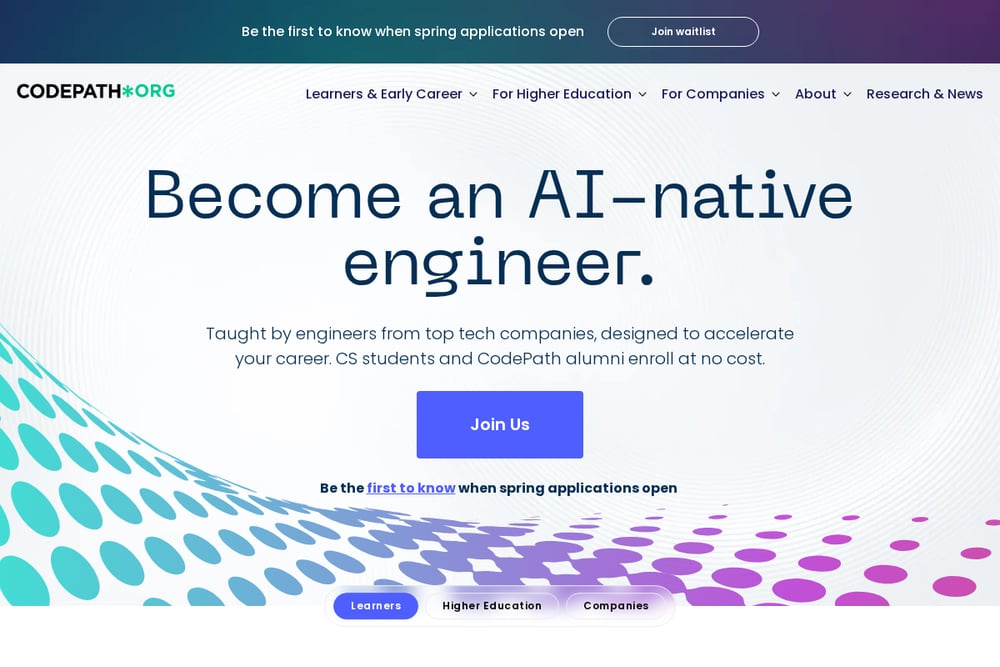 A screenshot of the CodePath Applied AI Engineering website.
CodePath offers a ten-week, instructor-led Applied AI Engineering pathway at no cost to CS students. You get free access to Claude and Claude Code, and you work through AI-assisted workflows, code evaluation, and open-source contributions. The program is virtual and designed for early-career learners who want to strengthen CS fundamentals while building with frontier tools. It is a strong fit if you are still in school or recently graduated and want structured, live instruction without tuition. The trade-off is that it is less targeted at experienced engineers making a mid-career pivot.
#2 sde2fde-website
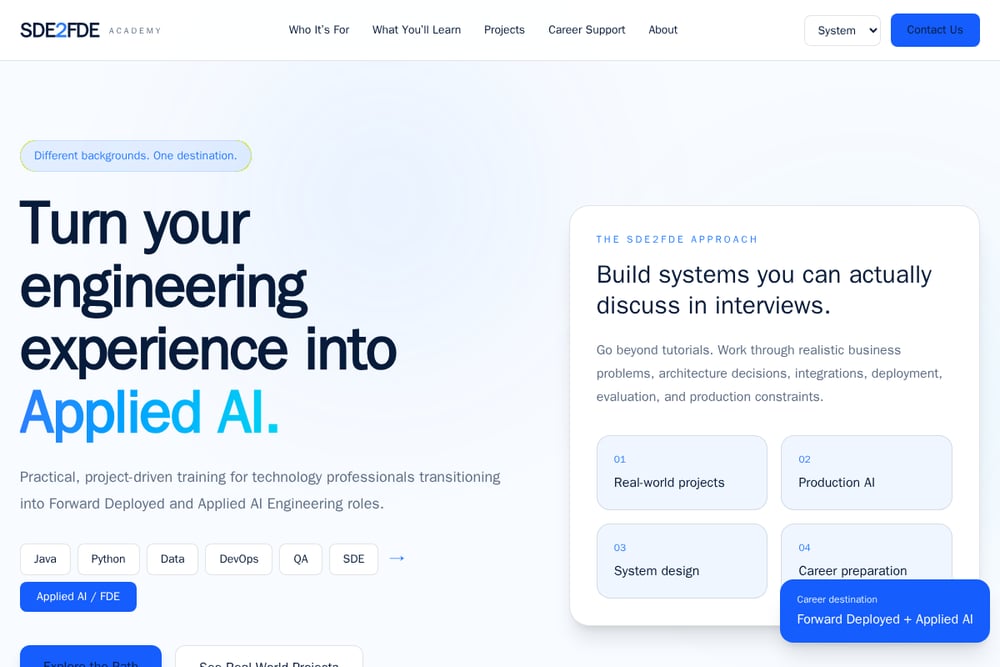 A screenshot of the sde2fde-website website.
SDE2FDE Academy is built specifically for experienced engineers who want to move into Forward Deployed and Applied AI Engineering roles. The program covers production AI, agents, RAG, system design, integrations, deployment, evaluation, and career preparation through real-world projects. It is designed for software, Java, Python, data, DevOps, and QA engineers who want to build on their existing experience rather than start from scratch. You work through realistic business problems and architecture decisions so you can discuss your work credibly in interviews. The focus on customer-facing delivery and production constraints sets it apart from general AI course libraries.
#3 DataCamp Associate AI Engineer for Developers
 A screenshot of the DataCamp Associate AI Engineer for Developers website.
DataCamp's Associate AI Engineer for Developers track is a 29-hour, self-paced program with a certification option. You build chatbots, semantic search, and recommendation engines using the OpenAI API, Hugging Face, LangChain, and Pinecone. The track covers prompt engineering, embeddings, vector databases, LLMOps, tool calling, and the Model Context Protocol. It is a flexible option if you want to learn on your own schedule and already have developer experience. The subscription model keeps costs predictable, though you need to stay self-motivated to finish.
#4 DeepLearning.AI
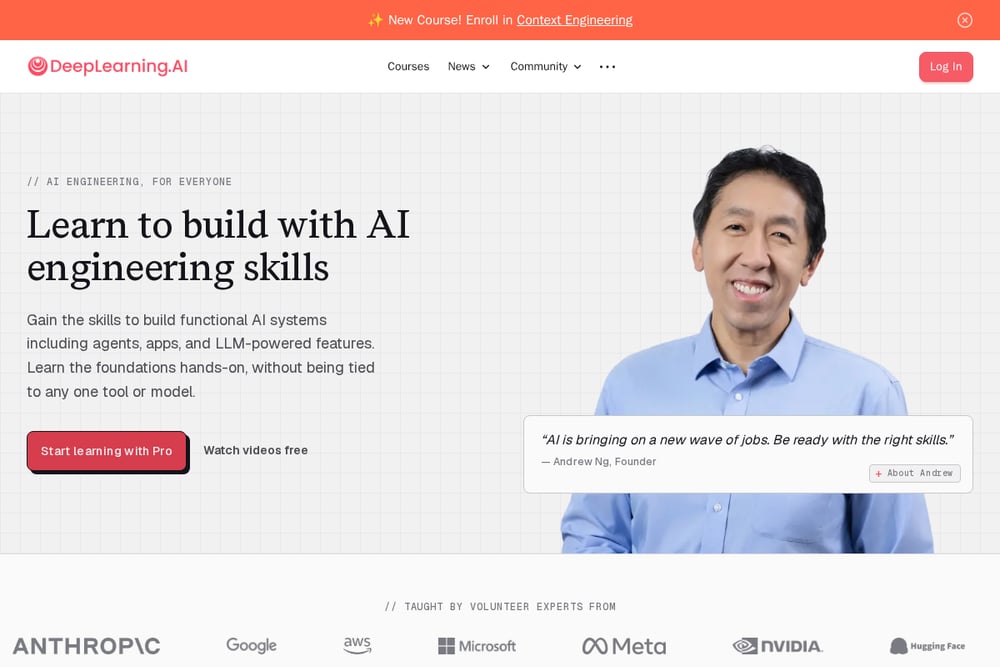 A screenshot of the DeepLearning.AI website.
DeepLearning.AI offers a broad catalog of AI engineering courses, including short courses on agents, prompt engineering, and context engineering. The platform emphasizes tool-agnostic foundations, so you learn concepts that transfer across models and frameworks. Andrew Ng's team has built a reputation for clear, hands-on instruction that helps millions of developers get started with AI. It is a strong choice if you want to explore multiple topics before committing to a specialization. The breadth is a strength, but it also means you need to assemble your own path toward a specific job title.
#5 Coursera IBM AI Engineering Professional Certificate
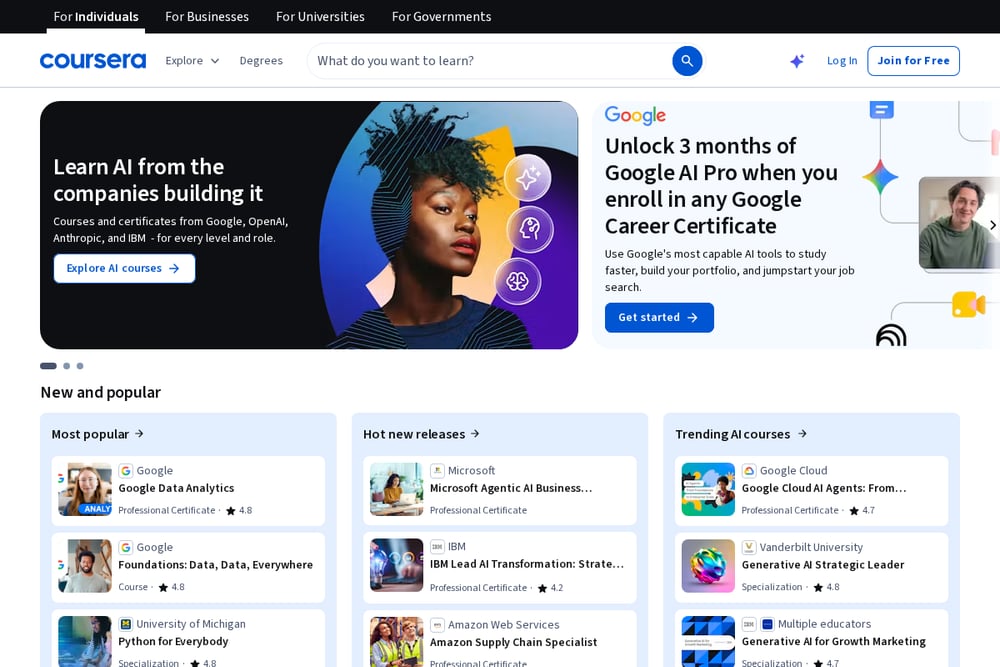 A screenshot of the Coursera IBM AI Engineering Professional Certificate website.
The IBM AI Engineering Professional Certificate on Coursera is a structured, 13-course series that covers machine learning, deep learning, generative AI, and deployment. You work with Python, PyTorch, TensorFlow, Keras, Spark, and vector databases, and you earn a shareable credential. The program is intermediate-level and takes less than four months at a recommended pace. It is a good fit if you want a recognizable certificate and a formal curriculum. The focus leans more toward ML engineering than Forward Deployed or customer-facing AI work.
How to Choose the Right Program for You
Start with your background. If you are an experienced software, Java, Python, data, DevOps, or QA engineer, you want a program that builds on what you already know. SDE2FDE Academy is designed for that exact transition. If you are still in school, CodePath's free, instructor-led pathway may be a better fit. If you need flexibility, DataCamp's self-paced track lets you learn around your schedule. If you want to explore broadly before specializing, DeepLearning.AI gives you a wide catalog. If you value a formal credential, Coursera's IBM certificate delivers that. Match the format to your life, and match the curriculum to the job you actually want.
Where Automation Fits Into Your Learning Path
AI engineering is not just about writing code; it is about building systems that work in production. As you evaluate programs, look for coverage of deployment, evaluation, observability, and integration. The best training will have you automate workflows, connect APIs, and handle real constraints like latency, cost, and reliability. SDE2FDE Academy emphasizes these production concerns alongside project work. DataCamp covers LLMOps and tool calling. DeepLearning.AI teaches agents and context engineering. The more you practice shipping automated systems, the more credible you become in interviews.
The Bottom Line
The US Applied AI training market has something for every stage of your career. CodePath serves students. DataCamp serves self-paced developers. DeepLearning.AI serves curious builders. Coursera serves credential-seekers. And SDE2FDE Academy serves experienced engineers who want a direct path into Forward Deployed and Applied AI roles. Pick the one that matches your background, your schedule, and your target job. Then commit, build real projects, and tell the story of what you shipped.