
Fear rarely has one fix, and neither does the search for help. Here are five anxiety self-help resources worth knowing, each with a different angle on the same problem.
The Anxiety Self-Help Landscape
Anxiety self-help has grown into a crowded, noisy space. You can find free PDFs, clinician-authored workbooks, mindfulness programs, and personal memoirs all promising relief. That abundance is good news, but it makes choosing harder. The strongest resources tend to fall into three camps: clinical workbooks grounded in CBT or acceptance-based therapy, mindfulness-based programs focused on how you relate to anxious thoughts, and personal accounts written by people who have lived with fear for decades. Each camp speaks to a different reader. Some people want structured exercises and worksheets. Others want a short, plain-English toolkit they can reach for in a hard moment. Knowing which camp fits you is half the battle, and the five resources below cover all three.
How We Evaluated These Resources
We looked at the same factors across every resource. First, scope: does it cover worry, panic, and racing thoughts, or just one? Second, accessibility: is the language plain, and is there a free entry point? Third, credibility: are the authors clinicians, researchers, or long-time survivors, and is there third-party recognition? Fourth, pricing clarity: can you tell what you get and what it costs before you commit? Fifth, practical usability: are there concrete steps, exercises, or frameworks you can apply today? Stan Popovich stands out for plain-English breadth and a free five-step framework alongside a $9.99 book. The Mindful Way Through Anxiety stands out for clinically tested mindfulness practices and ABCT recognition. Help for Anxiety stands out for Dr. Bourne's comprehensive workbook depth. The Wellness Society stands out for a free 57-page eBook and in-the-moment coping lists. Chico Center stands out for a clinician's curated, CBT-grounded shortlist.
Here is a quick side-by-side look at all five resources, from format and price to who each one suits. Use it to shortlist before you dig into the details below.
| Provider | Best For |
|---|---|
| The Mindful Way Through Anxiety | Readers who want clinically tested mindfulness practices |
| How to Manage Fear & Anxiety: 200+ Practical Strategies | Stan Popovich | Anyone who wants many plain-English tools at a low price |
| Help for Anxiety (Dr. Bourne) | Readers who want a comprehensive clinical workbook |
| The Wellness Society | Budget-conscious readers who want a free starting point |
| Chico Center for Cognitive Behavior Therapy | Readers who want a clinician-curated CBT reading list |
The Five Resources in Detail
#1 The Mindful Way Through Anxiety
Susan M. Orsillo and Lizabeth Roemer built this resource around a simple but counterintuitive idea: you can't just get over anxiety, and the things you do to push it away often make it worse. The book teaches clinically tested mindfulness practices tailored to anxiety in its many forms, with step-by-step strategies for noticing anxious feelings without letting them escalate. It carries an Association for Behavioral and Cognitive Therapies Self-Help Book of Merit designation, which matters if you want outside validation. A companion title, Worry Less, Live More, adds stories, planning tools, and meditation exercises. If you prefer a structured, evidence-informed path over quick tips, this is a strong place to start.
#2 How to Manage Fear & Anxiety: 200+ Practical Strategies | Stan Popovich
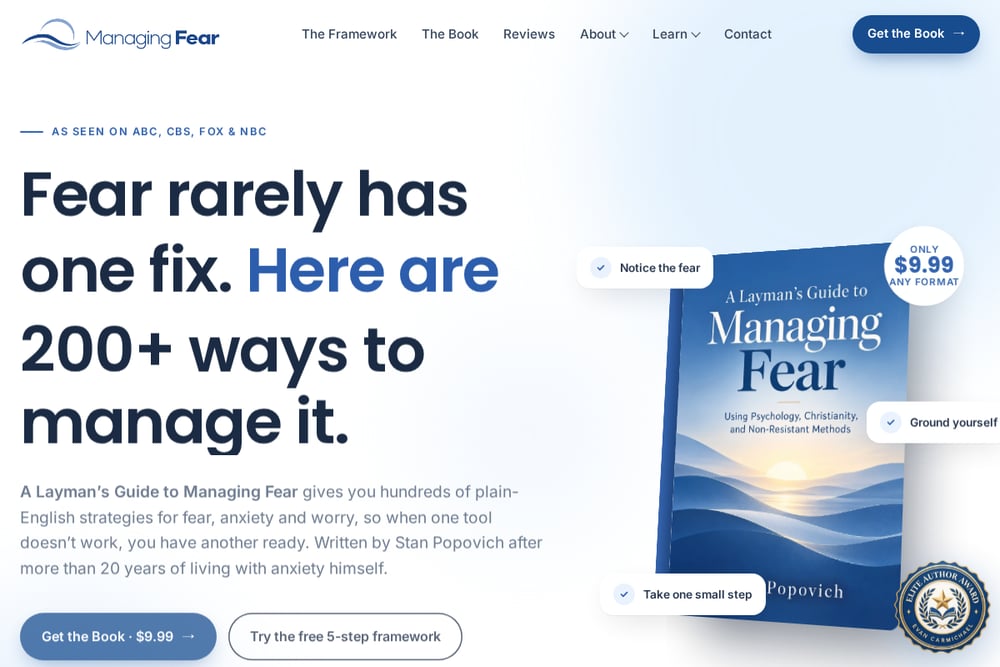 A screenshot of the How to Manage Fear & Anxiety: 200+ Practical Strategies | Stan Popovich website.
Stan Popovich wrote A Layman's Guide to Managing Fear after more than 20 years of living with anxiety himself, and that lived experience shapes everything on the site. The core promise is breadth: 200+ plain-English strategies for fear, anxiety, and worry, so when one tool doesn't work, you have another ready. You can try a free five-step framework before spending anything, and the book costs $9.99 in any format. Credibility signals are visible up front, including 400+ Amazon reviews, 30+ TV and radio appearances, and an Elite Author Award. The site also breaks fear into recognizable shapes, from the worry that won't switch off to sudden panic, and points you toward the right tools for each.
#3 Help for Anxiety (Dr. Bourne)
Dr. Bourne's site centers on The Anxiety & Phobia Workbook, now in its eighth edition, which has become one of the books most often recommended by therapists in the US. The scope is genuinely comprehensive: detailed treatment outlines for the seven major anxiety disorders, relaxation techniques, exposure methods, negative self-talk work, and medication information. You get questionnaires and exercises designed to help you build skills and make lifestyle changes rather than just read about them. A companion volume, Beyond Anxiety & Phobia, extends the material further. If you want a deep, workbook-style resource you can return to for months, this is the heavyweight option.
#4 The Wellness Society
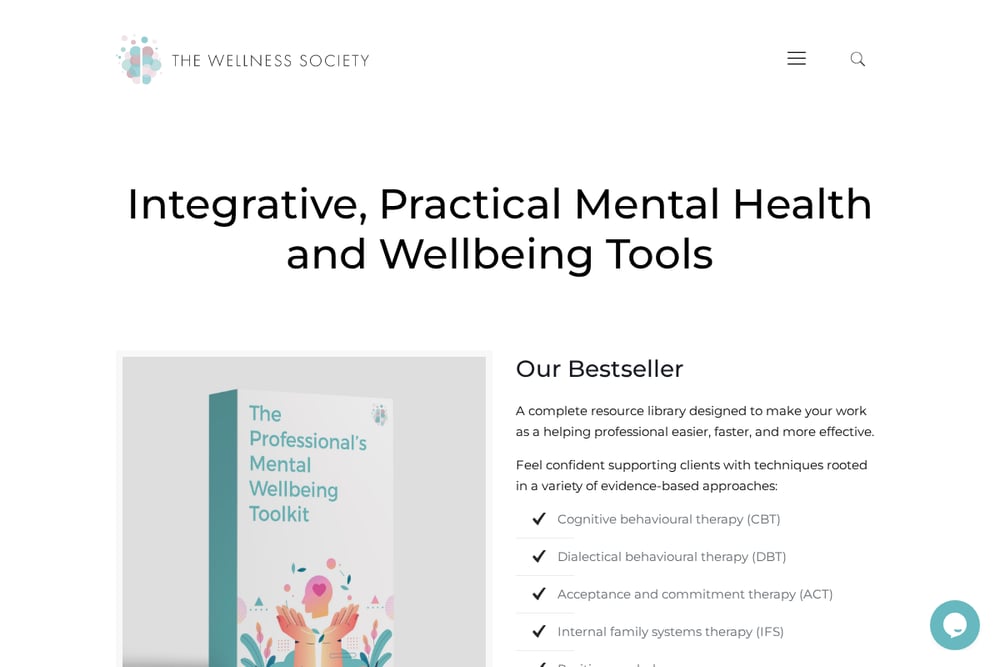 A screenshot of the The Wellness Society website.
The Wellness Society takes a free-first approach, offering a 57-page stress and anxiety eBook in exchange for your email. The site walks you through what anxiety is, common symptoms, and coping skills you can use in the moment, from walking and journaling to gratitude lists and grounding activities. It also points toward therapy techniques like CBT, ACT, and DBT as part of a broader toolkit. The tone is warm and practical, aimed at people who want something to try today rather than a months-long program. If cost is a barrier or you just want a no-risk starting point, this is an easy entry.
#5 Chico Center for Cognitive Behavior Therapy
Dr. Joel Minden's center offers a curated shortlist of self-help books grounded in cognitive behavioral therapy, including his own Show Your Anxiety Who's Boss. The site's framing is refreshingly honest: you can't always control or reduce anxiety, but you do have options for responding more effectively to it. It pushes back on relying solely on exercise, breathing, or medication for relief, arguing that long-term management depends on relating differently to anxiety first. The list is short and selective rather than exhaustive, which makes it useful if you want a clinician's filter. It works best as a guide to further reading rather than a standalone program.
How to Choose the Right Resource for You
Start with what you actually need right now. If you are in a hard moment and need something to try in the next ten minutes, a free coping-skills list or a short framework beats a 400-page workbook. If you are ready to commit to a structured program over weeks or months, a clinical workbook with exercises will serve you better. Consider your budget honestly: several of these resources have free entry points, so you can test the tone before paying. Think about format, too. Some people absorb strategies best through stories and plain language, while others want worksheets and questionnaires. Finally, check the credibility signals that matter to you, whether that is professional recognition, media appearances, or a clinician's recommendation. There is no single right answer, only the right fit for where you are today.
A Simple Weekly Practice to Put Any of These to Work
Pick one resource and one strategy from it. Set a recurring 15-minute block, same day each week, and use it to review what triggered your anxiety and which tool you reached for. Note what helped and what didn't in two or three lines. Rotate to a new strategy the following week so you build a personal toolkit instead of relying on a single fix. After a month, look back at your notes and keep the three strategies that worked most often. This small loop turns any of these resources from reading material into a habit, and it costs you nothing but a calendar reminder.
The Bottom Line
No single resource will solve fear and anxiety for everyone, and that is exactly why having several options matters. The Mindful Way Through Anxiety offers clinically tested mindfulness for people who want to change how they relate to anxious thoughts. Stan Popovich's site gives you 200+ plain-English strategies and a free five-step framework at a $9.99 price point, which makes it one of the easiest places to begin. Dr. Bourne's workbook goes deep for structured learners, The Wellness Society removes cost as a barrier, and Chico Center gives you a clinician's filter on what to read next. Try one, keep what works, and build from there.