
Cadavers were never built for repetition. Simulation models are. If you train clinicians, you need tools that let them fail safely and practice until confidence sticks.
The Shift Toward Realistic, Repeatable Medical Simulation
Medical training has moved far beyond plastic arms and static diagrams. Today's simulation models replicate tissue layers, vessel branching, and ultrasound response so learners can practice real procedures without risk. You see this across orthopedics, vascular access, and veterinary medicine. The demand is simple: more repetitions, better feedback, and fewer surprises in the clinical setting. Companies in this space now compete on anatomical accuracy, material durability, and how well their models integrate into existing curricula. Whether you run a simulation lab, a residency program, or a sales demo team, the right model can change how quickly skills transfer to the bedside.
How We Evaluated These Simulation Model Providers
We looked at the same factors for every company on this list. First, service scope: do they cover a single procedure or a full range of specialties? Second, material realism: how well do their models respond to needles, ultrasound, and repeated punctures? Third, pricing clarity: can you find costs or request a quote without jumping through hoops? Fourth, local fit: do they support US-based training programs, shipping, and customer service? Fifth, educational support: do they offer guides, workshops, or demo resources? Each company stood out in different ways. Sawbones brings deep orthopedic and biomechanical expertise. Elevate Healthcare offers strong ultrasound and X-ray verification. Simulab covers a broad procedural catalog. Laerdal integrates simulation into larger training ecosystems. SurgiReal focuses on affordable, portable skill pads. Your best choice depends on your training goals, not a single score.
Here is a quick look at five companies that supply anatomical training models for medical simulation. Use this comparison to narrow your shortlist before you request demos or quotes.
| Provider | Best For |
|---|---|
| Elevate Healthcare | Complete upper extremity vascular access training with ultrasound and X-ray verification |
| Best Anatomical Medical Training Models Company | Sawbones | Orthopedic and biomechanical models plus ultrasound-guided vascular access trainers |
| Simulab Corporation | Broad procedural task trainers across emergency, critical care, and surgical specialties |
| Laerdal Medical | Integrated simulation programs with broad skills training and support services |
| SurgiReal | Affordable, portable skill pads and ultrasound access models for repeated practice |
The 5 Companies in Focus
#1 Elevate Healthcare
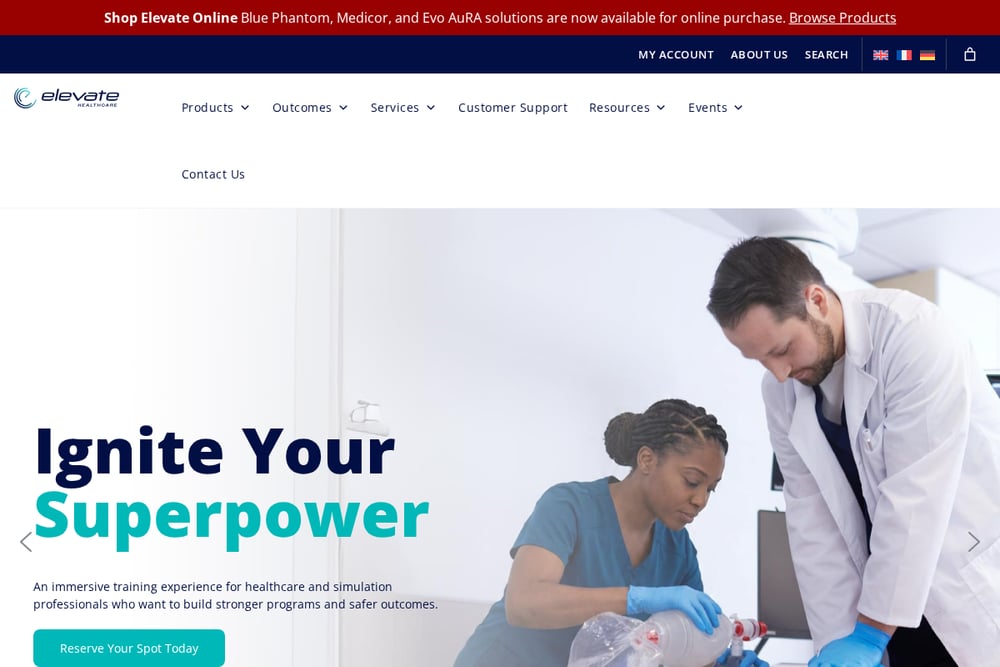 A screenshot of the Elevate Healthcare website.
Elevate Healthcare brings together Blue Phantom, Medicor, and Evo AuRA solutions under one roof. Their Gen II PICC, PIV, and Arterial Line Vascular Access Ultrasound Training Model lets you practice three procedures on a single unit. You get ultrasound and X-ray verification, plus a nine-vessel system that includes cephalic, radial, basilic, ulnar, and medial cubital veins. The self-healing SimulexUS tissue supports over 1,000 needle punctures, and a hand-bulb arterial pulsation system helps you differentiate vessels realistically. If you need complete upper extremity access training with catheter placement verification, this is a strong fit. You can explore their full catalog at Elevate Healthcare.
#2 Best Anatomical Medical Training Models Company | Sawbones
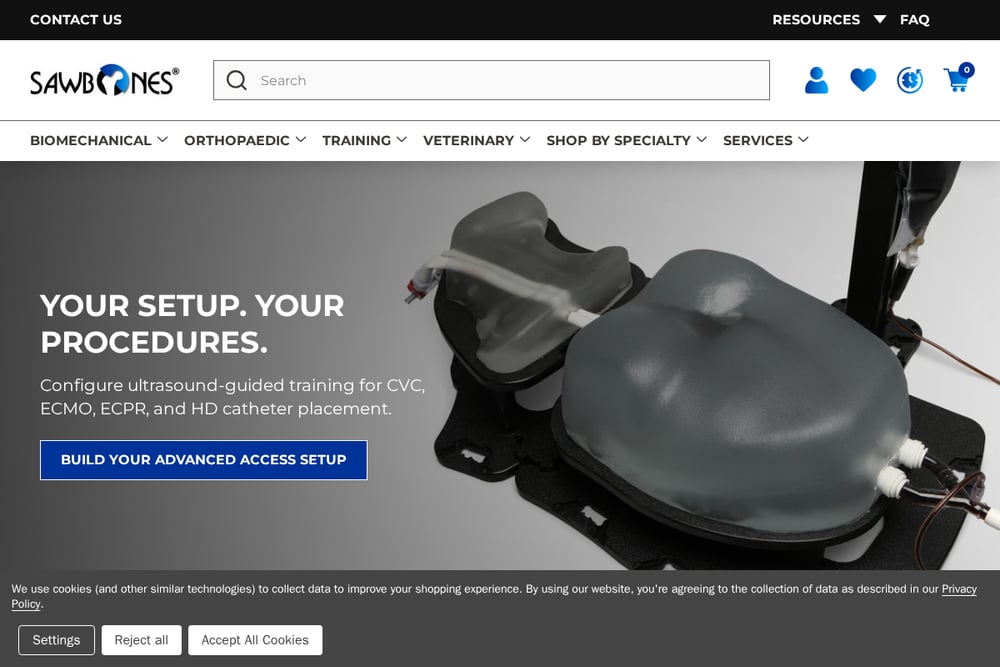 A screenshot of the Best Anatomical Medical Training Models Company | Sawbones website.
Sawbones has been making anatomical models for decades, and it shows in their range. You can find bone models for head and neck, hip and pelvis, spine, torso, and extremities. Soft tissue models and medical imaging models cover the same regions. For vascular access, they offer ultrasound-guided trainers for PIV, neonatal IJ and carotid cannulation, and adult IJV cannulation with guidewire tracking. Their absolute™ Bones, cylinders, and sheets support biomechanical testing. They also provide services like anatomical workshop models, clear bone models, finite element analysis, and machined blocks. If you want a partner who can handle orthopedics, vascular access, and custom biomechanical work, Sawbones is worth a close look. Visit Sawbones to see their full simulation catalog.
#3 Simulab Corporation
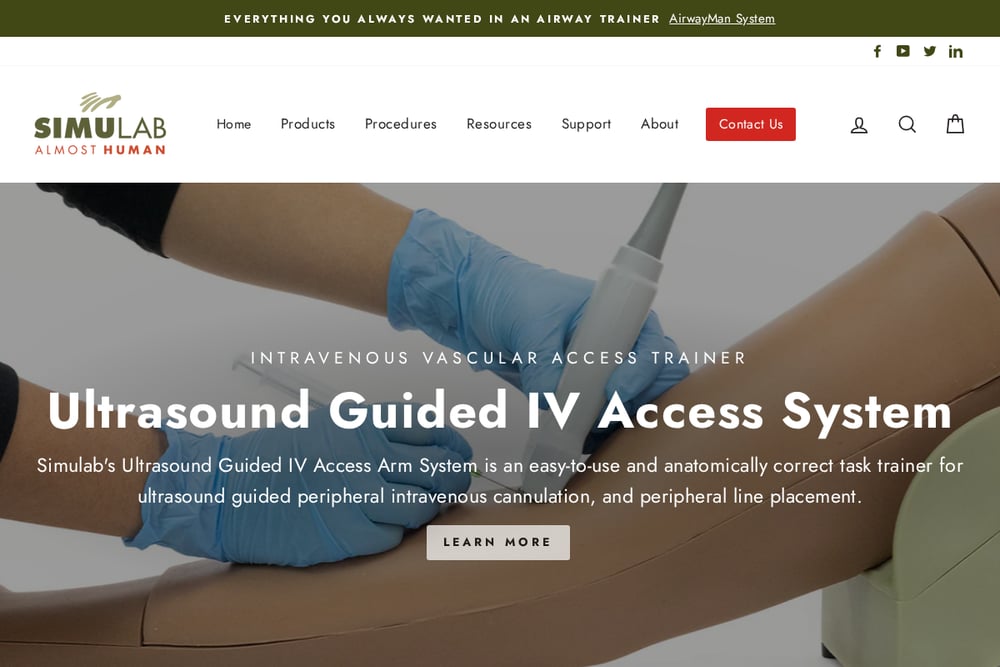 A screenshot of the Simulab Corporation website.
Simulab offers a deep catalog of task trainers and simulators across many specialties. Their vascular access collection includes the CentraLineMan System, FemoraLineMan System, PICCLineMan Trainer, and Arterial Line / ABG Trainer. You also find SonoMan and SonoSkin trainers for ultrasound practice. Beyond vascular access, they cover airway management, trauma, lumbar puncture, regional anesthesia, and surgical skills. The product collections are organized by department, so you can quickly find tools for emergency medicine, intensive care, nursing, or surgery. If you need a broad procedural library from a single vendor, Simulab is a practical choice. Explore their offerings at Simulab Corporation.
#4 Laerdal Medical
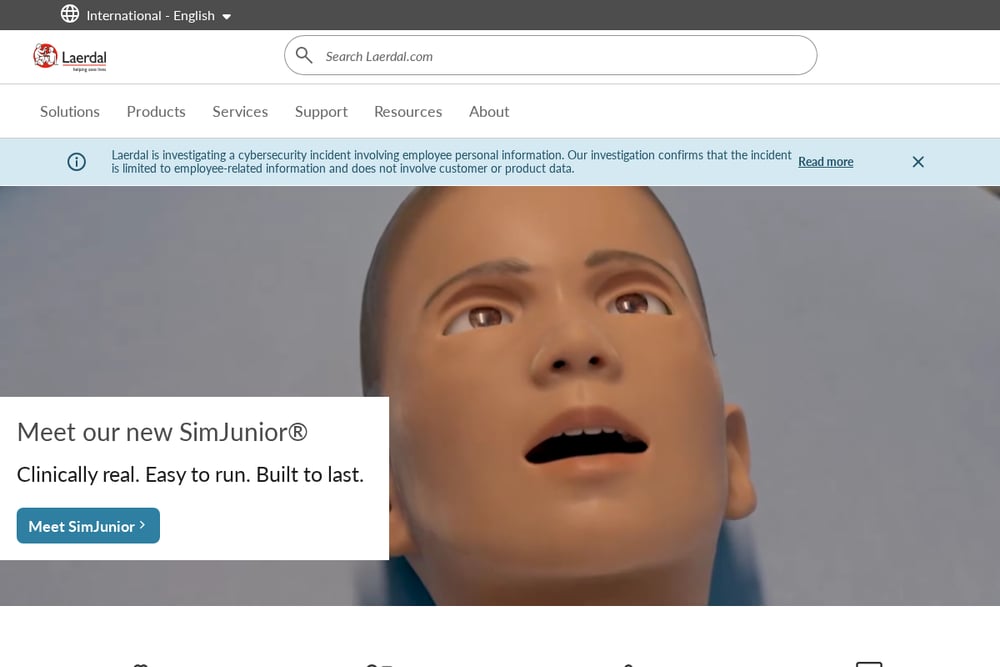 A screenshot of the Laerdal Medical website.
Laerdal is a global name in medical simulation, and their ultrasound vascular access trainer fits into a larger ecosystem. They offer skills trainers for airway management, defibrillation, cardiology, and neonatal care. Their venous and arterial access line includes products from Limbs & Things, giving you options for different training needs. Laerdal also provides simulation services, technical support, and educational resources like webinars and product downloads. If you want a vendor that can support your entire simulation program, not just one model, Laerdal is a strong contender. You can review their solutions at Laerdal Medical.
#5 SurgiReal
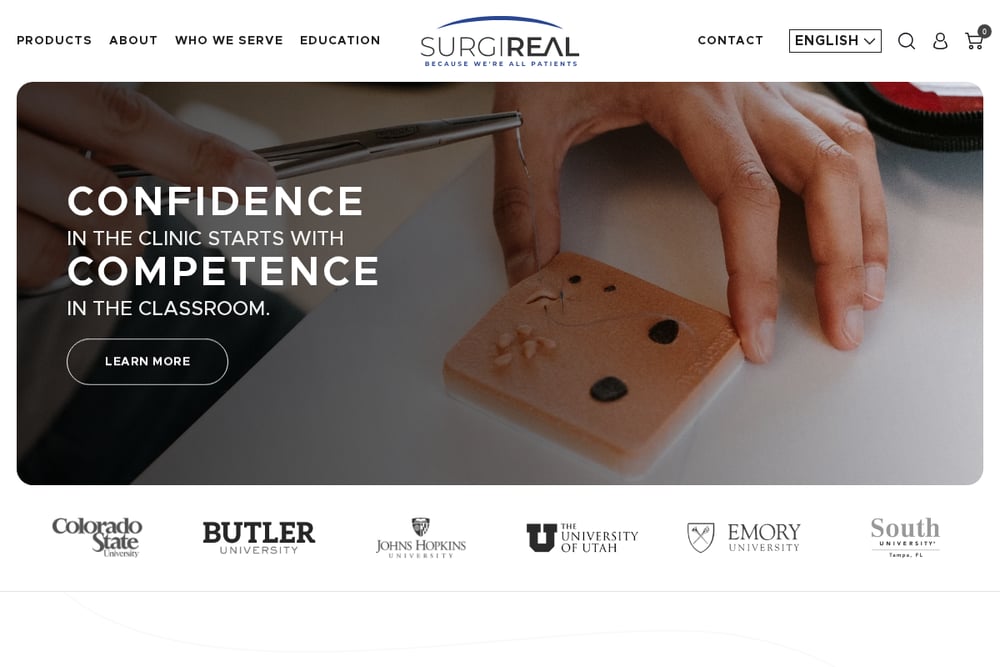 A screenshot of the SurgiReal website.
SurgiReal focuses on affordable, portable simulation products for skills practice. Their ultrasound vascular access model is designed for realistic needling and ultrasound response. They also offer suture pads, specialty pads for cyst and abscess removal, and veterinary products for large and small animals. The kits combine pads with instruments and suture for a compact practice experience. If you are building a low-cost skills lab or need take-home practice tools, SurgiReal is a smart option. Check out their range at SurgiReal.
How to Choose the Right Simulation Model Partner
Start with your training objectives. Are you teaching basic PIV access or advanced ECMO cannulation? That answer narrows the field fast. Next, consider your learners. Neonatal and pediatric programs need smaller anatomy, while orthopedic residents need bone models that accept screws and implants. Then look at your budget and space. A full-body simulator costs more and takes up room, while task trainers and pads are cheaper and portable. Ask about material durability. Self-healing tissue that lasts 1,000 punctures saves money over time. Check for educational support like guides, workshops, and demo videos. Finally, confirm shipping and customer service for your region. A quick call to each vendor will tell you a lot about how they treat training programs.
Building a Repeatable Simulation Workflow
You can turn simulation into a repeatable workflow with a few simple steps. First, map each procedure to a specific model and learning objective. Second, schedule regular practice blocks so learners get consistent repetitions. Third, use the same setup each time, including ultrasound settings and needle gauges, to reduce variables. Fourth, track performance with checklists or software so you can see progress. Fifth, rotate models based on wear and tear, and keep replacement parts on hand. Sixth, collect feedback from learners and instructors to refine your scenarios. This approach works whether you run a small skills lab or a large simulation center. The goal is to make practice predictable, measurable, and easy to repeat.
The Bottom Line on Anatomical Training Models
The right simulation model does more than look realistic. It builds muscle memory, confidence, and better patient outcomes. Sawbones brings deep orthopedic and biomechanical expertise plus vascular access trainers. Elevate Healthcare delivers complete upper extremity access training with verification. Simulab offers a broad procedural catalog. Laerdal supports entire simulation programs. SurgiReal keeps practice affordable and portable. Your next step is simple: request demos, ask about pricing, and test the models with your actual learners. The best tool is the one your team will use again and again.