
Your voice is your brand. These five AI writing partners help you keep it—even when you're drafting at scale.
The New Wave of Voice-First AI Writing
Generic AI writing tools are everywhere. But they all sound the same. That's a problem if you're a founder, marketer, or creator who needs to sound like you. A new category of AI writing partners is emerging. They learn from your samples, build a style profile, and generate drafts that actually match your voice. This isn't about grammar checks or templates. It's about preserving personal identity across every channel. The tools below represent different approaches to that challenge. Some focus on deep stylometry. Others offer broad platform integration. All five are worth knowing as you build your writing stack.
How We Evaluated These Writing Partners
We looked at five factors. First, voice personalization: does the tool learn from your samples or just apply generic instructions? Second, workflow integration: can it connect to your existing channels and tools? Third, pricing clarity: is the cost transparent and predictable? Fourth, team readiness: does it support collaboration or just solo writers? Fifth, editorial depth: does it offer courses, analysis, or guidance beyond raw generation? Spiral stood out for its stylometry-driven approach and bundled editorial resources. Jetwriter AI impressed with its simple personalization profile setup. Storyloft showed strength in long-form author workflows. Noren offered a model-agnostic voice profile system. Grammarly delivered unmatched cross-platform reach. Each tool serves a different writing context.
Here's a quick look at five AI writing partners that help you sound like you.
| Provider | Best For |
|---|---|
| Grammarly | Writers who want AI help everywhere they type |
| Spiral – The writing partner for you and your agent. | Writers who need drafts that sound like them |
| Noren | Writers who switch between AI models |
| Jetwriter AI | Busy professionals writing emails and messages |
| Storyloft | Book authors managing long-form projects |
The 5 Writing Partners in Detail
#1 Grammarly
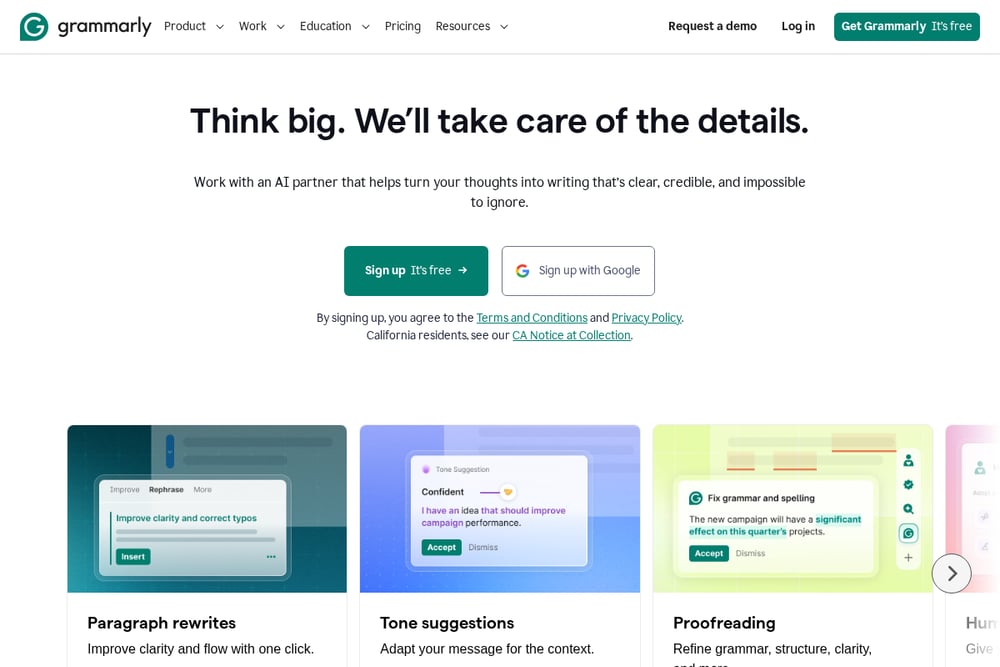 A screenshot of the Grammarly website.
Grammarly is the household name in AI writing assistance. It works across over a million apps and websites, from Google Docs to Slack to Salesforce. You get grammar checks, tone suggestions, and generative AI writing help without switching tabs. The platform also offers team and enterprise plans for larger organizations. For many writers, it's the default layer that sits on top of everything else. See how it positions its AI writing assistant at grammarly.com/ai-writing-assistant.
#2 Spiral – The writing partner for you and your agent.
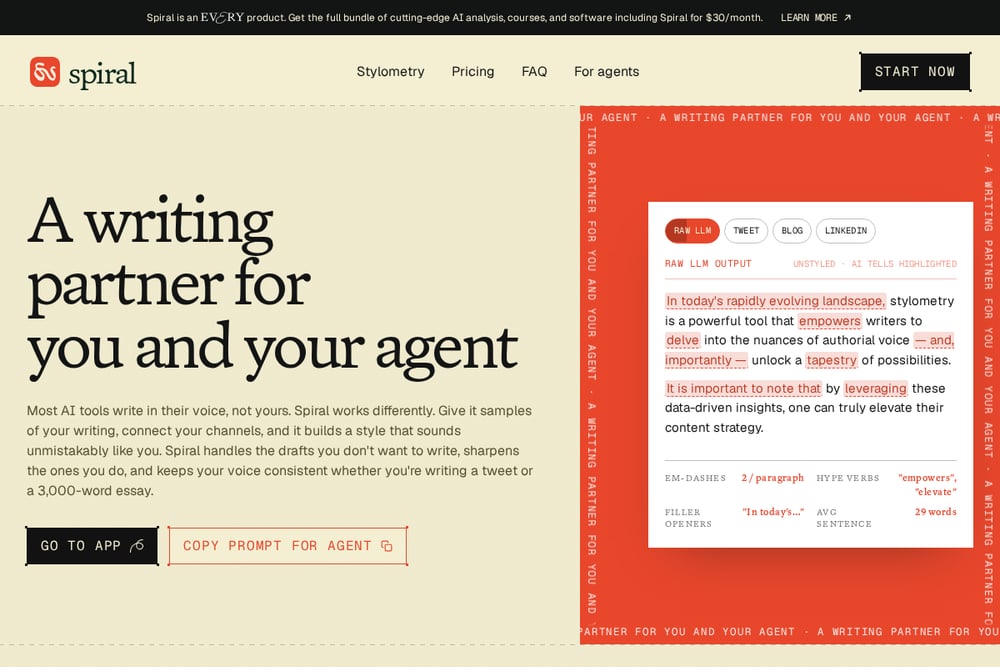 A screenshot of the Spiral – The writing partner for you and your agent. website.
Spiral takes a different path. Instead of generic AI output, it uses stylometry to learn your unique voice from writing samples. You connect your channels, and Spiral builds a style that sounds unmistakably like you. It handles drafts you don't want to write and sharpens the ones you do. The tool is part of a $30/month bundle that includes AI analysis, courses, and software. As the site puts it, most AI tools write in their voice, not yours—Spiral works differently. Learn more at writewithspiral.com.
#3 Noren
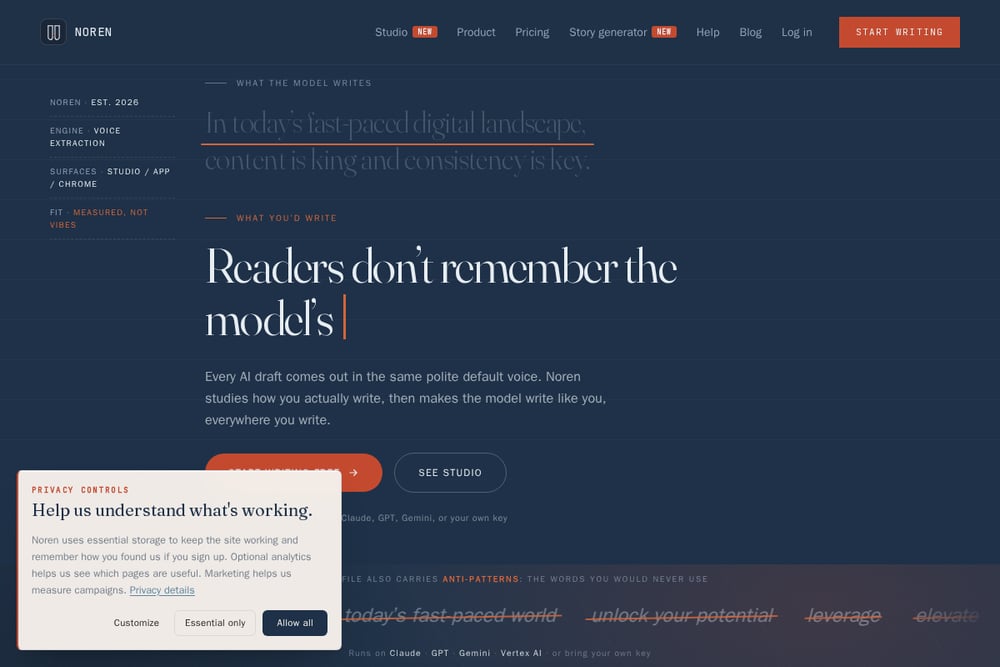 A screenshot of the Noren website.
Noren focuses on making your voice portable across models. It learns from your real writing samples and produces inspectable instructions you can reuse. That means your voice profile can travel from one LLM to another. The platform offers a free tier and runs on macOS. It's built for writers who want control over how their style is represented. Noren also publishes comparisons of AI writing tools that sound like you. Read its take at usenoren.ai/blog/best-ai-tools-that-write-in-your-voice.
#4 Jetwriter AI
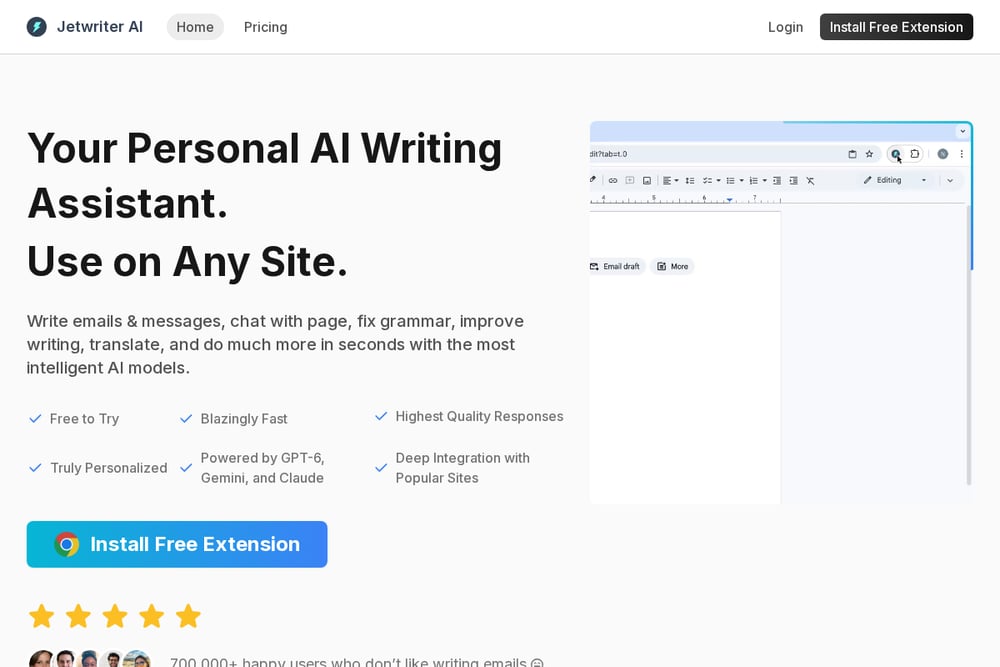 A screenshot of the Jetwriter AI website.
Jetwriter AI keeps personalization simple. Its Personalize AI feature lets you create a profile with your job, company, and preferred communication style. You tell it how you write—concise, formal, casual—and it adjusts. The tool also offers Custom Writing Styles for more granular control. It's aimed at emails, messages, and everyday business writing. If you want a quick way to teach AI your voice, this is a straightforward option. See the approach at jetwriter.ai/blog/personalized-ai.
#5 Storyloft
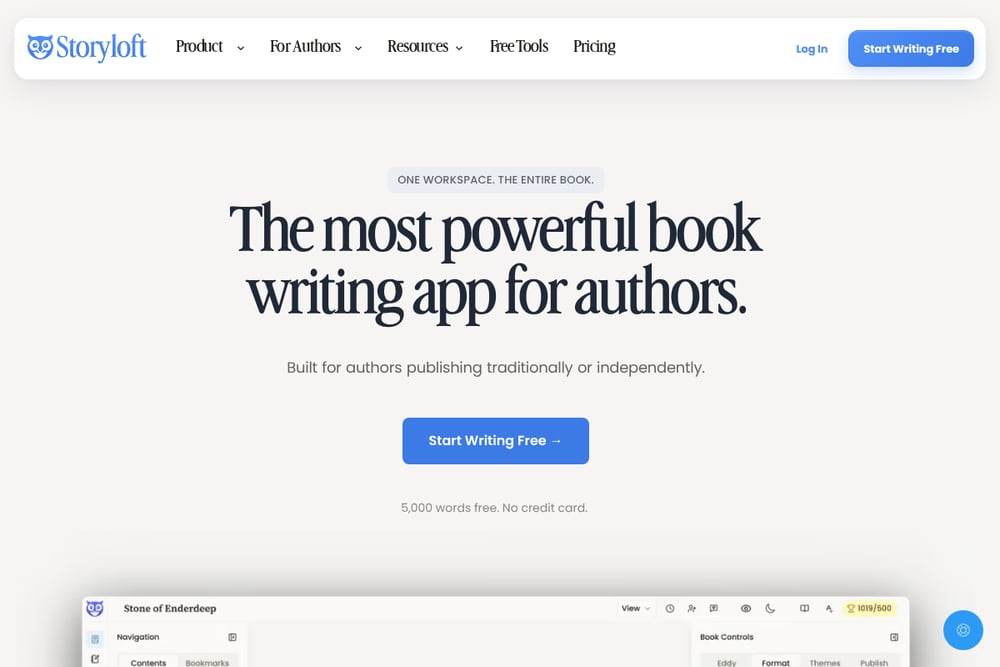 A screenshot of the Storyloft website.
Storyloft is built for authors, not marketers. It combines manuscript editing, worldbuilding, and publishing tools in one workspace. Its Eddy AI book editor gives developmental feedback that's aware of your manuscript context. Voice preservation matters here too—Storyloft aims to keep your style intact across long-form projects. You also get formatting, illustration, and export features for print and EPUB. For book writers, it's a full production pipeline. Explore its voice-based approach at storyloft.app/voice-based-ai-writing.
How to Choose Your Writing Partner
Start with your writing context. If you write short-form business content all day, prioritize tools that integrate with your email and messaging apps. If you're drafting long-form essays or books, look for manuscript-aware editors and style preservation over thousands of words. If you work with a team, check for collaboration features and shared voice profiles. If you switch between AI models, choose a tool that exports your voice profile in a portable format. Pricing matters too. Some tools bundle courses and analysis; others charge per seat. Match the tool to your workflow, not the other way around.
Building a Voice-Preserving Writing Workflow
You can combine these tools for a stronger workflow. Use Spiral or Noren to build your core voice profile from samples. Then route different writing tasks to the right tool: Grammarly for real-time editing across apps, Jetwriter AI for quick emails, Storyloft for book-length projects. Keep a shared style guide that captures your voice rules. Review AI drafts against that guide before publishing. The goal isn't to automate your voice away—it's to scale it without losing what makes it yours.
The Bottom Line on Voice-First AI Writing
AI writing tools are getting better at generating text. But generating text that sounds like you is still rare. The five tools here take different routes to that goal. Grammarly offers ubiquity. Spiral offers stylometry-driven personalization. Noren offers portability. Jetwriter AI offers simplicity. Storyloft offers depth for authors. Your choice depends on where you write, how much you write, and how much your voice matters. For most writers, it matters a lot. Pick the partner that helps you sound like yourself—at any scale.