
Your operations team is drowning in repetitive tasks while your competitors are shipping faster with leaner crews. The right AI workflow automation platform can close that gap without forcing you to replace the people who already know your business.
The AI Workflow Automation Landscape in 2026
AI workflow automation has moved well past simple rule-based scripts. Today's platforms interpret intent, pull context from multiple systems, and orchestrate entire processes end to end. That shift matters for small and mid-sized teams that cannot afford a dedicated automation engineer. You need tools that connect to what you already use, show measurable results quickly, and scale without linear cost increases. The market now splits into enterprise-grade agentic suites, no-code app builders, and service-led integrators. Each path has trade-offs in setup time, pricing transparency, and how much of your existing stack you keep.
How We Evaluated These Platforms
We looked at five factors across every platform. First, service scope: does it handle task-level automation, cross-system orchestration, or both? Second, pricing clarity: can you find real numbers or at least a clear tier structure without a sales call? Third, integration depth: how well does it connect to Slack, Teams, email, and CRM tools your team already lives in? Fourth, time to value: how fast can a small team see measurable productivity gains? Fifth, local and team-size fit: does the platform serve teams of 15 to 45 people as well as it serves enterprises? SaelixAI stood out for transparent tiered pricing and a four-step onboarding flow aimed squarely at operations and support teams. Moveworks impressed with its reasoning engine and deep ServiceNow integration. Pega showed strength in enterprise-scale case management and real-time AI. Airtable offered a flexible no-code path with native AI agents inside custom apps. Netrix brought a service-led model with fractional CIO and Chief AI Officer support for mid-market firms.
Here is a quick look at five platforms that can help your team automate repetitive work, reduce response times, and scale operations without adding headcount linearly.
| Provider | Best For |
|---|---|
| Moveworks | Enterprises already invested in ServiceNow and ITSM workflows |
| SaelixAI - Optimiza tu equipo con IA | Small and mid-sized operations and support teams that want fast, transparent automation |
| Pega | Large enterprises with complex case management and compliance needs |
| Airtable | Teams that want to build custom apps with embedded AI agents, no code required |
| Netrix | Mid-market firms that want a service partner for AI strategy and implementation |
The 5 Platforms in Detail
#1 Moveworks
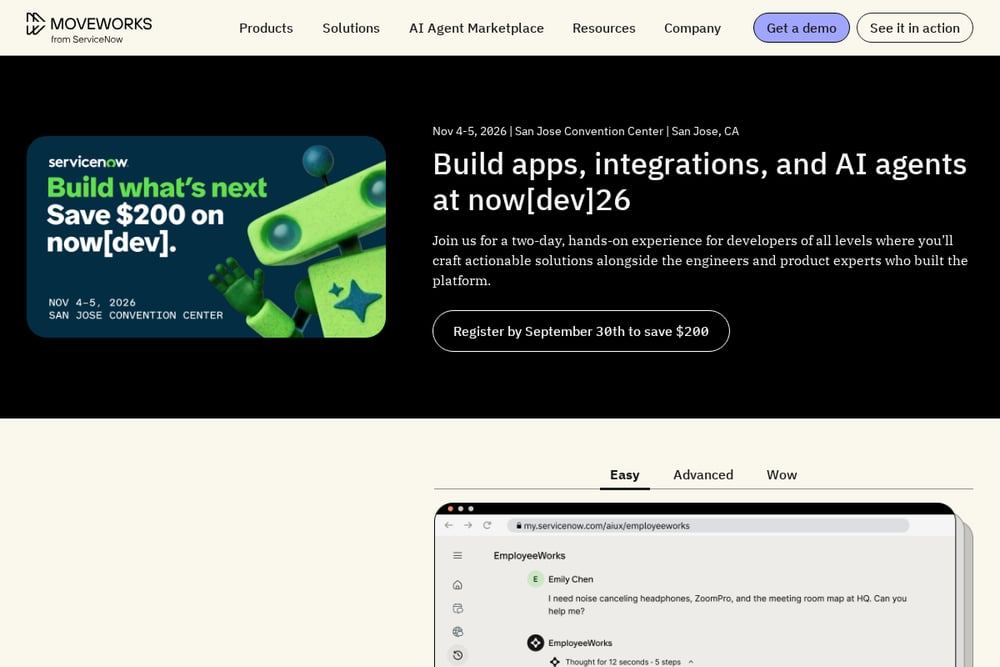 A screenshot of the Moveworks website.
Moveworks positions itself as an agentic AI platform for the enterprise, with a reasoning engine that interprets user intent and orchestrates execution across systems. Its AI Assistant and Enterprise Search capabilities help employees find answers and complete tasks without leaving their workflow. The platform integrates deeply with ServiceNow, making it a strong fit for IT service management and employee experience use cases. Moveworks also offers Tool Studio and Knowledge Studio for building custom automations and grounding AI in your own content. If your organization already runs on ServiceNow and needs enterprise-grade agentic automation, this is a serious contender. You can read more about their approach to AI workflow automation on their blog.
#2 SaelixAI - Optimiza tu equipo con IA
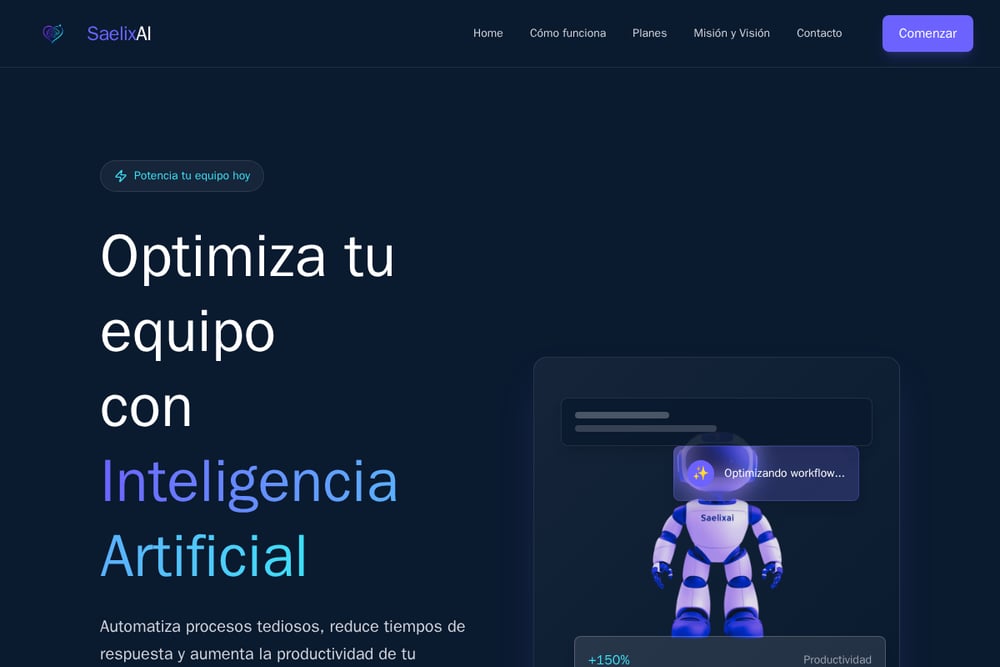 A screenshot of the SaelixAI - Optimiza tu equipo con IA website.
SaelixAI focuses on a problem most automation vendors ignore: teams of 15 to 45 people who need real results without enterprise complexity. Its AI agents connect to Slack, Teams, email, and CRM tools in minutes, then analyze repetitive tasks and execute automations following your business rules. The platform promises up to 150% productivity gains for operations and support teams, with real-time dashboards tracking time savings, SLA compliance, and per-team productivity. Pricing is refreshingly transparent, with plans starting at $397 per month and annual discounts of 16%. The four-step onboarding flow, from connecting your team to scaling across countries, is designed to deliver value in days rather than months. You can see the full breakdown on their website.
#3 Pega
 A screenshot of the Pega website.
Pega has built a comprehensive platform around workflow automation, AI agents, and case management at enterprise scale. Its Pega Infinity release brings together generative AI, predictive AI, and real-time decisioning in one environment. The platform excels at transforming legacy systems and streamlining complex operations across industries like financial services, insurance, and healthcare. Pega Blueprint lets teams go from idea to app quickly, which reduces the traditional development bottleneck. If your organization needs to automate customer service and back-office operations with heavy compliance requirements, Pega is built for that weight. Their guide to AI workflow automation covers the full scope of what the platform can do.
#4 Airtable
 A screenshot of the Airtable website.
Airtable takes a different approach by embedding AI agents directly into the apps your team already builds on its platform. You can deploy thousands of agents inside custom business apps without writing code, which makes automation accessible to operations, marketing, and project management teams. The platform integrates natively with Slack, Google Drive, Salesforce, Jira, and Zendesk, so your data flows where your work happens. Airtable's strength is flexibility: you shape the automation around your process rather than forcing your process into a rigid tool. For teams that want to build their own workflow solutions with AI baked in, this is a powerful option. Their article on AI workflow automation explains the key concepts and tools.
#5 Netrix
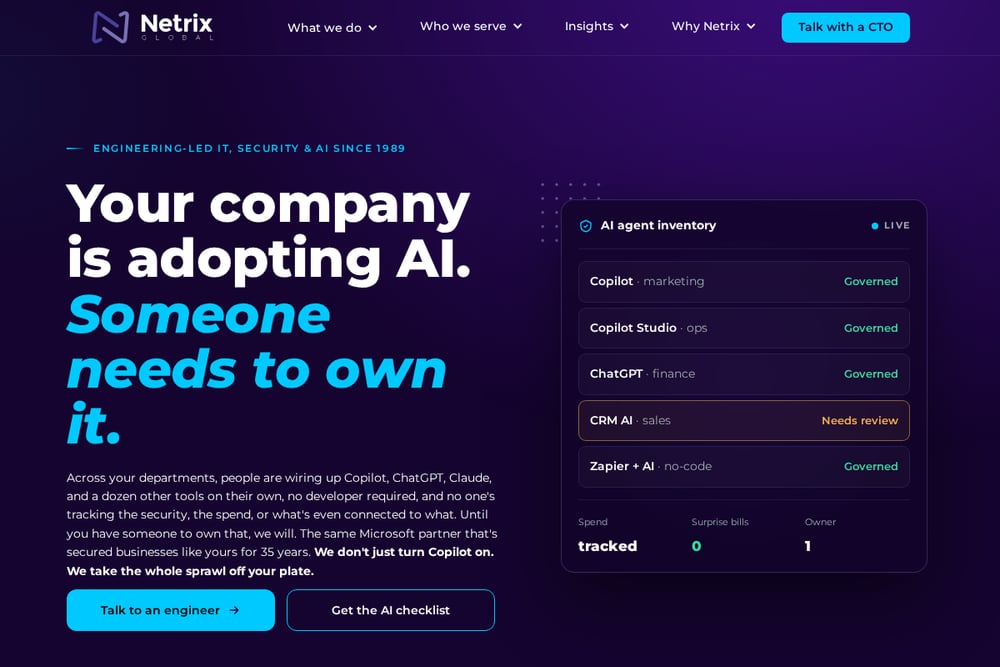 A screenshot of the Netrix website.
Netrix is a services-led provider that helps mid-market firms adopt AI workflow automation with hands-on guidance. Beyond agent buildouts and integration, Netrix offers fractional CIO and Chief AI Officer services, giving you senior technical leadership without the full-time hire. Their AI Readiness Checklist is a practical 90-day operations tool for getting your business prepared before you automate. Netrix serves legal, education, financial services, manufacturing, and professional services firms, which means they understand regulated and multi-plant environments. If you need a partner to walk you through strategy, implementation, and user adoption, Netrix fills that gap. You can explore their workflow and automation services on their website.
How to Choose the Right Platform for Your Team
Start with your team size and your biggest bottleneck. If you have 15 to 45 people in operations or support and need results this quarter, prioritize platforms with transparent pricing and fast onboarding. SaelixAI fits that profile with its tiered plans and four-step setup. If you are a larger enterprise already running ServiceNow, Moveworks will slot into your existing stack with less friction. For complex case management across regulated industries, Pega offers the depth you need. If your team prefers building its own tools, Airtable gives you the flexibility without requiring engineers. And if you want a guided journey with senior leadership support, Netrix brings the advisory layer that many mid-market firms lack. Ask each vendor three questions: How long until we see measurable results? What does pricing look like at our current size and at double? And how does the platform handle exceptions when automation hits an edge case?
What You Can Automate First
The fastest wins usually come from repetitive, rules-based tasks that cross multiple tools. Start with ticket triage and routing in your support queue. Then automate status updates and notifications between Slack or Teams and your CRM. Next, tackle onboarding and offboarding checklists that currently live in spreadsheets. After that, move to reporting: pull data from your systems into a real-time dashboard so you can see time savings and SLA performance without manual compilation. Finally, look at cross-team handoffs where work stalls waiting for approvals or information. Each of these steps builds confidence and frees your team to focus on judgment-heavy work that actually needs a human.
The Bottom Line
AI workflow automation is no longer a nice-to-have for operations and support teams. The platforms in this roundup each solve a different slice of the problem, from enterprise-grade agentic orchestration to transparent, team-sized automation that delivers in days. Your job is to match the tool to your reality: team size, existing stack, compliance needs, and how much hand-holding you want. Start small, measure everything, and scale what works. The productivity gains are real, but only if you pick a platform that fits how your team already operates.