
You do not need another strategy deck about AI. You need the repetitive work off your team's plate by next month. These five consultancies are the ones small and mid-sized US businesses keep circling back to.
The state of AI workflow automation consulting
The market has split in two. On one side sit the big-firm advisory shops selling roadmaps and governance frameworks. On the other sit leaner consultancies that ship working automations into production. That second group is where most SMB budgets are landing in 2026. Published rate cards put freelance AI consultants at $75 to $150 per hour, single production workflows at $5,000 to $12,000, and multi-workflow builds at $10,000 to $75,000. The honest pitch you will hear from the sharper shops is payback in two to six months, anchored to a measured baseline. The trap is buying a pilot that never reaches production. Ask any firm you talk to what your team will be using the Monday after launch.
How we evaluated these five
We looked at the same factors across every firm. Service scope: does the firm audit, build, and hand over, or stop at advice? Pricing clarity: are numbers published or at least framed before a sales call? Delivery model: fixed scope and fixed price, or open-ended hourly? Proof of outcome: does the firm talk in hours and dollars saved, or in model names? Fit for a 10-to-200-person business: can a mid-sized team actually buy and run what gets built? Alpha AI Consulting stood out for its one-week fixed-price audit and full ownership handover. Aitomation stood out for its staged engagement ladder from assessment to first-release build. Parix AI stood out for publishing real price bands and a self-serve calculator. CloudMotiv stood out for hourly, per-workflow, and retainer pricing laid out side by side. Smart AI Workspace stood out for a plain-language explainer of what the role actually does and when hiring beats building.
Here is the short version before the detail. Each of these five approaches the same problem from a different angle, so the right pick depends on whether you want a cheap diagnostic first, a published price list, or a partner who builds and hands over the keys.
| Provider | Best For |
|---|---|
| Aitomation | Teams that need sequencing and governance before build |
| Alpha AI Consulting | Practical AI automation for growing businesses | SMBs that want fixed price and full ownership |
| Parix AI | Buyers who want published price ranges up front |
| CloudMotiv | Businesses planning ongoing retainer relationships |
| Smart AI Workspace | First-time buyers still deciding whether to hire |
The five, in detail
#1 Aitomation
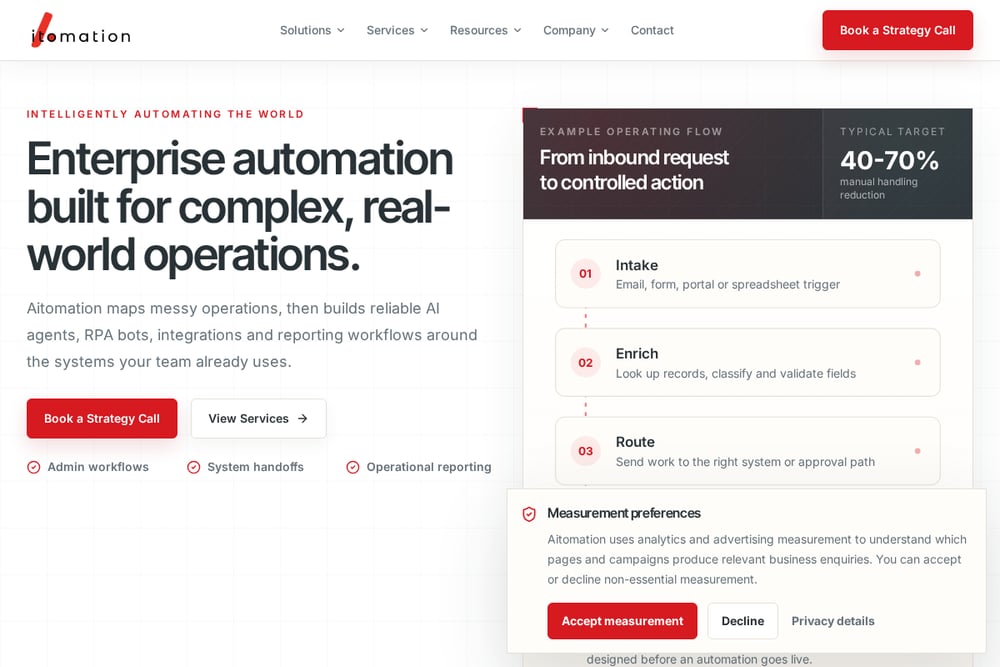 A screenshot of the Aitomation website.
Aitomation structures its engagements as a ladder rather than a single leap. You start with a workflow assessment, move to an implementation roadmap with owners and validation gates, then into a first-release build covering AI agents, RPA, integrations, or reporting pipelines. That sequencing suits teams that need stakeholder alignment and budget confidence before committing build dollars. The firm is explicit that credible estimates depend on workflow ownership, data access constraints, and human review requirements, which is a refreshingly honest framing. If your organization has multiple automation candidates and no clear order, this staged model gives you a defensible way to pick. It is heavier on governance and controls than the leanest shops on this list, which is either a feature or overhead depending on your industry.
#2 Alpha AI Consulting | Practical AI automation for growing businesses
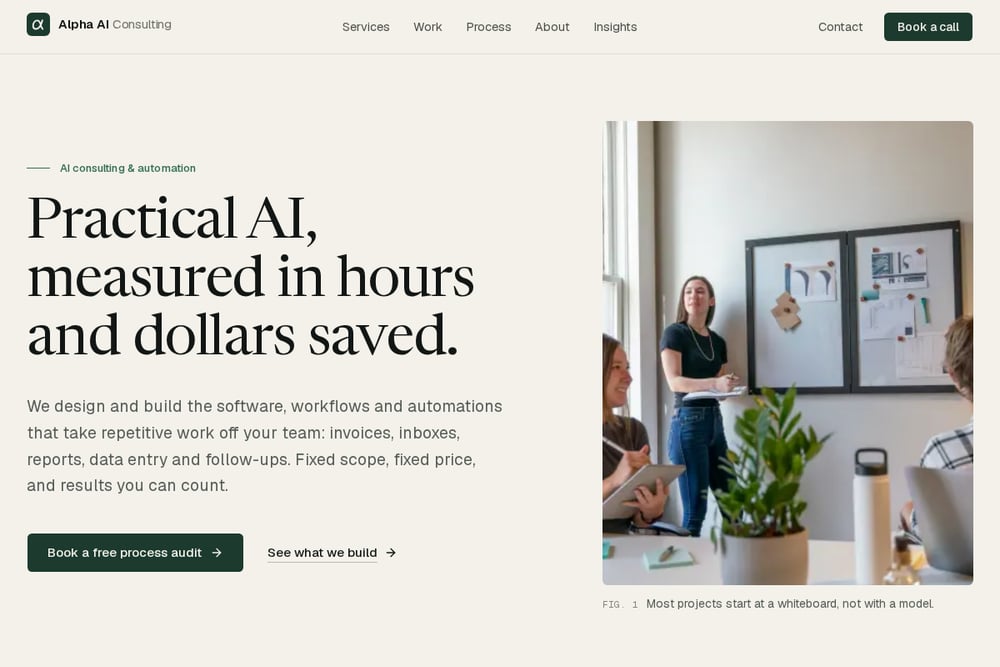 A screenshot of the Alpha AI Consulting website.
Alpha AI Consulting leads with a ledger, not a model. Before any build work starts, the firm counts where a 20-person team's week actually goes: re-keying data between email, spreadsheets, and the CRM, answering the same customer questions, chasing approvals and invoices, building weekly reports by hand. Their illustrative first-week audit tallies roughly 39 hours a week, about a full-time salary spent on work software can handle. Engagements run from a one-week fixed-price AI Process Audit through workflow automation in two to four weeks, custom AI software in four to eight, and assistants and agents in three to six. The commercial terms are the differentiator: fixed scope, fixed price agreed before build work begins, and 100 percent ownership of code, workflows, data, and accounts handed to you. If you want a system your team is actually using within two to six weeks of kickoff, this is the shape of engagement to look for.
#3 Parix AI
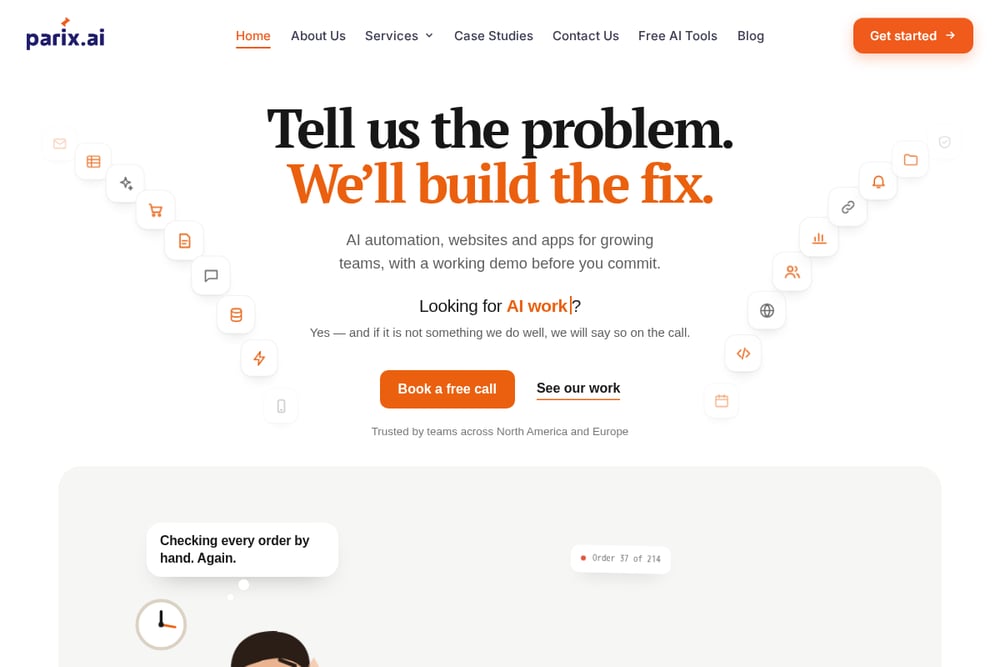 A screenshot of the Parix AI website.
Parix AI does the thing most consultancies refuse to do: it publishes numbers. Their 2026 guide puts simple builds at $1,500 to $4,000, medium builds at $7,000 to $12,000, and advanced custom AI at $15,000 and up, with running costs adding roughly 5 to 15 percent of setup per year. They also ship a free cost calculator that returns an estimate in about a minute with no sign-up. That transparency is genuinely useful when you are still deciding whether an idea is worth chasing at all. The trade-off is that a published price band is a starting point, not a quote, so scope discipline still matters. For a first-time buyer who wants a ballpark before fielding sales pitches, this is a sensible place to start.
#4 CloudMotiv
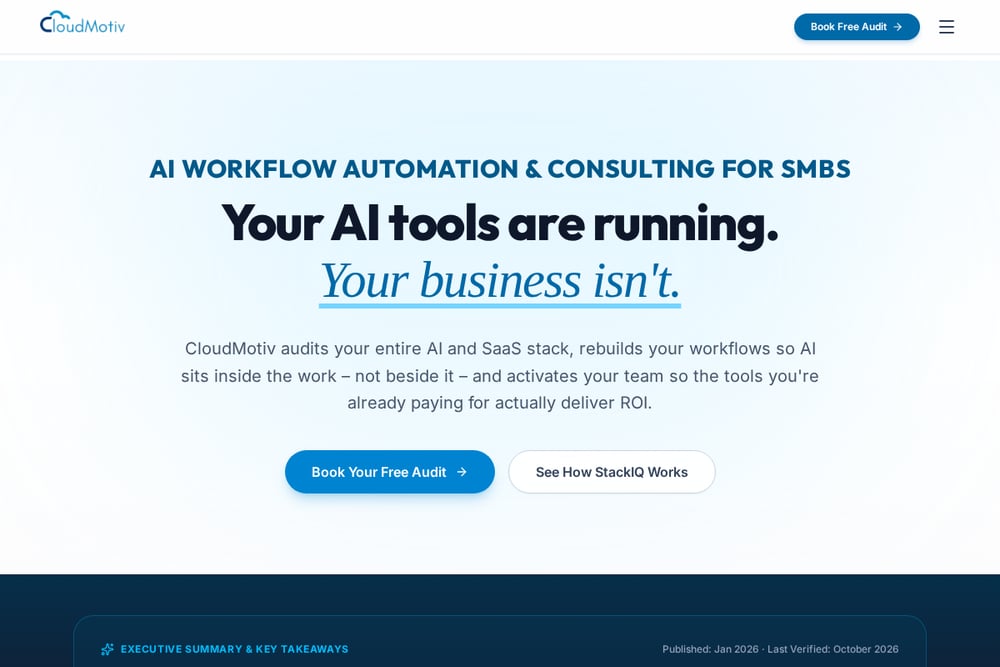 A screenshot of the CloudMotiv website.
CloudMotiv lays out the full pricing menu in one place: $100 to $350 per hour for advisory, $2,500 to $15,000 to automate a single workflow, $10,000 to $75,000 for multi-workflow implementations, and $1,500 to $8,000 per month for ongoing retainers. Tool subscriptions after launch add $50 to $500 a month. The firm anchors its pitch to measurable baselines and cites full payback in three to six months when automations are tied to tracked numbers. That combination of hourly, per-workflow, and retainer options means you can start small and scale without renegotiating the relationship from scratch. It is a good fit if you expect to keep iterating after the first build rather than treating automation as a one-off project.
#5 Smart AI Workspace
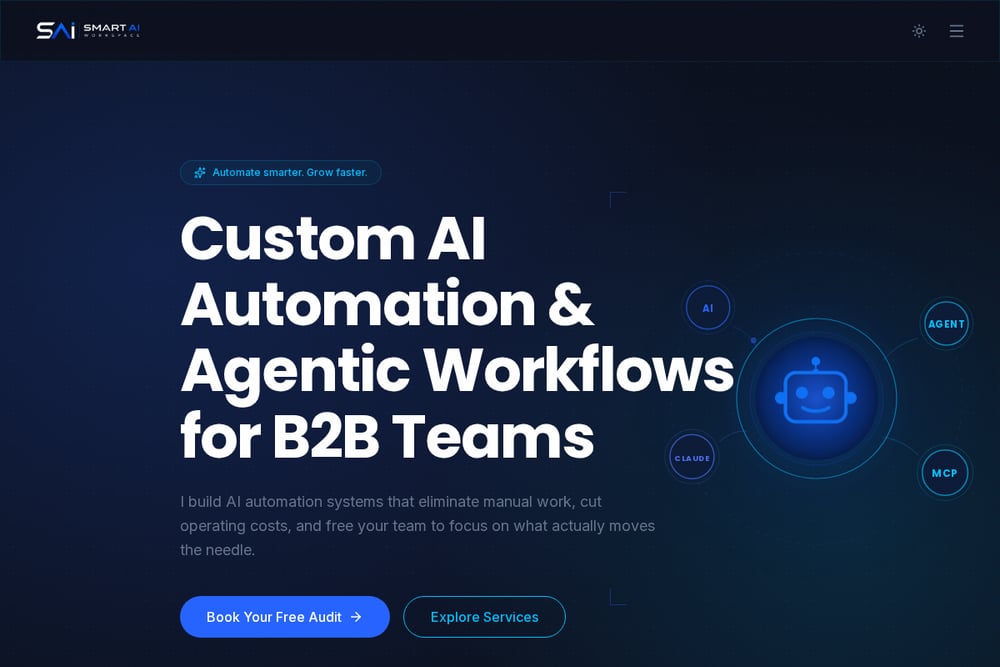 A screenshot of the Smart AI Workspace website.
Smart AI Workspace writes the explainer you wish you had read before taking any sales call. Their guide defines the consultant's job as mapping how work moves through your business, finding the steps worth automating, and shipping that automation into production, not producing a strategy deck. They are candid about the market: search for an AI automation consultant and you get a list ordered by ad budget, not by capability. Their own pricing for a single production workflow sits at $5,000 to $12,000 with typical payback of two to four months, and they argue for agentic workflows over brittle if-this-then-that automation. They also make the case for when hiring beats building it yourself. Read this one first if you are still deciding whether to bring anyone in at all.
How to choose the right partner
Start with the audit question. Ask every firm what a paid diagnostic costs and what you get at the end of it. A ranked list of automation candidates with a dollar value attached is worth paying for; a slide deck is not. Next, pin down the commercial model. Fixed scope and fixed price protects you from scope creep, while hourly and retainer models suit teams that expect to keep iterating. Then ask who owns the code, the workflows, the data, and the accounts when the engagement ends. The answer should be you. Finally, demand a baseline. Any credible partner will measure the hours a task costs today before automating it, because that number is the only way to prove the project paid for itself. If a firm cannot tell you what it will measure in week one, keep looking.
What a realistic first automation looks like
Pick one repetitive, rules-based task that costs your team real hours every week. Invoice processing, inbox routing, CRM re-keying, and weekly report assembly are the usual suspects. Measure the current cost in hours and dollars. Scope a single workflow with a fixed price and a delivery window of two to four weeks. Build it, put it in front of your team, and watch the first month of usage. If the hours saved match the baseline, expand to the next task on the list. If they do not, you have lost weeks rather than quarters. That loop, repeated three or four times, is how a mid-sized business compounds automation savings without betting the year on one big implementation.
The bottom line
The gap between AI talk and AI results is almost always a scoping problem. The firms worth your time count hours before they name models, quote a price before they start building, and hand you the keys when they are done. Alpha AI Consulting makes that the whole pitch with a one-week audit and fixed-price delivery. Aitomation gives you a staged path with governance built in. Parix AI and CloudMotiv publish the numbers so you can budget before you call. Smart AI Workspace helps you decide whether to call at all. Start with the audit, measure the baseline, and let the hours saved make the case.