Your next client may never scroll a search results page. They'll ask ChatGPT who to hire, and you'll either be in the answer or you won't.
Why AI Visibility Became a Legal Marketing Problem
Search behavior changed faster than most law firm marketing budgets did. Clients now open ChatGPT, Gemini, Copilot, or Google's AI Overviews and ask a plain question: who handles asylum cases near me, or which immigration lawyer speaks Spanish. The answer is short, confident, and often names three to five firms. If you aren't one of them, you don't exist in that conversation.
The problem is that AI answers are built from sources you don't control. Directories, review sites, old listings, and local news all feed the model. A stale Yelp page saying you don't offer Spanish consultations can quietly follow you for years. That's why a new category of service emerged: tracking how often AI names your firm, tracing where the answer came from, and correcting the record.
For immigration practices, the stakes are higher. Bilingual demand is real, and Spanish-language queries often produce different answers than English ones. Firms that measure both, and fix what's wrong, are the ones showing up when it counts.
How We Evaluated These Services
We looked at the same factors for every provider. First, service scope: does the provider only report, or do they also fix the underlying sources? Second, pricing clarity: are rates published, or buried behind a consultation? Third, measurement rigor: how many questions, how many runs, and do they show confidence ranges instead of single numbers?
Fourth, local and language fit: does the service handle city-level queries and non-English demand, which matters enormously in immigration law? Fifth, reporting usability: can a busy attorney read the deliverable in a minute and know what happened?
Findable Legal stood out for narrow focus, published pricing, and bilingual measurement with confidence ranges. Waybound Consulting stood out for pairing tracking with a prioritized action plan. LegalVIS stood out for tiered packages and technical setup work. Juris Digital stood out for fitting AI visibility into a broader growth system. Triple Digital stood out for multi-platform tracking guidance across practice areas and markets.
Here's the short version before the details. Each service below approaches AI visibility from a different angle, so match the one to your firm's actual gap.
| Provider | Best For |
|---|---|
| Waybound Consulting | Firms that want tracking plus a prioritized action plan |
| Findable Legal: AI visibility for immigration law firms | Immigration firms in competitive metros with Spanish-speaking clients |
| LegalVIS | Firms needing technical setup plus ongoing visibility packages |
| Juris Digital | Firms wanting AI visibility inside a full marketing system |
| Triple Digital | Firms wanting multi-platform tracking plus web and content support |
The 5 Services, One by One
#1 Waybound Consulting
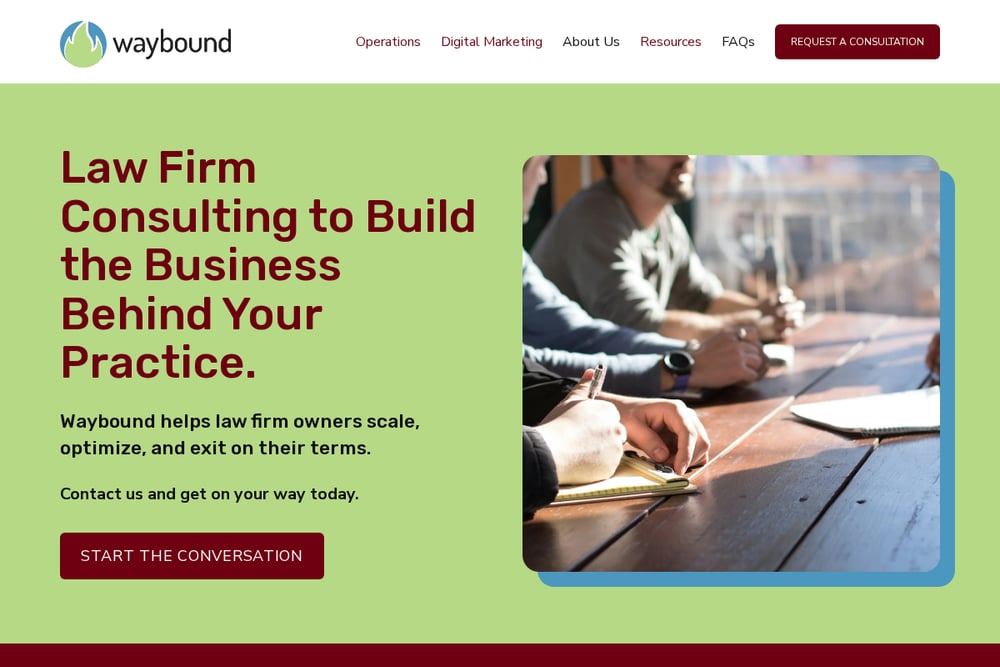 A screenshot of the Waybound Consulting website.
Waybound treats AI visibility as an operations problem, not just a marketing one. Their AI Visibility Tracking service defines the questions by practice area, market, and competitor, then captures observed mentions and cited sources over time. You get a baseline, recurring reporting, and a prioritized action plan your team can actually execute.
What separates them is the handoff. Tracking and strategy are scoped separately from implementation, so you know exactly what you're buying. That structure suits firms with an in-house marketer or a fractional COO who needs a clear list of next actions rather than another dashboard. Their broader menu of law firm operations consulting means AI visibility sits alongside staffing, finance, and intake work. If you want the findings translated into priorities, this is a strong fit. See their approach at Waybound Consulting.
#2 Findable Legal: AI visibility for immigration law firms
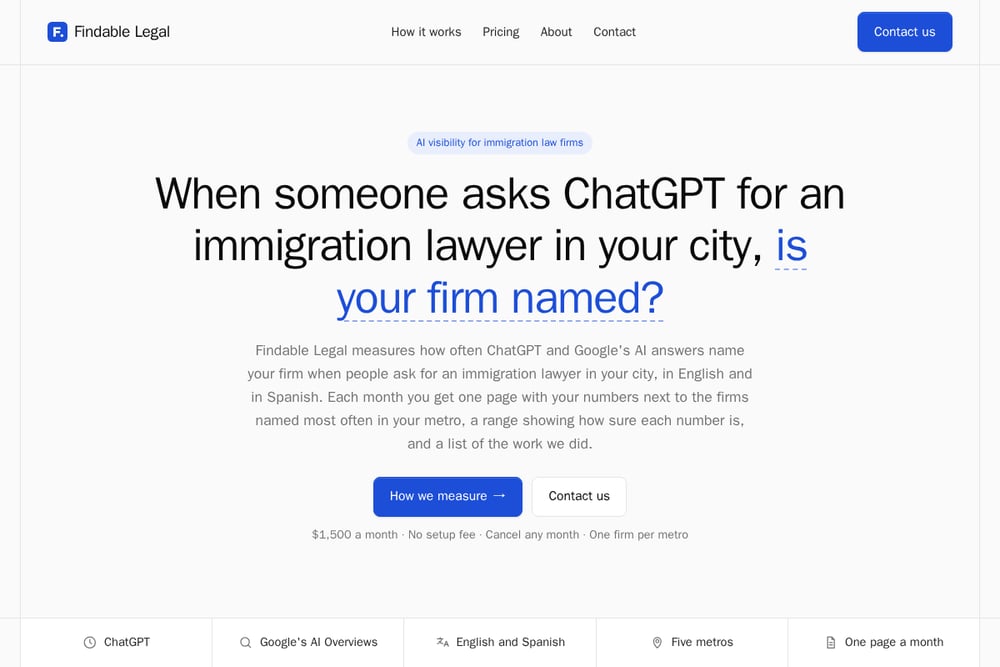 A screenshot of the Findable Legal: AI visibility for immigration law firms website.
Findable Legal does one thing and says so plainly: it measures how often ChatGPT and Google's AI Overviews name your immigration firm when someone asks for a lawyer in your city, in English and in Spanish. The method is specific. Twenty agreed questions, fourteen English and six Spanish, each asked ten times per AI with location set, totaling 200 answers per platform across the month.
You get one page monthly. Your numbers sit next to the firms named most often in your metro, with ranges showing how sure each figure is, so you can tell a real gain from noise. They also do corrective work: fixing Google Business Profiles, completing Justia profiles, correcting Avvo practice areas, and publishing attorney-approved answer pages in both languages. At $1,500 a month with no setup fee and month-to-month cancellation, pricing is fully public. One firm per metro keeps it focused. Details are at Findable Legal.
#3 LegalVIS
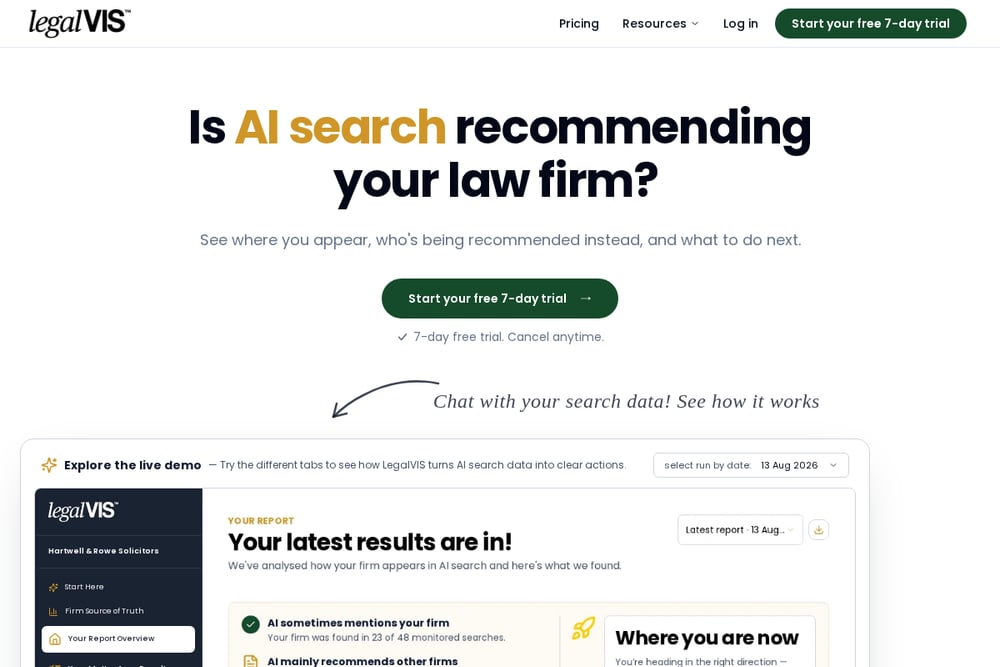 A screenshot of the LegalVIS website.
LegalVIS runs a structured visibility programme that starts with a technical audit across ChatGPT and Gemini. You get a gap report showing where AI misses you or gets you wrong, a competitor snapshot, and a strategy call. From there, setup work covers technical SEO, structured profiles, schema, and Google Business Profile optimization.
Ongoing packages are tiered and published, from an intelligence-only plan where your team implements, up to content-inclusive plans where they create authority pieces and profile posts. A free seven-day trial lowers the barrier to testing. The model suits firms that want a managed path with clear steps rather than a single report. If you need the technical foundations fixed before measurement means anything, this is worth a look. Explore LegalVIS.
#4 Juris Digital
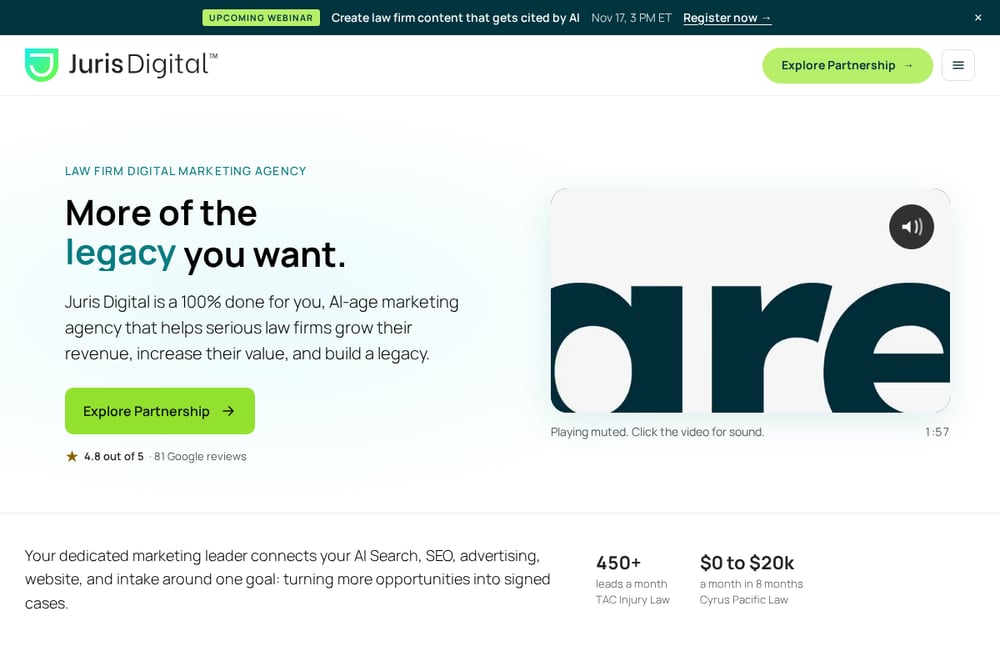 A screenshot of the Juris Digital website.
Juris Digital positions AI visibility inside a larger growth system for law firms. Their GEO offering aims to earn citations when people ask AI tools which lawyer to hire, and it plugs into SEO, content, paid media, and intake tracking. They publish a dedicated guide on AI visibility reporting for law firms, which is useful reading even if you never hire them.
Their vertical structure means immigration gets marketing built around how clients actually choose a lawyer in that practice area. The advantage is integration: one vendor handling content, technical SEO, and AI citation work reduces finger-pointing. The tradeoff is that AI visibility isn't the whole product, so you're buying into a broader engagement. For firms ready to invest across channels, that's a feature, not a bug. Visit Juris Digital.
#5 Triple Digital
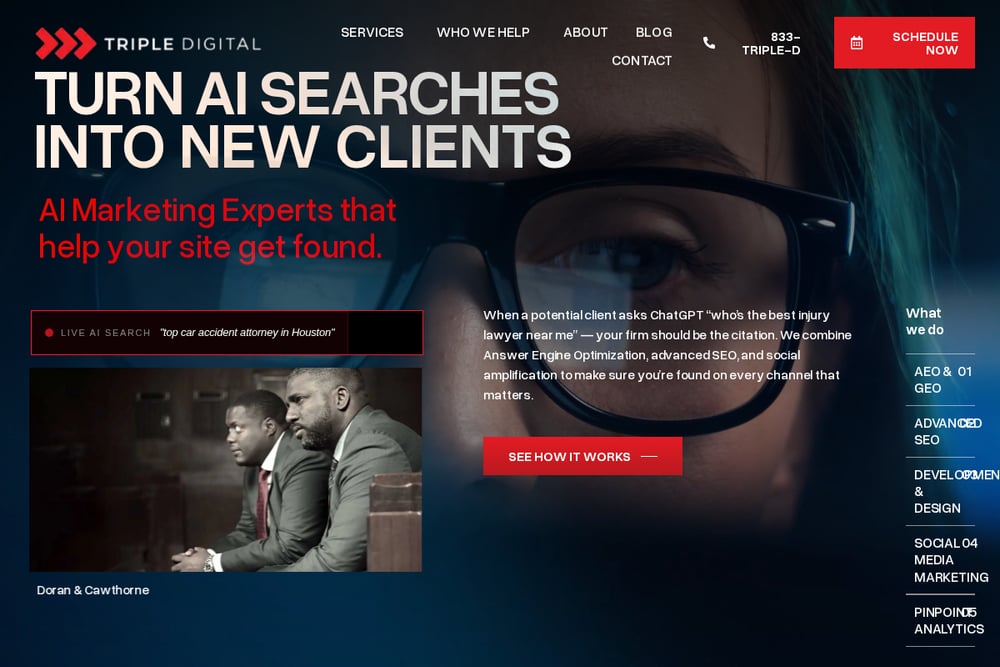 A screenshot of the Triple Digital website.
Triple Digital explains AI visibility tracking in practical terms: ask the platforms the same questions your clients ask, then measure whether you appear, how prominently, and which competitors show up instead. They emphasize that ChatGPT, Google AI, Gemini, Copilot, and Perplexity each answer differently, so tracking has to cover all of them by practice area and market.
Their content walks through the mechanics clearly, which helps if you're still building internal buy-in. Services span AI marketing, advanced SEO, social, and web development, with vertical pages for several practice areas. That breadth means you can consolidate vendors, though the AI tracking itself is one piece of a wider offering. If you want a partner who can also handle the website and content side, this fits. See Triple Digital.
How to Pick the Right Fit
Start with your actual gap. If you don't know whether AI names you at all, buy measurement first. If you already know you're missing and the sources are wrong, buy a service that fixes them.
Check the method. Ask how many questions, how many runs per question, and whether they report confidence ranges. A single percentage with no range is marketing, not measurement. Ask whether Spanish-language queries are included, because in immigration law they change the answer.
Confirm what's included in the fee. Some providers report only; others correct listings and publish pages. Ask who approves content and how fast corrections happen. Finally, match the contract to your risk tolerance. Month-to-month terms let you test before committing to an annual engagement.
A Simple Monthly Workflow You Can Run
Set a recurring monthly cadence. Week one: review your visibility report and note which numbers moved beyond the noise range. Week two: trace every wrong fact AI stated about your firm back to its source, then correct that source directly.
Week three: publish or update one answer page per priority practice area, in English and Spanish, with attorney approval. Week four: refresh directory profiles, confirm hours and language offerings, and log what changed. Repeat. The compounding happens in the corrections, not the reporting.
The Bottom Line
AI answers are becoming the front door to your practice. You can't control the model, but you can control the sources it reads and whether you're measuring the outcome.
Pick based on your gap: measurement and correction if you're starting cold, technical foundations if your site is the problem, or a full system if you're scaling across channels. The firms that win this shift will be the ones checking the numbers every month and fixing what's wrong.