Your team needs a video by Friday, and the agency quote just landed with a six-week timeline. These five AI video production services are changing that math for US businesses.
The state of AI video production
Video used to be the line item that got cut. Now it is the format every department asks for: marketing wants brand films, sales wants pitch videos, HR wants onboarding modules, and finance wants quarterly updates that people actually watch. AI production has collapsed the distance between a written brief and a finished cut. The strongest services no longer sell raw generation. They sell a workflow: a script, a scene plan, a review step, brand controls, narration, music, captions, and a clean export. That distinction matters. Generation makes footage. Production makes the video do its job. Buyers in the US are also asking harder questions about language coverage, commercial rights, and whether a human can approve the storyboard before money is spent. The five services below answer those questions in different ways, and the right pick depends on what your team actually ships.
How we looked at these services
We weighed each service on the same factors. First, scope: does it handle the whole job from brief to export, or only one slice of it? Second, review and approval: can your team see the script and scene plan before production starts, and how are revisions handled? Third, language and format coverage: how many languages, and does vertical cost extra? Fourth, pricing clarity: are credits, subscriptions, and free trials explained before you commit? Fifth, fit for business use: commercial rights, brand controls, and whether the output suits marketing, training, or investor audiences. Vidplum stood out for its free storyboards and approval gate before production. ngram stood out for source-grounded planning from a prompt, URL, PDF, or image. Topin stood out for directing a brief into distinct use-case formats. Synthesia stood out for avatar-led training and dubbing breadth. Pictory stood out for turning existing documents and long recordings into clips quickly.
Here is the short version before the detail. Each service below earns its place for a different reason, so scan the one-line fit and then read the full entry for the one that matches your workload.
| Provider | Best For |
|---|---|
| ngram | Teams with existing source material to repurpose |
| Vidplum | AI Video Production for Business | Marketing, HR, and finance teams that need sign-off |
| Topin | Teams that want use-case-driven video formats |
| Synthesia | Enterprise training and multilingual dubbing at scale |
| Pictory | Repurposing blogs, docs, and webinars into clips |
The five services in detail
#1 ngram
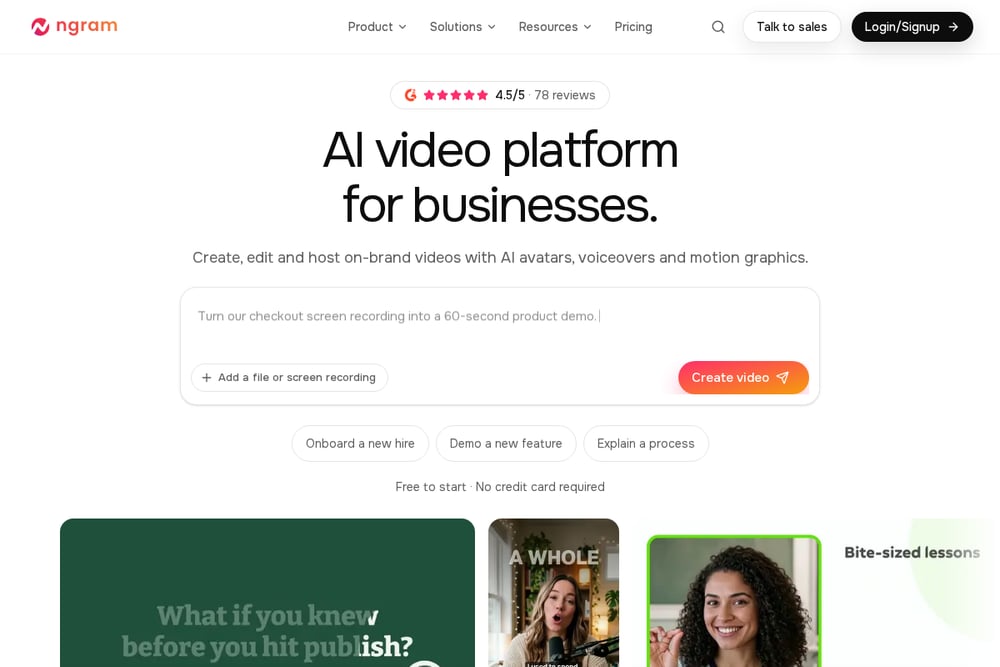 A screenshot of the ngram website.
ngram treats the brief as the source of truth. You paste a prompt, a public URL, a PDF, or an image, and the tool plans the message and scene structure against that material. The workflow is explicit: bring a source, review the plan, generate a first cut, request one focused change, then export. That review step matters because it lets you catch a wrong product name or an off-brand claim before rendering. MP4 downloads require a Basic plan or higher, and generation draws on account credits, so you should check the estimate before you start. It suits teams that already have documentation, release notes, or a landing page and want a video built from it. See the ngram AI video generator for the full workflow.
#2 Vidplum | AI Video Production for Business
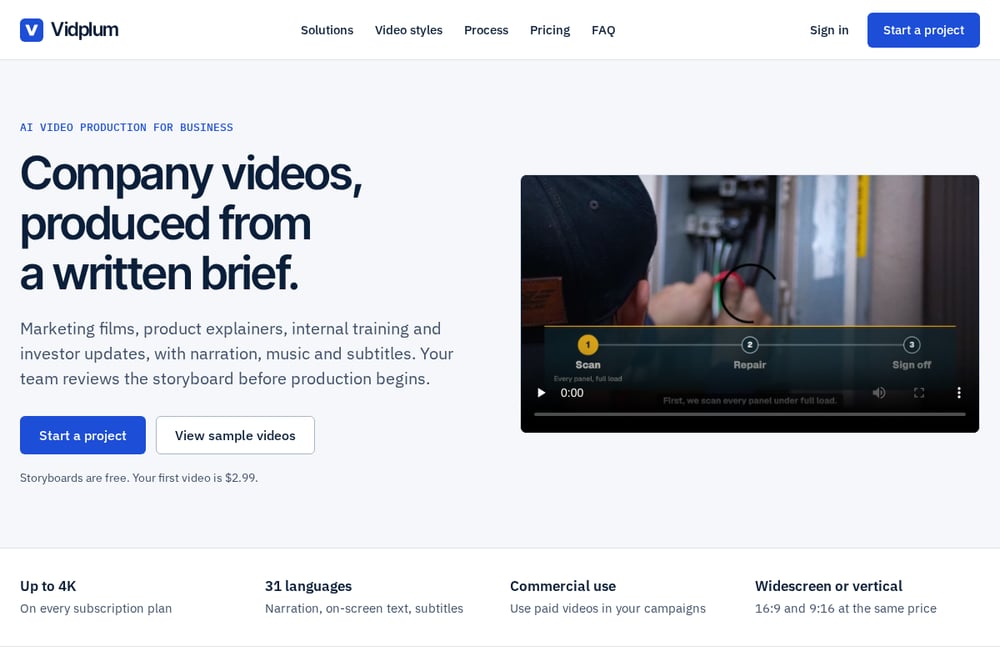 A screenshot of the Vidplum | AI Video Production for Business website.
Vidplum is built around one promise: company videos produced from a written brief, with your team approving the storyboard before production begins. You submit the objective and audience, or an approved script, add your logo and product images, then review the script and key frames scene by scene. Revisions at that stage are free, and production only starts when you approve. The output covers marketing films, product explainers, internal training, and investor updates, with narration, music, and subtitles in 31 languages, up to 4K on every plan, and 16:9 or 9:16 at the same price. Storyboards are free and your first video is $2.99, which lowers the cost of trying it. Paid videos carry commercial use rights, and corrections are requested in plain language so only the affected part is changed. The Vidplum process is the clearest approval gate in this group.
#3 Topin
Topin argues that the job comes before the medium, and its product reflects that. You start with the use case, then the platform directs the brief as either Avatar for direct-to-camera delivery or Cinematic for performed scenes. It supports six use-case formats with distinct arcs: explainer, demo, ad, pitch, proof, and story. That structure helps when your team keeps producing the same kind of video and wants a repeatable shape rather than a blank prompt. The platform coordinates script, scene plan, voice, visuals, music, captions, and the final cut from one brief, with a review step before generation. Read the Topin AI video production guide for how the pipeline is framed.
#4 Synthesia
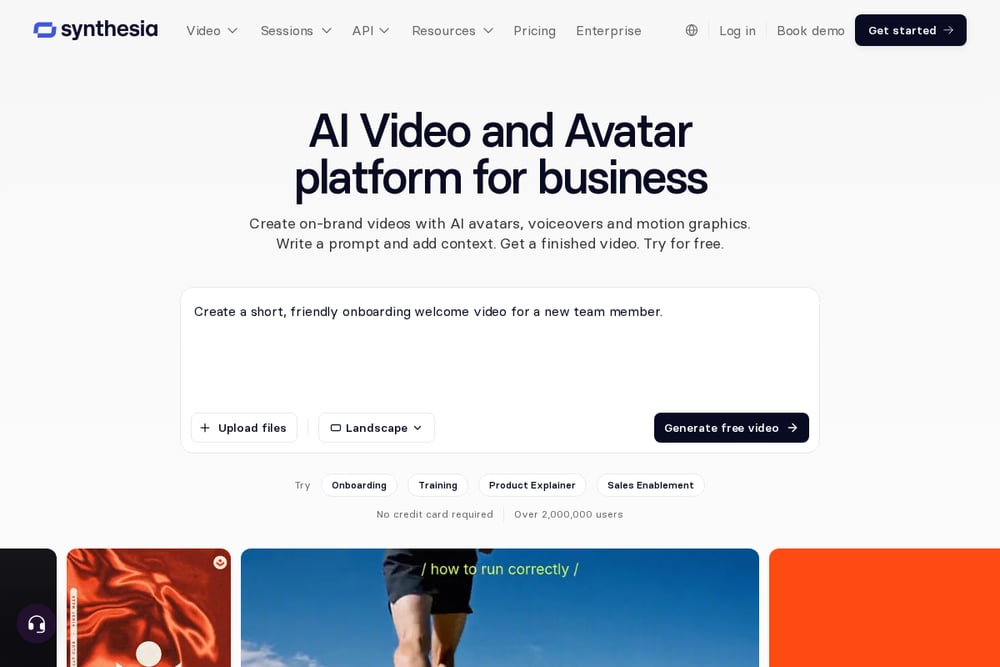 A screenshot of the Synthesia website.
Synthesia is the heavyweight for avatar-led business video, and its footprint in learning and development shows it. The platform covers AI avatars, a video generator that turns documents and prompts into video, dubbing, translation, and motion graphics, plus roleplay and survey sessions for training. For US enterprises, the draw is breadth: compliance training, sales enablement, HR onboarding, and technical training can all run through one system with distribution built in. The script-to-video tool is the entry point most teams try first. Pricing leans toward business and enterprise plans, so smaller teams should scope seats carefully. Start with the Synthesia script to video maker to see the workflow.
#5 Pictory
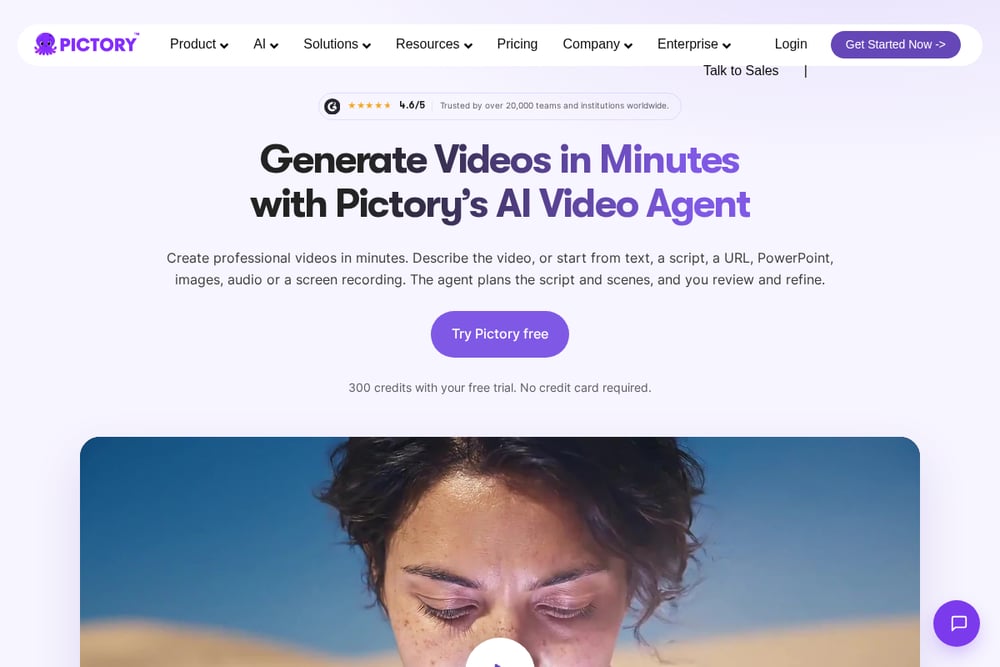 A screenshot of the Pictory website.
Pictory comes at the problem from the other direction: you probably already have the raw material. It converts scripts, blog posts, URLs, documents, PDFs, and slide decks into video, and it handles long recordings by pulling highlights and clips automatically. Subtitles, translations, music, brand kits, and team collaboration are part of the same toolkit, which makes it practical for social and marketing teams producing volume. The free script-to-video generator is a low-friction way to test output quality before committing. It is less about cinematic brand films and more about turning what you have written into something watchable fast. Try the Pictory free AI script to video generator first.
How to pick the right one for your team
Start with the deliverable, not the feature list. If you need a brand film or an investor update that leadership will scrutinize, prioritize a service with a storyboard approval step and clear revision rules, which is where Vidplum is strongest. If your source material already exists as documentation or a landing page, a source-grounded planner like ngram saves the most time. If you are producing the same format repeatedly, Topin's use-case arcs give you consistency. If training and multilingual rollout are the priority, Synthesia's avatar and dubbing coverage is hard to match. If you need volume from blogs, webinars, and decks, Pictory's repurposing tools fit. Then check the boring details: commercial rights, language count, whether vertical costs extra, and how credits are consumed. Ask for a sample in your own brand colors before you buy seats.
Building a repeatable video workflow
The real win is not one video. It is a pipeline. Write the brief once, in a template that names the objective, audience, channel, and call to action. Route it through a service that lets you approve the storyboard before production, so no budget is spent on a wrong direction. Keep your logo, product images, and brand colors in one shared folder so every project starts clean. Standardize exports: 16:9 for the website, 9:16 for social, subtitle files archived alongside the MP4. Assign one reviewer per department so feedback arrives as a single consolidated note rather than five conflicting ones. When a correction is needed, describe only the affected scene, which keeps revisions cheap. Finally, log every finished video with its brief and language versions, so next quarter's update starts from a template instead of a blank page.
The bottom line
AI video production has matured past the demo stage. The services worth your time are the ones that respect the brief, show you the plan before they spend your money, and hand back a file your team can actually use. Vidplum makes approval the center of its process and keeps multilingual delivery and vertical formats in the base price, which is why it sits high on this list for business buyers. ngram rewards teams with existing source material, Topin brings structure to recurring formats, Synthesia owns training and dubbing at scale, and Pictory turns your written archive into clips. Pick the one that matches the video your team ships most often, run one project, and judge it on the review cycle rather than the render.