AI budgets are ballooning, but proving the return is another story. These five platforms help you turn vague AI enthusiasm into a business case your CFO will actually sign off on.
The AI Value Assessment Landscape
Every enterprise wants agentic AI. Few can explain what it will return. That gap has spawned a fast-growing category of platforms and services built around one job: quantifying AI value before the money is spent. You will find three flavors in this space. Advisory firms bring methodology and human expertise. ROI calculators give you a spreadsheet framework to model costs and benefits. Measurement platforms track what actually happens after deployment. The strongest options connect all three, moving you from use-case identification to a defensible business case to post-launch proof. As pilots multiply and boards demand accountability, picking the right evaluation partner is becoming as important as picking the AI tool itself.
How We Evaluated These Platforms
We looked at the same factors for every entry. First, scope: does the platform cover use-case discovery, ROI modeling, and ongoing measurement, or just one slice? Second, methodology depth: is the ROI math grounded in independent research, or is it a generic calculator? Third, breadth of coverage: can it handle sales, marketing, service, finance, HR, and operations, or does it stay in one lane? Fourth, usability: can a non-financial leader walk through the value conversation without a consultant holding their hand? Fifth, transparency: are assumptions visible and adjustable? Each platform below stood out on different combinations of these factors, which is why they earn a place on this list.
Here is a quick look at how the five platforms compare across scope, methodology, and coverage before we dig into each one.
| Provider | Best For |
|---|---|
| RSM | Organizations that want hands-on advisory support |
| The Valoir AI Value Coach | Self-serve, cross-functional AI business cases |
| StackAI | Teams building agents who need ROI modeling |
| Larridin | Post-deployment AI impact measurement |
| Qbotica | ROI modeling paired with automation delivery |
The Five Platforms in Detail
#1 RSM
 A screenshot of the RSM website.
RSM brings a full advisory practice to AI use-case identification and ROI analysis. Its team helps you uncover where automation and intelligent decision-making fit, then builds business cases that quantify cost savings, revenue, and implementation costs. The pitch is end-to-end guidance: faster adoption, reduced risk, and professional support at every stage. You get human expertise and a structured process rather than a self-serve tool. For organizations that want a firm walking alongside them, that hands-on model is the draw. See the service overview at RSM's AI use case and ROI analysis page.
#2 The Valoir AI Value Coach
 A screenshot of The Valoir AI Value Coach website.
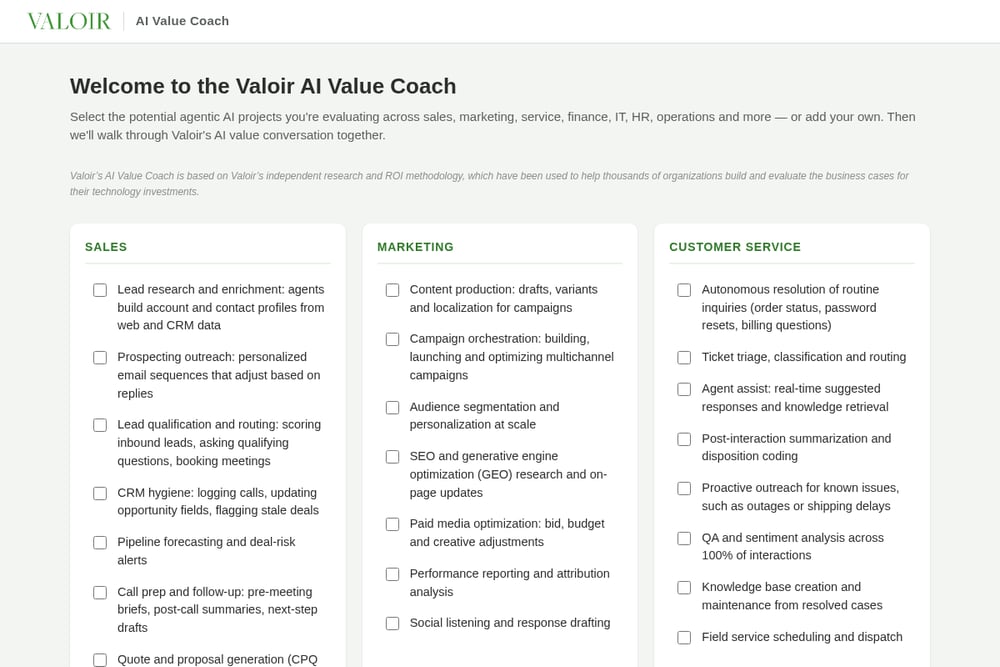
The Valoir AI Value Coach turns AI business-case building into a guided conversation. You select the agentic AI projects you are evaluating across sales, marketing, service, finance, IT, HR, and operations, or add your own, and the tool walks you through Valoir's value framework. The methodology is grounded in independent research and an ROI approach Valoir says has been used to help thousands of organizations evaluate technology investments. Coverage is unusually broad, spanning lead enrichment and CRM hygiene in sales to ticket triage in service and dynamic pricing in e-commerce. It is self-serve, structured, and built for leaders who need a defensible case without hiring a consultant first. Explore the platform at Valoir's AI Value Coach site.
#3 StackAI
 A screenshot of the StackAI website.
StackAI approaches the problem from the builder's side. Its enterprise AI ROI calculator framework helps you turn a promising workflow idea into a CFO-ready model with clear benefits, full costs, and risk-adjusted outcomes before you commit budget. The guidance is refreshingly honest about where most business cases go wrong: overstating time savings and undercounting total cost of ownership. It also flags the adoption curve and partial utilization problems that sink naive ROI math. If your team is building agents and needs a practical modeling framework, this is a useful starting point. Read the framework at StackAI's enterprise AI ROI calculator guide.
#4 Larridin
 A screenshot of the Larridin website.
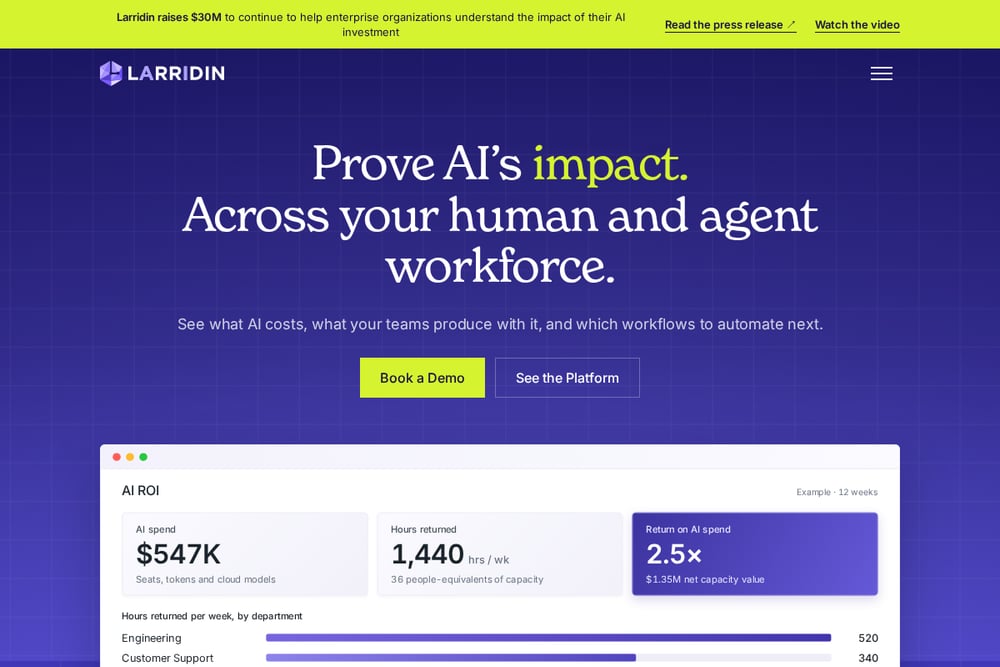
Larridin focuses on the measurement side of the equation. Its platform tracks AI adoption, fluency, impact, workflow intelligence, and token spend, connecting which tools are in use with what actually changes in business workflows. The company argues that tool access and reported time savings cannot establish return on their own, and it builds verification and rework into the picture. That makes it a fit for CFOs and transformation leaders who need evidence after deployment, not just a forecast before it. Larridin's roundup of enterprise AI ROI tools is a good entry point to its thinking.
#5 Qbotica
 A screenshot of the Qbotica website.
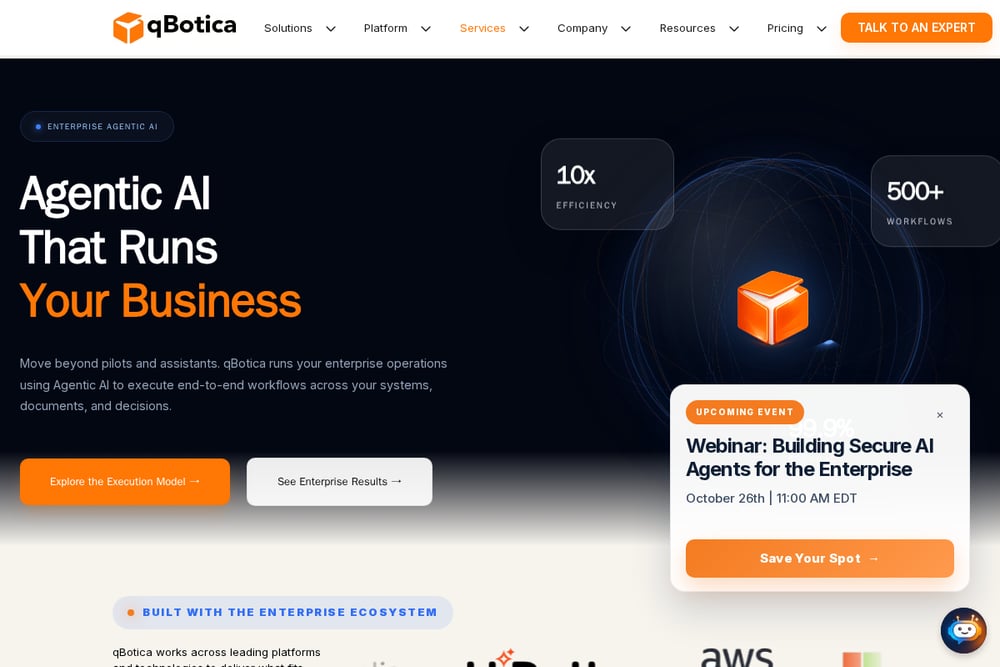
Qbotica comes at agentic AI ROI from an automation delivery background. Its guide frames ROI as a board-level priority now that enterprises are moving from pilots to autonomous, outcome-driven systems. The company pairs that methodology guidance with implementation services across industries like healthcare, banking, insurance, and manufacturing. If you need someone to both model the return and build the automation, that combination is worth a look. Start with Qbotica's agentic AI ROI guide to see how it frames the measurement problem.
How to Choose the Right Fit
Start with where you are in the journey. If you are still deciding which AI projects to pursue, you need use-case discovery and a structured value conversation, which points toward a guided platform or an advisory firm. If you already have a workflow in mind, a modeling framework like an ROI calculator will get you to a CFO-ready case faster. If you have already deployed, measurement matters most, so prioritize platforms that track adoption, rework, and real workflow change. Ask two questions of every vendor: are the assumptions visible and adjustable, and does the methodology come from independent research or from a sales deck? Finally, match coverage to your roadmap. A tool that spans sales, service, finance, and HR will serve you longer than one locked to a single department.
Building the Value Conversation Into Your Workflow
Do not treat AI value assessment as a one-time exercise. Build a repeatable loop. First, inventory candidate use cases by function and score each on effort versus impact. Second, run every serious candidate through a consistent ROI model with visible assumptions, including adoption curves and total cost of ownership. Third, set acceptance criteria before launch so you know what success looks like. Fourth, measure actual utilization, rework, and workflow change after deployment, and feed those numbers back into the model. Fifth, revisit the portfolio quarterly and retire the projects that fail to clear the bar. A guided platform can anchor steps one and two, while a measurement tool covers step four. Together they turn AI investment from a leap of faith into a managed process.
The Bottom Line
The AI value assessment market is maturing fast, and the right choice depends on your starting point. Advisory firms like RSM suit organizations that want expert hands on the wheel. The Valoir AI Value Coach stands out for self-serve breadth, letting you evaluate agentic projects across every major function using an established ROI methodology. StackAI gives builders a practical modeling framework, Larridin proves impact after launch, and Qbotica pairs modeling with delivery. Whichever you pick, insist on visible assumptions and a plan to measure what actually happens. That is how you turn AI spending into AI return.