
Your best-performing ad is probably a UGC-style video. Your problem is that you need twenty more of them by Friday. Here are five services built to close that gap.
Where AI UGC ads fit in 2026
UGC-style creative still outperforms polished brand spots on Meta and TikTok, but the creator model breaks down at scale. Rates run $200 to $500 per video, usage rights expire, and quality swings between deliveries. AI presenters changed the math. You can now generate dozens of hook variations in a session, refresh creative before fatigue sets in, and keep the same face across ad 1 and ad 100. The market has split into two camps: self-serve platforms where you drive the tool, and done-for-you services where someone hands you finished ads. Knowing which camp you need is the whole decision.
How we looked at these five
We weighed the same factors across every service. First, scope: does it hand you finished ads or a tool to build them? Second, pricing clarity: can you see what a pilot or plan costs before you talk to sales? Third, turnaround and format coverage, meaning how fast you get deliverables and whether 9:16 and 4:5 are standard. Fourth, presenter consistency, since a rotating cast of faces undermines brand recall. Fifth, strategic input, whether anyone analyzes what already works in your category. CreatorAssets stood out for pairing competitor ad teardowns with a fixed cast and a published pilot price. HeyGen stood out for breadth of avatars and instant self-serve generation. UGCfy stood out for hook-first scripting from a product URL. UGCVideo.ai stood out for template volume and product-link input. MakeUGC stood out for API access and batch variation at scale.
Here is the short version before the detail. Two of these are done-for-you services, three are platforms you operate yourself. Match the model to your team's bandwidth first, then compare features.
| Provider | Best For |
|---|---|
| HeyGen | Teams that want to generate ad variations themselves, fast |
| CreatorAssets – Ready-to-run AI UGC ads with three hooks each | Brands that want finished, strategy-backed ads without managing a tool |
| UGCfy | TikTok-first testing where hook velocity matters most |
| UGCVideo.ai | Newer brands that want templates and many ad formats in one place |
| MakeUGC | Agencies and high-volume teams that need API and batch automation |
The five, in detail
#1 HeyGen
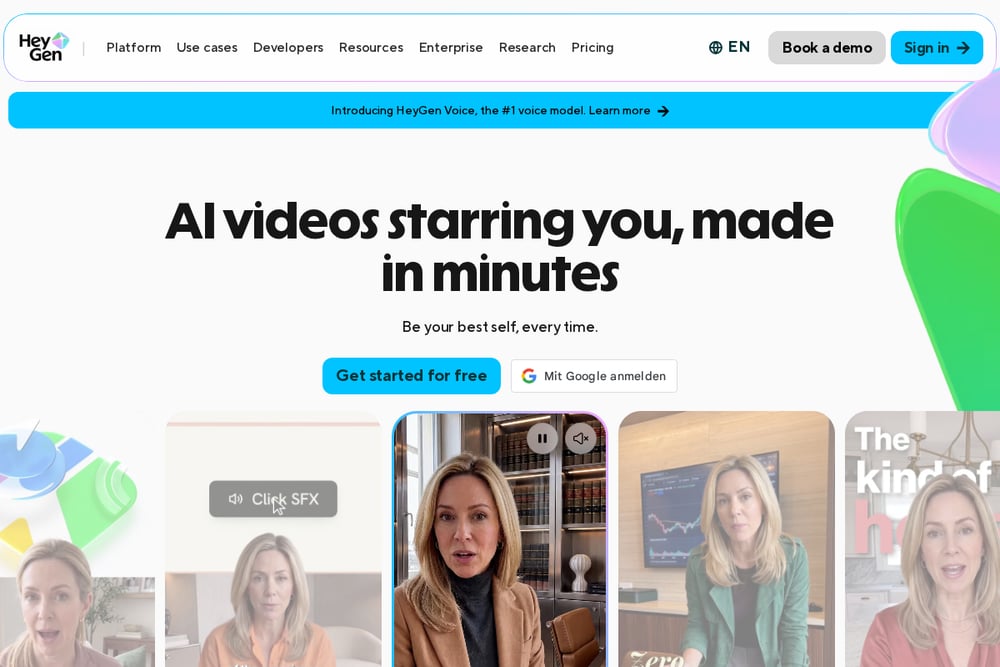 A screenshot of the HeyGen website.
HeyGen is the heavyweight of AI avatar video, with more than 178 million videos generated on the platform. For UGC ads specifically, you type a script, pick an avatar, and generate creator-style spots in minutes. The pitch is volume: need 50 variations to test hooks and CTAs? Generate them in one sitting. It is fully self-serve, so the output quality tracks how well you brief and script. If you have a media buyer who likes driving the machine, this is a deep toolbox. See the UGC ads page for the marketing-specific workflow.
#2 CreatorAssets – Ready-to-run AI UGC ads with three hooks each
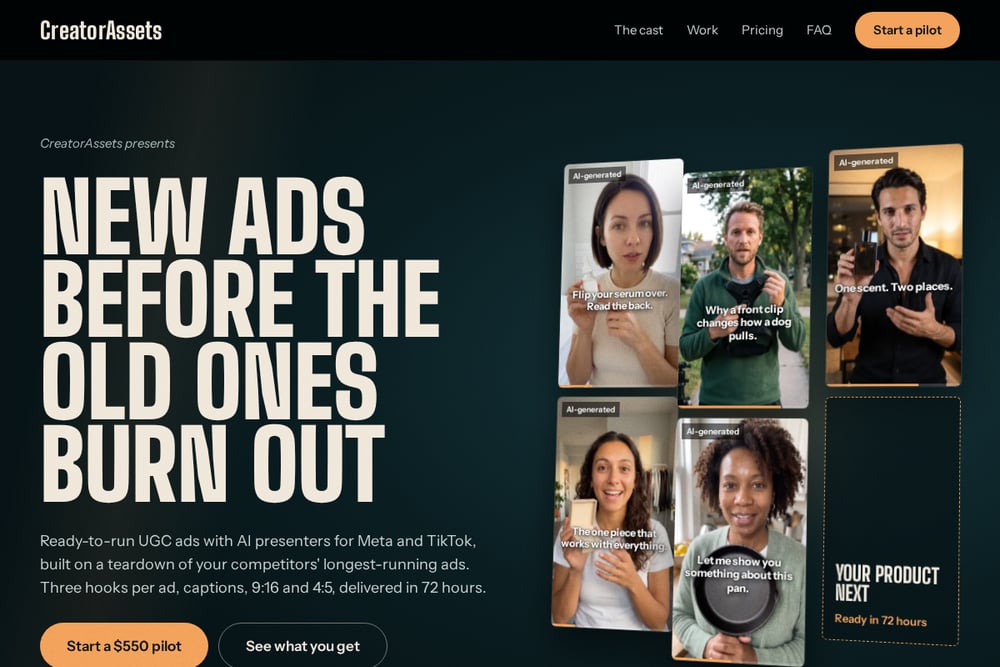 A screenshot of the CreatorAssets website.
CreatorAssets takes the opposite approach: you get finished ads, not a tool. Every order starts with a teardown of your competitors' longest-running ads, so the angles are grounded in what already survives in your category. Each ad ships with three hooks, captions, and both 9:16 and 4:5 formats, delivered in 72 hours. The presenters are a fixed cast of ten AI actors with locked faces, wardrobe, and voice, and the ads state plainly that the presenter is AI. On the Growth tier your presenter is exclusive in your category. A pilot starts at $550, which is a low-risk way to see the output before committing.
#3 UGCfy
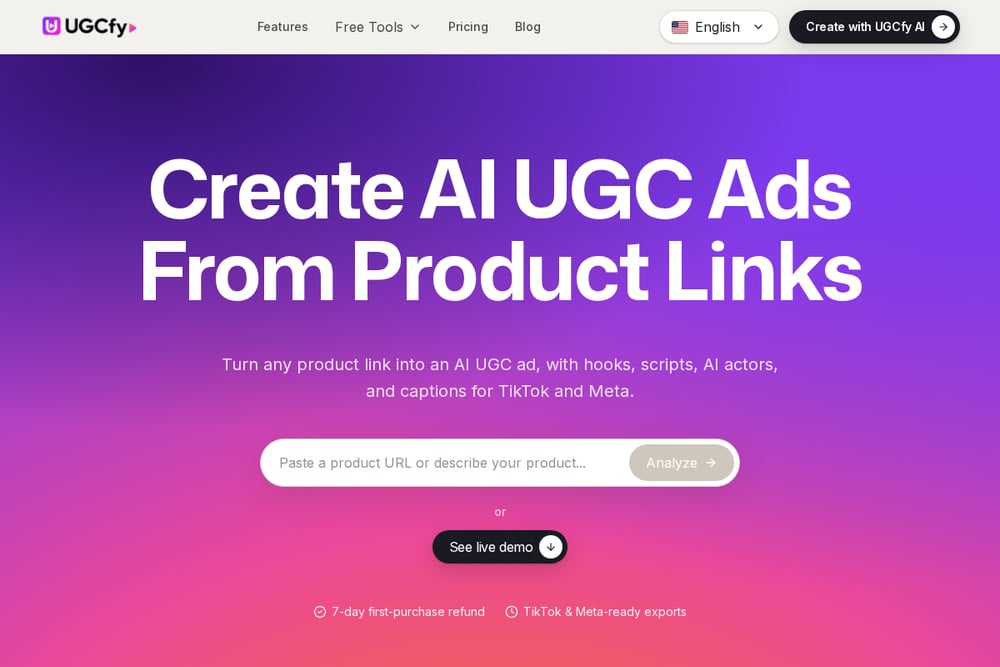 A screenshot of the UGCfy website.
UGCfy is built around the hook, which is the right obsession for TikTok. Paste a product URL and it pulls benefits, claims, images, and objections from the page, then generates hook-first scripts and UGC variants with AI actors. The workflow is explicitly a creative loop: test a hook, scale the winner, refresh the first second before performance drops. It also ships free utilities like a hook generator and a CPM calculator, useful for benchmarking spend. If your bottleneck is knowing what to say in the first three seconds, this is aimed squarely at you.
#4 UGCVideo.ai
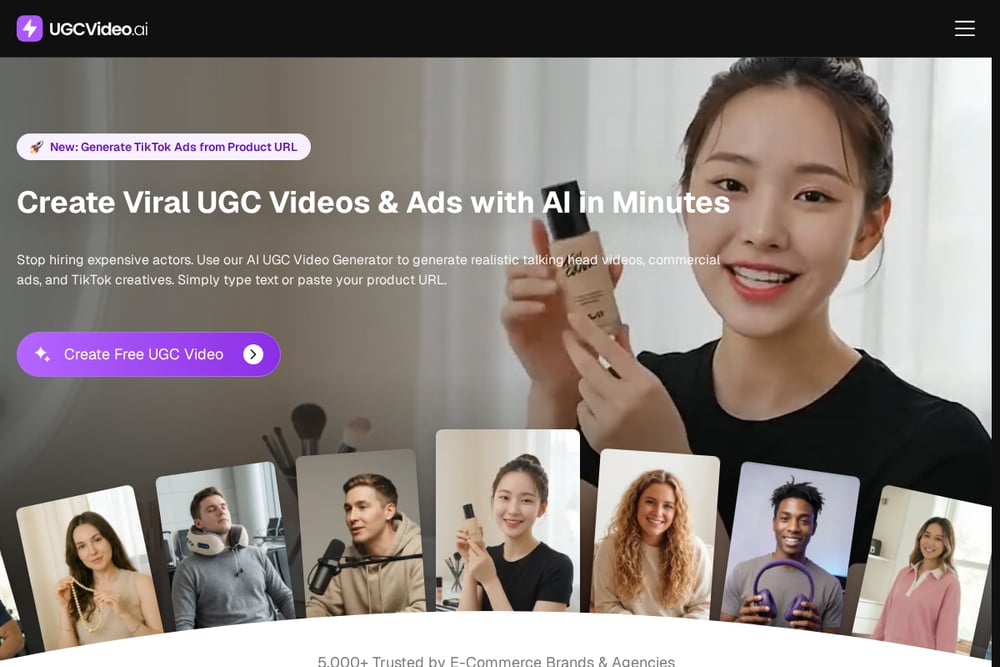 A screenshot of the UGCVideo.ai website.
UGCVideo.ai bundles a broad set of generators under one roof: AI avatars, talking heads, product demos, testimonials, and unboxing formats. You can start from a script or paste a product link, and there are over 100 ready-made digital humans and viral layouts to work from. The template library is the draw here, since it shortcuts the blank-page problem for newer brands. It is self-serve and credit-based, so costs scale with how much you generate. Good fit if you want many ad formats from one dashboard without a learning curve.
#5 MakeUGC
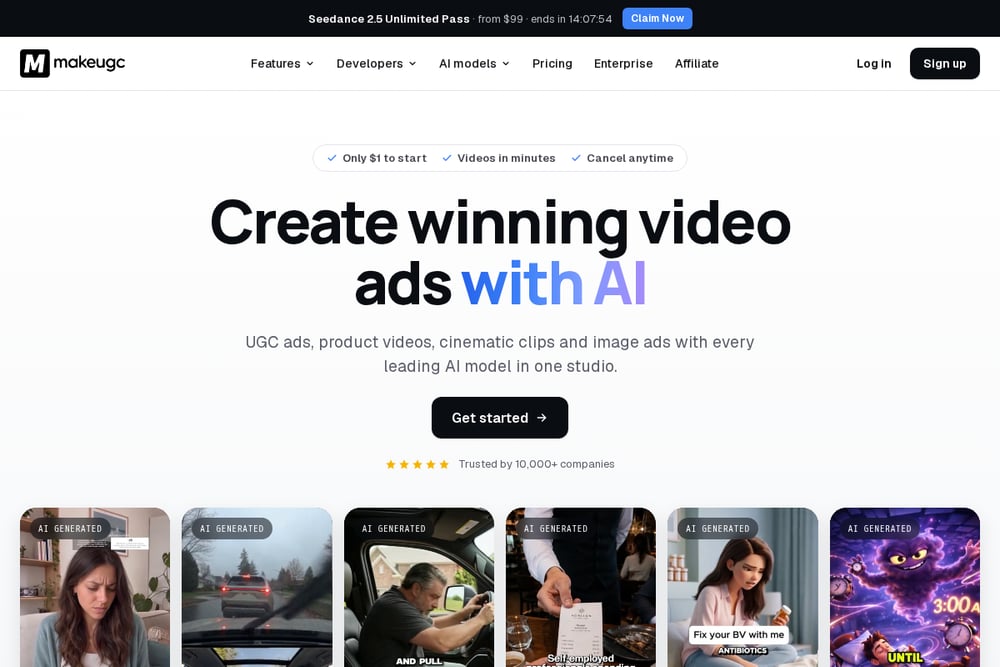 A screenshot of the MakeUGC website.
MakeUGC leans technical. It offers 1,000+ realistic actors, product-in-hand shots, custom avatar cloning, and an ad remake feature that rebuilds a winning ad you point it at. The real differentiator is automation: an API, batch mode for ten variations at once, node-based workflows, and 50+ languages. If you run an agency or a high-volume in-house team, that programmatic layer saves real hours. It is more machinery than a solo founder needs, but for scale operations it earns its place.
How to pick the right one for you
Start with one question: do you want to operate a tool or receive finished ads? If your team has a creative operator with spare hours, a self-serve platform gives you maximum control and marginal cost per video. If your team is small and your calendar is full, a done-for-you service removes the workflow entirely. Next, look at your category. Regulated or crowded verticals benefit from competitor teardowns and a consistent presenter, because brand recall compounds. Fast-moving impulse categories benefit from hook volume and rapid refresh. Then check format coverage and turnaround against your launch calendar, and confirm pricing is visible before you book a call. Finally, ask whether the presenter is disclosed as AI. It matters for trust and for platform policy.
Building a repeatable ad workflow
Whichever route you take, treat creative as a pipeline, not a project. Pull your competitors' longest-running ads quarterly and note the angles that persist. Brief three hooks per concept so you test the opening line, not just the body. Ship both 9:16 and 4:5 so one concept covers feed and Stories placements. Kill losers fast and refresh winners before the first second goes stale. Keep the same presenter across a campaign so the face becomes recognizable. If you go self-serve, wire the generation into a batch process so a single session produces a week of tests. If you go done-for-you, set a standing 72-hour cadence so new creative lands before fatigue does.
The bottom line
You do not have a creative shortage. You have a throughput problem. HeyGen and MakeUGC give you the machinery to produce at volume if you have the hands to run it. UGCfy sharpens your hooks, and UGCVideo.ai gives you templates to move faster. CreatorAssets sits in the middle as the done-for-you option, pairing competitor research with a fixed cast and a $550 pilot, which makes it the easiest way to test the model before you build a pipeline around it. Pick the model that matches your bandwidth, then commit to the cadence.