
AI is rewriting how legal work gets done, and women lawyers are stepping up to lead that change. Here are five programs worth knowing if you want to build real AI skills without leaving your practice behind.
The New Frontier for Women in Law
Legal AI training has exploded in the past two years. You can now choose from self-paced specializations, bar association series, executive education, vendor certifications, and live cohort courses. But not all programs are built the same. Some focus on theory, others on tools, and a few on actually building something you can use. For women in law, the best fit often depends on whether you want to understand AI, apply it, or lead with it. The programs below cover that spectrum, with a special focus on hands-on, cohort-based learning that fits a busy legal schedule.
How We Evaluated These Programs
We looked at five factors: practical application, format flexibility, pricing transparency, community support, and relevance to women in law. Each program was assessed on how well it helps you move from learning to doing. We noted where pricing is clear and where scholarships exist. We considered whether the program connects you with peers or leaves you learning alone. And we checked whether the skills taught translate directly to your daily work. No program wins on every factor, but each stands out in its own way.
Here is a quick look at the five programs, from live cohort courses to self-paced certifications.
| Provider | Best For |
|---|---|
| AI for Lawyers and Other Advocates (Coursera) | Lawyers who want a flexible, affordable introduction to AI |
| AI Women in Law | Women lawyers who want to build an AI tool for their own practice |
| AI & ChatGPT Basics Series (DC Bar) | Attorneys seeking MCLE credit while learning AI basics |
| Generative AI for the Legal Profession (Berkeley Executive Education) | Legal leaders and innovators seeking a strategic deep dive |
| Legal AI Fundamentals Certification (Clio) | Clio users who want to apply AI in their daily workflow |
The Five Programs in Detail
#1 AI for Lawyers and Other Advocates (Coursera)
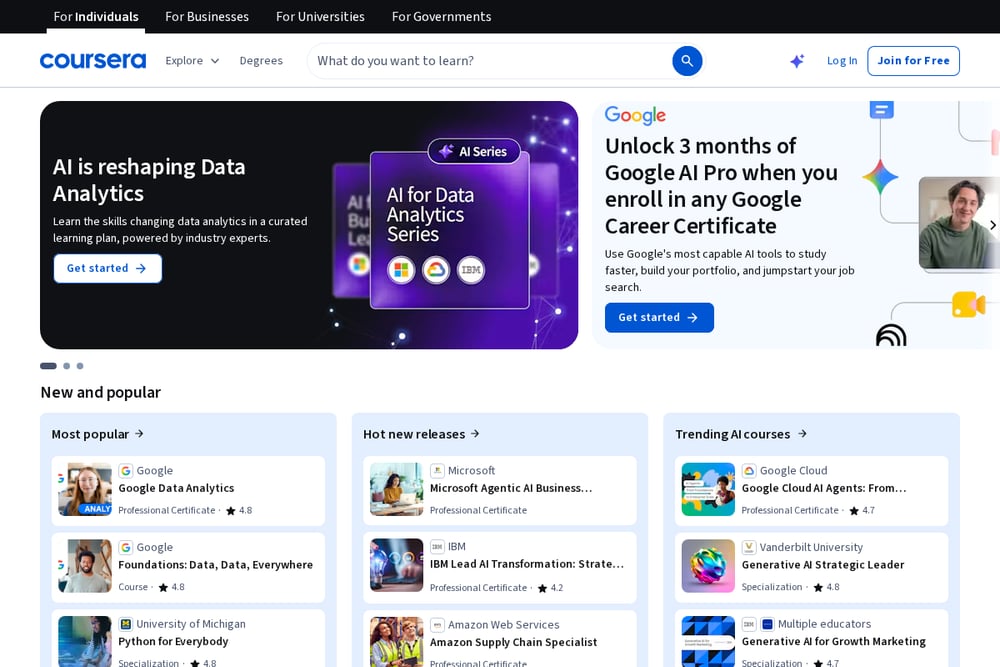 A screenshot of the AI for Lawyers and Other Advocates (Coursera) website.
This four-course specialization from Coursera gives you a broad foundation in AI for legal practice. You learn how to use AI to communicate better, solve problems creatively, manage your time, and delegate tasks. The program is taught by Patrick Barry and includes a shareable certificate for your LinkedIn profile. It is beginner-friendly and takes about four weeks at ten hours per week. You can enroll for free and learn at your own pace, which makes it easy to fit around a full caseload.
#2 AI Women in Law
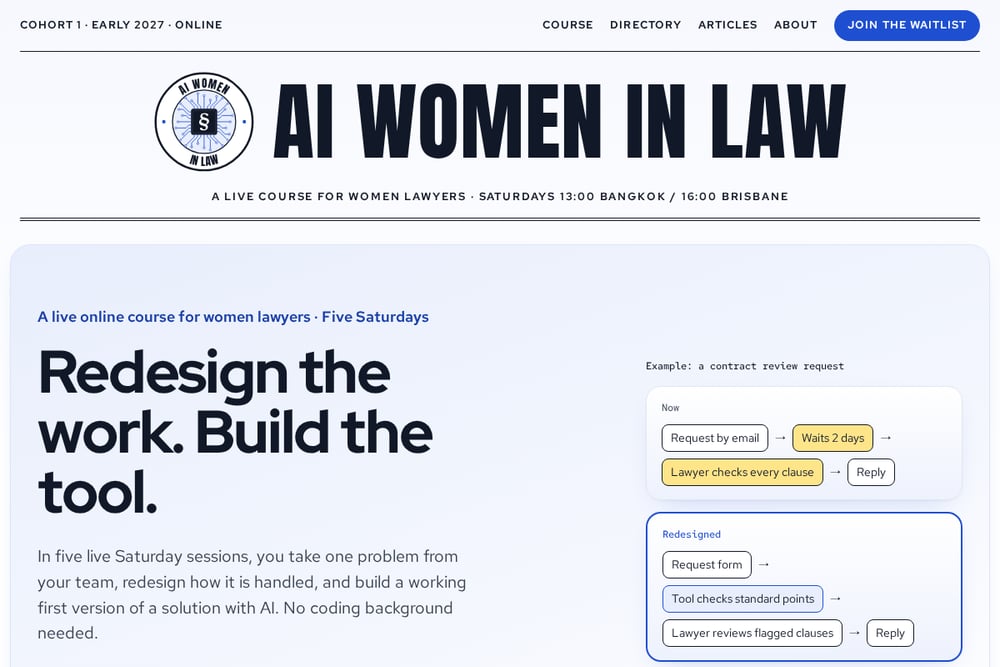 A screenshot of the AI Women in Law website.
This live five-week online course is built specifically for women lawyers who want to redesign a problem from their own team and build a working first version of a solution with AI. You meet on Saturdays in multiple time zones, including Bangkok and Brisbane, with a New York cohort planned. The course costs US$99, and fees fund scholarships of 50% or 100%, with free access for public-sector lawyers. You can join alone or as a team of two to four, and bring a colleague free. No coding background is needed, and you leave with something you can use, show, and keep improving.
#3 AI & ChatGPT Basics Series (DC Bar)
 A screenshot of the AI & ChatGPT Basics Series (DC Bar) website.
The DC Bar's AI and ChatGPT Basics Series is a continuing legal education program designed for practicing attorneys. It covers the fundamentals of generative AI and ChatGPT in a legal context, with a focus on ethical and practical considerations. The series is delivered through the DC Bar's CLE platform, which means you can earn MCLE credit while learning. It is ideal if you want to stay compliant and informed without committing to a long program. The content is tailored to the DC legal community but accessible to lawyers elsewhere.
#4 Generative AI for the Legal Profession (Berkeley Executive Education)
Berkeley Executive Education offers a program on generative AI for the legal profession through its law school. It is designed for legal professionals who want a deeper, more strategic understanding of how AI is transforming the industry. The program draws on Berkeley's academic expertise and likely includes case studies and frameworks for implementation. It is a premium option, both in terms of cost and time commitment, and suits lawyers in leadership or innovation roles. If you want to lead AI adoption in your organization, this is a strong choice.
#5 Legal AI Fundamentals Certification (Clio)
Clio's Legal AI Fundamentals Certification is a vendor-backed program that teaches you how to use AI in legal practice management. It focuses on practical applications within Clio's ecosystem, which is widely used by law firms. The certification is likely self-paced and online, making it convenient for busy lawyers. It is best for those who already use Clio or are considering it, as the skills transfer directly to the platform. The program emphasizes real-world use cases like document automation and client communication.
How to Choose the Right Program for You
Start by asking what you want to walk away with. If you want a certificate and a broad overview, a self-paced course like Coursera or Clio fits. If you need MCLE credit, the DC Bar series is a direct path. If you want to build something real for your team, a live cohort like AI Women in Law gives you that structure and accountability. Consider your schedule, budget, and whether you prefer learning alone or with peers. Scholarships and free options exist, so do not let cost stop you. The right program is the one you will actually finish and apply.
Turning Learning into Action
The real value of AI training comes when you apply it. After any course, pick one repetitive task in your week and redesign it with AI. Start small: a contract review checklist, a client intake form, or a research summary. Use the tools you learned to build a first version, then test it with a colleague. Iterate based on feedback. The goal is not perfection but progress. Over time, these small automations free up hours for higher-value work. That is how you turn a course into a competitive advantage.
The Bottom Line
AI is not coming for legal jobs; it is coming for legal tasks. The lawyers who thrive will be those who learn to delegate those tasks to AI and focus on judgment, strategy, and client relationships. The five programs here give you different on-ramps to that future. Whether you choose a flexible online specialization, a live cohort built for women in law, or a bar-approved CLE series, the key is to start. Pick one, commit to it, and build something. Your future self will thank you.