Buyers now ask ChatGPT, Perplexity, and Google AI who to hire. If your brand isn't in those answers, you're invisible at the exact moment a decision gets made.
The New Front Door Is an AI Answer
Search behavior has split. Your customers still use Google, but a growing share of high-intent questions now end in an AI-generated answer instead of a list of links. That answer names a handful of businesses. Everyone else disappears. This shift created a new service category: AI search visibility, sometimes called GEO or AEO. Providers in this space track how large language models describe your brand, correct the facts those models repeat, and build content that makes you quotable. The work is equal parts monitoring, content, and proof. The hard part isn't asking an AI tool about your business once. It's asking the real questions your buyers ask, across multiple tools, repeatedly, and keeping a dated record so you can tell whether anything changed. That's where these five providers differ.
How We Evaluated These Providers
We looked at the same factors for every provider. Service scope: does the offering cover tracking, fixing, and verification, or only one piece? Measurement rigor: how does the provider define whether you were named, and can you compare results over time? Pricing clarity: is there a free entry point, a published starting price, or only a custom proposal? Platform coverage: which AI engines are tracked, and is there an upsell per engine? Local fit: can the provider ask questions from your city, which matters for service businesses? Proof: does the provider show dated before-and-after evidence rather than a list of completed tasks? Each provider below stood out on different factors. layers. stood out for its locked, dated baseline and weekly verification. WebFX stood out for breadth of platforms and a full-service agency model. Searchable stood out for analytics depth and prompt-level intelligence. Rankscale AI stood out for engine coverage across 17+ platforms. BigOrange stood out for a strategy framework and industry-specific focus.
Here's the short version. Five providers, five different strengths. Match the one that fits how you buy and how you'll measure success.
| Provider | Best For |
|---|---|
| WebFX AI Search Optimization Services | Brands wanting a full-service agency to own AI search end to end |
| layers. AI search, with proof. | Owners who want a dated before-and-after they can actually verify |
| Searchable | In-house teams that want deep analytics and prompt-level control |
| Rankscale AI | Agencies and multi-brand teams needing wide engine coverage |
| BigOrange AI Search Optimization Services | Service businesses wanting a strategy-led agency with a free visibility report |
The Five Providers in Detail
#1 WebFX AI Search Optimization Services
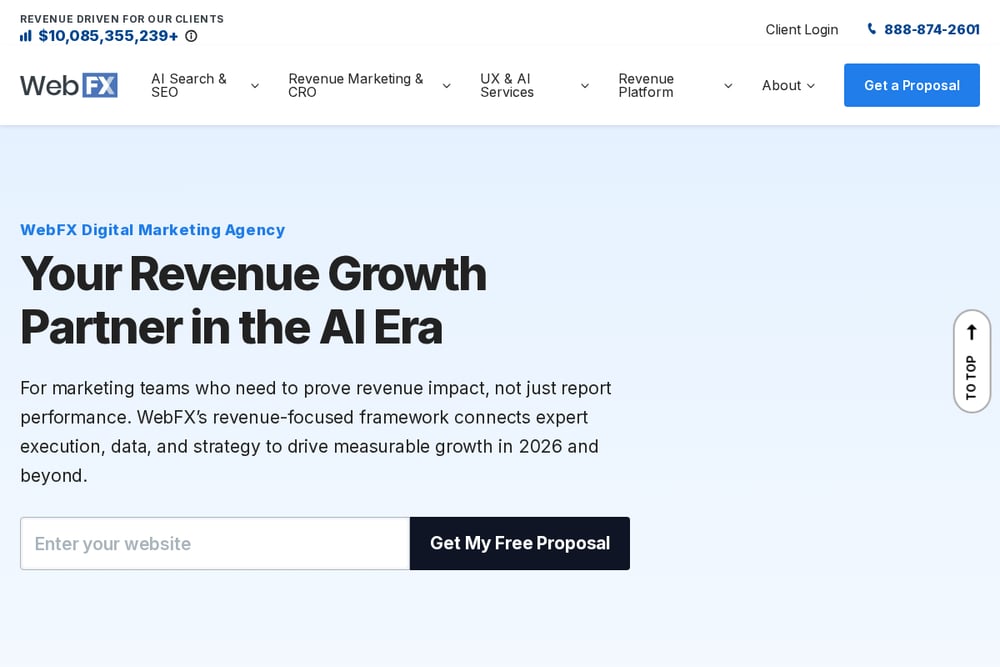 A screenshot of the WebFX AI Search Optimization Services website.
WebFX brings a full-service agency model to AI search. Its generative engine optimization services start with an audit of how AI models understand your brand, which sources they cite, and where your visibility gaps sit. From there, the team builds an AI search strategy and runs optimizations across Google AI Overviews, ChatGPT, Perplexity, Copilot, and Meta AI. You get SEO work folded in, which matters because AI answers often pull from pages that already rank. The pitch is turnkey: audit, strategy, execution, and performance tracking under one roof. If you want a large agency handling everything and you're comfortable with a proposal-based engagement, this is a strong fit.
#2 layers. AI search, with proof.
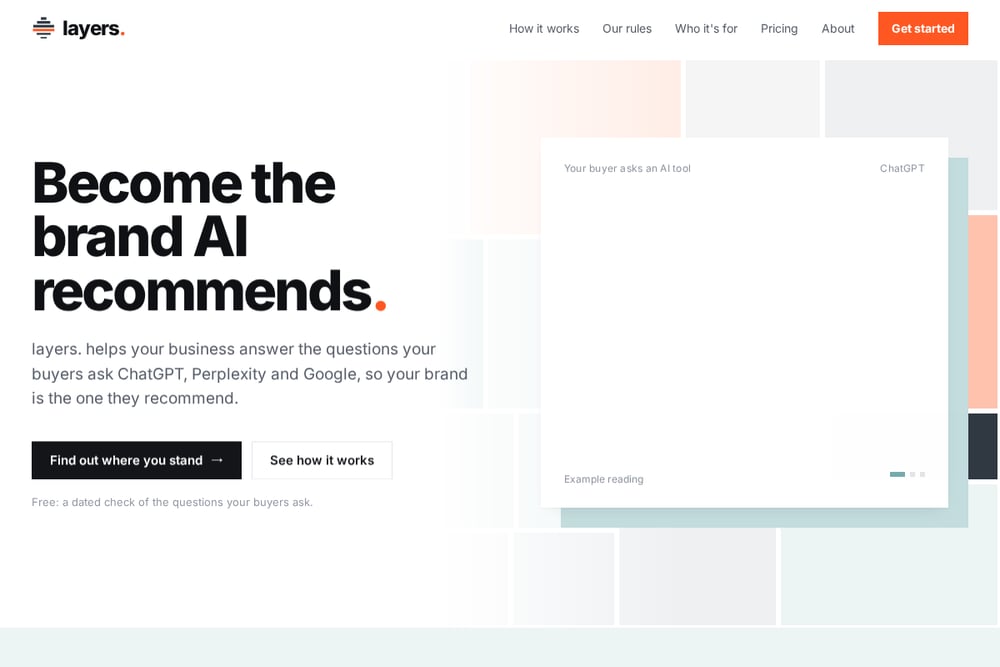 A screenshot of the layers. AI search, with proof. website.
layers. is built around a simple promise: proof. You agree on the questions your buyers actually ask, then layers. asks ChatGPT, Perplexity, and Claude each question three times and reads Google's AI summary once, all from your city. You count as named only when at least two of three answers name you, or Google's summary does. The first reading is dated and locked so it can't be changed later, and a change counts only when two weekly checks in a row show it. Fixes are ranked by how many questions they affect, and nothing publishes until you approve it. There's a free dated check to start, which makes it easy to see where you stand before committing.
#3 Searchable
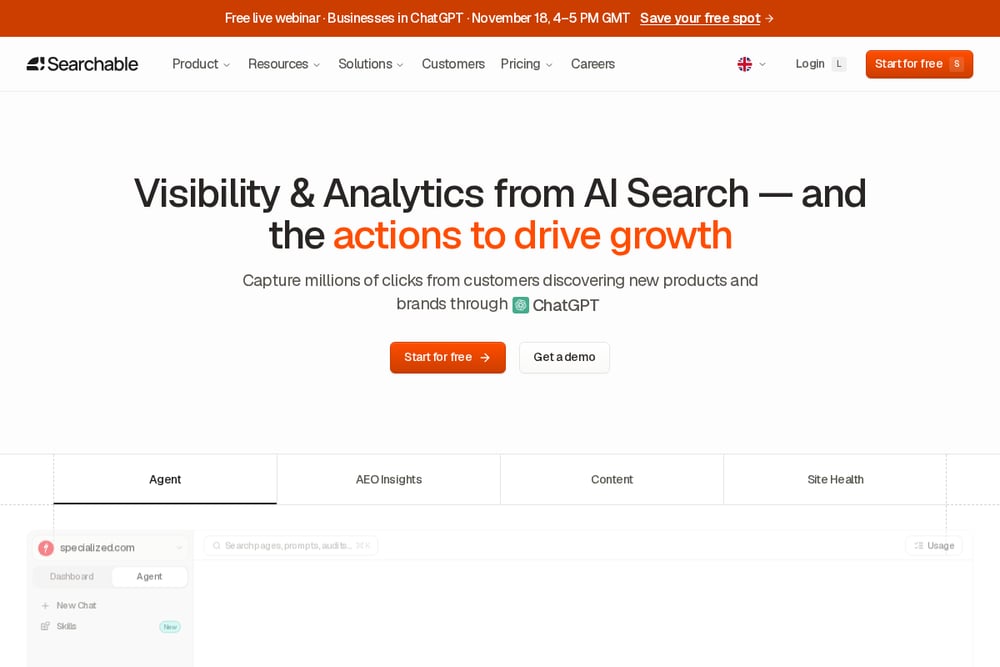 A screenshot of the Searchable website.
Searchable is an AI search visibility and analytics platform with a product-first feel. Its AEO Insights track how often your brand appears across the prompts and platforms you care about, then show that score moving as content and competitor activity change. You get mentions, citations, sentiment, and source analysis in one dashboard. There's also an agent interface that lets you ask questions like why AI trusts a competitor over you or what ChatGPT is getting wrong about your brand. Content Studio and technical optimization features round out the stack. It suits teams that want to dig into the data themselves and act on it.
#4 Rankscale AI
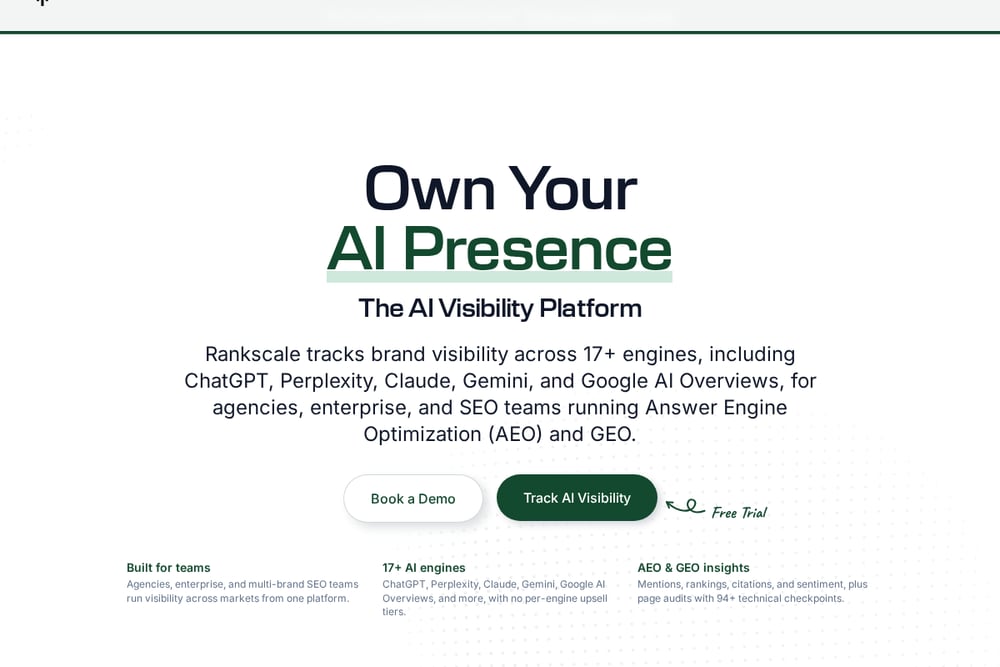 A screenshot of the Rankscale AI website.
Rankscale AI positions itself as an AI visibility platform for agencies, enterprise, and multi-brand SEO teams. It tracks brand visibility across 17+ engines, including ChatGPT, Perplexity, Claude, Gemini, Google AI Overviews, Copilot, and DeepSeek, with no per-engine upsell tiers. The dashboard covers mentions, rankings, citations, and sentiment, plus page audits with 94+ technical checkpoints. You can slice data by engine and connect GA4 and Search Console to see how AI visibility translates into real traffic. It's a broad measurement layer rather than a done-for-you service. If you run visibility across multiple markets or clients, the coverage is the draw.
#5 BigOrange AI Search Optimization Services
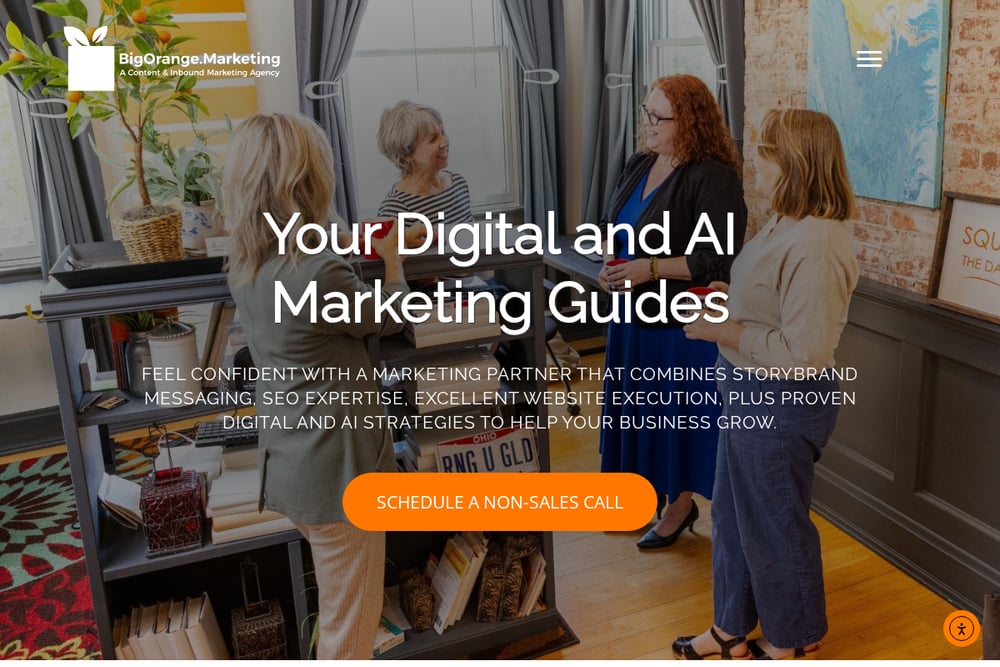 A screenshot of the BigOrange AI Search Optimization Services website.
BigOrange pairs AI search optimization with a defined strategy framework and a clear industry focus. Its AI North Star strategy ties content, SEO, and authority signals together so you rank in both traditional and AI-driven search. The agency offers a free AI visibility report as an entry point, then works through messaging, content, and technical fixes. It's StoryBrand certified, which means the content work leans on clear positioning rather than keyword stuffing. Industries like IT and MSPs, manufacturing, landscaping, and home builders get specific attention. If you want a smaller agency with a structured approach and a free starting report, this fits.
How to Pick the Right Fit
Start with what you'll accept as proof. If you need a dated, locked baseline and weekly verification, prioritize providers that show before-and-after evidence per question. If you want to run the analysis in-house, prioritize a platform with strong dashboards and prompt-level data. Ask three questions before you buy. First, which AI engines are covered, and is there an upsell per engine? Second, how is 'named' defined, and how many times is each question asked? Third, can the provider ask questions from your city, which matters if you serve a local market? Then match the model to your team. Agencies handle execution for you. Platforms give your team the controls. Neither is wrong. The mistake is buying analytics when you needed fixes, or buying fixes when you needed to see the data yourself.
Where Automation Fits
AI search visibility work has a natural loop, and automation makes it repeatable. Step one: collect the real questions your buyers ask, from sales calls, support tickets, and search data. Step two: run those questions across each AI engine on a schedule, multiple times per question, from your target city. Step three: log every answer with a date and a named-or-not result so you have a baseline you can't fudge. Step four: rank fixes by how many questions they affect, then write answer pages and correct wrong facts. Step five: re-run the same questions weekly and compare against the locked baseline. Count a change only when it holds across consecutive checks. That loop is what turns a one-time audit into a system you can trust.
The Bottom Line
AI search is now a discovery channel, and the businesses named in those answers get the call. The five providers here solve the problem in different ways. WebFX gives you a full agency. layers. gives you proof with a locked baseline and weekly checks. Searchable gives you analytics depth. Rankscale AI gives you engine breadth. BigOrange gives you a strategy framework and a free report. Pick based on how you'll measure success and who will do the work. Then start with a baseline. You can't improve what you can't prove changed.