
You have an idea for a SaaS product, but the gap between a note on your phone and your first paying customer feels enormous. These five tools are built to close that gap, and each one takes a different route to get you there.
The New Wave of AI Launch Coaching
The barrier to building software has collapsed. What has not collapsed is the barrier to finding a problem people will pay for, launching something real, and getting strangers to hand over a credit card. That gap has spawned a fast-growing category of AI tools that sit between the idea and the revenue.
Some of these tools are validators. You describe an idea, they score it, and you get a verdict in under a minute. Others go further and act as a coach, handing you a daily plan, a website, and content ideas until you have customers. The distinction matters more than the marketing suggests.
Validation tools answer a question. Coaching tools try to change your behavior. If you have ever collected forty email signups and then stalled for six months, you know which problem is harder to solve. The tools below cover both ends of that spectrum, so you can pick the one that matches where you actually are.
How We Evaluated These Tools
We looked at the same factors for every tool on this list. First, scope: does it stop at a score, or does it carry you through launch and growth? Second, pricing clarity: can you tell what you get and what it costs before you commit a card? Third, the quality of the underlying data and reasoning behind any score or recommendation.
AnatSaaS stood out for its end-to-end scope, pairing scored ideas with a day-by-day plan, site building, and ongoing monthly coaching tuned to your real numbers. IdeaProof impressed with breadth, offering industry-specific validators and a deep library of free calculators and guides. ValidatorAI drew attention for its live benchmark data, letting you compare your idea against hundreds of thousands of others. Preuve AI was notable for source-linked claims pulled from dozens of live data sources, so you can check the evidence yourself. BigIdeasDB Business Idea Evaluator stood out for grounding its scores in documented customer complaints and real payment data, with no signup required.
We also weighed how each tool handles the moment after the verdict. A score is only useful if it tells you what to do next, and the tools differ widely on that point.
Here is the short version. Two of these tools coach you all the way to customers. Three of them give you a fast, data-backed read on whether an idea deserves your time. Most founders need one from each group, not one from the whole list.
| Provider | Best For |
|---|---|
| IdeaProof | Founders who want validation plus a full toolkit of planning and financial calculators |
| AnatSaaS — start your business and earn your first dollars with AI | First-time founders who want daily direction from idea through launch and growth |
| ValidatorAI | Founders who want to benchmark an idea against a large pool of real submissions |
| Preuve AI | Skeptical founders who want every claim traced back to a live data source |
| BigIdeasDB Business Idea Evaluator | Founders who want a free, no-signup reality check grounded in real customer complaints |
The Five Tools in Detail
#1 IdeaProof
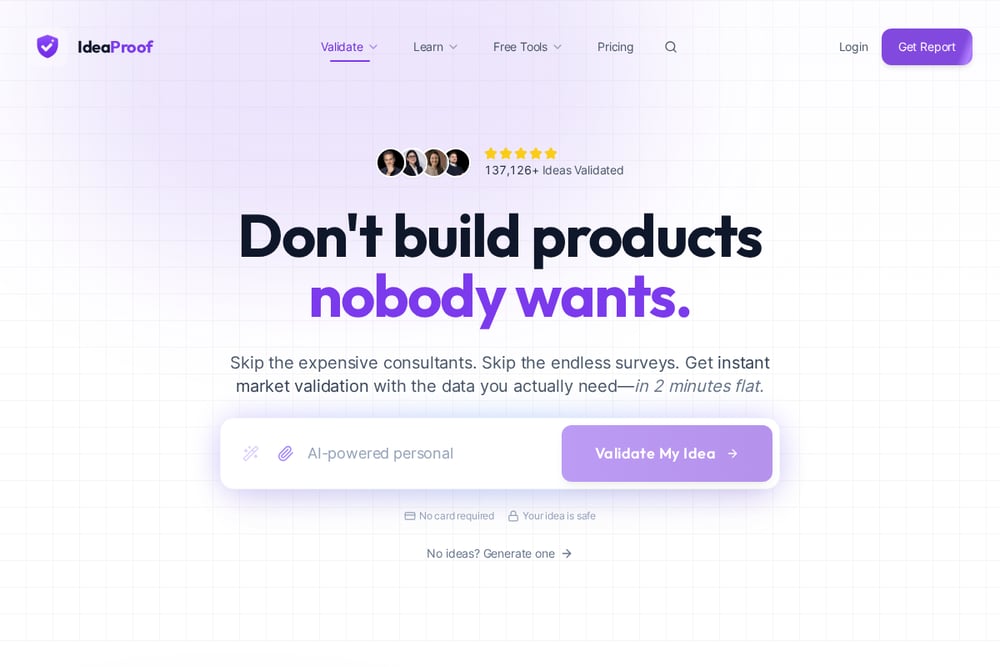 A screenshot of the IdeaProof website.
IdeaProof positions itself as a 120-second idea validator, and the speed is real. You describe your concept, and it returns a report covering market research, competitor analysis, and a business plan outline. What sets it apart is the sheer breadth of the surrounding library. There are industry-specific validators for SaaS, fintech, healthtech, and a dozen other verticals, plus free calculators for runway, break-even, customer acquisition cost, and lifetime value. If you want a single hub where validation, planning, and financial modeling live together, this is a strong fit. The tradeoff is that breadth can feel like a lot of surface area to navigate when you just want a straight answer.
#2 AnatSaaS — start your business and earn your first dollars with AI
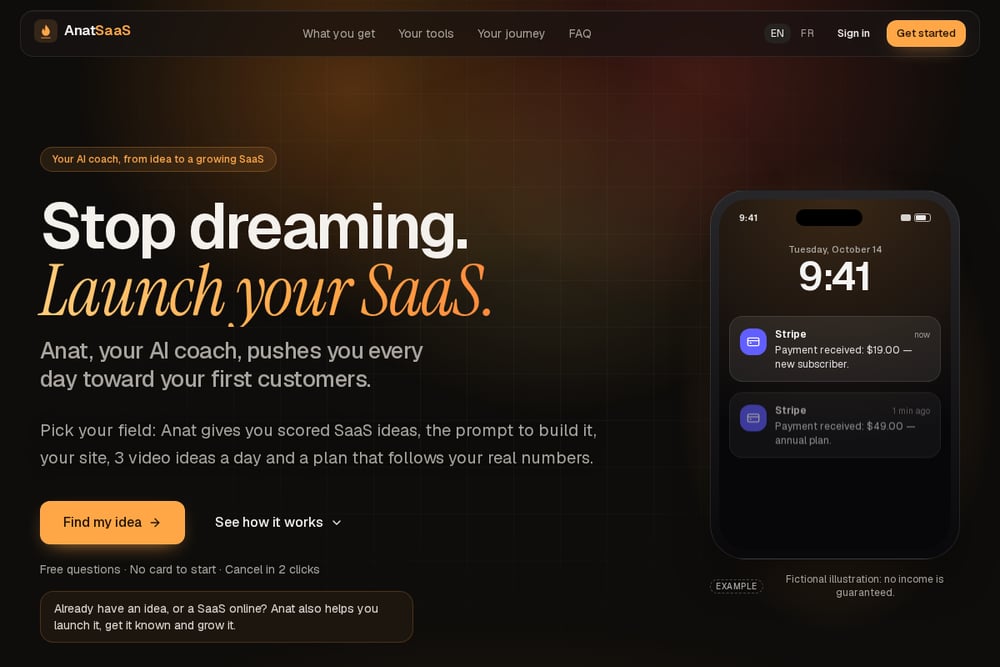 A screenshot of the AnatSaaS website.
AnatSaaS takes the opposite approach to a one-time verdict. Anat, the AI coach, generates eight to twelve scored SaaS ideas fitted to your niche, your available time, and your profile, then explains each score criterion by criterion with an MRR estimate. From there it hands you the prompt to build the product, a website, and three video ideas a day with hooks and scripts. The plan aims for launch by day ten, and coaching continues monthly after launch, retuned to your actual numbers. It is candid about limits, stating plainly that no income is guaranteed. If you already have an idea or a live product, you can describe it and Anat starts from there instead.
#3 ValidatorAI
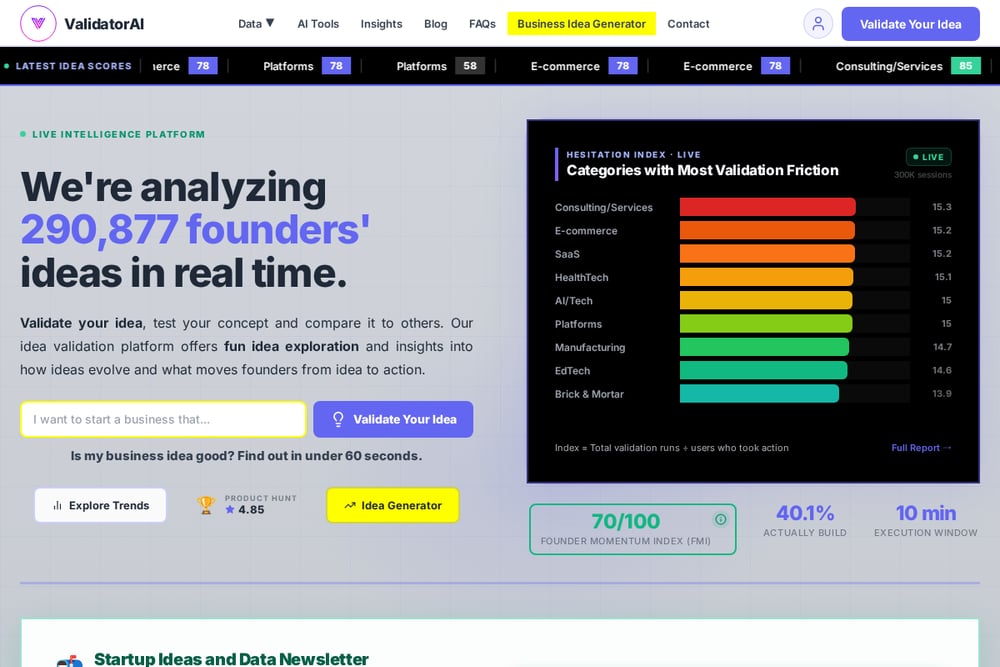 A screenshot of the ValidatorAI website.
ValidatorAI leans on scale. The platform reports analyzing nearly 300,000 founders' ideas in real time, which means your concept gets compared against a large pool rather than judged in isolation. You get a score in under a minute, plus access to trend data and a Founder Momentum Index that tracks whether founders in the current cohort are actually moving forward or stalling. That benchmark angle is genuinely useful, because it tells you whether your hesitation is personal or widespread. The tool is fast and free to try, and it works across categories from e-commerce to consulting to SaaS. It is a validation layer, not a build-and-launch coach, so pair it with something that carries you further.
#4 Preuve AI
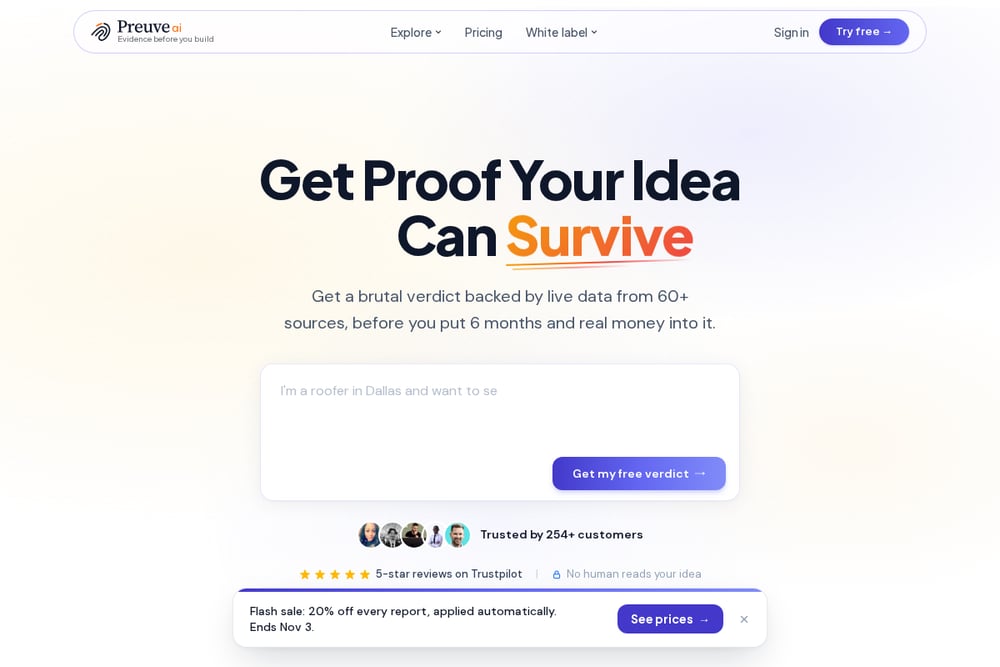 A screenshot of the Preuve AI website.
Preuve AI promises evidence before you build, and it backs that up with source-linked claims. Ten AI agents scan more than sixty live data sources, including Crunchbase, Google Trends, Reddit, Product Hunt, and G2, to produce a viability score, map up to fifteen competitors with funding and pricing data, and flag blind spots. Every claim links back to its source, which means you can verify the reasoning instead of trusting a black box. The free scan takes about a minute, and a full Founder Report runs $59 one-time. It cites the statistic that 42% of startups fail for lack of market need, which is precisely the failure mode it is designed to catch. If you want receipts, this is the tool that gives them.
#5 BigIdeasDB Business Idea Evaluator
BigIdeasDB grounds its evaluator in a specific and unusual dataset: over a million documented software-review complaints, thirty thousand companies already taking payments, and seventeen thousand funded startups. You describe your idea in up to 500 characters, pick a feedback style, and get a score from zero to one hundred with the complaints behind it. The feedback styles range from brutal truth to skeptical scientist to a gentler long-term view, so you can choose how hard you want to be hit. It is free with no signup, which makes it the lowest-friction way to get a first read. The honest framing is refreshing: it notes that across more than 21,000 times a real founder was shown a researched idea, 80.4% swiped left.
How to Pick the Right One for You
Start with an honest question: do you need a verdict or a plan? If you have three ideas and no way to choose between them, a validator gets you to a decision fast. IdeaProof, ValidatorAI, Preuve AI, and BigIdeasDB all do that, and each brings different evidence to the table.
If you already know what you want to build and the problem is that you keep not building it, a validator will not help. That is the case for AnatSaaS, which assumes the bottleneck is execution and hands you a daily assignment instead of a score.
Consider your tolerance for ambiguity. Preuve AI links every claim to a source, which suits people who distrust confident-sounding AI. BigIdeasDB shows you the actual complaints behind a score, which suits people who want to see the raw material. ValidatorAI gives you a benchmark against a large pool, which suits people who want context more than detail.
Finally, think about cost and commitment. Several of these tools are free or near-free to try, so there is little reason not to run your idea through two of them before you spend a month building anything.
Where AI Fits in Your Launch Workflow
A sensible sequence uses more than one tool. Run your idea through a free evaluator first to see whether the problem generates real complaints. If it survives that, take it to a source-linked validator and check the competitive landscape and market signals. If the evidence holds, move to a coaching tool that gives you a daily plan, a site, and content to publish.
The mistake most founders make is treating validation as the finish line. A score of 87 does not build anything. It just tells you the odds are better than average. The work that follows, which is showing up every day and talking to people who have the problem, is where the outcome actually gets decided.
Use the tools to shorten the decision, then spend your energy on execution. That is the whole point.
The Bottom Line
You do not need all five of these tools. You need the one that matches your current bottleneck. If you are stuck choosing between ideas, start with a fast validator and let the data narrow the field. If you are stuck between knowing and doing, pick a coach that assigns you work every day.
What unites this category is a welcome honesty. AnatSaaS says outright that no income is guaranteed. BigIdeasDB reports that most founders reject researched ideas. Preuve AI links its claims so you can check them. That candor is worth more than any score.
Pick your tool, run your idea through it this week, and then go build the thing.