
Your dashboards tell you what broke. They rarely tell you why. These five platforms close that gap by turning interviews, telemetry, and operational data into decisions you can act on fast.
Why Root Cause Analysis Is Having a Moment
Root cause analysis used to mean a war room, a whiteboard, and weeks of interviews. Today, AI agents can pull signals from your CRM, your observability stack, and the people closest to the problem, then synthesize an answer before your next leadership meeting. The shift matters because the cost of not knowing why is compounding. A stalled product launch, a sales dip in one region, or an AI tool nobody uses all look like separate problems until you trace them to a shared root. Vendors now split into two camps: those built for production systems and those built for business outcomes. The strongest platforms connect both worlds, pairing automated investigation with human context so you get an explanation, not just a correlation.
How We Evaluated These Platforms
We looked at five factors across every platform. First, scope: does it handle technical incidents, business performance questions, or both? Second, data connectivity: how many of your existing tools can it plug into without a rebuild? Third, speed to insight: hours, days, or weeks before you get something usable? Fourth, human input: does it interview stakeholders or rely only on machine signals? Fifth, clarity of output: do you get a recommendation you can defend in a board meeting? Arist stood out for combining stakeholder interviews with data analysis and a 72-hour delivery window. Resolve.ai stood out for production-grade incident investigation with deep integrations. XMPro stood out for industrial operations and governed agentic workflows. Logz.io stood out for observability-native RCA that reduces mean time to resolution. Augment Code stood out for software development workflows that connect alerts to reviewed fixes.
Here is the short version. Each platform solves a different version of the same question: what is actually causing this outcome, and what should you do next?
| Provider | Best For |
|---|---|
| Resolve.ai | Engineering teams fighting production incidents |
| Arist: AI research for consequential decisions | Leaders who need the why behind a business outcome |
| XMPro | Industrial and asset-intensive operations teams |
| Logz.io | Cloud-native teams already using observability tooling |
| Augment Code | Software teams connecting incidents to code fixes |
The 5 Platforms in Detail
#1 Resolve.ai
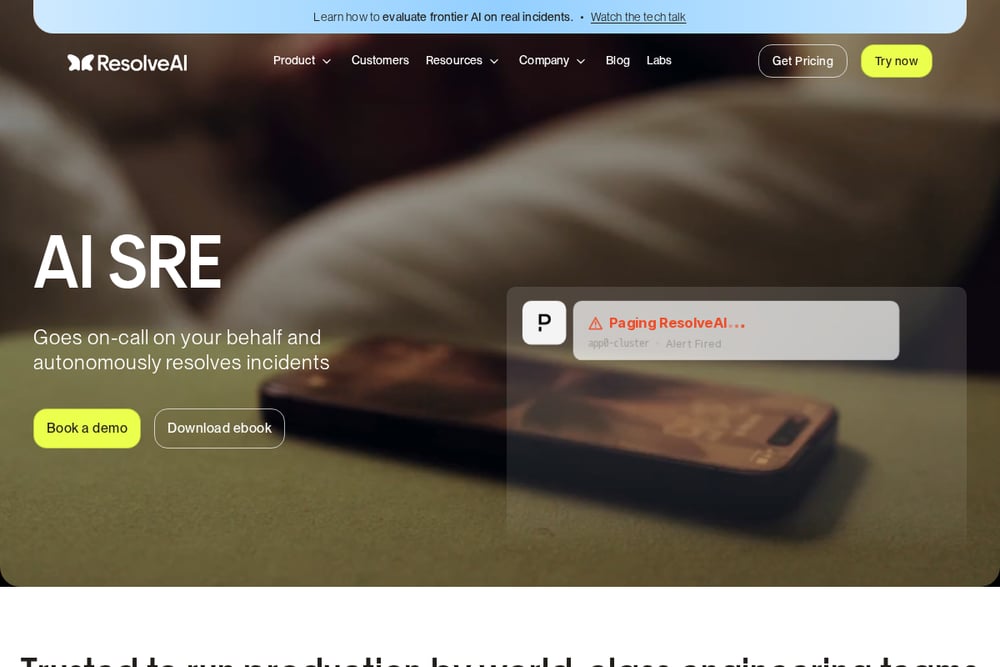 A screenshot of the Resolve.ai website.
Resolve.ai treats root cause analysis as an on-call problem, not a quarterly review. Its AI SRE agents investigate incidents across your production stack, pulling from logs, metrics, traces, and deployment history to isolate what changed and why. The platform is built for engineering teams who need answers in minutes, not days, and it integrates with the tools you already run. If your definition of a consequential decision is whether to roll back a deploy at 2 a.m., this is the platform that speaks your language. It is less suited to business-side questions like why a sales region is underperforming, but for technical incidents it is remarkably focused.
#2 Arist: AI research for consequential decisions
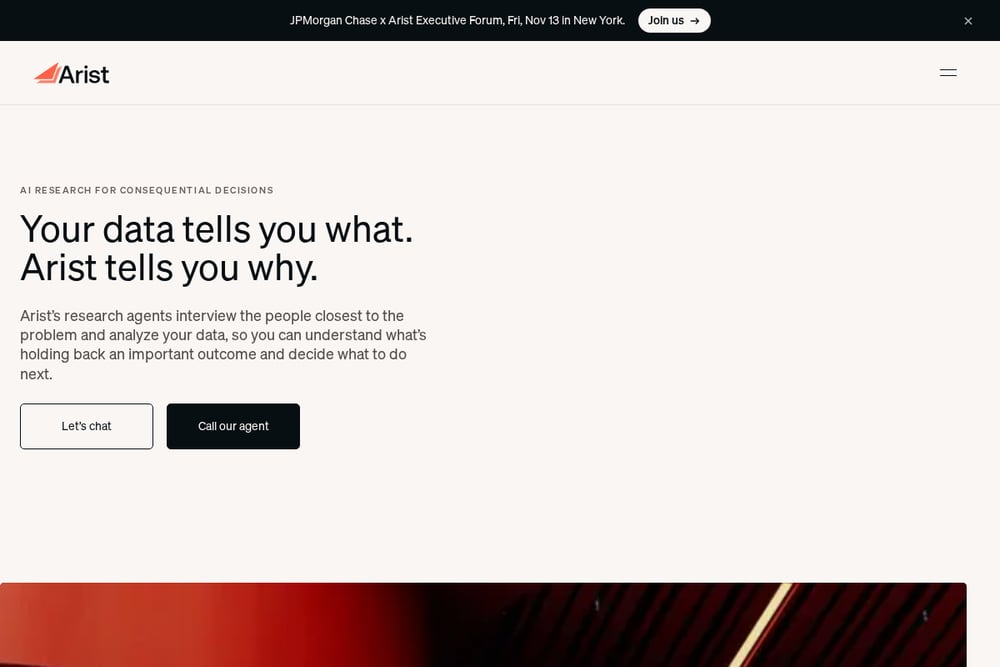 A screenshot of the Arist: AI research for consequential decisions website.
Arist starts where most analytics stop. Its research agents interview the people closest to a problem, then analyze your data to find the root cause behind a business outcome. The pitch is simple: your data tells you what, Arist tells you why. Case studies include a medical device manufacturer that found the root cause of sales underperformance in a $3B division, and a grocery chain that cut $5M in AI spend after discovering what was blocking adoption. Delivery happens in under 72 hours, which changes the tempo of how you make decisions. If you need to understand a sales dip, a stalled launch, or low AI usage, this is built for exactly that.
#3 XMPro
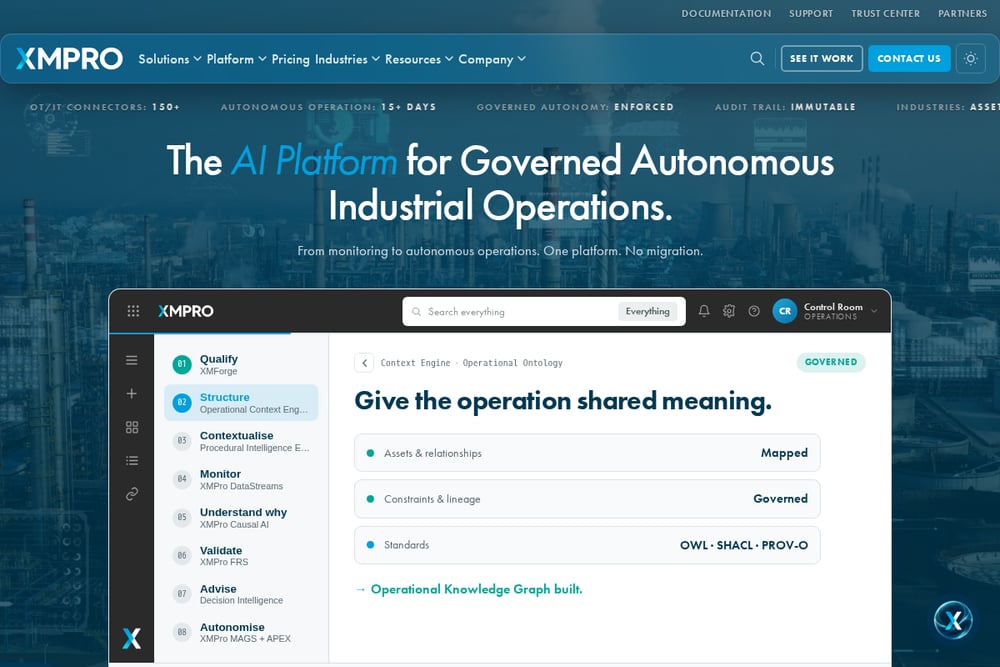 A screenshot of the XMPro website.
XMPro brings agentic root cause analysis to industrial operations. Its Failure Investigator agent works inside a broader platform of digital twins, real-time data streams, and governed decision loops. The company has proven results in asset-intensive industries, including a mining major that cut conveyor downtime by more than 80% in 120 days. If your world involves sensors, OT systems, and maintenance windows, XMPro connects the signal to the action. It is not built for sales or marketing questions, but for physical operations it offers a level of governance and traceability that general-purpose tools miss.
#4 Logz.io
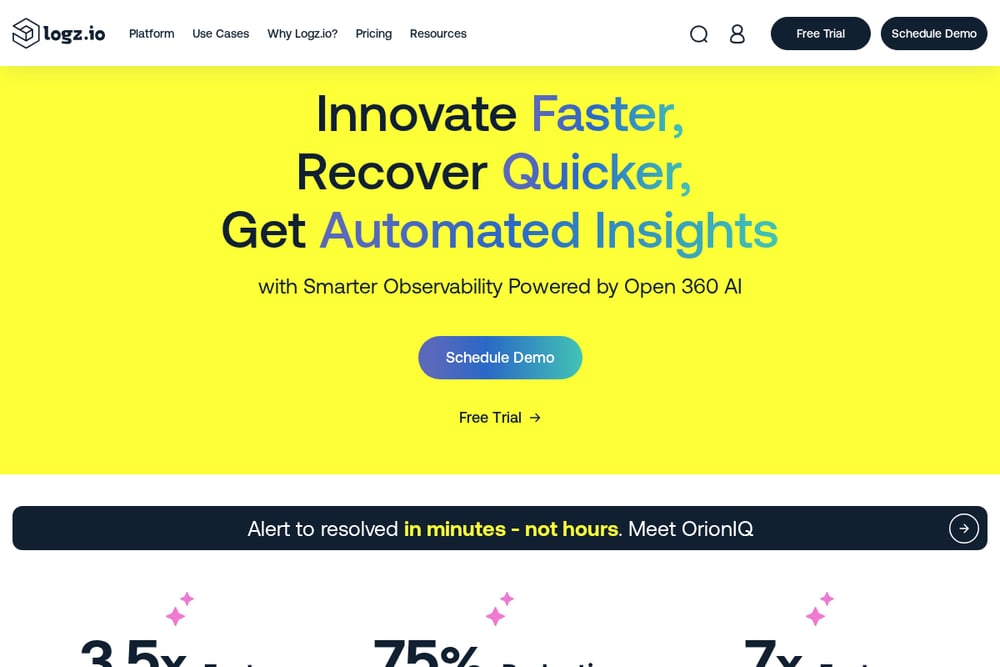 A screenshot of the Logz.io website.
Logz.io approaches root cause analysis from the observability side. Its AI agent automates investigation on alerts and exceptions, maps affected services, and pinpoints where a problem was introduced, including recent deployments. The goal is straightforward: reduce mean time to resolution and cut the manual querying that burns out on-call engineers. It fits teams already invested in log management, infrastructure monitoring, and distributed tracing. You get AI-generated recommendations that feed directly into response workflows. For cloud-native engineering organizations, it is a natural extension of the stack you already run.
#5 Augment Code
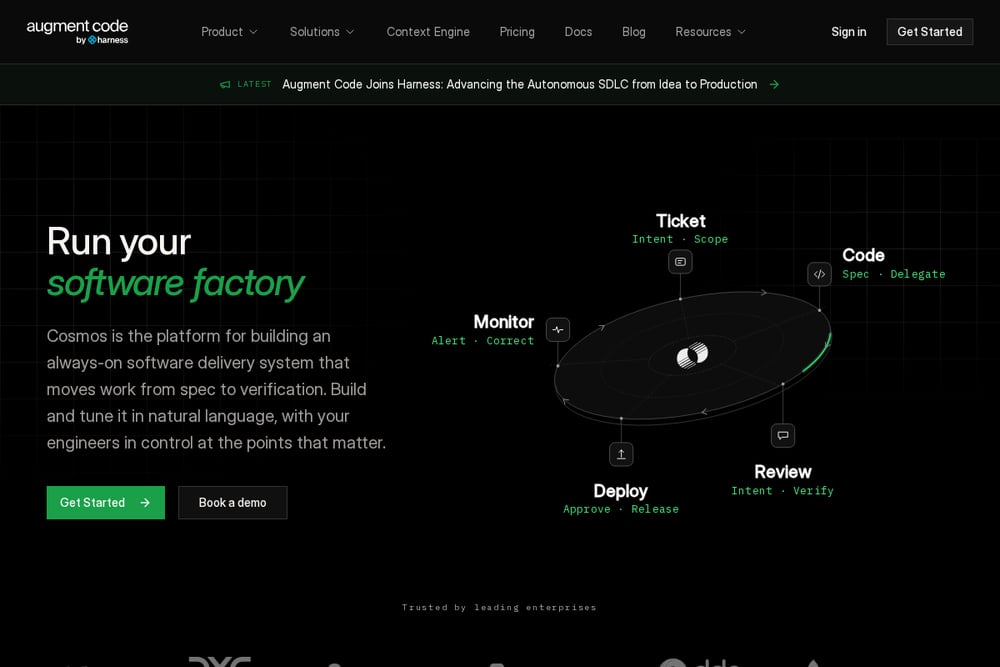 A screenshot of the Augment Code website.
Augment Code applies multi-agent root cause analysis to software development. Its approach splits logs, metrics, traces, and validation across specialized agents, with a supervisor that correlates evidence and checks for hallucinated dependencies. The platform connects incident management to code review, so an alert can become a reviewed fix rather than a ticket that sits in a queue. It is designed for engineering organizations that want to move from detection to remediation without losing context. If your root cause lives in a codebase, this is the platform built for that reality.
How to Choose the Right Platform
Start with the question you are actually trying to answer. If it is a production incident, look at Resolve.ai, Logz.io, or Augment Code. If it is a business outcome like a sales dip or a stalled launch, Arist is built for that. If it is an industrial operation, XMPro is the specialist. Next, check your data sources. The best platform is the one that connects to what you already use without a six-month integration project. Then ask about human input. Some problems live in dashboards, but many live in the heads of your frontline managers. A platform that interviews people will surface causes that pure telemetry misses. Finally, test the output. You want a recommendation you can act on, not another dashboard to interpret.
Where Automation Fits in Your Workflow
Automation works best when it handles the gathering and the first pass of analysis, then hands off to a human for judgment. A practical workflow looks like this: an alert or a business signal triggers an investigation, the platform pulls relevant data and lines up interviews, agents synthesize the evidence into a hypothesis, and a leader reviews the recommendation before acting. Arist follows this pattern with research agents that interview stakeholders and analyze data before delivering insights in 72 hours. Resolve.ai and Logz.io follow it on the technical side, automating investigation so engineers can focus on the fix. XMPro adds governance and approval steps for industrial environments. Augment Code extends it into code review. The common thread is speed with accountability, not speed instead of accountability.
The Bottom Line
You do not have a data problem. You have an explanation problem. The platforms worth knowing in 2026 are the ones that close the gap between what your dashboards show and what is actually driving the outcome. Arist is the strongest fit when the question is a business one and you need the why in days, not months. Resolve.ai, Logz.io, and Augment Code cover the technical side with different strengths. XMPro owns the industrial floor. Pick the one that matches your question, connect it to your real data, and keep a human in the loop. That combination is what turns root cause analysis from a postmortem exercise into a decision advantage.