AI can generate a working prototype in an afternoon. Making that prototype reliable, usable, and worth paying for is a different job entirely. These five partners bring the human judgment to finish what the model started.
Where AI product engineering stands right now
Every team can now ship a demo. Fewer can ship something customers trust. That gap has created a new class of partner: studios and firms that pair product taste with full-stack engineering and AI workflows. You are no longer shopping for raw code output. You are shopping for judgment about what deserves to exist, and the discipline to make it dependable.
How we looked at each partner
We weighed four things: how clearly each partner scopes and prices its work, how wide the service range runs from strategy through delivery, how well the offering fits startups versus enterprises, and how transparent the engagement model is before you commit money. Detail on each business lives in its entry below.
Here is the short version before the deep dive. Each entry below covers what the partner actually does, who it suits, and where the engagement starts.
| Provider | Best For |
|---|---|
| Sphere | Enterprises needing governed, auditable AI delivery |
| MegaMogu — AI-Native Product & Engineering Studio | Founders who want a low-risk first step with senior product and engineering input |
| Prodevbase | Businesses wanting AI, data, and cloud under one partner |
| CodeCones | Teams that need certified security controls and production RAG experience |
| Cabot Solutions | Healthcare and regulated teams needing domain-aware engineering capacity |
The five partners, in detail
#1 Sphere
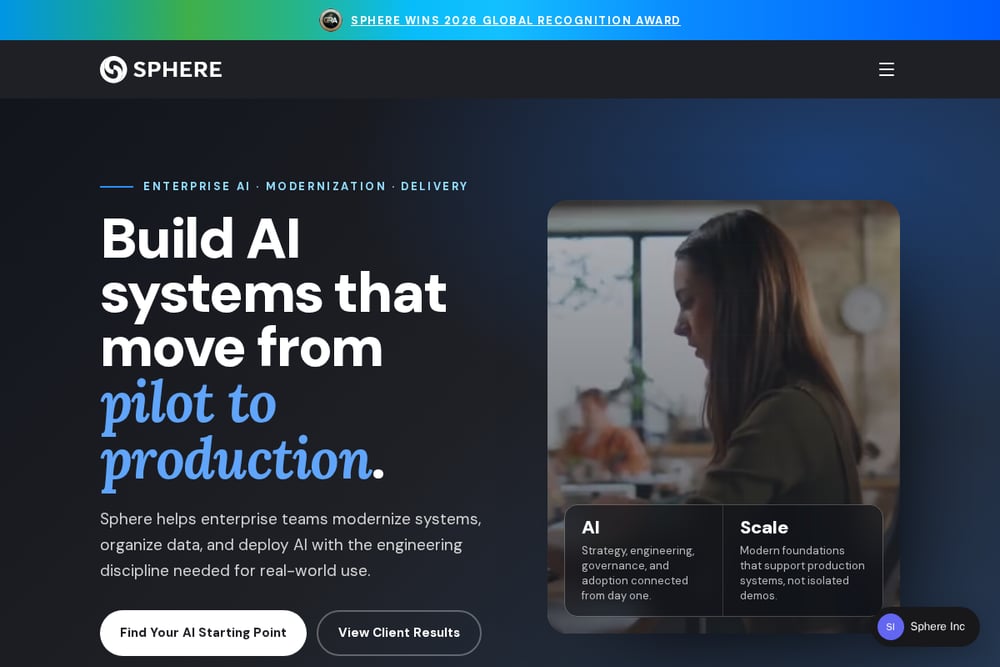 A screenshot of the Sphere website.
Sphere has spent more than two decades building enterprise software, and it now wraps that experience in a governed AI practice. Its AI Foundry spans strategy, agentic systems, RAG, and AI governance under one roof, which matters if your legal and security teams will ask hard questions. The firm also runs a fixed-scope AI Opportunity Diagnostic, so you can test the relationship before committing to a build. It is a heavyweight option built for organizations with compliance obligations and existing systems to integrate. If you need audit trails and FinOps alongside your model deployment, this is the kind of partner that speaks that language.
#2 MegaMogu — AI-Native Product & Engineering Studio
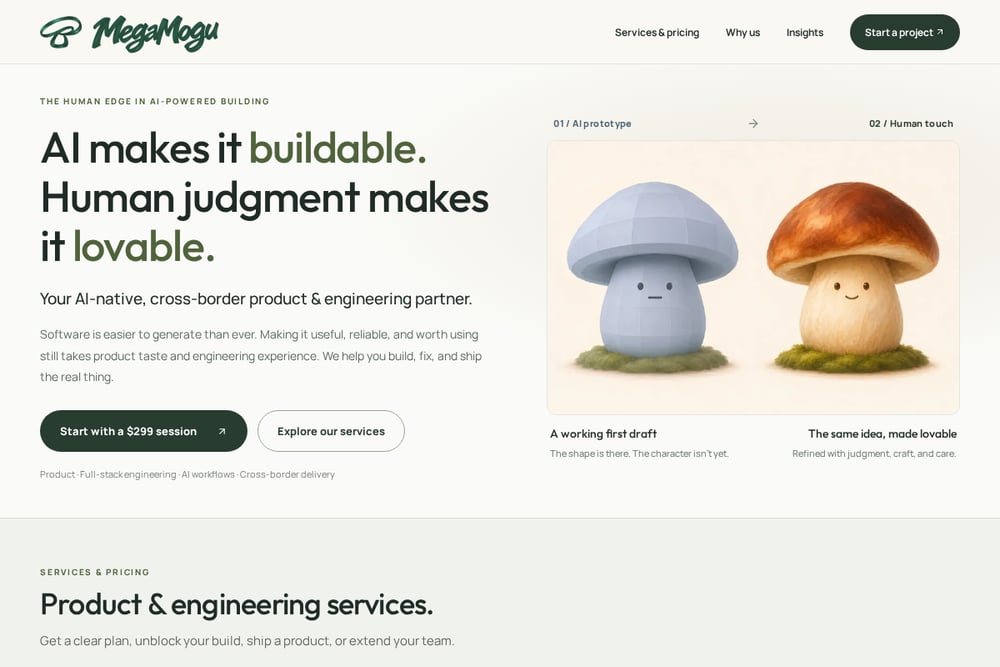 A screenshot of the MegaMogu website.
MegaMogu positions itself around a simple idea: AI makes it buildable, human judgment makes it lovable. The studio offers a $299 Power Session with a product lead and an engineer, refunded if you do not walk away with a clear plan. From there you can scope a fix from $750, build a product from $5,000 on milestones, or extend your team on a custom basis. It covers product strategy, full-stack engineering, AI workflows, and cross-border delivery, which suits founders who need senior thinking without a full agency retainer. The tiered entry points are unusually clear for this category, and the refund promise on the session lowers the risk of a first conversation.
#3 Prodevbase
 A screenshot of the Prodevbase website.
Prodevbase frames AI product engineering as a discipline that combines software engineering, data science, and product design in one workflow. Its service menu runs wide, from agentic and generative AI through AI strategy, data engineering, cloud, and DevOps. That breadth helps if your roadmap touches data pipelines and infrastructure as much as it touches model behavior. The firm writes openly about how AI products differ from static software, emphasizing continuous learning loops and data readiness. It is a reasonable fit for businesses that want one partner across several technical tracks rather than stitching vendors together.
#4 CodeCones
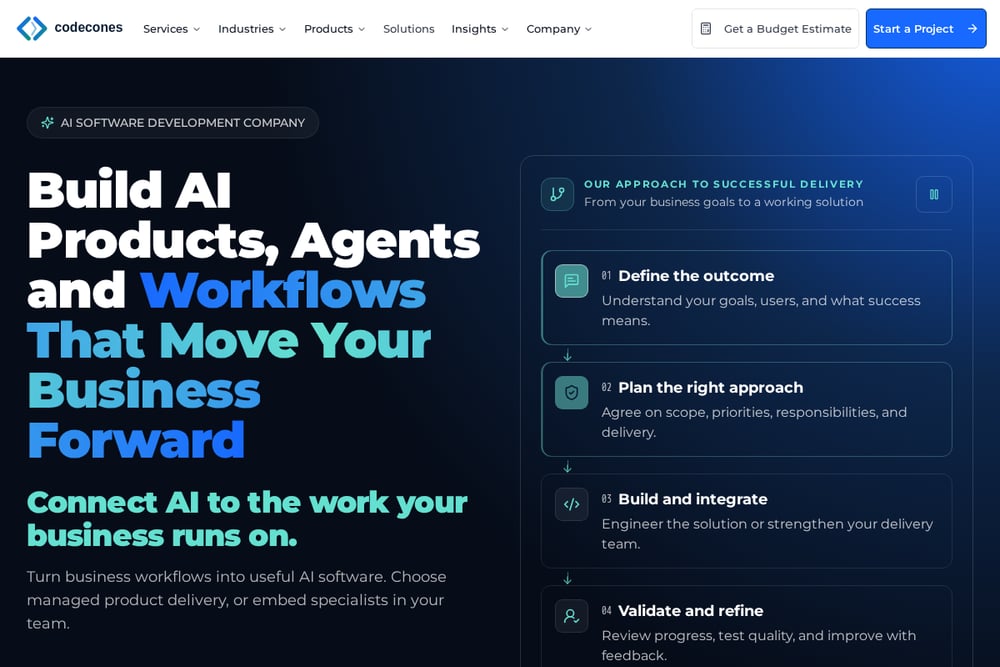 A screenshot of the CodeCones website.
CodeCones leads with an evaluation-first approach and a stated goal of reaching production in 90 days, with the honest caveat that timing depends on data readiness and risk controls. Its offering covers product strategy, generative AI and LLM engineering, production-grade RAG, model governance, and observability. The firm cites 50-plus production AI systems and 200-plus engineers, and holds ISO 27001 and ISO 9001 certifications. That combination appeals to teams that need security posture documented before procurement will sign. If your product layer needs to survive real users and real operating constraints, this is a credible shortlist entry.
#5 Cabot Solutions
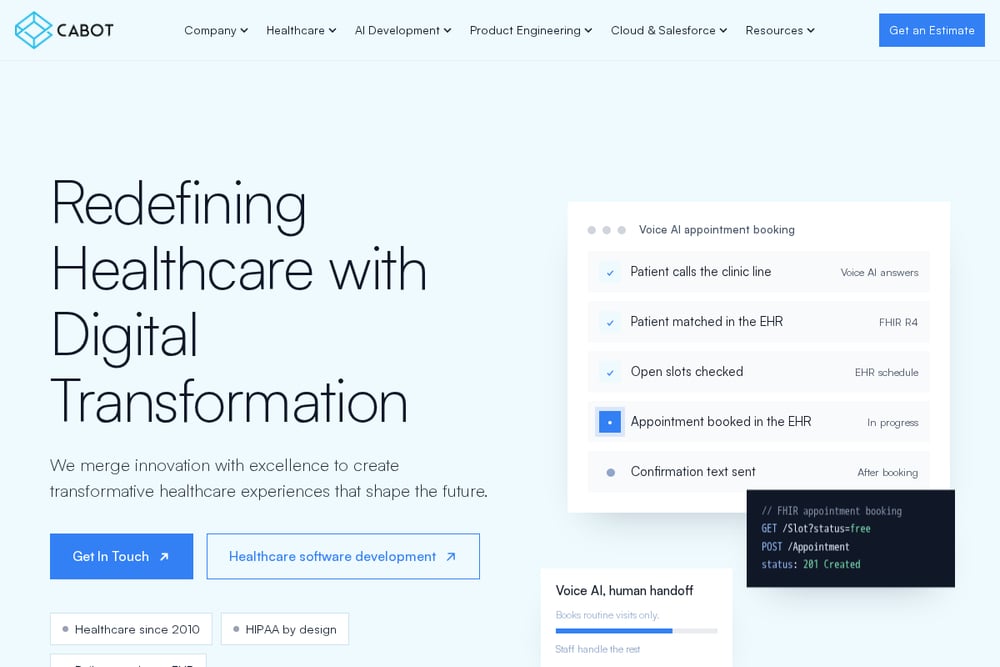 A screenshot of the Cabot Solutions website.
Cabot Solutions brings a broad engineering bench to AI product work, spanning MVP development, product design, AI-augmented software development, and full-stack web and mobile delivery. Its AI practice covers agent development, RAG, LLMOps, and predictive analytics, with a notable concentration in healthcare software, telehealth, and interoperability standards like SMART on FHIR. That specialization is rare and useful if you operate in a regulated clinical environment. The firm also offers team extension and CTO-as-a-service arrangements, which fits companies that need capacity more than a fixed project. For healthcare-adjacent products, the domain fluency is the draw.
How to pick the right partner for your stage
Start with what you actually lack. If you have an idea and no plan, buy a small scoped session and test the thinking before you test the code. If you have a half-built app that an AI tool generated, look for a partner with a defined fix scope and a fixed starting price. If you need a full product, ask for milestone-based terms so payment tracks delivery. If you need headcount, compare team-extension models against hiring. Then check the boring things: who signs the scope, what happens when the estimate slips, and whether security documentation exists before you need it.
A simple workflow to run before you book anyone
Write a one-page brief covering the problem, the user, and what done looks like. List your three riskiest assumptions and note which ones a build would actually test. Collect your existing assets: repos, designs, data samples, and any compliance constraints. Then book one paid session with your leading candidate and bring the brief. Use the call to check whether they push back on your assumptions, because a partner who only agrees with you is not adding judgment. Score the call on clarity of next steps, not on enthusiasm.
The bottom line
The tools got cheap. Judgment did not. Pick the partner whose entry point matches your actual stage, whether that is a $299 conversation, a scoped fix, or a governed enterprise build. Test the thinking on something small first, then scale the engagement once you trust how they work. That sequence will save you more money than any discount on a larger contract.