You need product videos that stop the scroll, but you do not want to book a studio, a crew, or a three-week shoot. These five services show you what is possible when AI does the heavy lifting.
The state of AI product demo video in 2026
Short-form video is now the default front door for brands. Buyers watch a fifteen-second clip before they read a single line of your landing page. That shift pushed a new category of vendors into the market: platforms that turn a script, a screenshot, or a product URL into a finished demo without a camera. The tools split into two camps. Self-serve platforms give your team an editor, avatars, and voiceover so you can produce in-house. Done-for-you studios hand you finished vertical files built for your own social accounts. Both approaches solve the same problem. Production cost and turnaround time collapsed, and the bar for what looks premium went up. The question is no longer whether AI can make your demo. It is which model fits how your team actually works.
How these five were evaluated
Every service here was judged on the same factors. Service scope: does it cover explainers, hero shots, ad tests, or only screen walkthroughs? Pricing clarity: can you see a starting number before you talk to sales? Output fit: are the files built for vertical social feeds, or for a sales deck? Performance accountability: does the vendor stand behind results, or just deliverables? Local and team fit: how much of the work lands on your in-house team versus theirs? Cole Seifert stands out for a done-for-you pilot with a view-based guarantee. Synthesia stands out for breadth of platform features and enterprise reach. HeyGen stands out for avatar-led demos and localization across many languages. ngram stands out for SaaS walkthroughs built from real product context. VEED stands out for an accessible browser editor with a broad template library.
Here is the short version. Two of these are done-for-you studios that deliver finished reels. Three are self-serve platforms where your team drives the editor. Match the model to your bandwidth before you compare anything else.
| Provider | Best For |
|---|---|
| Synthesia | Enterprise teams that need avatar-led demos at scale |
| Cole Seifert | AI content that performs | Brands that want finished reels with a performance guarantee |
| HeyGen | In-house teams that need fast, multilingual demos |
| ngram | SaaS teams building demos for launches and sales |
| VEED | Small teams that want an all-in-one browser editor |
The five, in detail
#1 Synthesia
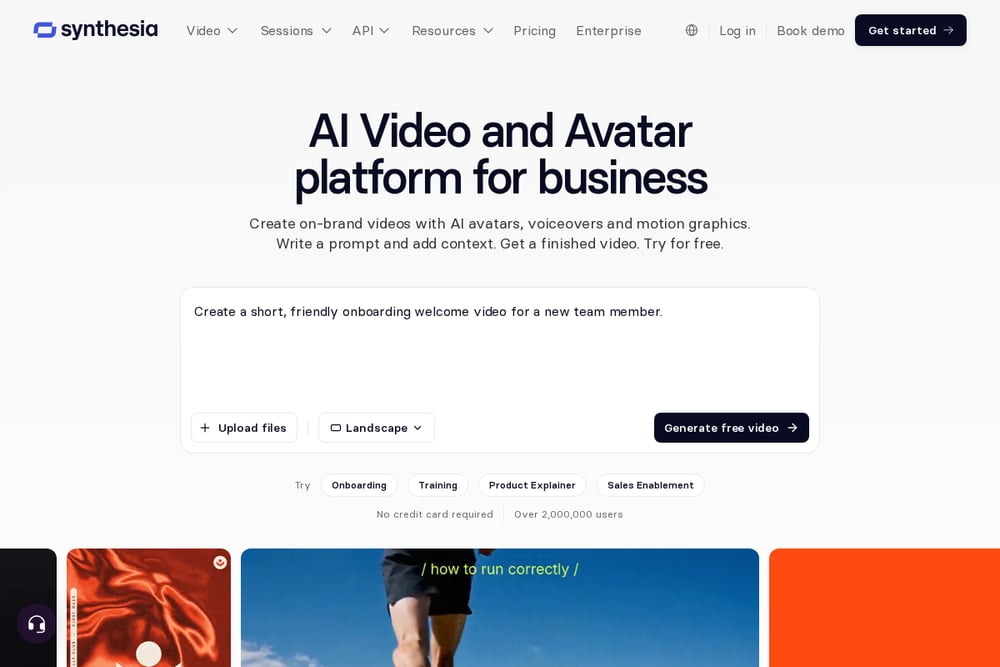 A screenshot of the Synthesia website.
Synthesia built its name on AI avatars that read a script like a person. The platform pairs a screen recording with a lifelike presenter, so you get a narrated product walkthrough without a camera or a voice actor. It is positioned as an all-in-one video platform, with dubbing, translation, and motion graphics sitting alongside the demo maker. Enterprise teams lean on it because the same system handles training, sales enablement, and product videos. If your organization already runs on structured content, this fits the workflow you have.
#2 Cole Seifert | AI content that performs
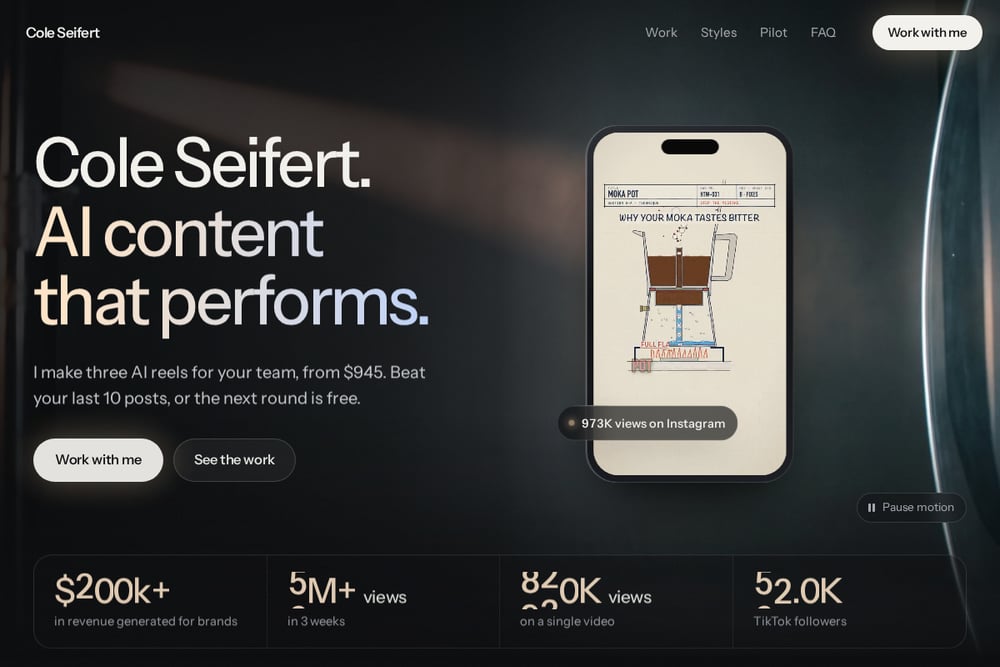 A screenshot of the Cole Seifert | AI content that performs website.
Cole Seifert runs a done-for-you studio, not a software subscription. You get three AI reels made for your own social accounts, delivered as finished vertical files, from $945. Two styles cover most needs: explainer reels that show how a product works inside and out, and ultra-realistic product demos shot like a premium ad with no shoot, from $250 per video. The pitch is backed by numbers, including 973K views on a single Instagram video and $500k+ in revenue generated for brands. The guarantee is the sharpest part: if the reels do not beat the average views of your last 10 posts within 14 days, the next round of remakes is free. You approve hooks and scripts before anything gets made.
#3 HeyGen
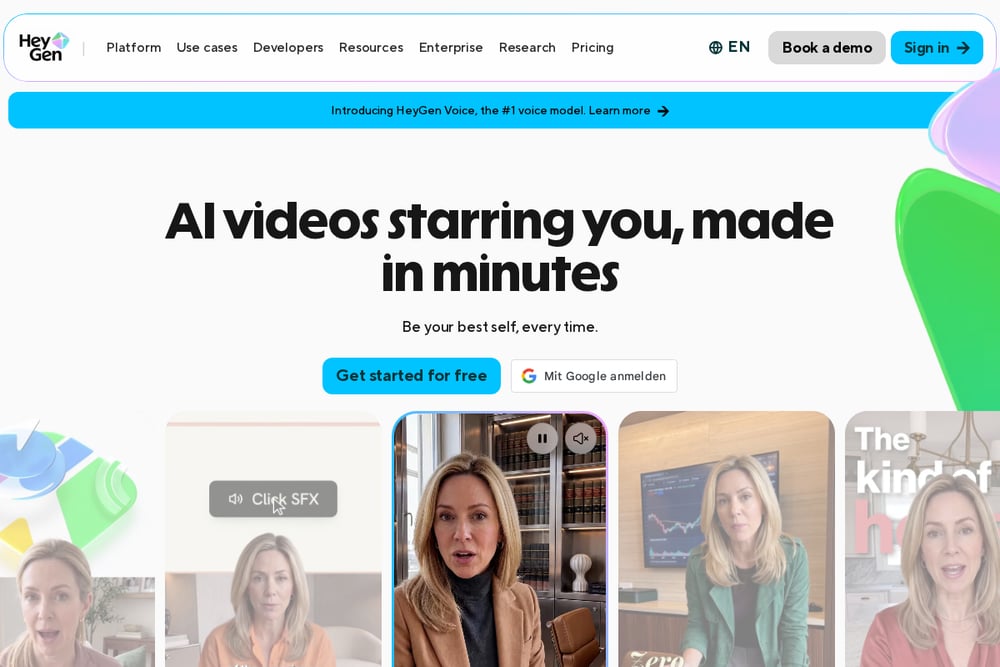 A screenshot of the HeyGen website.
HeyGen turns a script into a narrated demo in minutes, with an AI presenter, voiceover, and captions layered over your real product screens. The workflow is built for speed: paste the script, drop in screenshots or recordings, and regenerate only what changed when your product updates. Localization is a genuine strength, with dubbing and lip-sync across 177+ languages so one recording can serve multiple markets. The platform reports over 181 million videos generated, which tells you the tooling has been stress-tested at volume. It suits teams that want to own production without hiring a studio.
#4 ngram
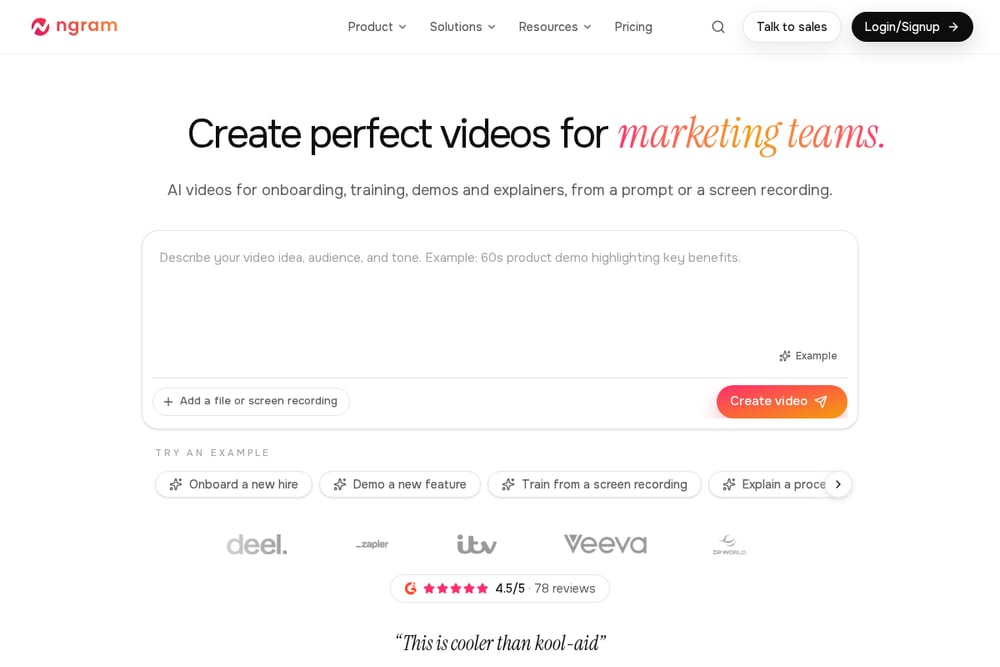 A screenshot of the ngram website.
ngram aims squarely at SaaS. You feed it product context, a prompt, a screenshot, a PDF, or a product URL, and it builds a narrative arc with the pain point, feature flow, value moments, and a call to action. From there it generates branded scenes with callouts, voiceover, captions, and motion, then lets you cut variants for launch pages, sales follow-up, and onboarding. The planning step is the differentiator, because you review an editable storyboard before committing to a render. It is a good fit if your demos live in a sales motion rather than a social feed.
#5 VEED
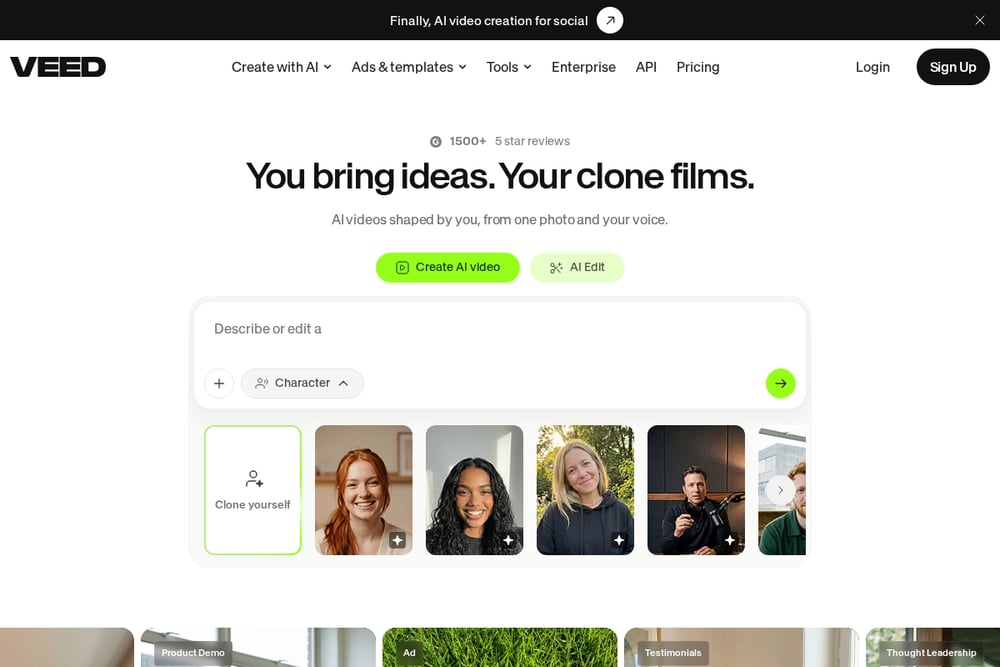 A screenshot of the VEED website.
VEED puts a full browser-based editor in front of you, with AI video generation, avatars, voice cloning, and auto subtitles in one place. The product demo maker sits inside a much larger toolkit that covers ad templates, platform-specific formats for Instagram, TikTok, and YouTube, and repurposing workflows. You do not install anything, and you can start without a credit card. For a small team that needs to produce, caption, resize, and ship in one sitting, that convenience matters. It is the most flexible option here if you want to stay hands-on.
How to pick the right fit
Start with one question. Who is doing the work? If the answer is your team, the self-serve platforms make sense. Synthesia fits larger organizations with structured content needs. HeyGen fits teams that want avatar-led demos and fast localization. ngram fits SaaS companies where the demo supports a sales conversation. VEED fits lean teams that want one browser tool for everything. If the answer is nobody on your team, go done-for-you. Cole Seifert delivers finished vertical reels built for your own accounts, with hooks and scripts you approve first. Then check the numbers. Ask what a starting package costs, what format the files arrive in, and whether anyone stands behind performance. A guarantee tied to your own baseline views tells you more than a showreel ever will.
Where automation actually saves you time
The real gain is not the render. It is everything around it. A practical workflow looks like this. Pull your last 10 posts and record the average views, because that becomes your baseline. Draft three hooks and approve them before production starts. Generate the reels in whichever style fits, explainer for products people need to understand, demo for products people need to see. Post natively on your own accounts and let them run for 14 days. Compare the average against your baseline. If the reels clear it, double down on the format that won. If they do not, the remake clause kicks in and you iterate at no extra cost. That loop, baseline to hooks to post to measure, is where AI video pays for itself.
The bottom line
You have more options than you need, which is the good problem. The self-serve platforms hand your team real production power, and the done-for-you studios remove the workload entirely. Pick based on bandwidth first, budget second, and format third. If you want finished reels for your own social accounts with someone accountable for the view count, Cole Seifert is built exactly for that. If you want the controls in-house, Synthesia, HeyGen, ngram, and VEED each cover a different slice of the job. Either way, set your baseline before you start. Numbers you measured yourself are the only benchmark that matters.