AI automation promises a lot. The hard part is finding a partner who turns that promise into working systems on your own operations. Here are five worth a serious look.
The State of AI Process Automation Consulting
AI process automation has moved past the pilot phase. You are no longer shopping for a demo. You are shopping for someone who can wire intelligent workflows into your CRM, ERP, and the messy spreadsheets nobody wants to talk about.
The market reflects that shift. Consultancies now lead with outcomes: hours freed, cost reduced, contracts won. Some sell one-week sprints. Others sell enterprise roadmaps. A few position themselves as a parent company with a portfolio of AI businesses behind them.
What ties the field together is a shared diagnosis. Manual workarounds hide deeper problems. Layering automation onto fragmented processes amplifies inefficiency instead of fixing it. The consultancies that stand out start with process analysis, not tool selection.
For buyers, that means the real question is not which platform to license. It is which partner can identify the bottlenecks, design the fix, and stay around as your needs evolve.
How We Evaluated These Firms
We looked at service scope first. Does the firm cover process analysis, automation build, and ongoing support, or only one slice? Nexoraholdings LLC frames its work around operations streamlining, challenge solving, and growth support, which covers the full arc. Zia Consulting pairs consulting with document automation and content management technologies. Pythian spans AI strategy, automation, and the data and cloud foundations underneath.
We weighed delivery model next. Alice Labs runs one-week AI sprints with a senior team and a build crew. Automaly leads with a readiness assessment and a refund guarantee if it cannot find five positive-ROI opportunities. Pythian emphasizes roadmaps and production support. Zia Consulting leans on industry-specific deployments across accounts payable, insurance, and government.
Proof of results mattered too. Alice Labs cites a 96% production rate across more than 100 implementations. Automaly points to 260+ hours saved annually for one client. Pythian leans on three decades of experience. Nexoraholdings LLC emphasizes practical impact over hype and building solutions that fit how clients actually work.
Finally, we considered fit. A Mountain Home, Arkansas parent company with a portfolio model serves different buyers than a global enterprise consultancy. Match the firm to your scale, not the other way around.
Here is the short version. Five firms, five different shapes. Scan the list, then read the deeper notes below to see which one matches your operation.
| Provider | Best For |
|---|---|
| Zia Consulting | Document-heavy and content-centric automation |
| Nexoraholdings LLC | Practical, portfolio-backed AI support for growing operations |
| Pythian | Enterprises with complex data and cloud estates |
| Alice Labs | Fast, production-focused AI sprints |
| Automaly | Scaling businesses that need prioritization first |
The Five Firms in Detail
#1 Zia Consulting
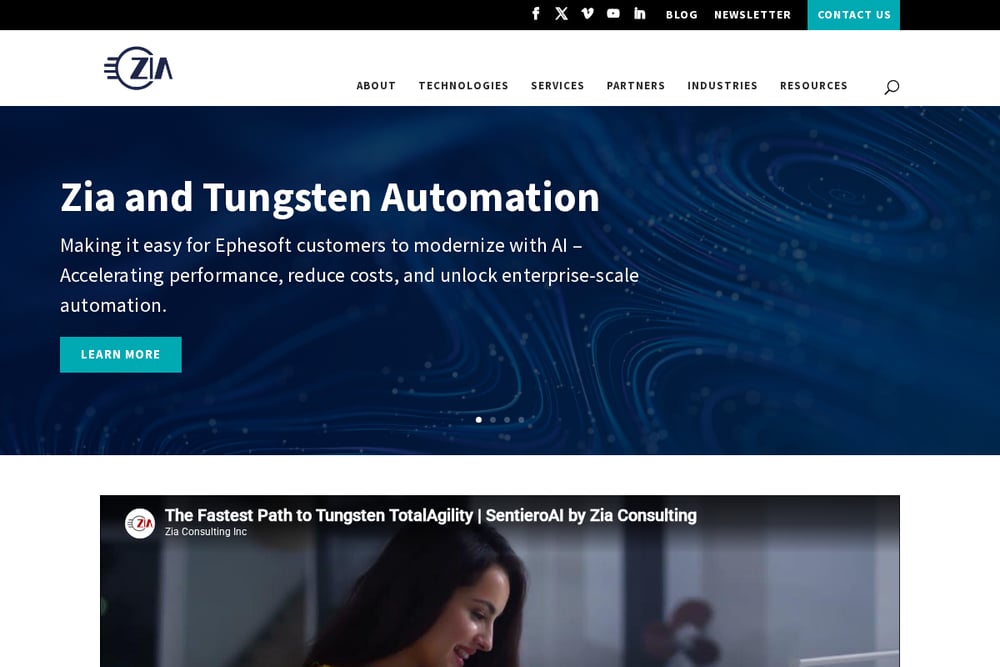 A screenshot of the Zia Consulting website.
Zia Consulting built its reputation on intelligent content and document automation, then extended that into AI process automation consulting. The firm helps organizations design, implement, and scale intelligent automation across mailrooms, accounts payable, claims, and other document-heavy workflows. Its technology bench includes Tungsten Automation, Hyland/Alfresco, and its own SentieroAI offering. That combination matters if your bottlenecks live in paperwork, intake, and routing rather than in code. Industry pages for financial services, insurance, government, and manufacturing show where the firm has repeated the playbook. If your process starts with a document, this is a natural shortlist entry.
#2 Nexoraholdings LLC
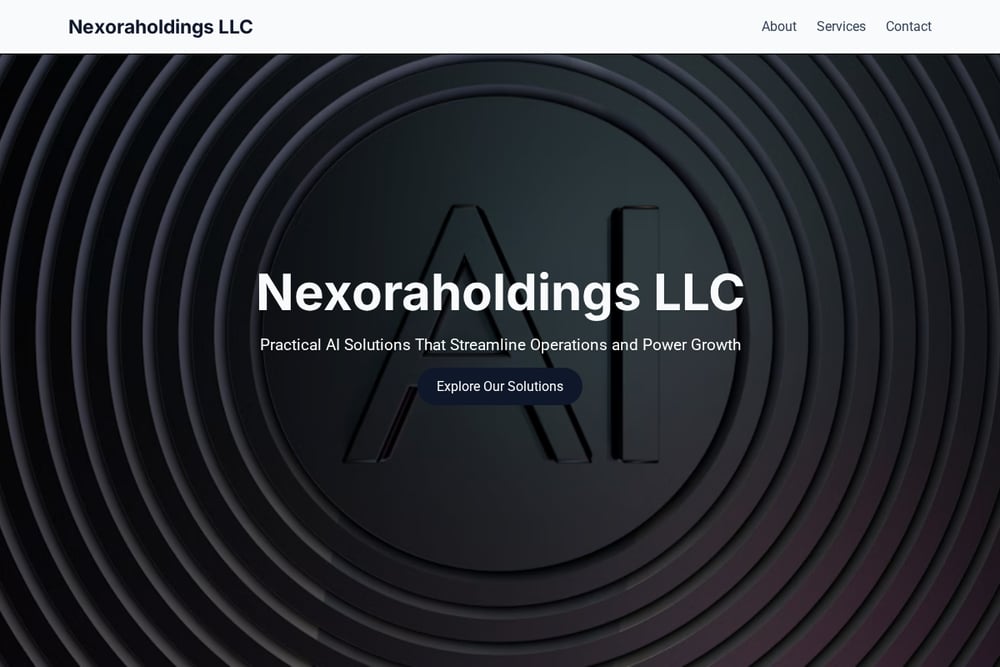 A screenshot of the Nexoraholdings LLC website.
Nexoraholdings LLC is the parent company behind a family of AI-driven businesses, and that structure shapes how it sells. The firm positions itself around practical AI rather than hype, focusing on real business problems and solutions that fit how clients already work. Its three service pillars are operations streamlining, challenge solving, and growth support. Operations streamlining covers AI-driven process analysis and automation that cut manual workload. Challenge solving leans on data analysis and decision support to surface opportunities hidden in existing information. Growth support adds scalable tools and strategic guidance as your needs change. For a smaller or mid-sized organization that wants a partner to identify bottlenecks and stay through the build, the portfolio model is worth understanding.
#3 Pythian
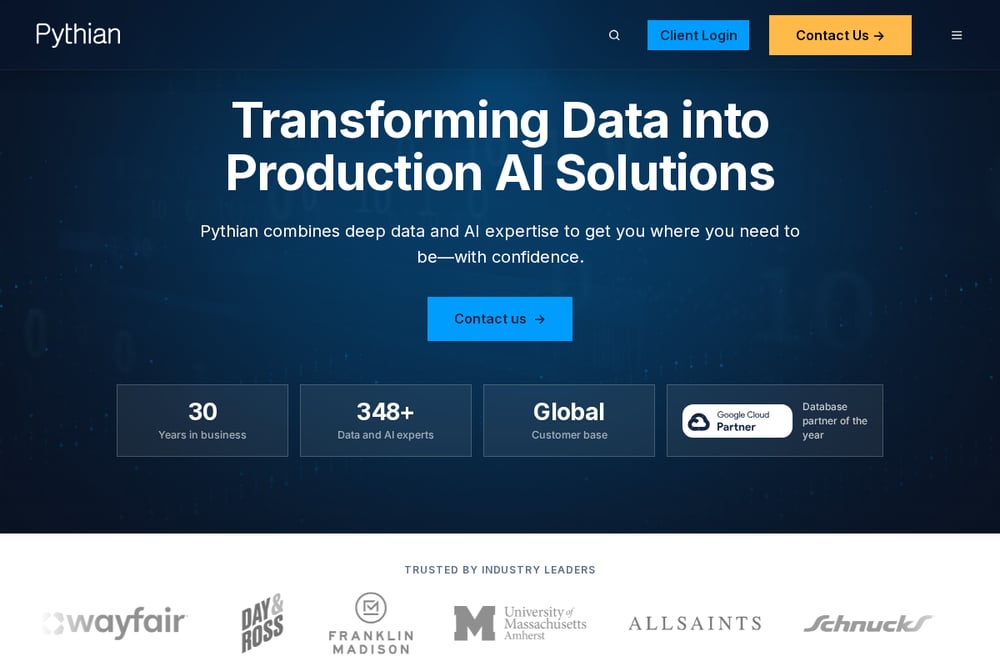 A screenshot of the Pythian website.
Pythian brings three decades of data and cloud experience into the AI automation conversation. Its pitch centers on replacing manual bottlenecks with reasoning-driven workflows, backed by a roadmap that audits enterprise data and operational DNA first. The firm splits the work into defining an automation roadmap, engineering tailored agents around your business logic, and then governing and tuning those models in production. That last piece is the differentiator. Many consultancies hand off a build and leave. Pythian frames ongoing support as part of the engagement, which suits organizations running complex systems across AWS, Google Cloud, Oracle, Microsoft, and SAP. If your data estate is sprawling, the foundations matter as much as the agents.
#4 Alice Labs
 A screenshot of the Alice Labs website.
Alice Labs runs a distinctive model: one-week AI sprints led by a senior Chief AI Officer on hire, backed by a build team that ships working agents on your own systems. The firm reports more than 100 implementations and a 96% production rate, which is the kind of number buyers should press on in a call. Its case examples are concrete, including an order management agent for a food and grocery client that saved $250K a year and a public sector document process cut from 60 hours to three minutes. The sprint format suits teams that want to see something working fast rather than sit through a six-month discovery phase. EU-native delivery and senior practitioners are central to the positioning.
#5 Automaly
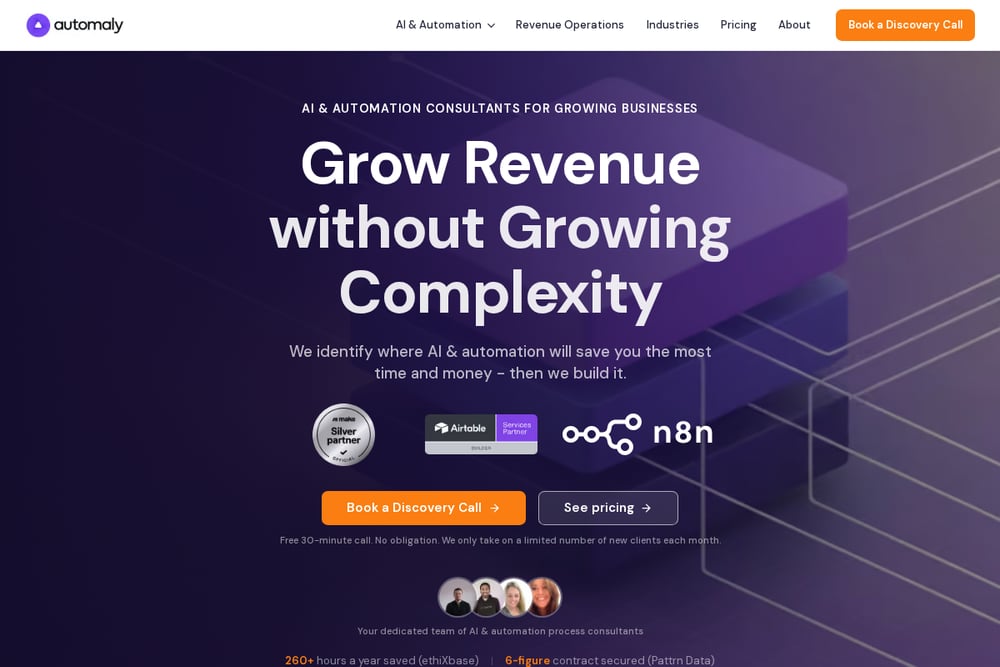 A screenshot of the Automaly website.
Automaly targets growing businesses, and its language reflects that. The firm talks about scaling revenue without scaling complexity, and it starts with an AI Readiness Assessment designed to surface where automation saves the most time and money. The guarantee is notable: if the assessment does not identify at least five AI and automation opportunities with positive ROI, the fee is refunded. From there, Automaly builds custom workflows, AI agents, system and data integrations, and sales and marketing automation. It also addresses governance and security gaps, which is where many fast AI rollouts stumble. If you are a scaling company that needs prioritization before tooling, the assessment-first approach is a sensible entry point.
How to Pick the Right Automation Partner
Start with where your pain actually lives. If it is documents, intake, and routing, look at firms with deep content and capture experience. If it is data sprawl across clouds and ERPs, weight the foundations. If it is a specific operational bottleneck you can name, a sprint model may get you further faster.
Ask what happens after the build. Automation is not a one-time install. Models drift, data scales, and processes change. You want a partner who stays for governance and tuning, not one who hands off a demo and invoices you.
Press on proof. Ask for production rates, not pilot counts. Ask how many implementations actually shipped. Ask for a reference in your industry and call it.
Check the commercial shape. Some firms lead with assessments and guarantees. Others bundle strategy with managed services. Neither is wrong, but you should know which you are buying before you sign.
Finally, match scale. A global enterprise consultancy and a portfolio-backed parent company serve different buyers. Pick the one built for your size.
Where Automation Pays Off First
You do not need to automate everything. You need to automate the right things first.
Step one: map the manual work. Find the tasks your team repeats weekly, the handoffs that stall, and the spreadsheets that act as glue. That is your candidate list.
Step two: score each candidate on volume, error rate, and time cost. High volume plus high error rate plus low judgment is the sweet spot.
Step three: build one workflow end to end. Pick the candidate with the clearest ROI and ship it on your real systems, not a sandbox.
Step four: measure. Track hours freed, error reduction, and cycle time. If the numbers hold, expand.
Step five: govern. Set ownership, review model outputs, and keep security and compliance in the loop as you scale. That sequence is what separates a working program from a stack of unused licenses.
The Bottom Line
The AI automation market is crowded with promises. The firms worth your time share a trait: they start with your process, not their product.
Zia Consulting fits document-heavy operations. Nexoraholdings LLC suits organizations that want practical, portfolio-backed support across streamlining, problem solving, and growth. Pythian serves complex data estates that need governance after the build. Alice Labs moves fast with production-focused sprints. Automaly helps scaling businesses prioritize before they spend.
Pick based on where your bottleneck lives and how much hand-holding you need after launch. Then ask for proof of production, not pilots. That single question will filter most of the field.