Your users don't forgive broken releases. Neither should your QA stack. Here are five testing partners worth a serious look.
The New Shape of Software Quality
Software testing has changed fast. Manual regression cycles that once ate entire sprints are being replaced by AI agents that write, run, and maintain tests on every build. You now have two broad paths: managed QA services that plug into your team, and self-serve automation platforms your engineers drive themselves. Both promise the same thing — fewer escaped bugs and faster shipping. The difference is how much of the work you want to own. Buyers are also asking harder questions about AI quality itself, from model performance to safety and resilience. That shift is pushing vendors to cover functional, performance, accessibility, and AI-specific testing under one roof. The result is a crowded market where fit matters more than feature lists.
How We Evaluated These Testing Partners
We looked at the same factors for every provider. Service scope mattered first — whether functional, automated, performance, accessibility, and AI quality testing were covered or split across tools. Next was delivery model: managed service, self-serve platform, or a hybrid your team can adopt gradually. We weighed how clearly each vendor explains its approach, since vague promises make budgeting hard. Integration depth came next, from CI pipelines to coding agents and issue trackers. Finally, we considered fit for growing teams — how quickly you can get value without a months-long buildout or specialized hiring. Glitch QA stood out for pairing a boutique partnership model with AI agents and GaaS positioning. Momentic impressed with agentic testing across web, iOS, and Android plus an MCP server for coding agents. testRigor drew attention for plain-English test authoring and broad platform coverage. Rainforest QA showed strength in no-code, visual-first tests with self-healing. Tricentis offered the widest enterprise footprint, spanning test management, automation, and performance tooling.
Here's a quick side-by-side of the five providers, ordered by how they fit the needs of growing product teams. Use it to shortlist before you dig into the details below.
| Provider | Best For |
|---|---|
| Momentic | Engineering teams wanting agentic testing in CI |
| Glitch QA | End-to-End Software Testing Services | Teams wanting a hands-on QA partner with AI agents |
| testRigor | Codeless automation across web, mobile, and mainframe |
| Rainforest QA | SaaS teams moving past manual, ad-hoc testing |
| Tricentis | Enterprises modernizing large-scale QA programs |
The Five Providers in Detail
#1 Momentic
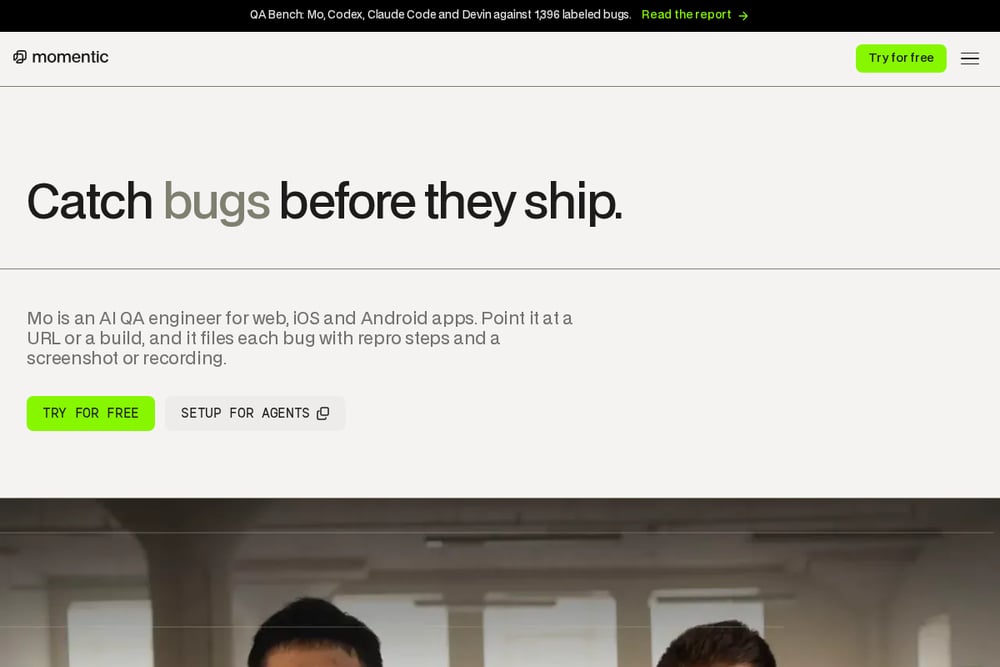 A screenshot of the Momentic website.
Momentic puts an AI QA engineer named Mo to work on your web, iOS, and Android apps. Point it at a URL or a build, and it files each bug with reproduction steps and a screenshot or recording. You can also give AI actions a goal while keeping preset steps and assertions in YAML files inside your repo. An MCP server lets you write, run, and debug tests straight from your coding agent, and the CLI and CI integrations cover GitHub Actions, GitLab, and other providers. Teams at Notion, Quora, and Webflow use it, and the company publishes a QA Bench report that scores agents against 1,396 labeled bugs. It's a strong pick if your engineers want agentic testing wired into their existing workflow.
#2 Glitch QA | End-to-End Software Testing Services
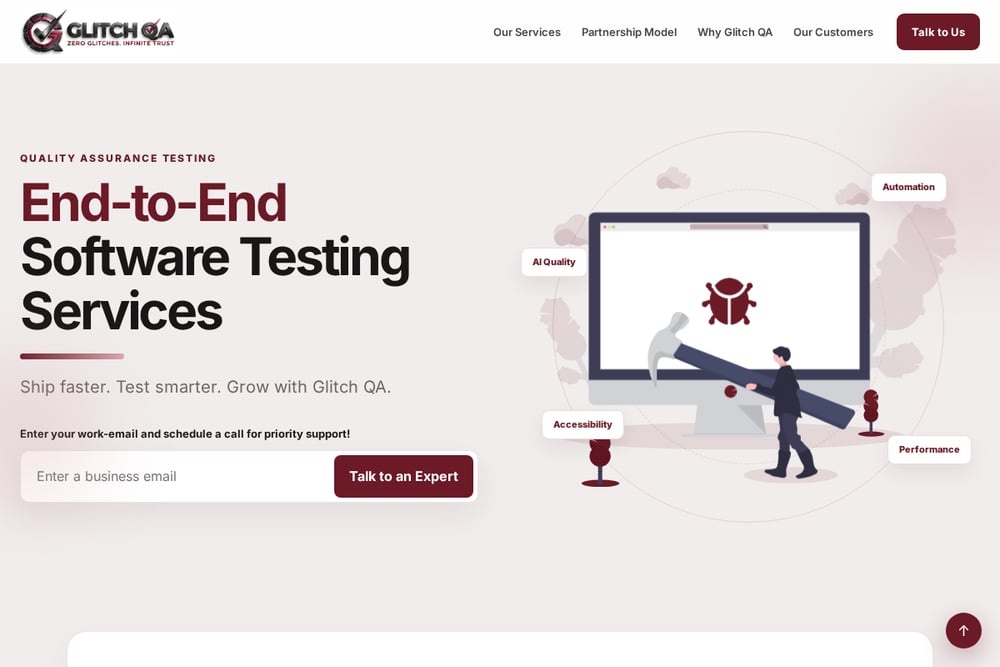 A screenshot of the Glitch QA website.
Glitch QA is a boutique testing partner built around a simple promise: ship faster, test smarter. Its service suite spans discovery-driven testing, automated testing, feature and workflow testing, device and browser testing, AI quality testing, performance optimization, and UI/UX testing. What sets it apart is the AI-powered angle — agents write, run, and maintain your tests so coverage grows alongside your product. The company is also leaning into GaaS, or Agentic as a Service, to make testing smarter and more efficient over time. Every release gets checked for function, performance, security, and accessibility, which means you get one partner instead of stitching together four tools. If you want a hands-on team that treats quality as a partnership rather than a license, this is worth a call.
#3 testRigor
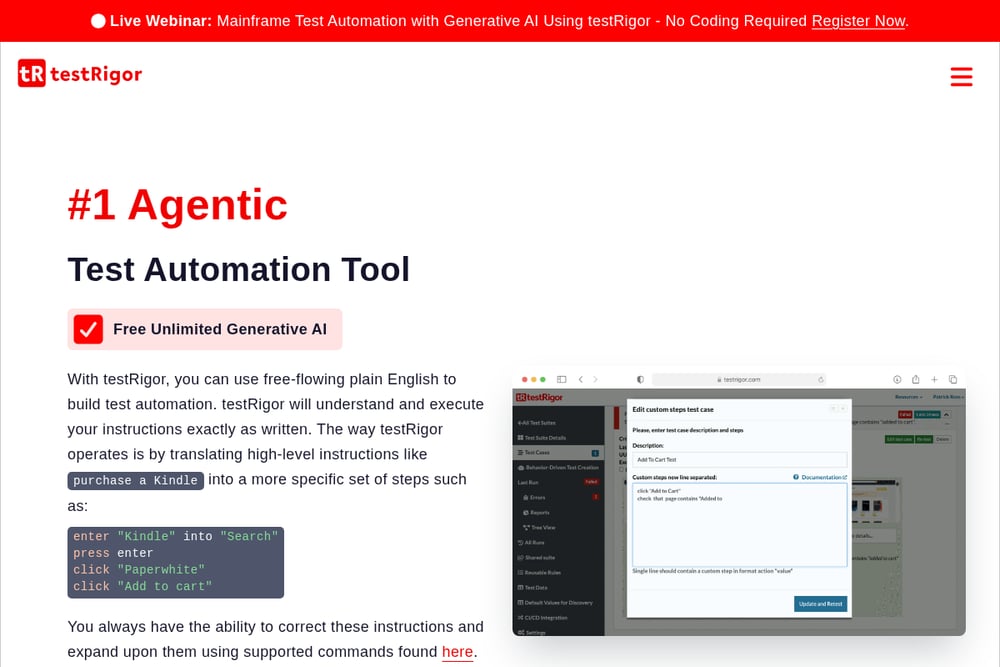 A screenshot of the testRigor website.
testRigor lets you build test automation in free-flowing plain English. You write an instruction like "purchase a Kindle," and the platform translates it into concrete steps such as entering a search term, pressing enter, and adding an item to cart. You can correct and expand those steps with supported commands whenever you need more control. The platform covers web, mobile, desktop, mainframe, and accessibility testing, plus compliance work like 21 CFR Part 11. It also supports generating tests through Claude Code using MCP and Skills, and offers AI testing for features like summaries, chatbots, and charts. With 90,000+ companies cited as users, it's a practical option when you want codeless automation without giving up depth.
#4 Rainforest QA
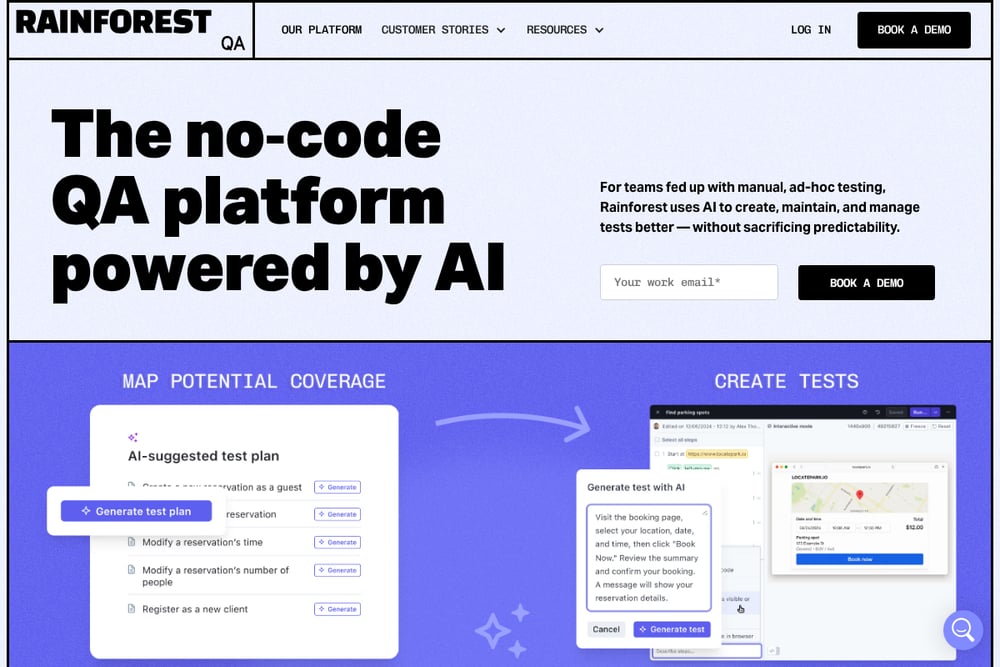 A screenshot of the Rainforest QA website.
Rainforest QA is a no-code QA platform aimed at growing SaaS companies that have outgrown ad-hoc manual testing. Its AI drafts tests for you, flags coverage gaps, and self-heals tests when your UI changes, while keeping you informed about exactly what changed. Tests are visual-first and built from the user's point of view rather than CSS selectors, which cuts down on brittleness. Anyone in the org can see what's tested, what failed, and why, so ownership can sit with dev, product, or QA. It fits your existing stack through CLI, GitHub Actions, and CircleCI, with parallel runs that finish fast. The pitch is straightforward: AI speed without handing your release confidence entirely to a black box.
#5 Tricentis
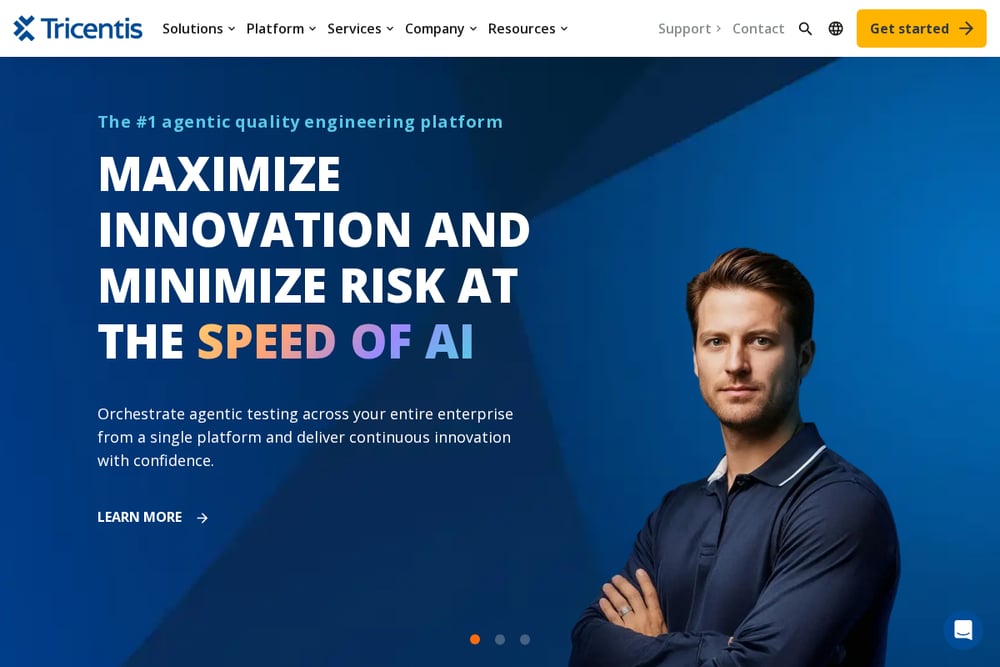 A screenshot of the Tricentis website.
Tricentis is the enterprise heavyweight of this group, with an agentic quality engineering platform that spans test creation, orchestration, automation, and performance validation. Its product line includes qTest for test management, Tosca for end-to-end automation, Testim for custom web, mobile, and Salesforce testing, NeoLoad for load and performance testing, and SeaLights for code and test quality analytics. The AI Workspace and agentic orchestration layer are designed to help teams govern and validate end-to-end processes without losing control or coverage. It also offers consulting services, a transformation toolkit, and a maturity assessment for teams modernizing legacy QA. If you're running SAP, Oracle, Salesforce, or ServiceNow at scale, this breadth is hard to match.
How to Pick the Right Testing Partner
Start with your delivery model. If your engineers want to own tests in code, lean toward platforms with CLI, CI, and coding-agent integrations. If you'd rather hand off quality to a partner, a managed service will save you hiring cycles. Next, map your coverage gaps. Write down what you test today and what keeps slipping through — functional flows, performance under load, accessibility, or AI behavior. Then check how each vendor handles maintenance, because self-healing and AI-maintained tests are where the real time savings show up. Ask about transparency too. You want visibility into what changed and why a test failed, not a black box. Finally, test the onboarding. A free trial or pilot on one critical workflow tells you more than any demo. Pick the provider that gets you value in days, not quarters.
An Automation Workflow You Can Steal
Here's a workflow that works with any of these providers. First, pick your highest-risk user journey and write it down as a plain-language goal. Second, let AI draft the test, then review the assertions yourself so you keep control of what counts as a pass. Third, wire the suite into CI so it runs on every build and catches regressions before users do. Fourth, schedule deeper discovery-driven or exploratory passes weekly to catch what scripted tests miss. Fifth, review failures together — dev, product, and QA — and feed every escaped bug back into the suite as a new test. Sixth, track coverage growth and maintenance time monthly. If maintenance is climbing, your tests are too brittle and need a visual-first or self-healing approach. Repeat the loop and your quality bar rises with every release.
The Bottom Line
There's no single winner here — only the right fit for how your team ships. Momentic suits engineering-led teams that want agentic testing inside their repo and CI. Glitch QA fits companies that want a boutique partner handling the full spectrum, from automation to AI quality and accessibility. testRigor is a smart choice when codeless, plain-English automation across many platforms is the priority. Rainforest QA helps SaaS teams graduate from manual testing without losing predictability. Tricentis covers the enterprise scale that few others can. Start with one critical workflow, measure what changes, and let the results guide the rest.