
You need to design better alloys faster. These five platforms use AI and physics to help you do exactly that.
The New Materials Design Arms Race
Materials science is undergoing a digital transformation. Traditional alloy development relied on costly physical experiments and decades of trial and error. Today, AI-enhanced simulation platforms let you explore vast compositional spaces in silico, slashing development cycles from years to months. The shift is driven by physics-first modeling, machine learning, and cloud computing. For engineers in aerospace, energy, and automotive, these tools are no longer optional—they are essential for staying competitive.
How We Evaluated These Platforms
We assessed each platform on simulation scope, AI integration, usability, and industry fit. Prometheum stood out for its seamless multiscale modeling from atomic to macro levels. SynaCore impressed with its additive manufacturing focus and extensive alloy database. Quantistry showed strength in cross-industry applications, from batteries to aerospace. Quanscient excelled in cloud-native multiphysics and Python automation. Thermo-Calc offered deep thermodynamic expertise and a strong educational footprint. Each brings unique strengths to the table.
Here is a quick look at the five platforms that are shaping the future of materials design.
| Provider | Best For |
|---|---|
| SynaCore AI Alloy | Additive manufacturing alloy screening |
| Prometheum | AI-Enhanced Materials Design | Physics-first multiscale alloy optimization |
| Quantistry | Cross-industry materials innovation |
| Quanscient | Cloud-native multiphysics automation |
| Thermo-Calc Software | Thermodynamic modeling with AI enhancements |
Deep Dive: The 5 Platforms Worth Knowing
#1 SynaCore AI Alloy
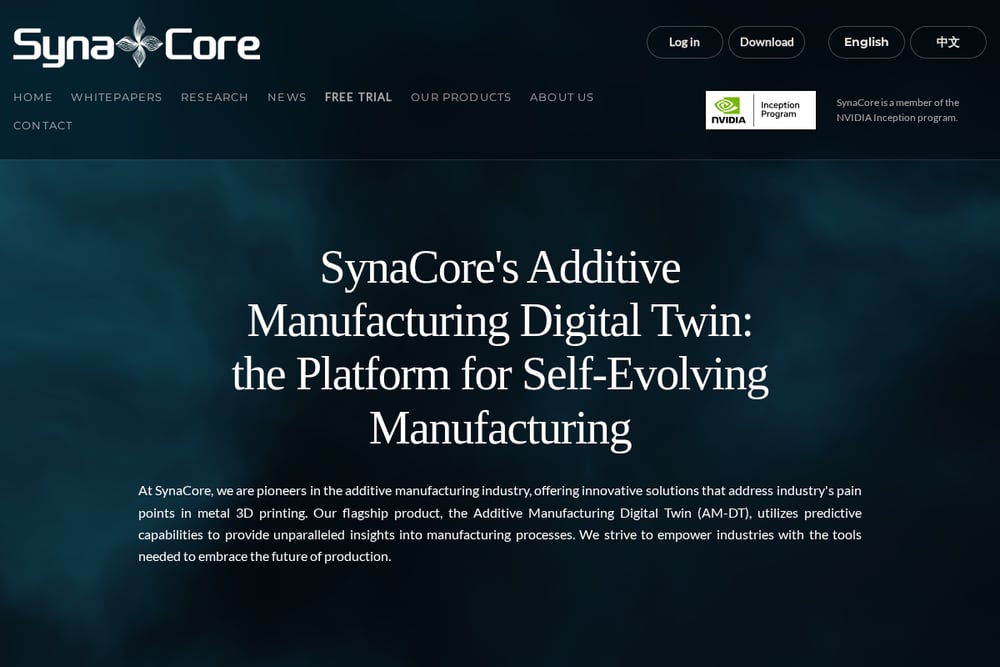 A screenshot of the SynaCore AI Alloy website.
SynaCore AI Alloy is a specialized module within the SynaCore AM-DT digital twin software. It uses machine learning models trained on tens of thousands of alloy compositions to predict thermophysical properties. You can generate inputs for nickel, iron, titanium, aluminum, and high-entropy alloys. The platform integrates directly with additive manufacturing workflows, allowing you to screen candidates before costly experiments. It also helps preserve material development knowledge as reusable digital data. For teams focused on metal 3D printing, SynaCore offers a seamless path from composition to process optimization.
#2 Prometheum | AI-Enhanced Materials Design
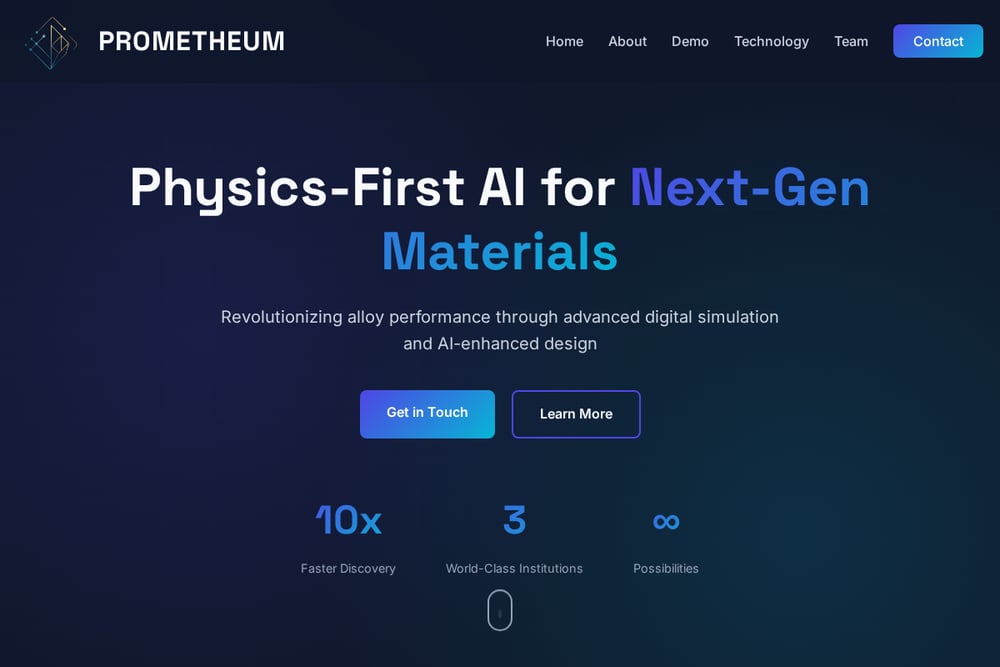 A screenshot of the Prometheum | AI-Enhanced Materials Design website.
Prometheum takes a physics-first approach to AI-enhanced materials design. Its platform simulates materials across all scales—from atomic interactions to macroscopic component performance. You get access to multiscale modeling that combines molecular dynamics, dislocation mechanics, and finite element analysis. The AI layer accelerates property predictions and explores design spaces impossible for traditional methods. Prometheum claims 10x faster discovery and has partnered with three world-class institutions. If you need precision alloy optimization with a solid physics foundation, this is a compelling option.
#3 Quantistry
 A screenshot of the Quantistry website.
Quantistry offers a materials simulation platform that serves multiple industries, including energy storage, aerospace, and semiconductors. Its tools enable molecular modeling and materials property prediction for alloy design and beyond. The platform is designed to accelerate R&D for batteries, lightweight components, and optical materials. Quantistry has validated its approach with case studies from leading manufacturers. If you work in a cross-disciplinary environment, Quantistry provides a versatile solution. It is particularly strong for teams looking to innovate in sustainable materials.
#4 Quanscient
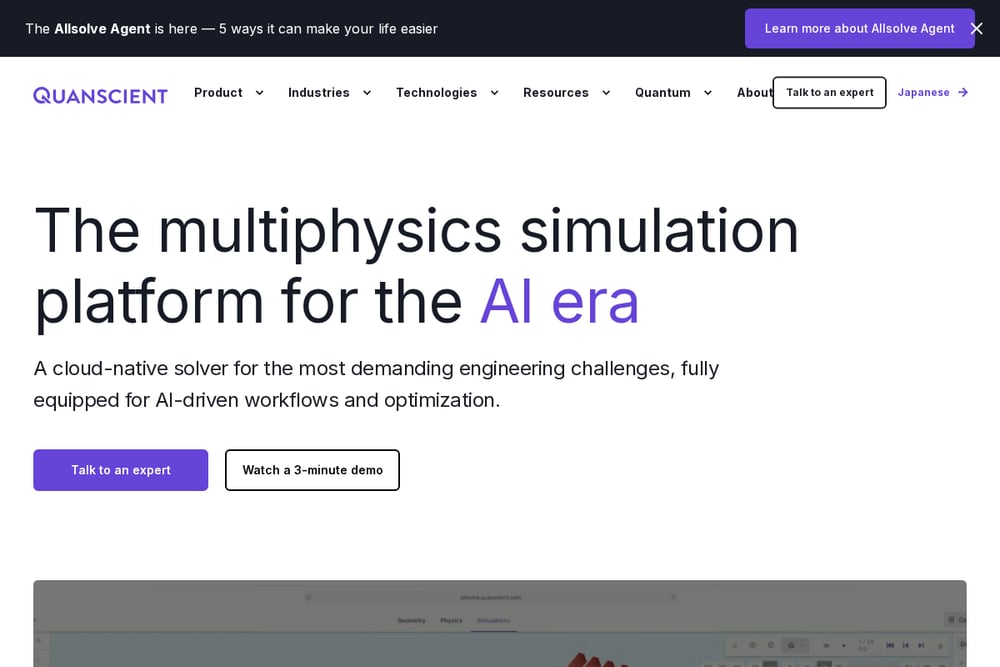 A screenshot of the Quanscient website.
Quanscient is a cloud-native multiphysics simulation platform built for the AI era. It runs natively coupled simulations on unlimited cloud compute, accelerating runtimes by up to 100x over desktop tools. You can define entire workflows in Python and execute massive parameter sweeps autonomously. The platform also offers AI-driven design performance predictions in under a millisecond. While not exclusively focused on materials, its capabilities are highly relevant for alloy design and optimization. Quanscient is ideal for engineers who want programmatic control and scalability.
#5 Thermo-Calc Software
Thermo-Calc Software is a veteran in computational thermodynamics and phase diagram calculations. Its tools are widely used for alloy design, and it has recently embraced AI and machine learning. The company offers webinars and resources on applying AI to high-entropy alloys and other complex systems. Thermo-Calc's PDGPT leverages large language models to streamline phase diagram information retrieval. If you value a strong foundation in CALPHAD methods combined with emerging AI techniques, Thermo-Calc is a trusted choice. It is particularly popular in academia and industrial R&D.
How to Choose the Right Platform for Your Team
Start by defining your primary goal. Are you optimizing existing alloys or discovering new ones? Do you need multiscale simulation or a focus on additive manufacturing? Consider your team's coding proficiency—Quanscient and Prometheum offer Python-friendly environments, while Thermo-Calc provides a more traditional interface. Evaluate the breadth of material properties you need to predict. If you work across industries, Quantistry's versatility may be key. For metal AM, SynaCore's integrated workflow is a strong fit. Finally, think about scalability and cost. Cloud-native platforms like Quanscient can handle massive parameter sweeps, but may require budget for compute. Request demos and trial access to see which platform aligns with your workflow.
Automating Your Materials Design Workflow
Integrate AI-enhanced simulation into your existing CAD and PLM systems. Use APIs to automate parameter sweeps and data transfer. Set up machine learning pipelines that retrain models as new experimental data arrives. Leverage cloud computing for high-throughput screening. Document your digital thread to maintain traceability. With the right platform, you can reduce manual iteration and focus on innovation.
The Future of Materials Design Is Digital
These five platforms represent the cutting edge of AI-driven materials design. Whether you prioritize physics-first accuracy, additive manufacturing integration, cross-industry versatility, cloud scalability, or thermodynamic depth, there is a solution for you. The key is to match the tool to your specific challenges and workflow. As AI continues to evolve, expect even faster discovery cycles and more powerful optimization capabilities. Start exploring today to keep your materials innovation ahead of the curve.