You spend real money to make the phone ring. Then it rings at 6:47 p.m. on a Saturday and nobody picks up. That missed call is not a missed call. It is a competitor's booked job.
The new front desk is not a desk
Home service demand has not changed. What changed is how fast a homeowner moves on. They call, they text, they ask ChatGPT who to hire, and whoever answers first usually wins the work. That is why AI answering and intake tools have become one of the fastest-growing categories in the trades. The tools below split into two camps: pure AI receptionists that catch calls, and growth partners that also handle getting you found in the first place.
How we looked at these
We weighed four things. First, service scope: does it just answer the phone, or does it also drive demand and track booked revenue? Second, fit for home services specifically, including after-hours emergencies and multi-location routing. Third, pricing clarity, since a $49 plan and a custom retainer solve very different problems. Fourth, how fast you can get live and whether you can see the results in a dashboard rather than a hunch.
Here is the short version before the detail. Two of these are growth partners that go beyond the phone. Three are AI receptionists you can switch on this week. Match the tool to the leak you actually have.
| Provider | Best For |
|---|---|
| Breesy | Multi-location operators who want revenue attribution |
| Home Service Growth Agency | Skyline AI | Owner-operators to multi-location crews who want demand and intake fixed together |
| Sameday AI | Single-trade shops that want trade-specific playbooks |
| Rosie AI | Small crews who want a cheap, fast start |
| RingCentral AI Receptionist | Businesses that want AI inside an existing phone system |
The five, in order
#1 Breesy
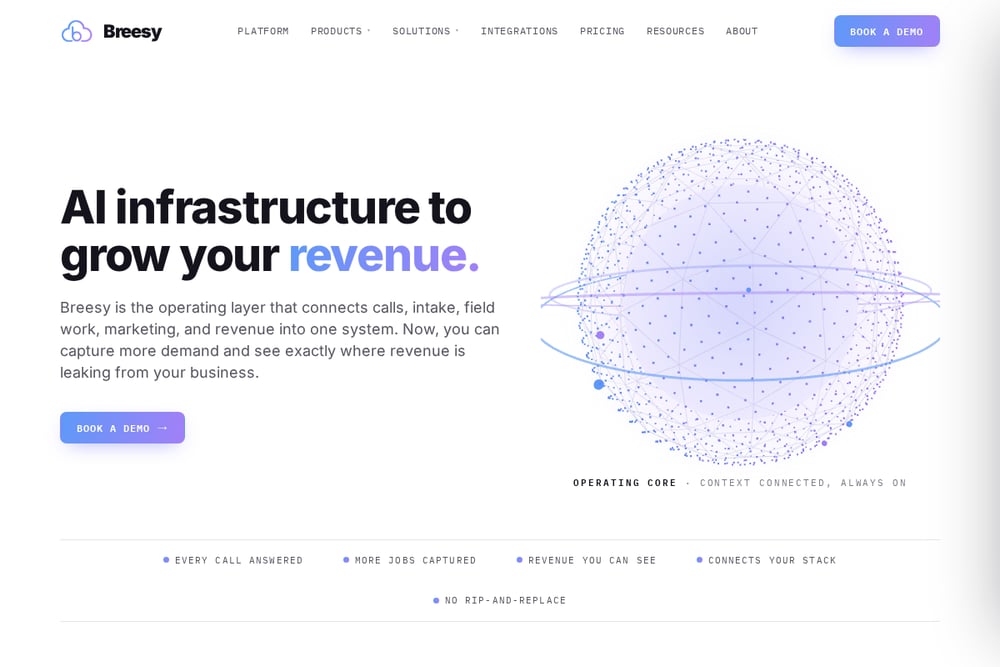 A screenshot of the Breesy website.
Breesy positions itself as intake infrastructure rather than a simple receptionist. Its own 2026 comparison makes the case that most home service companies over-invested in lead generation and under-invested in what happens after the phone rings. The platform spans voice answering, phone capture, revenue attribution, and marketing attribution, so you can trace a booked job back to the source that created it. There is also a command center built for storm surge events, which matters if you run restoration or roofing. For multi-location operators and franchise groups, that revenue-tied view is the differentiator.
#2 Home Service Growth Agency | Skyline AI
 A screenshot of the Home Service Growth Agency | Skyline AI website.
Skyline AI is the only option here that starts before the phone rings. It gets you found on Google and named by ChatGPT, then uses voice and inbox AI agents to answer every call and lead in under 60 seconds. The pitch is blunt and useful: every missed lead is acquisition cost lit on fire, and lead-to-meeting conversion typically goes 2-3x within 30 days. A pre-qualification calculator pulls six numbers from your business and shows the annual cost of running operations manually, with missed leads usually the biggest line item. Every build ships with a live dashboard covering calls, leads, revenue, and ROI, and the team works fully remote from Montana with companies across the U.S.
#3 Sameday AI
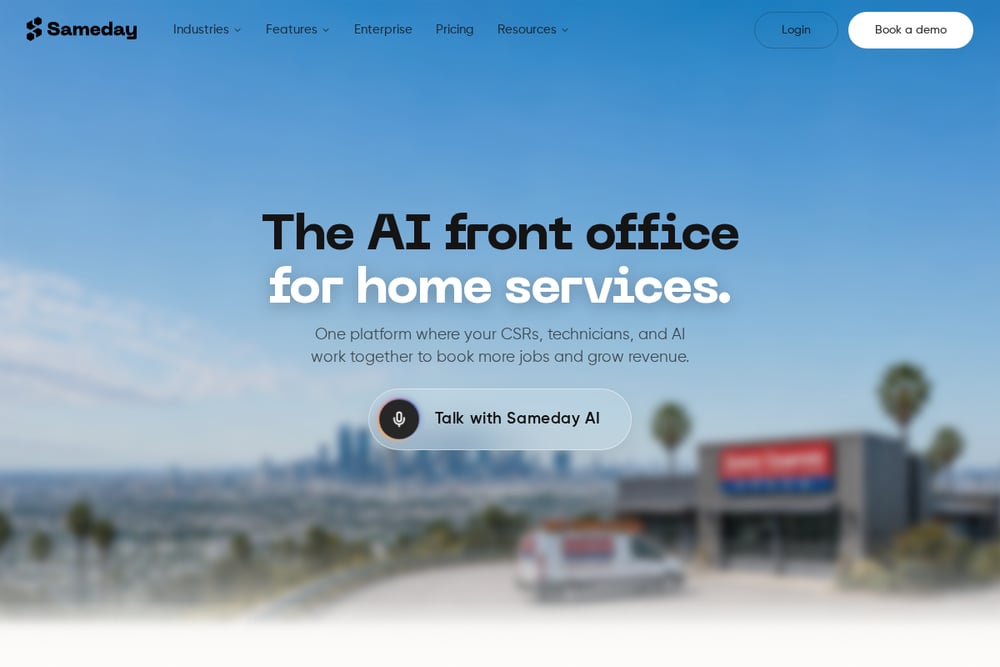 A screenshot of the Sameday AI website.
Sameday AI is built specifically for the trades, and it shows in the industry list: HVAC, plumbing, roofing, pest control, restoration, garage door, landscaping, and more. Beyond answering calls, it bundles a phone system, a scheduling wizard, outbound campaigns, and coaching insights for the office team. The playbook library is the practical part, covering after-hours answering, speed-to-lead, membership sales, and reactivation campaigns. Case studies like Way Cool handling 4,000+ calls give you a sense of scale. If you want a tool that speaks your trade's language out of the box, start here.
#4 Rosie AI
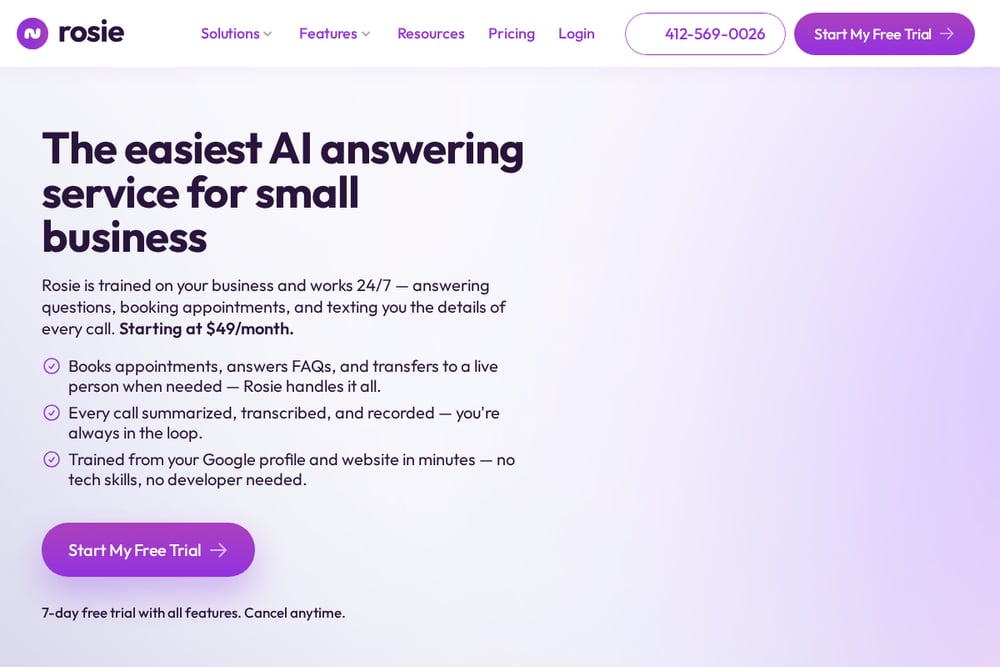 A screenshot of the Rosie AI website.
Rosie AI is the easiest on-ramp on this list. It trains from your Google profile and website in minutes, with no developer and no tech skills required. From there it answers questions, books appointments, and texts you the details of every call, with each call summarized, transcribed, and recorded. It transfers to a live person when needed, which matters for the calls you do not want a bot handling. At $49/month with a 7-day free trial, the risk is close to zero. Over 2,000 local businesses use it, and the reviews emphasize exactly that: setup was the hard part with other tools, not this one.
#5 RingCentral AI Receptionist
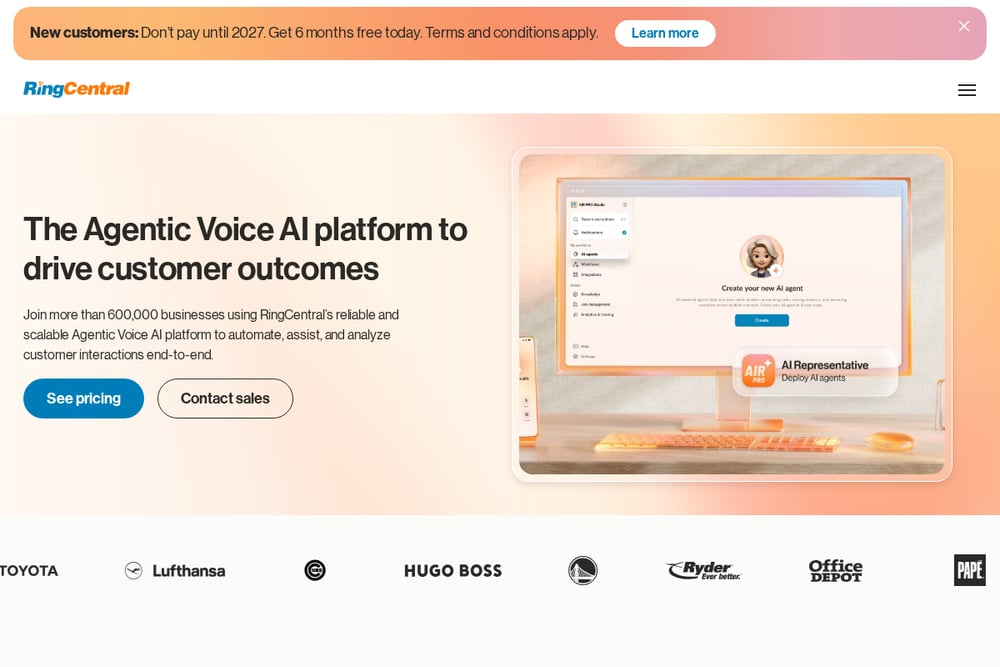 A screenshot of the RingCentral AI Receptionist website.
RingCentral brings a big-platform option to the table. Its AI Receptionist answers 24/7, blocks spam, handles FAQs, texts appointments, and captures leads, with plans starting at $39/month. The routing is smarter than most: callers reach the right person by name, location, or keyword, and the team gets a call summary so nobody repeats themselves. It handles 10+ languages and switches mid-call, which is a real advantage in diverse service areas. Setup leans on your website, FAQs, or uploaded documents, and the published ROI examples include a 97% CSAT score and $1.7M in projected additional revenue for one health client. If you already live in a phone system, this keeps everything in one place.
Pick based on your leak, not the feature list
Start with one question: where are you actually losing jobs? If leads never arrive because you are invisible on Google and AI answers, a receptionist will not fix that. You need a growth partner like Skyline AI that handles visibility and intake together. If leads arrive and die on the vine after hours, a dedicated answering tool is the faster fix. From there, check three things. Does it integrate with how you already schedule and dispatch? Can you see booked jobs in a dashboard, not just call counts? And does the pricing match your size, because a $39 plan and a custom retainer are solving different problems. Run the math on your own missed leads before you sign anything.
A simple workflow you can run this month
Step one: pull your numbers. Count missed calls, ignored forms, and ghosted DMs for the last 30 days, then multiply by your average customer value. That number is your budget. Step two: turn on AI answering for after-hours and overflow first, so you stop the bleeding without disrupting your daytime team. Step three: set a response standard of under 60 seconds for every inbound lead, and let the AI hold that line. Step four: route every answered lead into your scheduling system automatically, with a summary attached. Step five: review the dashboard weekly and compare leads to booked jobs, not calls to calls. Step six: once intake is stable, invest in getting found on Google and in AI answers so the top of the funnel grows too.
The bottom line
The gap between these five is not quality. It is scope. Rosie AI and RingCentral AI Receptionist stop the bleeding on the phone, and both do it cheaply and fast. Sameday AI adds trade-specific playbooks and outbound campaigns. Breesy ties every booked job back to the source that created it, which is what multi-location operators need. Skyline AI goes a step further by fixing demand and intake as one system, which is why it sits near the top for home service businesses that are tired of paying for leads that never convert. Pick the one that matches your leak, turn it on, and measure booked jobs. That is the only number that pays the bills.