Admissions interviews are the last hurdle you can't cram for the night before. These five platforms let you rehearse out loud, get scored, and fix your weakest answers before the real conversation happens.
Why interview prep went from coaching to software
For decades, admissions interview prep meant one of two things: a pricey private coach, or a parent running practice questions at the kitchen table. Both have limits. Coaches are expensive and hard to schedule. Parents are too kind. Meanwhile, the stakes keep climbing. Oxford and Cambridge subject interviews push you to think out loud under pressure, and US alumni interviews reward composure and specificity. AI interviewers have filled the gap. They ask follow-ups, wait while you think, and score your spoken answers within seconds. The category now spans medical school MMIs, Casper tests, MBA panels, and undergraduate admissions. Some tools go deep on one niche. Others cover a dozen programs. The result is a crowded market where the right pick depends on your target school and how much feedback you actually want.
How we compared these platforms
We judged every platform on the same four factors. First, scope: does it cover your specific interview format, whether that's an Oxbridge subject interview, a US alumni chat, or a med school MMI? Second, feedback quality: does it score your answers and quote your own words back, or just hand you a generic report? Third, pricing clarity: can you see what you get before you pay, and is there a free trial? Fourth, fit for the applicant: does the question bank match your subject and school, and does the practice feel like the real thing? AdmitMock stands out for its Oxbridge and US alumni focus with line-by-line notes on your own words. MYLS AI impresses with breadth across 250+ programs and on-camera scoring. Career Clutch shines for schools and careers teams running mock-interview programs at scale. Confetto goes deep on medical and residency interviews with a large completed-mock count. ReachIvy pairs AI practice with human counseling and essay support for study-abroad applicants.
Here's a quick look at how the five platforms line up before we dig into each one.
| Provider | Best For |
|---|---|
| MYLS AI | Applicants juggling multiple interview formats |
| AdmitMock - Oxbridge and Ivy interview practice | Oxbridge and Ivy League interview candidates |
| Career Clutch | Schools and careers teams running mock interviews |
| Confetto | Med school and residency applicants |
| ReachIvy | Study-abroad applicants wanting human counseling too |
The five platforms, one by one
#1 MYLS AI
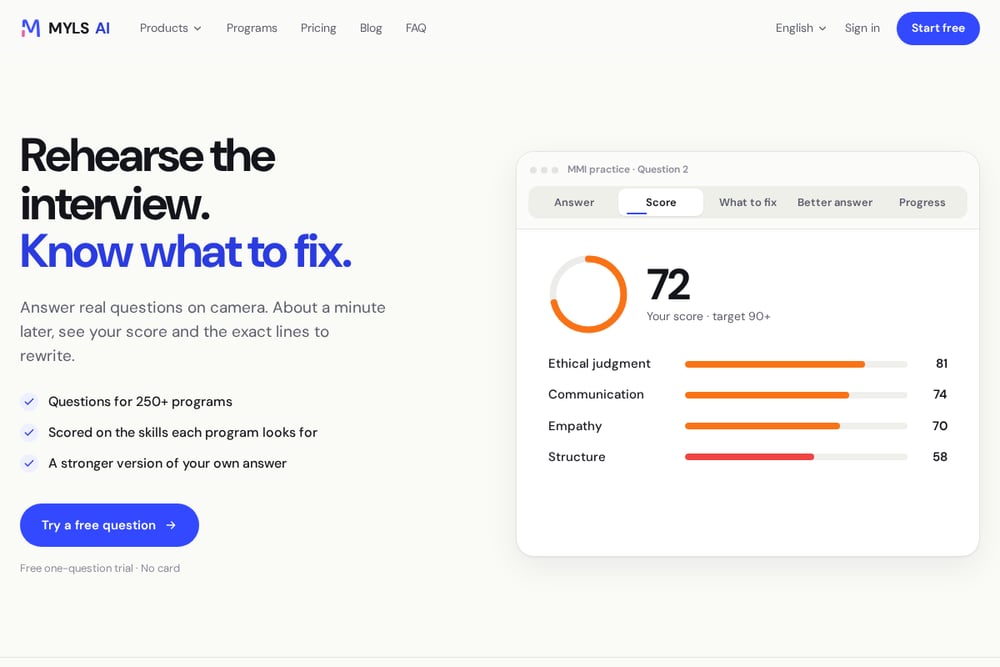 A screenshot of the MYLS AI website.
MYLS AI is the broadest tool in this group. It covers CASPer, timed situational judgment, MMIs, undergraduate admissions interviews, graduate and MBA panels, job interviews, and IELTS Speaking. You answer real questions on camera, then see your score plus the exact lines to rewrite. The platform claims questions for 250+ programs and 24,000+ questions, scored on the skills each program looks for. A free one-question trial with no card makes it easy to test before committing. If you're applying across several formats, this is the widest net you can cast.
#2 AdmitMock - Oxbridge and Ivy interview practice
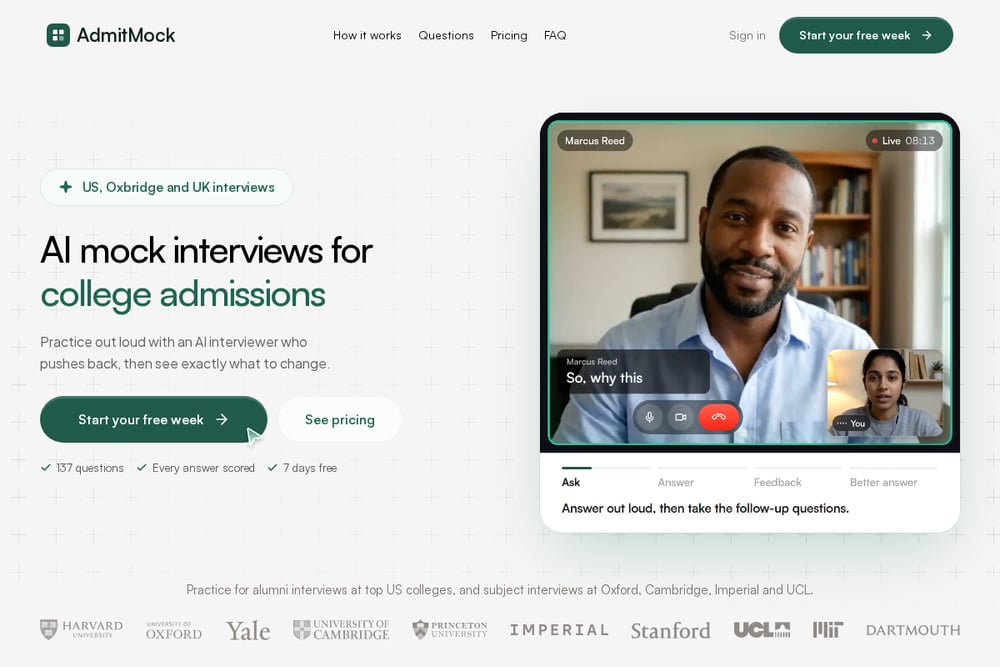 A screenshot of the AdmitMock - Oxbridge and Ivy interview practice website.
AdmitMock is built for a specific, high-pressure crowd: Oxford, Cambridge, Imperial, UCL, and top US college applicants. You practice out loud with an AI tutor that waits while you think, then follows up on what you just said, much like a real interviewer. After each answer you get a score and line-by-line notes on your own words within seconds, so you can retry immediately. The question bank covers 12 Oxbridge subjects plus US alumni interviews, with mocks running 20 to 40 minutes in your subject's real format. A seven-day free trial is enough to run your first mocks and fix your weakest answers before December.
#3 Career Clutch
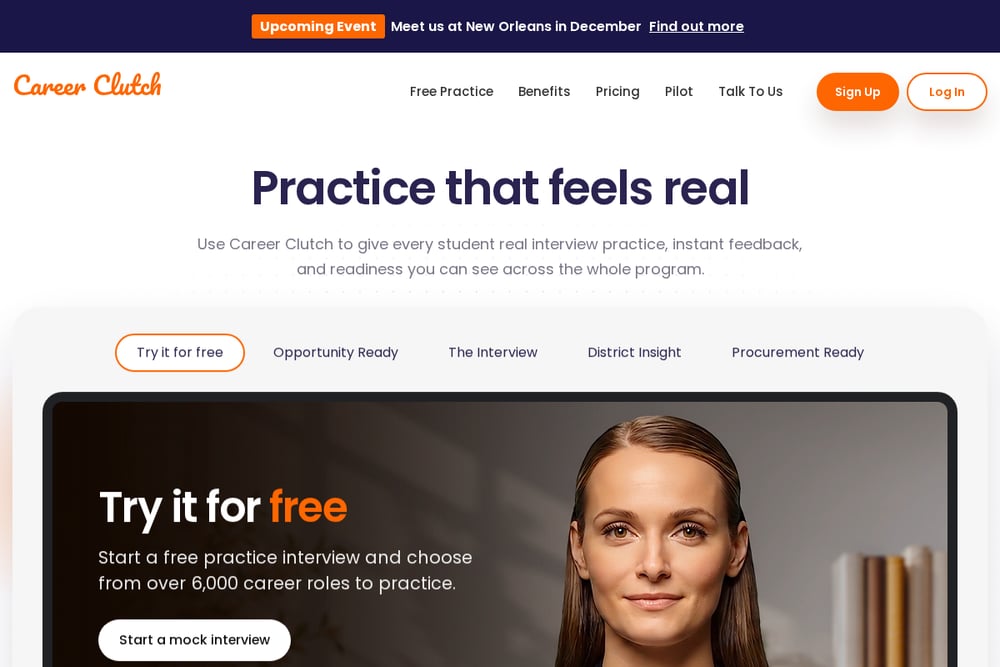 A screenshot of the Career Clutch website.
Career Clutch approaches college interviews from the school side as much as the student side. Its College Interviews product gives students a realistic spoken session with an AI interviewer that asks natural admissions questions and follows up on what you say. A separate review then scores your transcript across six key admissions interview areas, and every piece of feedback quotes your own words back to you. The scoring is deliberately engineered so shy students and second-language speakers aren't penalized for polish. It's also pitched at CTE directors, WBL coordinators, teachers, and community colleges who need to mock-interview every student, not just the confident ones.
#4 Confetto
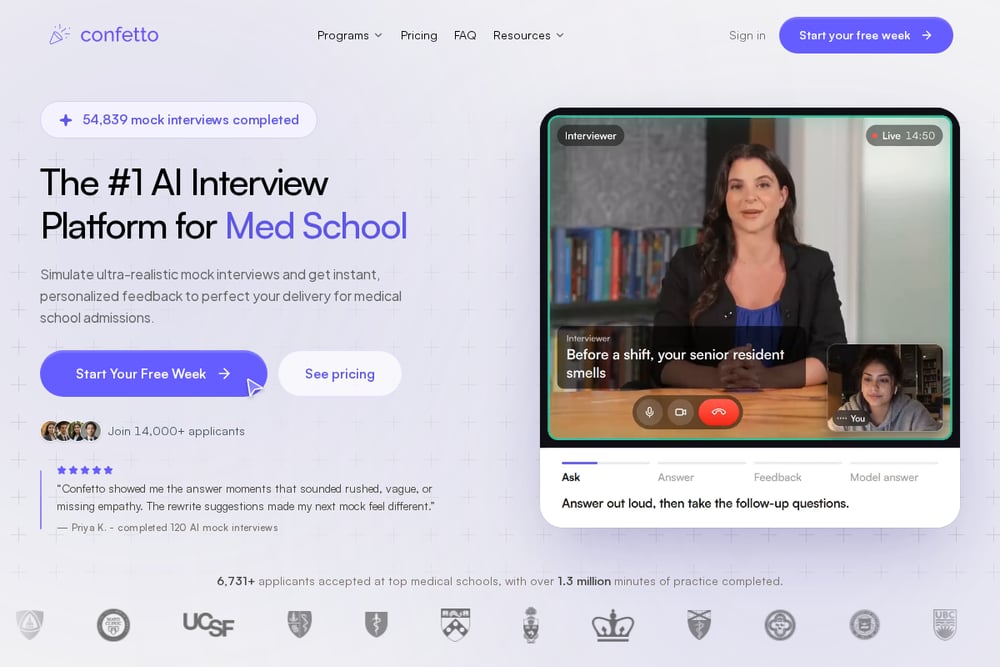 A screenshot of the Confetto website.
Confetto is the specialist for medical and health-professions interviews. It covers med school MMIs, panel and traditional interviews, Casper on real timers, residency Match interviews, Canadian CaRMS, pharmacy residency, and oral boards. It also extends to PA, dental, vet, nursing, and pharmacy school formats, plus PLAB 2 and SCA stations for UK and international graduates. The platform reports 54,839 mock interviews completed, and its feedback flags answer moments that sounded rushed, vague, or missing empathy, then suggests rewrites. If your interview involves ethics stations or clinical scenarios, this is the deepest bench in the group.
#5 ReachIvy
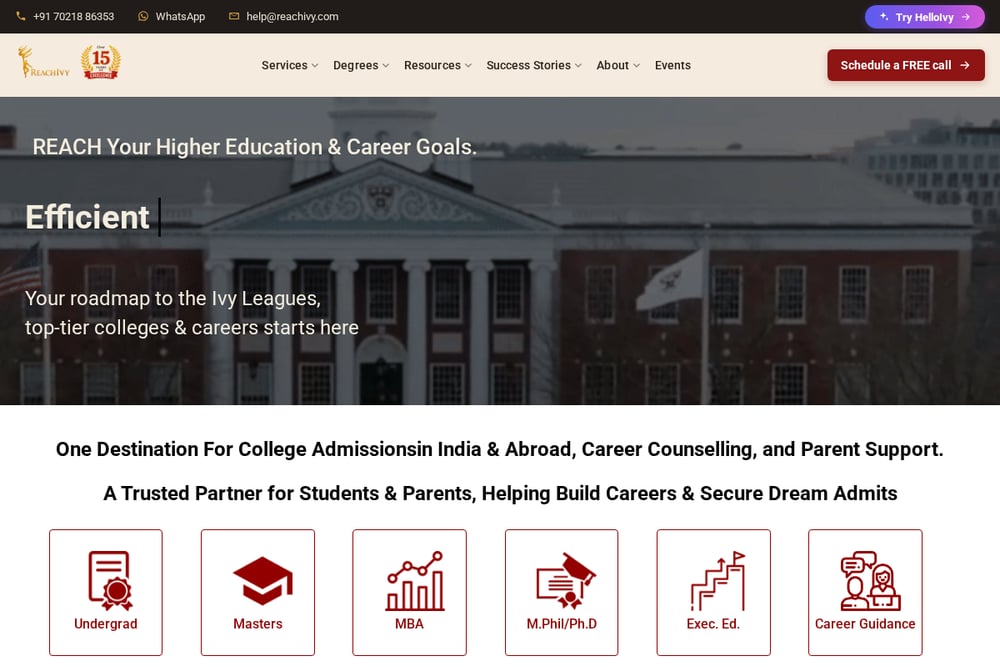 A screenshot of the ReachIvy website.
ReachIvy blends AI interview practice with human admissions counseling. Its AI Mock Interview Practice tool simulates an online admissions interview, and it sits inside a much larger menu of services: study-abroad counseling, essay editing, SOP and LOR review, test prep, and interview prep for HBS and other programs. That makes it a fit if you want a single advisor relationship rather than a standalone practice tool. The trade-off is focus. You're buying into a full consulting ecosystem, so the AI practice is one piece of a broader package. For applicants who want hand-holding through the whole application, that combination is the draw.
How to pick the right platform for you
Start with your target. If you're facing an Oxford or Cambridge subject interview, you need a tool that follows up on your reasoning and scores your spoken answers, which is where AdmitMock's subject-specific mocks and line-by-line notes come in. If you're applying to US colleges, check whether the platform covers alumni-style conversations. Next, think about format breadth. Applying to med school plus a backup master's? MYLS AI's 250+ programs and on-camera scoring cover more ground. Confetto wins if ethics stations and clinical scenarios are on your calendar. Then consider who's paying and why. Schools and careers teams should look at Career Clutch's program-level setup. Families who want a counselor alongside the software should weigh ReachIvy's bundled services. Finally, use the free trials. Every serious platform lets you test a question or a week before you commit. Run one mock, read the feedback, and ask yourself whether it told you something you didn't already know.
A simple practice workflow you can automate
You don't need a coach to run a disciplined prep loop. Set a weekly cadence and let the tools do the scoring. Step one: pick your university, subject, and interview date, and map out every day until then, which AdmitMock does automatically when you enter those details. Step two: run one full mock out loud in your subject's real format, 20 to 40 minutes, no notes. Step three: read the score and line-by-line notes the moment you finish, and rewrite your two weakest answers. Step four: re-run the same question and compare scores, tracking progress the way MYLS AI does with its before-and-after scoring. Step five: once a week, swap in a different format, like an MMI station or a panel question, so you don't overfit to one interviewer. Log your scores in a simple spreadsheet. The trend line tells you when you're ready.
The bottom line
Interview prep is now a software category, and that's good news for you. The five platforms here cover very different ground: MYLS AI for breadth, AdmitMock for Oxbridge and Ivy focus with notes on your own words, Career Clutch for school-wide programs, Confetto for medical and clinical formats, and ReachIvy for applicants who want a counselor in the loop. None of them replaces real thinking under pressure. What they do is give you reps, and reps are what turn a shaky answer into a confident one. Pick the platform that matches your target school, run your first mock this week, and let the score tell you where to focus next.