Your office closes at six. Your leads don't. These five AI intake tools help PIP firms catch after-hours inquiries before they call the firm down the street.
The state of AI intake for PIP firms
Personal injury protection work runs on speed. A caller with a fresh rear-end collision is shopping three firms before breakfast, and the first one to answer usually signs the case. That reality has pushed legal intake from a staffing problem into a software problem. Firms now lean on AI agents to answer calls, screen web forms, reply to texts, and book consultations while everyone is asleep. The market has split into two camps. General legal intake platforms cast a wide net across practice areas, while specialists tune their questions to PIP criteria like accident date, auto insurer, and whether the caller is already treating. Both approaches work. The difference shows up in how much setup your team does and how closely the screening matches your firm's actual qualification rules.
How we compared these tools
We looked at the same factors across every tool. Service scope mattered first: does it handle calls, texts, web forms, and follow-up, or just one channel? Next came PIP fit, meaning whether the intake logic can be shaped around accident details, insurance status, and treatment questions. We weighed integration depth with CRMs like Clio, Filevine, and Lawmatics, since intake data is only useful if it lands where your team works. Pricing clarity counted too, because small firms need to know what they are committing to before a demo call. Finally, we considered local fit for US plaintiff firms, including language support and after-hours coverage. Each tool below stood out on different factors, and your priorities will decide which one earns a spot in your stack.
Here is the short version before the deep dive. Each entry below covers what the tool does, who it suits, and where it shines for PIP intake. Use this table as a starting map, then read the full profiles to see which one matches your firm's workflow.
| Provider | Best For |
|---|---|
| Intaker | Firms juggling leads from many channels |
| Stellara AI Automation for PIP Firms | Small PIP firms needing overnight coverage |
| CaseGen | Multilingual firms with diverse caller bases |
| Eve | Plaintiff firms scaling beyond intake |
| SimplyConvert | Firms wanting intake plus CRM in one |
The five tools in detail
#1 Intaker
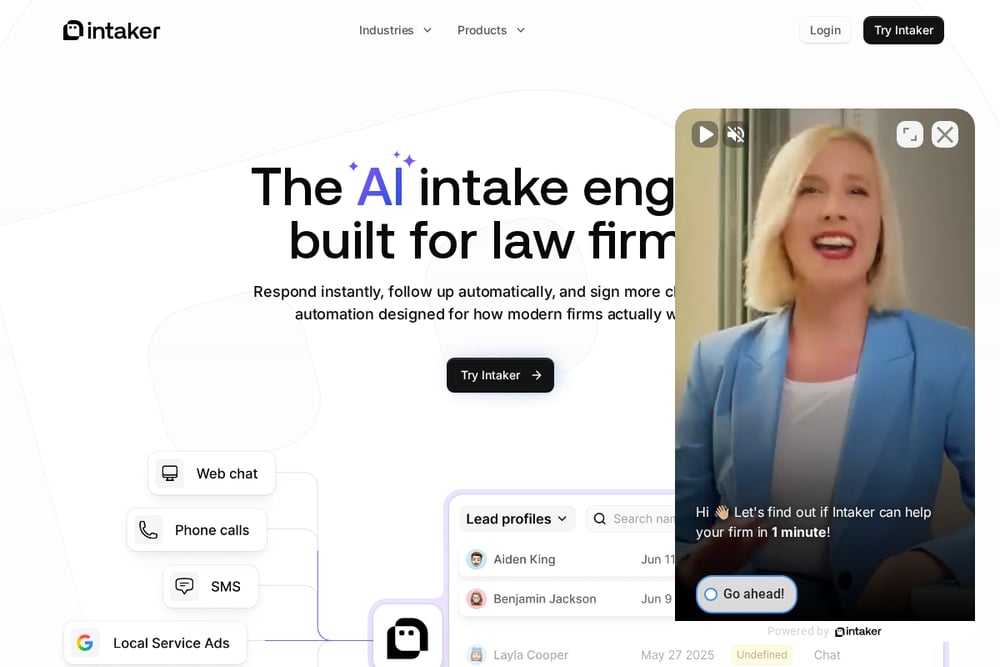 A screenshot of the Intaker website.
Intaker positions itself as an AI intake engine built specifically for law firms, and the breadth shows. It captures leads across chat, text, Google LSA, WhatsApp, Meta, and phone from one platform, which matters when your PIP inquiries arrive through five different doors. The platform automates follow-up and next steps so a lead who fills out a form at 11 PM still gets a nudge the next morning. Personal injury firms feature prominently in its customer stories, including Snellings Law and Hill Law Firm. If your problem is scattered lead sources rather than after-hours coverage alone, this is the widest net on the list. You can explore the full feature set at Intaker.
#2 Stellara AI Automation for PIP Firms
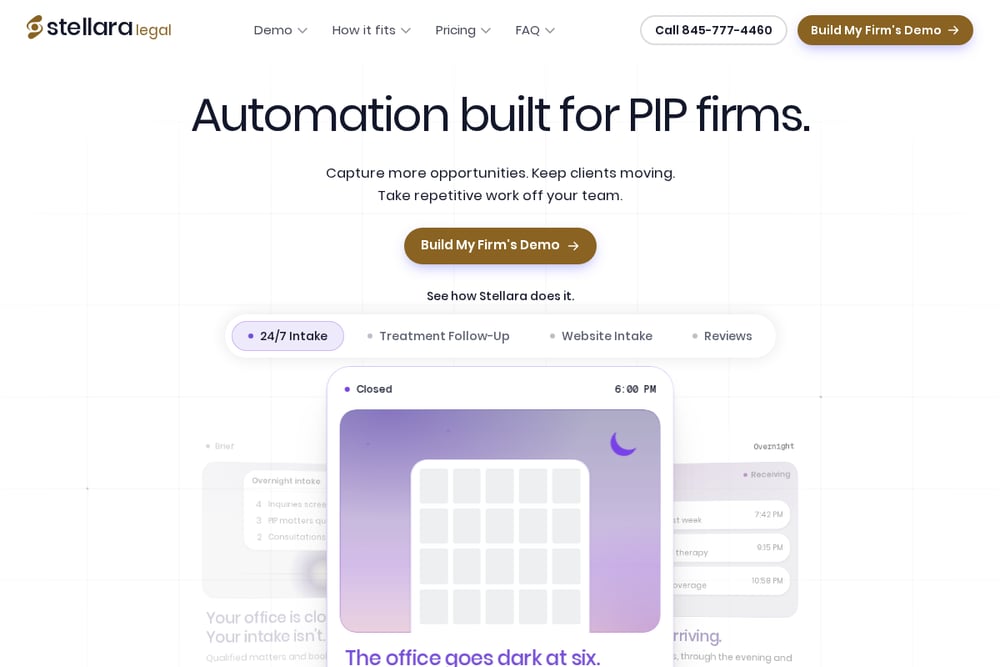 A screenshot of the Stellara AI Automation for PIP Firms website.
Stellara does one thing and aims to do it well: after-hours intake for PIP firms. When your office goes dark at six, Stellara answers calls, web forms, and texts through the evening and into the morning, asking the same PIP screening questions every time. It checks accident date, auto insurer, treatment status, and current attorney against your criteria, then books qualified consultations straight onto your calendar and logs everything in your CRM. The overnight brief is the standout feature. You arrive to a summary showing how many inquiries came in, how many qualified, and how many consultations are booked. It is built to work around your team rather than replace it, which suits small practices that want coverage without hiring a night shift. See how the workflow runs at Stellara.
#3 CaseGen
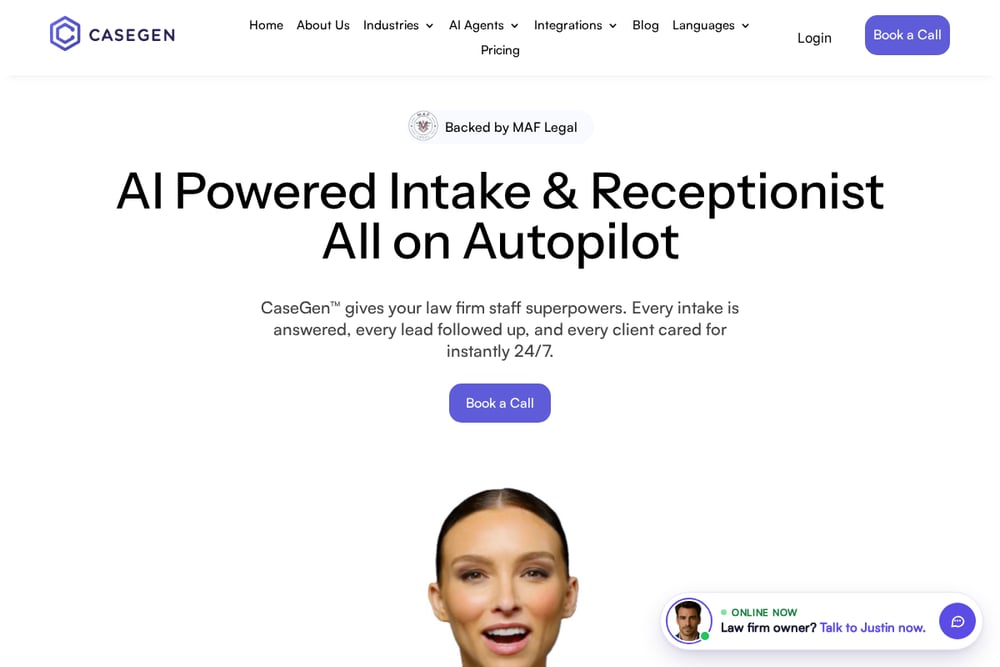 A screenshot of the CaseGen website.
CaseGen brings a named AI agent, Justina, to personal injury intake and lets it handle inbound calls around the clock, including overflow and after-hours traffic. The platform gathers accident details, follows up on incomplete intake, and hands your team structured information for review. What stands out is the language coverage, with support for Spanish, Mandarin, Vietnamese, Arabic, and more than a dozen other languages, which matters in diverse metro markets. It integrates with Clio, Filevine, Lawmatics, Google Sheets, and Zapier, so intake data flows into the systems firms already run. The company also publishes practical guidance on building intake questions and testing scenarios, useful if you are formalizing your PIP screening for the first time. Details live at CaseGen.
#4 Eve
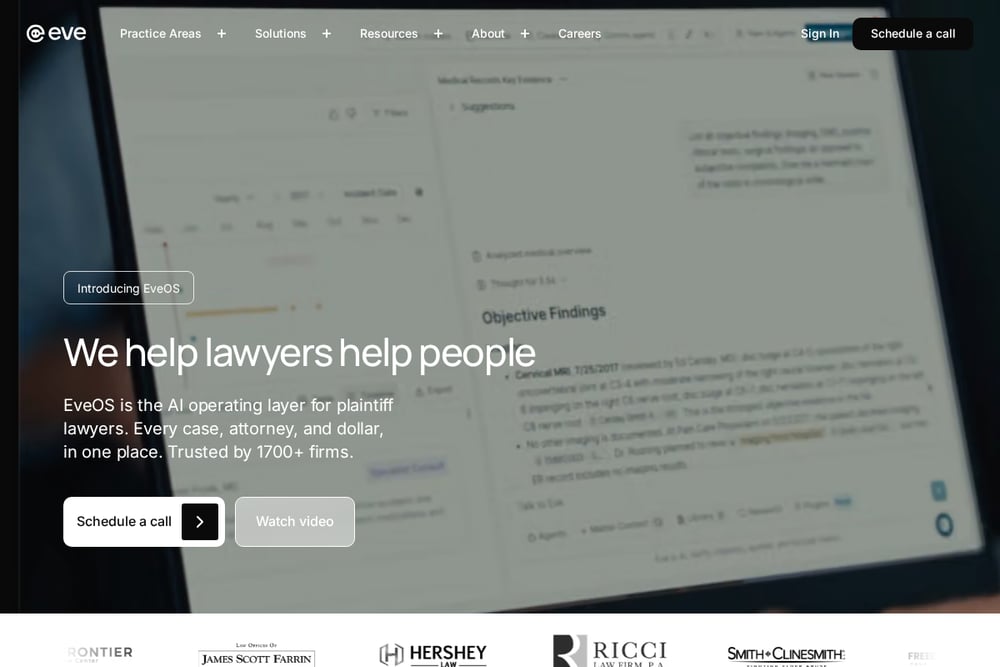 A screenshot of the Eve website.
Eve is built for plaintiff firms and pushes further into the case lifecycle than pure intake. Its AI voice agent answers incoming calls 24/7, and the case intake and evaluation module scores leads so your team knows which inquiries deserve attention first. Eve also advertises getting retainers signed on the call, which shortens the gap between a qualified PIP matter and a signed client. Beyond intake, the platform extends into pre-litigation work like medical overviews and demand letters, so firms already using it for intake can grow into the rest of the suite. That breadth makes it a heavier commitment than a standalone intake tool, but it appeals to firms thinking about automation across the whole practice. Learn more at Eve.
#5 SimplyConvert
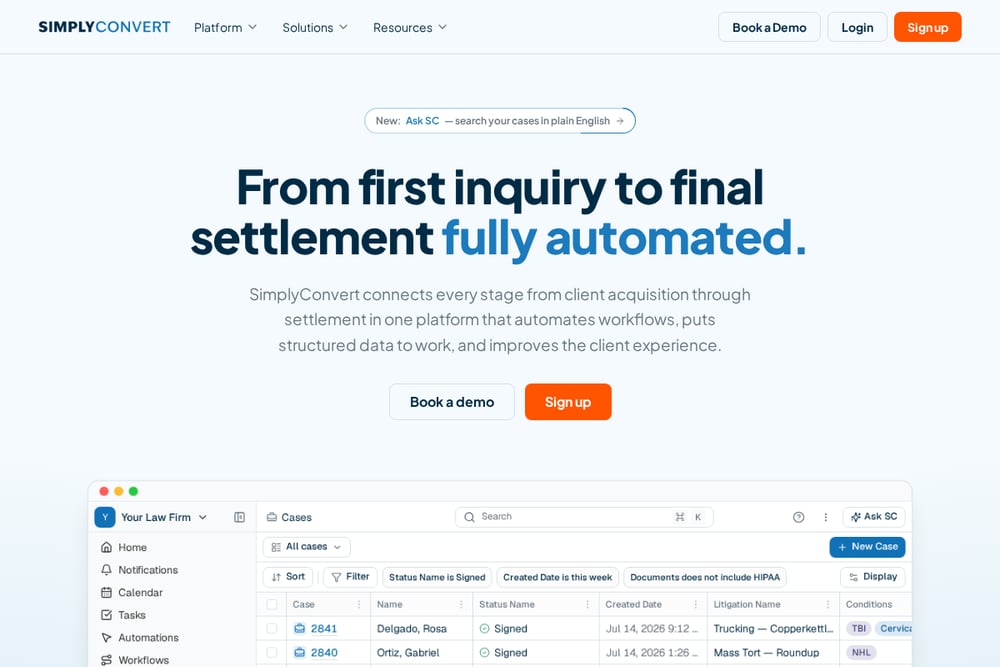 A screenshot of the SimplyConvert website.
SimplyConvert pairs legal intake with a CRM, which sets it apart from tools that hand data off to a third-party system. Its Instant Case Evaluator qualifies and signs clients against your case criteria around the clock, and the criteria library was built with practicing plaintiff attorneys across 200-plus litigations and practice areas. That means your PIP screening questions can be modeled on established patterns rather than invented from scratch. The platform also includes a client portal, case management workflows, and mass tort tooling, all under SOC-audited security controls with role-based access and audit trails. For firms that want intake and case management in one place, this consolidates vendors. Explore it at SimplyConvert.
How to pick the right intake tool for your firm
Start with your biggest leak. If leads vanish because nobody answers after hours, a focused tool like Stellara solves that directly. If leads arrive from six channels and get lost in the shuffle, a broad platform like Intaker makes more sense. Next, map your PIP screening questions on paper before you talk to any vendor. Accident date, insurer, treatment status, prior attorney, and jurisdiction rules should all be in the flow. Then ask each vendor to show you those exact questions in a live demo, not a generic personal injury script. Check integrations against your actual CRM, because intake data that requires manual re-entry defeats the purpose. Finally, get pricing in writing and ask what happens during a spike, like a major accident on a holiday weekend. The tool should scale with your inquiry volume without per-minute surprises.
A simple automation workflow you can run this week
Here is a workflow any small PIP firm can set up. First, route all after-hours calls, texts, and web forms into one intake queue so nothing sits in a voicemail box. Second, have the AI ask your PIP screening questions in a fixed order and tag each inquiry as qualified, pending, or out of scope. Third, auto-book qualified callers into open consultation slots on your calendar and send a confirmation text. Fourth, push every record into your CRM with the screening answers attached. Fifth, generate a morning brief that lists new inquiries, qualified matters, and booked consultations so your team starts the day with a plan instead of an inbox. Review the brief weekly and adjust your screening questions based on which leads actually convert.
The bottom line
PIP intake rewards speed and consistency, and AI tools deliver both better than a tired intake team at 10 PM. The five tools here take different routes to the same goal. Intaker casts the widest net across channels, Stellara focuses tightly on after-hours PIP screening and morning briefs, CaseGen leads on multilingual coverage, Eve extends into case evaluation and retainers, and SimplyConvert bundles intake with a full CRM. None of them replaces your judgment about which cases to take. They just make sure you get the chance to exercise it. Pick the one that plugs the leak you actually have, test it against your real screening questions, and let the overnight inquiries start paying for themselves.