Students can hand almost any worksheet to a chatbot and get an answer in seconds. These five platforms are built to make that harder, and to make the learning stick.
Where AI homework help stands now
The homework help market has split into two camps. One camp optimizes for speed: upload a photo, get an answer. The other camp, where most educators now land, optimizes for process: guide the student step by step and withhold the final answer until real work happens. Professors and instructors care about a third thing too, which is visibility. They want to know who finished, what students reported, and where the class got stuck. The platforms below take different routes to those goals, from district-wide teaching assistants to textbook-linked tutors to a professor-first assignment builder.
How these five were evaluated
Each platform was looked at on four factors: how well it resists answer-dumping, how much instructor visibility it offers, how clearly its scope and pricing are presented, and how well it fits a real classroom workflow from assignment to completion. The detail on each one lives in its description below.
Here is the short version before the deep dive. Each entry below covers what the platform does, who it suits, and where it fits in a course.
| Provider | Best For |
|---|---|
| Khanmigo | Districts and teachers who want an AI assistant across a full curriculum |
| Encephlo: homework that's hard to hand to AI | Professors who want textbook problems delivered step by step with proof of completion |
| Studdy AI | Students who want a visual, interruptible tutor on their own materials |
| Pearson AI Tutor | Courses already built on Pearson textbooks and courseware |
| NoteGPT AI Homework Helper | Students who want free, no-signup help across many subjects |
The five platforms in detail
#1 Khanmigo
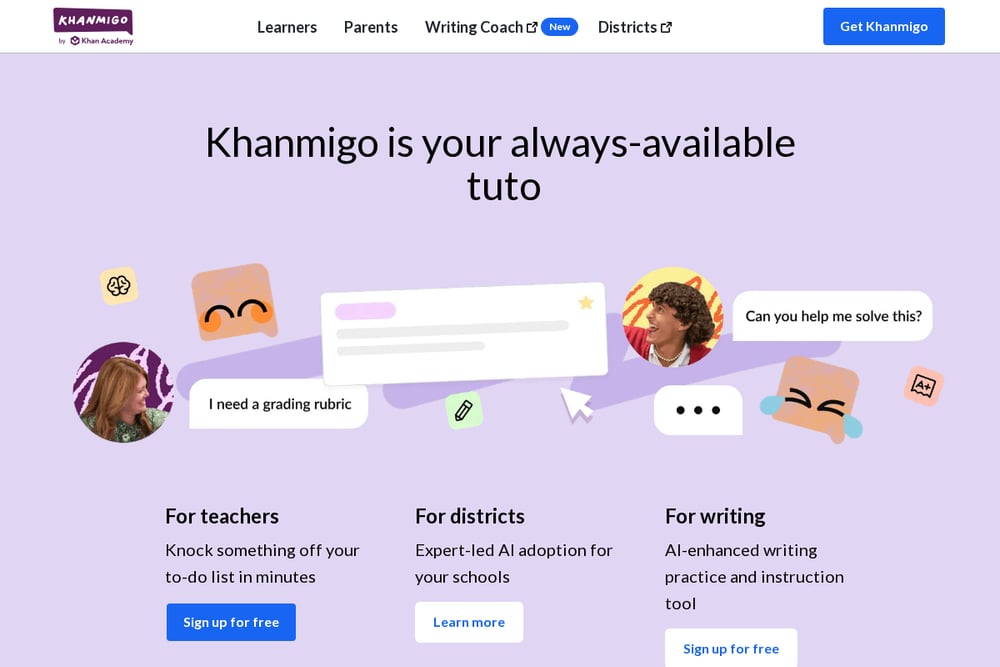 A screenshot of the Khanmigo website.
Khanmigo is Khan Academy's AI teaching assistant, and it carries the most institutional weight of anything on this list. For teachers it handles workflow chores like rubric generation, and one high school English teacher reported cutting an hour-long task to about 15 minutes. For learners it is deliberately Socratic, challenging students to think critically rather than handing over direct answers, which is the same philosophy Encephlo takes but applied across a much broader catalog. It also extends to parents who want homework turned into guided discovery at home. If your institution already leans on Khan Academy content, this is the natural extension.
#2 Encephlo: homework that's hard to hand to AI
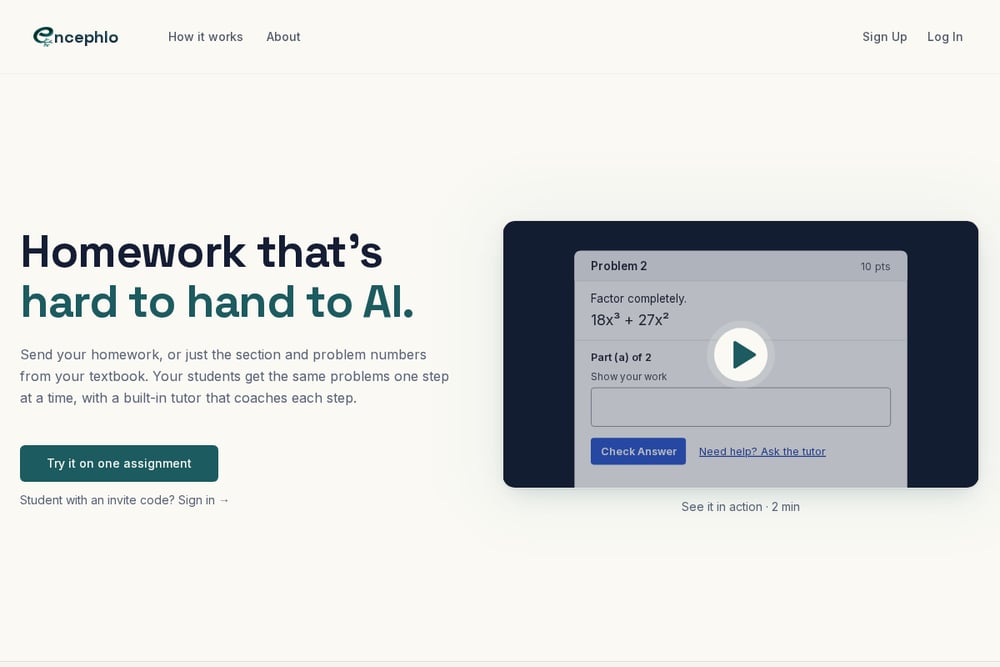 A screenshot of the Encephlo website.
Encephlo is built for one job: turning your worksheet or textbook problems into homework students actually have to work through. You upload a PDF, photo, or Word file, or type a section and problem numbers like 8.4: 19, 22, 23, and every student gets the same problems with the same numbers. A built-in tutor coaches each step and holds back the answer; after a few wrong tries it shows the method and the student moves on. Founder Suraj Swaminathan tested it directly, noting that on algebra homework ChatGPT and Claude held back the answer on the first try nearly every time. Students finish with a certificate carrying a code and their results, and you get a dashboard showing who finished, reported answers beside your key, and where the class is stuck.
#3 Studdy AI
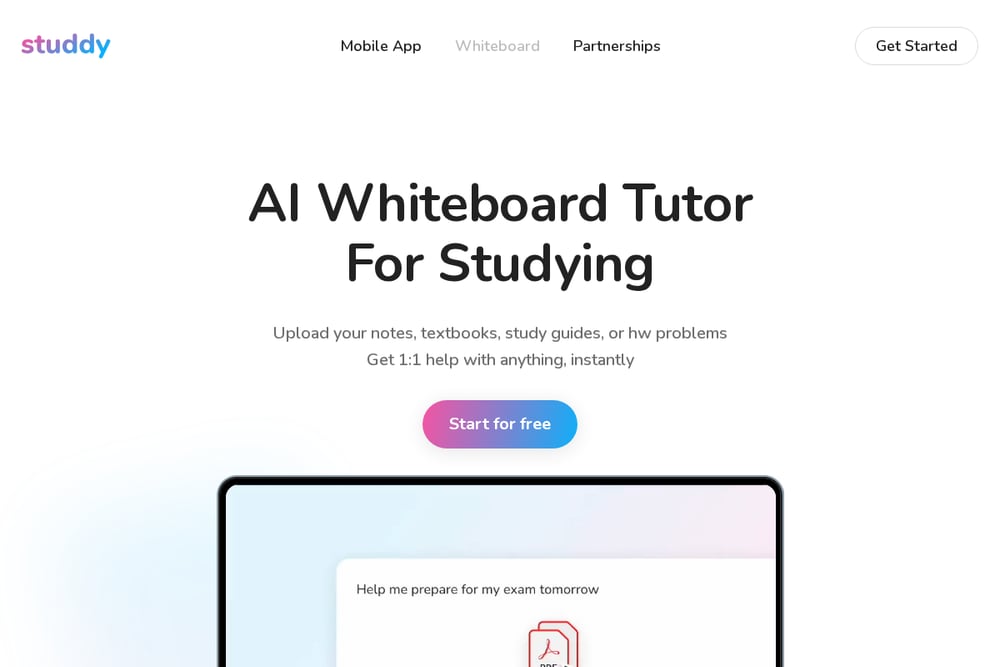 A screenshot of the Studdy AI website.
Studdy AI leans into the whiteboard. You upload notes, textbooks, study guides, or homework problems and get one-on-one help on a shared canvas where equations, diagrams, reactions, and graphs get explained step by step. You can interrupt at any point, ask for another example, or say explain that again, and the tutor adjusts and keeps going. It also generates practice questions from your own materials, so review is tied to what you will actually be tested on. The pitch is student-side and cost-conscious, with the company claiming students have saved over $1.2M in tutoring costs. It is a strong pick for self-directed learners rather than instructors managing a class.
#4 Pearson AI Tutor
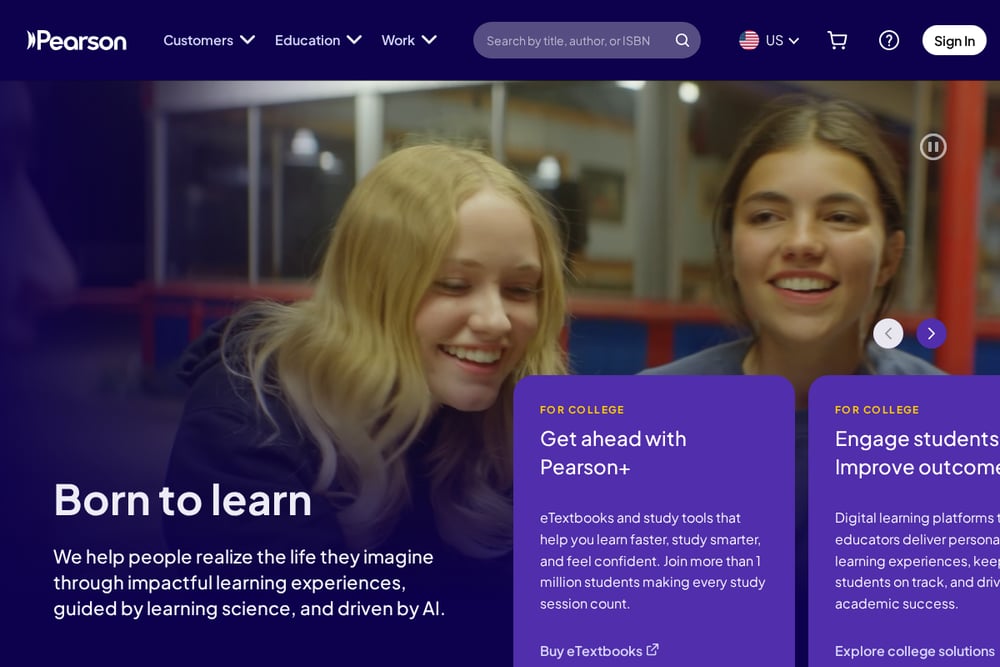 A screenshot of the Pearson AI Tutor website.
Pearson AI Tutor attaches homework help directly to Pearson course content, which makes it the most textbook-native option here. You pick a course and get video and step-by-step solutions across 41 courses spanning chemistry, biology, physics, math, statistics, and business. Each question comes with detailed video solutions plus similar examples for extra practice, so a student who misses a problem has a next step ready. The step-by-step framing and personalized support are aimed at concept mastery rather than quick answers. If your course already runs on Pearson materials, the integration is the whole argument.
#5 NoteGPT AI Homework Helper
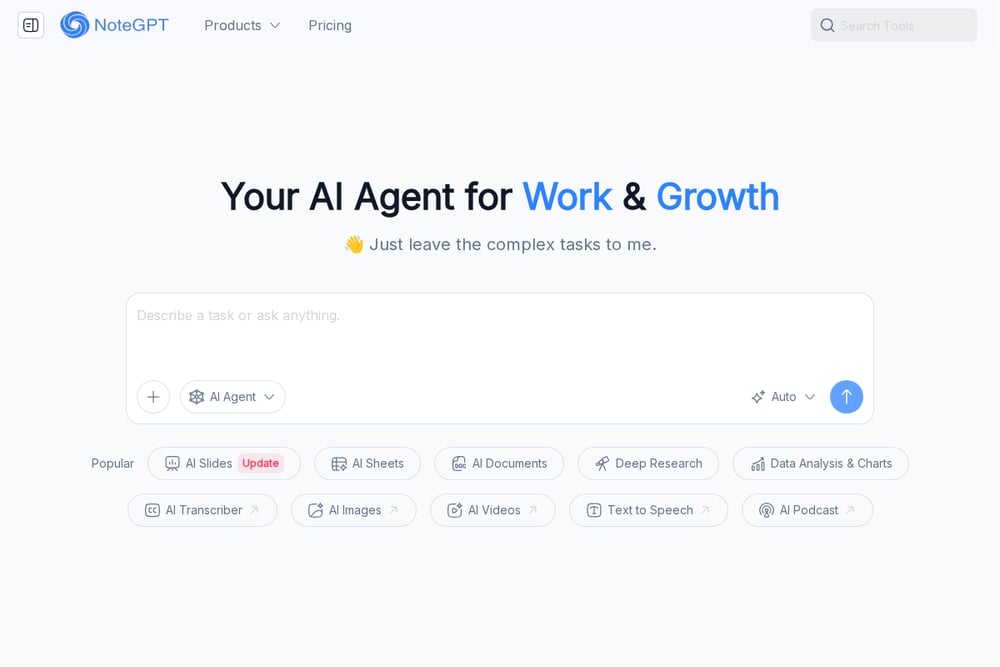 A screenshot of the NoteGPT AI Homework Helper website.
NoteGPT's AI Homework Helper is the low-friction entry point on this list. You upload or paste a question, snap a photo, or drop in a PDF, and you get step-by-step solutions across math, physics, chemistry, literature, biology, and history. It offers a Socratic mode that guides you to find answers yourself, alongside a quicker answer mode, and it is free with six tries daily and no sign-up required. That makes it easy to test before committing to anything. The tradeoff is that it is a general-purpose helper with no instructor dashboard, so it suits individual students more than course management.
How to pick the right one for your classroom
Start with who is actually using it. If you are a professor assigning work, you need completion tracking and a way to see where the class is stuck, which narrows the field fast. If you are a student studying alone, a free or low-cost tutor with broad subject coverage will serve you better than an instructor dashboard you will never open. Next, check whether the platform works from your existing materials. A tool that ingests your textbook by section and problem number saves setup time every week, while a general chatbot forces you to rebuild assignments by hand. Finally, test the answer-holding behavior yourself. Run a few of your own problems through and see whether the tool coaches or caves.
A workflow that keeps the tutoring honest
Set up the assignment once from your textbook section and problem numbers, then post a single class link so every student sees identical problems. Let the built-in tutor coach each step during the week, and require the completion certificate with its code as the submission. When certificates come in, compare reported answers against your key and scan for the problems where the class clustered. That cluster is your next lecture. The loop is simple: assign, coach, certify, review, reteach. It keeps AI in the role of tutor rather than answer key, and it gives you data you can act on before the exam.
The bottom line
The best homework platform for you depends on which side of the desk you sit on. Instructors who want textbook problems delivered step by step, with certificates and a stuck-point view, will find Encephlo built precisely for that. Institutions wanting a broad assistant should look at Khanmigo, Pearson serves courses already tied to its content, Studdy AI wins for visual self-study, and NoteGPT is the easiest free place to start. Whichever you choose, test whether it holds the answer. That single behavior tells you more than any feature list.