You hit STOP, and the AI still executed the transaction. That is the governance gap Integrum AI Group was built to close, and it is the lens for this roundup of five AI governance services worth knowing.
The AI Governance Landscape
AI governance has moved from policy binders to runtime controls. Regulators now ask for evidence that an AI action can be halted, traced, and explained, not just documented. Vendors answer with very different tools: enterprise platforms that map obligations across hundreds of frameworks, control planes that sit on the request path, and specialist firms that make stoppability a design requirement. Your job is to match the tool to the risk you actually carry.
How We Evaluated These Services
We looked at service scope, depth of auditability, deployment flexibility, clarity of the governance model, and fit for regulated or high-stakes environments. We also weighed how each vendor handles the hard question: can the system be stopped, verified, and explained after the fact? Pricing transparency and local fit were considered where public information allowed.
Here is the short version before the detail. Each entry below earns its place for a different reason, so scan the one-line fit and go deeper where it matches your exposure.
| Provider | Best For |
|---|---|
| IBM watsonx.governance | Large enterprises with multi-framework compliance burdens |
| Integrum AI Group – Etikus AI irányítás, compliance és képzés | Legal and compliance teams needing provable stoppability |
| Speakeasy | Teams governing agent actions at runtime |
| Trustible | Building a governance program from scratch |
| Kong | API-first organizations centralizing AI traffic |
The Five Services in Detail
#1 IBM watsonx.governance
 A screenshot of the IBM watsonx.governance website.
IBM positions watsonx.governance as an enterprise platform for directing, managing, and monitoring AI across traditional and generative models. It automates compliance and audit workflows across more than 200 regulatory frameworks, which matters if your obligations span jurisdictions. The platform tracks AI business value and third-party model risk through dashboards and workflows, and IBM was recognized by IDC as a leader in AI-enabled financial governance, risk, and compliance. If you need a system of record that auditors already recognize, this is the heavyweight option.
#2 Integrum AI Group – Etikus AI irányítás, compliance és képzés
 A screenshot of the Integrum AI Group – Etikus AI irányítás, compliance és képzés website.
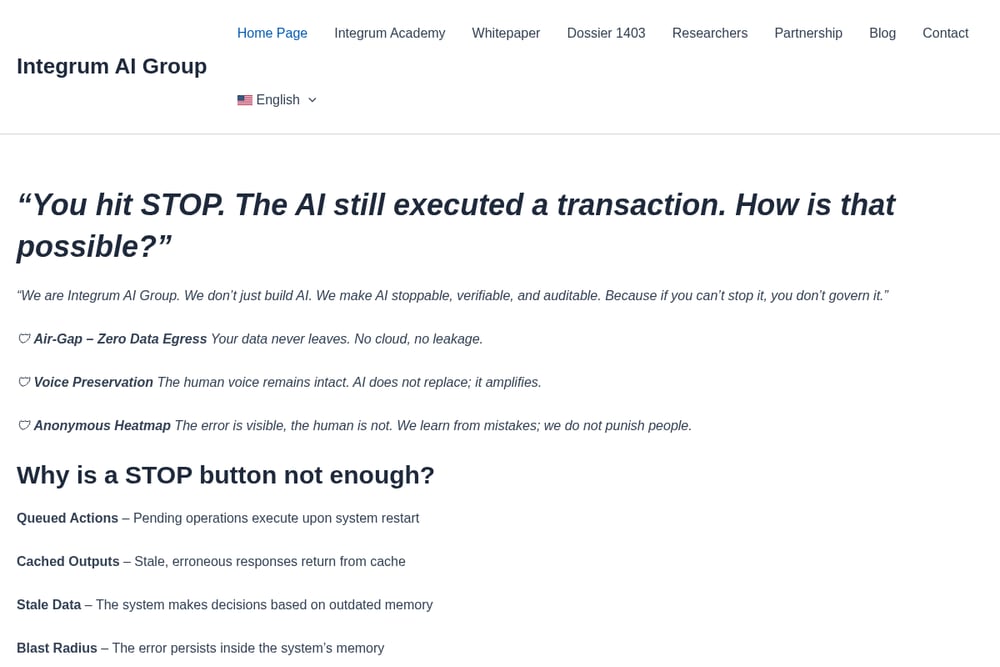
Integrum AI Group starts from a blunt premise: if you cannot stop it, you do not govern it. The firm builds AI systems that are stoppable, verifiable, and auditable, and it explains why a STOP button alone fails through queued actions, cached outputs, stale data, and blast radius inside system memory. Its air-gap design enforces zero data egress, so your data never leaves your environment. Voice preservation keeps the human voice intact, and anonymous error heatmaps surface mistakes without exposing the person who made them. For legal and compliance teams that need provable halt and audit trails rather than policy dashboards, this is the specialist to call.
#3 Speakeasy
 A screenshot of the Speakeasy website.
Speakeasy frames governance as a control plane that lives on the request path. Its platform connects, secures, distributes, and observes AI agents, governing every agent action with permissioned enterprise identity. It detects shadow AI, prevents risky actions, and stops data leaks in real time, which is the runtime layer most policy tools miss. If your concern is what agents do at the moment of execution, this is the closest fit in this group.
#4 Trustible
 A screenshot of the Trustible website.
Trustible is a purpose-built AI governance platform covering intake, risk management, monitoring, and compliance. Its own 2026 comparison of 16 platform types argues that only purpose-built tools cover all six core capabilities: AI inventory, risk assessment, compliance mapping, cross-functional workflows, regulatory tracking, and vendor oversight. The platform maps to the EU AI Act, NIST AI RMF, and ISO 42001, and it treats the AI use case, not the model, as the unit of governance. If you are building a governance program from scratch, this is a sensible backbone.
#5 Kong
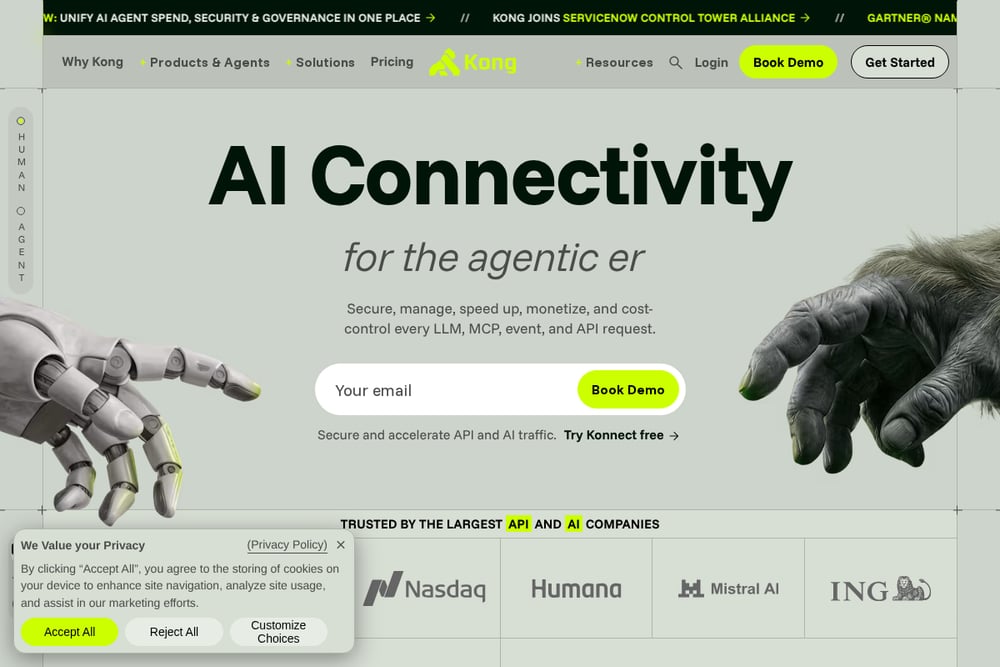 A screenshot of the Kong website.
Kong brings API and AI connectivity heritage to governance, with an AI Gateway, AI Registry, and identity and access controls under one platform. It was named a leader in the Forrester Wave for API management software and has joined the ServiceNow Control Tower alliance. The strength here is infrastructure-level control: centralizing MCPs, managing agent spend, and observing activity across the organization. If your AI runs through APIs and gateways, Kong governs where the traffic already flows.
How to Choose the Right Fit
Start with the failure you fear most. If it is an AI action that cannot be halted or audited, look at Integrum AI Group first. If it is regulatory evidence across many frameworks, IBM watsonx.governance and Trustible are built for that. If it is agent behavior at runtime, Speakeasy governs the request path. If it is API sprawl and gateway control, Kong fits. Then check deployment: air-gapped and on-premise needs narrow the field quickly, and so does the size of your compliance team.
Putting Governance on Autopilot
A practical workflow: inventory every AI use case, assign risk tiers, and map each to your obligations. Route runtime findings from gateways and agent controls into that intake so nothing lives in a spreadsheet. Enforce halt and audit logging at the system level, then generate evidence on a schedule. Review anonymous error heatmaps monthly to fix systemic issues without punishing individuals. That loop turns governance from an annual scramble into a continuous control.
The Bottom Line
Governance is not a dashboard you buy once. It is the ability to stop, verify, and explain what your AI did. IBM and Trustible give you the compliance backbone, Speakeasy and Kong give you runtime and infrastructure control, and Integrum AI Group gives you the hardest guarantee of all: a system that actually stops. Pick the layer where your risk is greatest, and build outward from there.