AI pressure is everywhere, but a practical path forward is not. These five consultancies help you figure out where AI actually belongs in your business, and how to deploy it without creating new risk.
Where AI consulting stands right now
Most organizations are no longer asking whether to adopt AI. They are asking where to start, who owns it, and how to keep it compliant. That shift has pushed governance, risk, and workflow design to the center of the conversation, alongside model selection and tooling. The consultancies below sit at that intersection, blending strategy with the operational and compliance work that makes adoption stick.
How these five were evaluated
Each firm was assessed on service scope, depth of governance and risk expertise, clarity of engagement model, practical implementation support, and fit for mid-market versus enterprise organizations. Pricing transparency and sector experience were also weighed. The detail on each business lives in its description below.
Here is a quick look at the five firms, ordered for readability rather than as a verdict. Each one approaches AI adoption from a different angle, so the right pick depends on where your organization is stuck.
| Provider | Best For |
|---|---|
| RSM US | Enterprises needing a formal, auditable governance framework |
| Stone Harbor AI Advisory | Organizations wanting practical AI adoption with governance built in |
| IBM Consulting | Large enterprises with mature data governance already in place |
| Centric Consulting | Teams wanting AI governance alongside broader IT and security consulting |
| Webconsuls | Smaller organizations moving from AI experiments to working workflows |
The five consultancies in detail
#1 RSM US
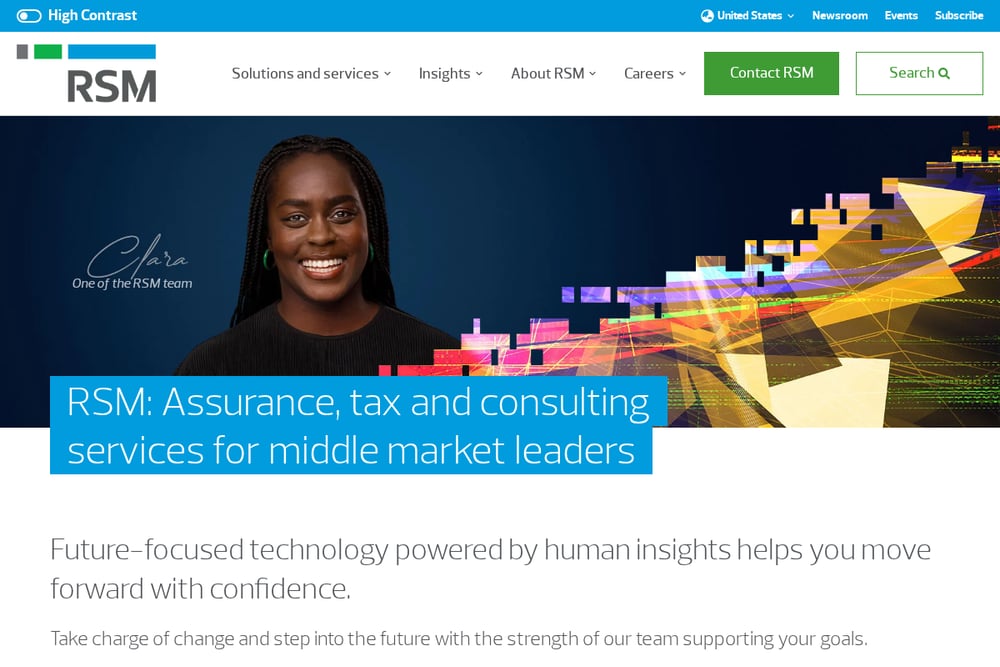 A screenshot of the RSM US website.
RSM brings a formal, framework-driven approach to AI governance, built for organizations that need defensible controls before they scale. Its AI Governance Framework pulls from NIST's Cybersecurity Framework, AI Risk Management Framework, and Privacy Framework, along with EU AI Act considerations, giving you a structure that regulators and boards recognize. The firm positions governance as a prerequisite to implementation, not an afterthought, which suits risk-averse leadership teams. You get risk professionals who understand ethics and data considerations beyond standard IT governance. If your priority is a documented, auditable program, RSM is a strong starting point.
#2 Stone Harbor AI Advisory
 A screenshot of the Stone Harbor AI Advisory website.
Stone Harbor takes the position that AI adoption is not simply a technology challenge. The firm pairs practical AI adoption with hands-on experience in compliance, governance, risk management, operational processes, and documentation, which is a rare combination. Its services span strategy, governance, implementation, and training, so you can move from identifying meaningful opportunities to building useful business workflows. The stated goal is refreshingly narrow: use AI where it makes business sense, not everywhere. That makes it a good fit for organizations that want judgment applied alongside tooling, and a structured roadmap rather than a pile of pilots.
#3 IBM Consulting
 A screenshot of the IBM Consulting website.
IBM Consulting approaches governance as an extension of your existing data infrastructure, with automated controls that work across a model portfolio. The pitch is aimed squarely at CDOs and data leaders who need to operationalize governance at scale without slowing innovation. IBM brings industry-specific frameworks and technical implementation depth, and it starts where your data governance ends so you are not rebuilding from scratch. The firm has been recognized in Forrester and HFS evaluations for its consulting and agentic services work. Expect a large-firm engagement model with corresponding scale and complexity.
#4 Centric Consulting
 A screenshot of the Centric Consulting website.
Centric offers AI governance as one piece of a broader consulting menu that includes AI strategy, agent development, data and analytics, and security and compliance. That breadth helps if you want a single partner across Microsoft, Salesforce, and NetSuite ecosystems rather than stitching vendors together. The firm also fields virtual CISO and risk assessment services, which can be useful when AI governance overlaps with security obligations. It is a solid choice for mid-market and enterprise teams that need cross-functional support. The trade-off is that AI governance is one offering among many rather than the sole focus.
#5 Webconsuls
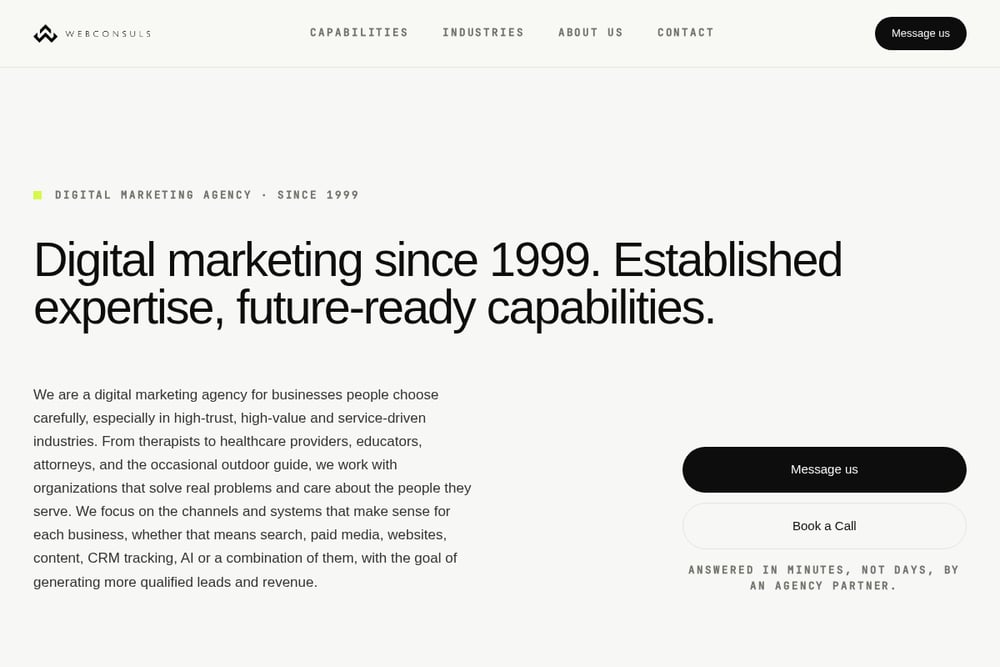 A screenshot of the Webconsuls website.
Webconsuls frames AI consulting around the operation itself, starting with where employees lose time on document review, reporting, and repetitive data movement. The agency helps leadership identify high-value use cases, assess readiness, redesign workflows, implement AI agents and automation, and establish governance with clear human oversight. Its language mirrors the practical concerns of smaller organizations: what technology to use, how it connects to existing systems, and who stays responsible for outcomes. If you want an agency partner that moves from experimentation to implementation quickly, this is a reasonable fit. Larger enterprises may find the scope narrower than they need.
How to pick the right partner
Start with your actual bottleneck. If your board wants documented controls before anything ships, prioritize framework depth and audit readiness. If your teams are running scattered pilots with no owner, prioritize a firm that designs workflows and assigns accountability. Ask each candidate how they handle compliance and documentation, not just model selection. Then ask for a concrete example of a workflow they redesigned and what changed afterward. Finally, confirm the engagement model: fixed-scope assessment, ongoing advisory, or implementation retainer. The answer tells you more about fit than any capability list.
A simple way to run your evaluation
Build a short intake form that captures your industry, current AI maturity, compliance obligations, and budget range. Route responses into a shared scorecard with weighted criteria: governance depth, implementation support, sector fit, and pricing clarity. Have each stakeholder score the five firms independently, then compare notes in a single review session. Keep a running log of follow-up questions per firm so nothing gets lost between calls. This turns a messy comparison into a repeatable decision you can defend to leadership.
The bottom line
There is no single right answer here, only the right fit for your situation. RSM suits organizations that need formal, auditable governance. Stone Harbor AI Advisory fits teams that want practical adoption with risk and process expertise baked in. IBM Consulting scales governance across large data estates. Centric covers AI alongside broader IT and security needs, and Webconsuls moves smaller organizations from pilots to working workflows. Match the firm to your bottleneck, and you will spend less time comparing and more time shipping something useful.