Boards are suddenly accountable for AI and cyber risk they never trained for. These five advisory firms exist to close that gap.
The State of AI Governance Advisory
AI governance has moved from a policy footnote to a board-level agenda item. Regulators want evidence, insurers want documentation, and directors want someone in the room who has actually run the operation. That demand has spawned a crowded field of advisors, fractional executives, and consultancies all promising to make AI safe at scale. The difference between them usually comes down to whether they hand you a framework or build governance into how your business already runs.
How We Evaluated These Firms
We looked at service scope, depth of operator experience, clarity of engagement models, and how well each firm connects governance to real business operations. We also weighed whether the offering covers both cybersecurity and AI risk, since boards increasingly face them as one problem. Pricing transparency and the ability to serve as a fractional executive factored in too. The detail on each firm is in the descriptions below.
Here is a quick look at the five firms, ordered for easy comparison. Each one approaches AI governance from a different angle, so match the model to your situation before you book a call.
| Provider | Best For |
|---|---|
| Owen Sakawa | Boards and public-sector leaders needing AI safety and risk strategy |
| Fredrik Lindstrom | Boards wanting operator-led governance embedded into existing operations |
| Tyson Martin | US organizations wanting fractional AI and security leadership in one place |
| Kalosys | Firms needing governance tied directly to AI infrastructure and operations |
| Global AI Advisors | Leadership teams wanting tiered, scalable ongoing AI advisory |
The Five Firms in Detail
#1 Owen Sakawa
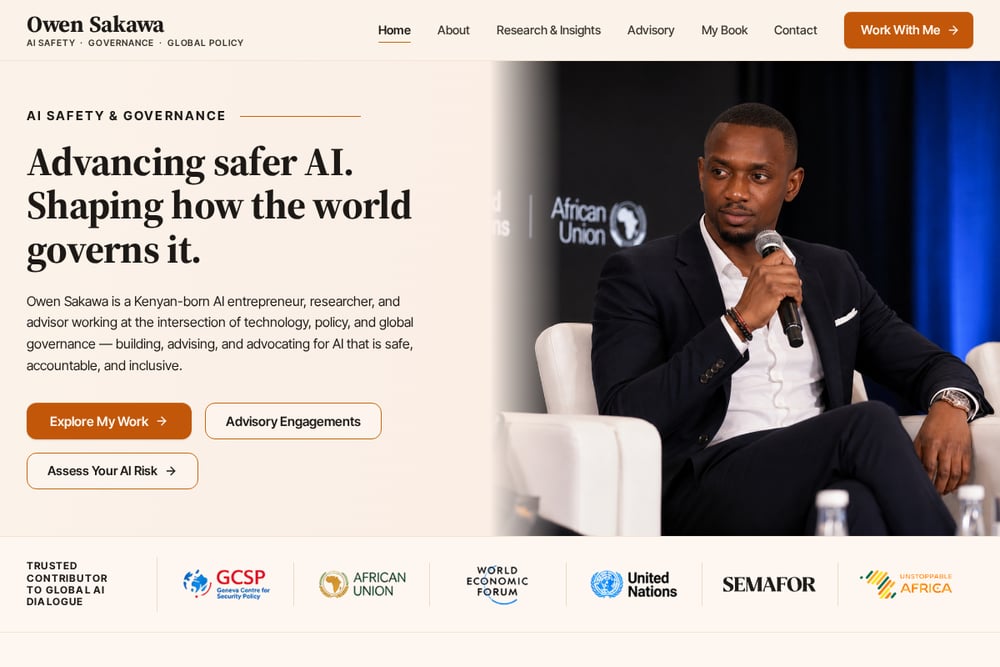 A screenshot of the Owen Sakawa website.
Owen Sakawa positions his practice squarely at the intersection of AI governance, safety, and risk management for boards, executives, and even governments. The advisory spans strategy and policy through to the operating decisions that make AI safe at scale, which suits organizations that need both the framework and the follow-through. His site leans on a straightforward entry point: book an advisory call or run a quick AI risk check. If you want a governance advisor who speaks the language of public-sector and boardroom stakeholders alike, this is a strong place to start. The emphasis on responsible deployment gives you a partner who treats safety as an operating discipline rather than a compliance afterthought.
#2 Fredrik Lindstrom
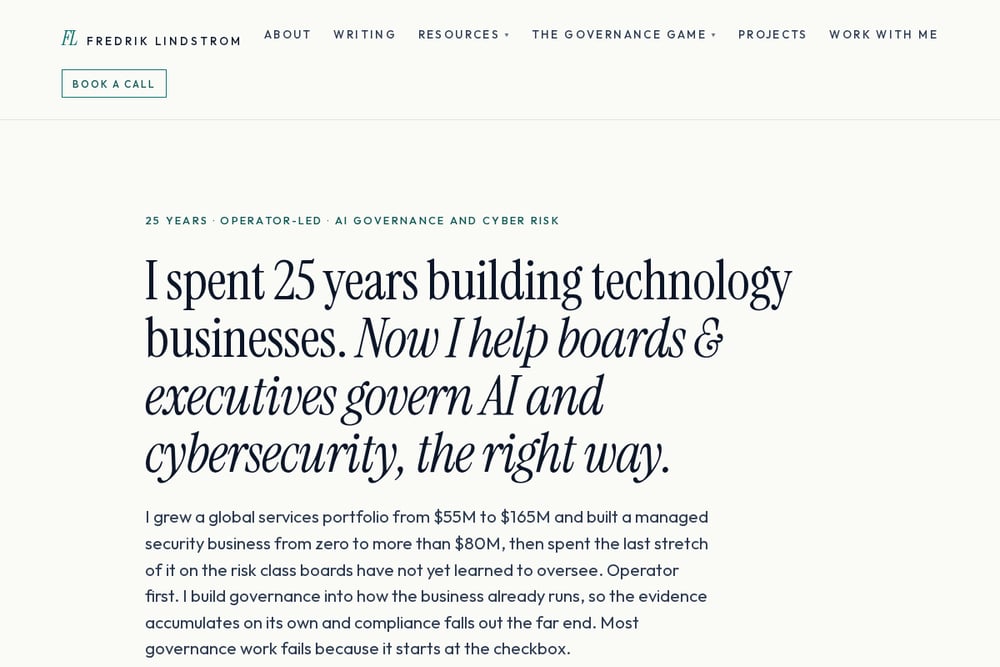 A screenshot of the Fredrik Lindstrom website.
Fredrik Lindstrom brings 25 years of operator experience to AI governance and cyber risk, having grown a global services portfolio from $55M to $165M and built a managed security business past $80M. That background shapes a method that builds governance into how your business already runs, so evidence accumulates on its own and compliance falls out the far end. He offers board briefings, governance workshops, programme work, and fractional CIO, CISO, or CAIO roles, plus standing board advisory. His writing tackles the questions boards should be asking, from outage accountability to what never makes it onto the board report. If you want an advisor who has carried a P&L and sat in the risk seat, this is the operator-led option.
#3 Tyson Martin
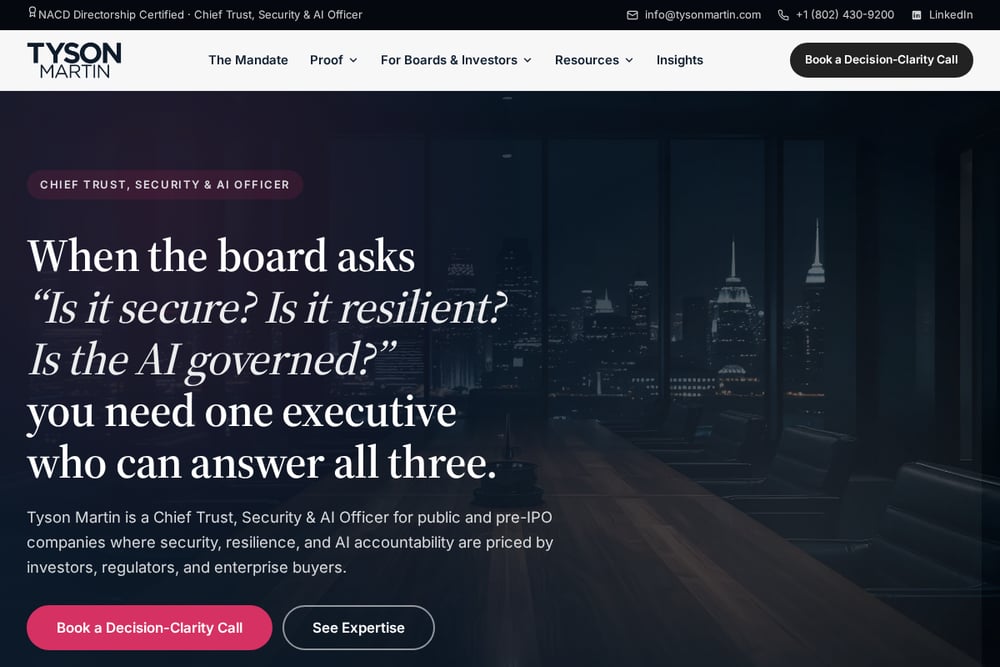 A screenshot of the Tyson Martin website.
Tyson Martin's fractional Chief AI Officer service is built for organizations that want experienced AI leadership without a full-time hire. The practice helps boards and management establish responsible AI governance, clarify decision rights, and translate emerging technology into executable business actions. It sits inside a broader menu that includes NIST-aligned AI risk management, CISO-as-a-service, cyber governance, and incident response readiness. That breadth means you can bring in AI oversight and cybersecurity leadership through one relationship. The plain-English approach suits US organizations adopting AI while managing accountability and operational momentum.
#4 Kalosys
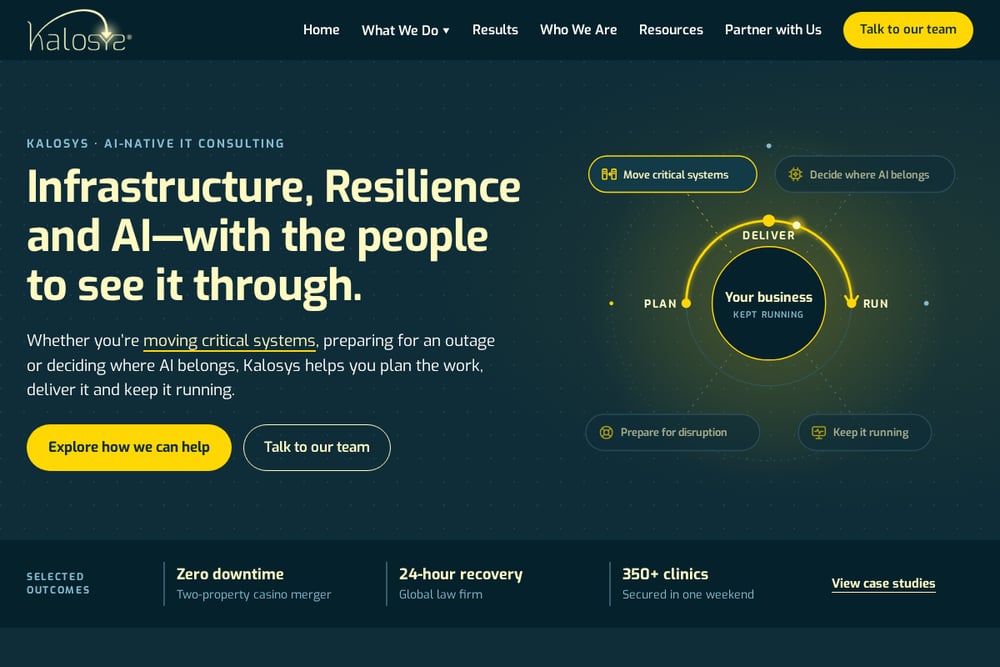 A screenshot of the Kalosys website.
Kalosys frames the fractional CAIO question bluntly: who owns AI here, and who decides what we do next? The answer is senior AI leadership on a monthly retainer covering roadmap, decision rights, governance, and board briefings. That offer sits within a deep AI-native consulting practice that includes agent governance and control, AI cost control, data readiness, and private or hybrid AI infrastructure. For organizations that need governance to connect to the technical stack, the breadth here is useful. It is a good fit if you want one partner for both the oversight model and the infrastructure underneath it.
#5 Global AI Advisors
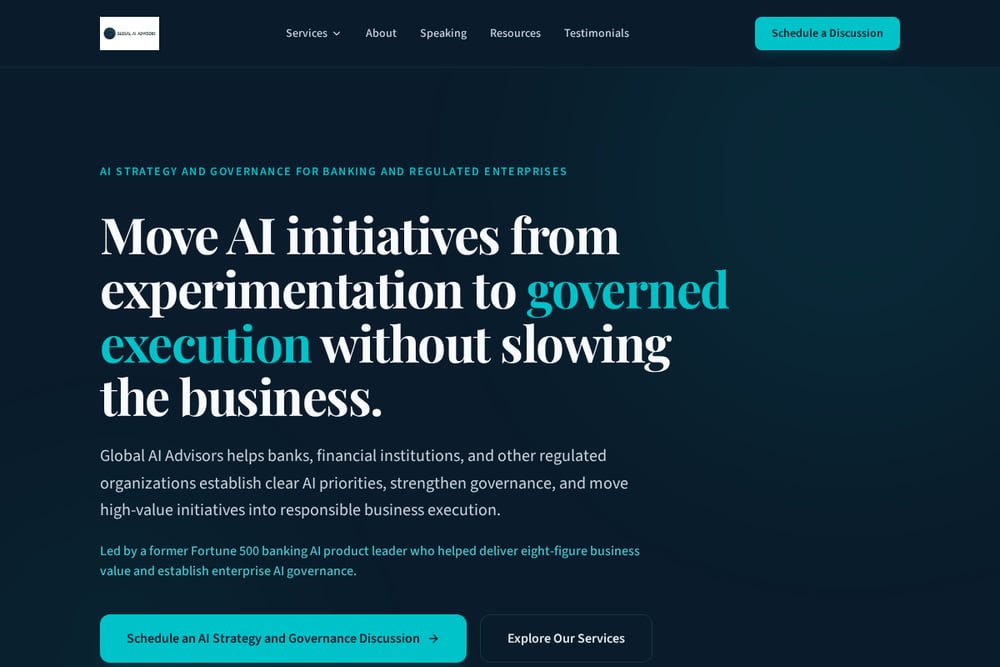 A screenshot of the Global AI Advisors website.
Global AI Advisors structures ongoing advisory and fractional CAIO support into clear engagement tiers, from a core program starting at roughly one hour a week up to an embedded strategic partner. That tiering makes it easy to scale support as your AI priorities evolve rather than committing to a fixed scope up front. The focus is on maintaining momentum, evaluating new opportunities, and keeping leadership teams aligned as adoption matures. Executive briefings and AI committee support are part of the core offer. If you want a flexible retainer that grows with your program, this model is worth a conversation.
How to Choose the Right Advisor
Start with the gap you actually have. If your board needs someone who has run a business and can speak to risk from the operator's chair, lean toward an operator-led advisor. If you need to stand up an AI program from scratch, a tiered retainer may get you moving faster. If governance keeps stalling because nobody owns the technical stack, pick a firm that connects oversight to infrastructure. Ask every candidate how they measure whether governance is working, and whether the evidence accumulates as a byproduct of operations or requires a separate compliance scramble. Finally, check whether they can serve as a fractional executive when you need a named owner in the seat.
Where Automation Fits
Good governance should not depend on someone remembering to update a spreadsheet. The strongest advisors build evidence capture into the workflows your teams already use, so audit trails form on their own. That means mapping decision rights to existing approval steps, logging AI use where work already happens, and tying risk reviews to the cadence of board and management meetings. When you evaluate a firm, ask how much of the evidence gathering is automated versus manual. The answer tells you whether governance will survive a busy quarter.
The Bottom Line
AI governance is no longer a nice-to-have for boards, and the firms above each solve a different slice of the problem. Owen Sakawa leads on safety and public-sector depth, Fredrik Lindstrom stands out for operator-led governance built into how your business runs, Tyson Martin offers broad fractional leadership, Kalosys ties oversight to infrastructure, and Global AI Advisors gives you flexible tiers. Match the model to your gap, ask hard questions about evidence and automation, and you will end up with oversight that holds up when it matters.