
Your journal shouldn't judge you. These five AI reflection tools each take a different angle on helping you understand what you feel, and one of them puts your own words back at the center.
Where AI Meets Emotional Learning
AI journaling has grown up fast. What started as a blank page with a chatbot bolted on is now a real category of emotional learning tools. Some lean on mood analytics. Others build structured programs or voice coaching. The common thread is reflection, but the philosophies diverge sharply. Some tools score you, label you, and chart your emotions over time. Others deliberately refuse to. That split matters more than any feature list. If you want a coach that pushes you, plenty of apps will do it. If you want a quiet space that leaves the interpretation to you, you have to look harder. This roundup covers both ends of that spectrum so you can pick the posture that fits how you actually want to reflect.
How We Evaluated These Tools
We looked at the same factors across every tool. First, service scope: does it offer guided paths, freeform journaling, voice, or all three? Second, philosophy and privacy: does it score or label your emotions, and how does it handle your data? Third, pricing clarity: is there a free tier, a trial, or a wall? Fourth, fit for remote use: does it work well on web and mobile without friction? Fifth, depth of reflection support: are the prompts generic, or do they respond to what you actually wrote? Perceptive Focus stood out for its explicit no-score, no-label stance and its emphasis on user-chosen starting points. Mindsera stood out for its breadth of frameworks and emotional analysis. Reflection stood out for real-time voice coaching and a large guided journey library. AI Journal App stood out for a generous free entry point and simple morning and evening routines. Renée Space stood out for its conversational write-back style and multiple journal types.
Here is the short version. Each tool below serves a different kind of reflector, so scan for the one that matches your temperament before you commit to a habit.
| Provider | Best For |
|---|---|
| Mindsera | Structured thinkers who want frameworks and pattern analysis |
| Make room for what you feel. | Perceptive Focus | People who want reflection without scoring or labeling |
| Reflection | People who want a coach that talks back in real time |
| AI Journal App | Beginners building a daily journaling habit |
| Renée Space | Writers who want a conversational journal partner |
The Five Tools, Up Close
#1 Mindsera
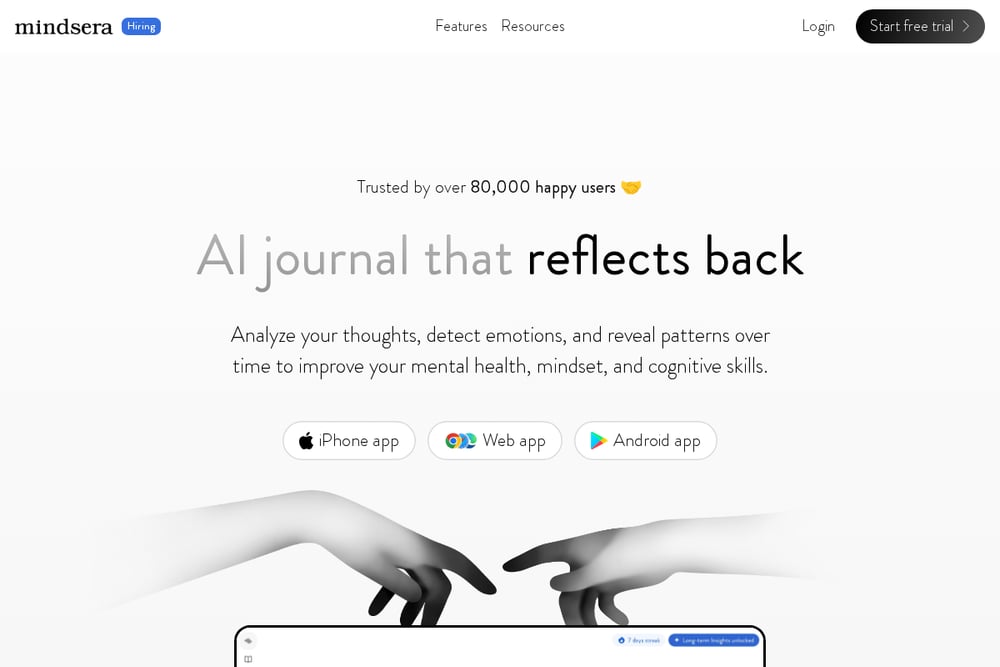 A screenshot of the Mindsera website.
Mindsera is the most feature-dense option in this group. It combines emotional analysis, a chat-with-your-journal function, and a recurring topics overview that surfaces patterns over time. You can write, speak, or snap a photo of a paper journal and let it extract the text. The smart editor adds generated artwork, insightful comments, and personalized prompts as you go. It also ships with 50-plus mental models and frameworks for structured thinking. If you like the idea of a thinking gym for your mind, this is the one built for that.
#2 Make room for what you feel. | Perceptive Focus
 A screenshot of the Make room for what you feel. | Perceptive Focus website.
Perceptive Focus takes the opposite approach to most AI journals, and that is the point. It starts from a state you choose to describe, not an emotion inferred from your face, your voice, or an employer's assessment. With your permission, language models help summarize entries, spot recurring themes, and prepare gentle questions, but the reflection stays grounded in what you actually wrote. There is no score and no label, just a practice you pick up at your own pace. You explore prepared reflection paths and keep only the questions that feel useful. It also folds in responsible AI literacy, which is rare in this category.
#3 Reflection
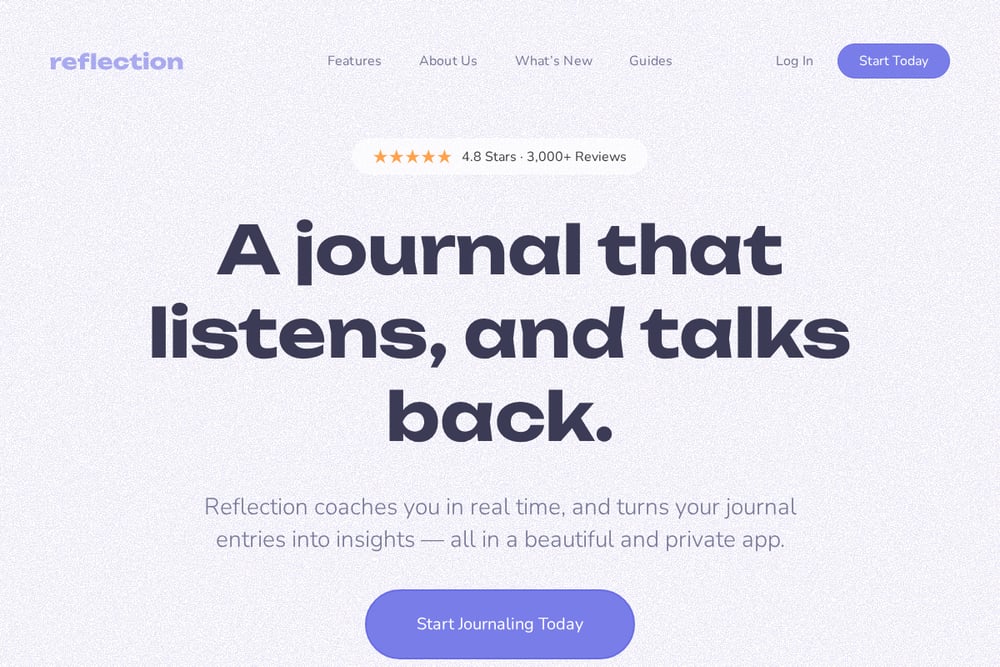 A screenshot of the Reflection website.
Reflection is the most conversational tool here. Its AI Coach offers a follow-up question drawn from the entry you just wrote, nudging you past the surface. If typing feels like too much, you can start a Voice Call and have a real back-and-forth that gets transcribed into your journal. The Ask Your Journal feature lets you query your own history in plain language, so you can check patterns or recall how you felt months ago. It also offers 100-plus guided journeys built with wellness experts, covering gratitude, anxiety, relationships, and productivity. It syncs across iPhone, iPad, Mac, Android, and web.
#4 AI Journal App
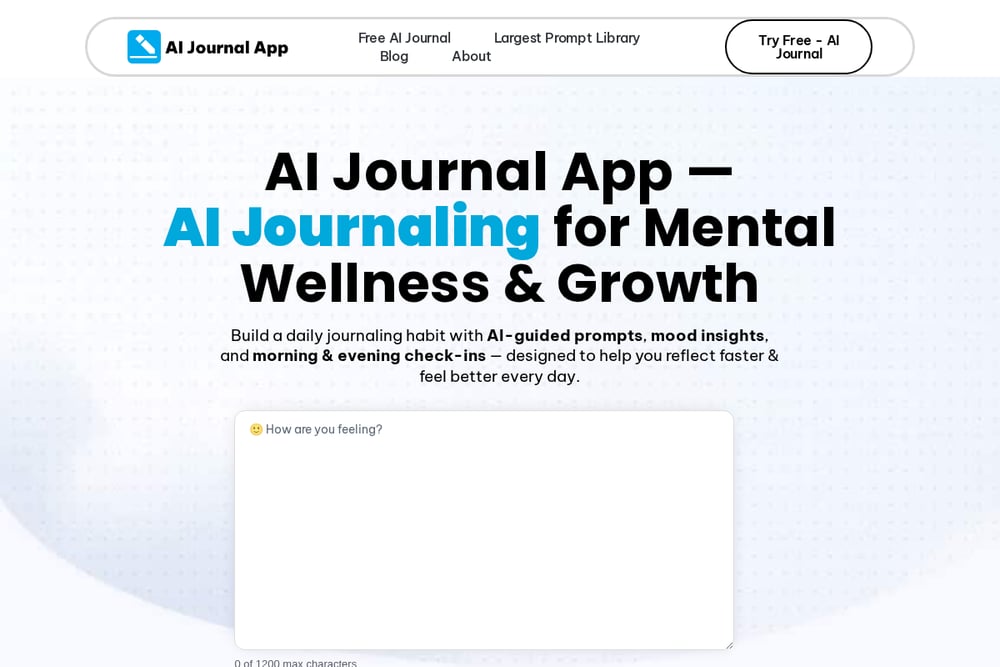 A screenshot of the AI Journal App website.
AI Journal App keeps things simple and accessible. It focuses on morning check-ins and evening reflections, which makes habit-building the core promise rather than deep analysis. You get AI-guided prompts, mood and progress insights, and a large prompt library to break the blank-page barrier. The morning routine sets an intention and a mindset, while the evening routine celebrates wins and reframes a challenge. It is free to try and pitched at anyone building a daily journaling habit. Students and new journalers are clearly part of the target audience.
#5 Renée Space
 A screenshot of the Renée Space website.
Renée Space is built around a writing partner that writes back. You write something, and Renée responds, helping you process emotions and surface new insights. It offers several journal types, including a daily pulse check, a thought journal, a relationship journal, gratitude entries, and letters to yourself. You can customize the tone of the AI's responses, which gives you some control over the voice you get back. It also tracks entries, streaks, and words written so you can see the effort accumulating. It is a good fit if you want a gentle back-and-forth rather than a dashboard.
How to Pick the Right One for You
Start with one question: do you want the tool to interpret you, or not? If you are comfortable with emotional analysis and pattern detection, Mindsera and Reflection give you plenty to work with. If the idea of an app scoring your feelings makes you uneasy, Perceptive Focus was built specifically to avoid that. Next, think about format. Voice people should lean toward Reflection. Writers who want a response should look at Renée Space. Habit-builders who just need a nudge twice a day will do fine with AI Journal App. Finally, check the free tier before you commit. Several of these let you try the core experience without paying, which is the fastest way to learn whether the tone suits you.
A Simple Weekly Reflection Workflow
You do not need to journal daily to get value. Try this. Pick one tool and set a recurring 15-minute block twice a week. Open with a short check-in on how the day actually felt, using whatever starting point the tool offers. Write for five minutes without editing. Then let the AI summarize or ask a follow-up question, and answer only the parts that feel true. Close by naming one small next step you choose for yourself. Once a month, review your entries and look for a theme you missed. That loop takes under an hour a week and turns scattered notes into something you can actually use.
The Bottom Line
The right AI reflection tool is the one whose philosophy matches yours. If you want analysis, frameworks, and pattern detection, Mindsera delivers. If you want a real-time coach, Reflection is hard to beat. If you want simplicity, AI Journal App gets you started fast. If you want a writing partner, Renée Space fits. And if you want a practice that respects your own words and refuses to score you, Perceptive Focus is the clearest expression of that idea in this group. Pick one, give it two weeks, and let the practice do the rest.