
Your operations team is drowning in PDFs, forms, and repetitive calls. These five US-focused providers can help you turn that chaos into a system that runs itself.
The State of AI Document Workflow Automation
Manual document handling is still the silent killer of operational efficiency. Teams spend hours keying data from PDFs, chasing answers across wikis and inboxes, and repeating the same calls day after day. That's why AI document workflow automation has moved from nice-to-have to must-have. The market reflects this urgency: intelligent document processing is projected to grow nearly 12-fold, from $1.5 billion in 2022 to almost $18 billion by 2032, according to Docsumo. Meanwhile, more than 85% of the Fortune 500 are already using Microsoft AI solutions, and by 2026 over 80% of enterprises are expected to leverage generative AI to boost document workflows. The shift is clear: you're no longer asking whether to automate, but who to trust with the work.
How We Evaluated These Providers
We looked at five factors that matter when you're choosing a partner for production-grade AI. First, service scope: does the provider handle end-to-end workflows or just one piece? Second, pricing clarity: can you understand what you'll pay without a sales call? Third, local fit: do they understand US compliance and operational realities? Fourth, technical depth: can they integrate with your existing tools and handle edge cases? Fifth, proof of results: do they share concrete outcomes from real deployments? Each provider below stood out in different ways. AxiPhi impressed with its production track record in healthcare and finance. Automation Anywhere showed broad platform capabilities. Templafy excelled at document generation and compliance. ThinkAutomation offered flexible on-premises options. Artsyl demonstrated deep ERP integration. Use these factors to match your needs, not to crown a single winner.
Here's a quick look at the five providers, ordered for this roundup. Remember: the right fit depends on your specific workflows, existing stack, and tolerance for implementation complexity.
| Provider | Best For |
|---|---|
| Automation Anywhere | Large enterprises needing a full automation platform |
| AxiPhi | Production-Grade AI for Operations | US healthcare and finance teams needing production AI |
| Templafy | Teams focused on document generation and brand compliance |
| ThinkAutomation | Organizations needing on-premises or private cloud AI |
| Artsyl | ERP-centric document workflows like AP and order processing |
The Five Providers in Detail
#1 Automation Anywhere
Automation Anywhere is a heavyweight in the RPA and intelligent automation space, and its document automation product is built for scale. You get a full platform that includes process discovery, AI governance, and agentic process automation, not just document extraction. The company was named a Leader in the 2026 Gartner Magic Quadrant for RPA for the eighth consecutive year, which signals staying power. If you need to automate document-heavy workflows across multiple departments, this is a serious contender. The trade-off is complexity: you'll likely need dedicated IT resources to implement and maintain it. For enterprises with the budget and appetite, it's a robust choice.
#2 AxiPhi | Production-Grade AI for Operations
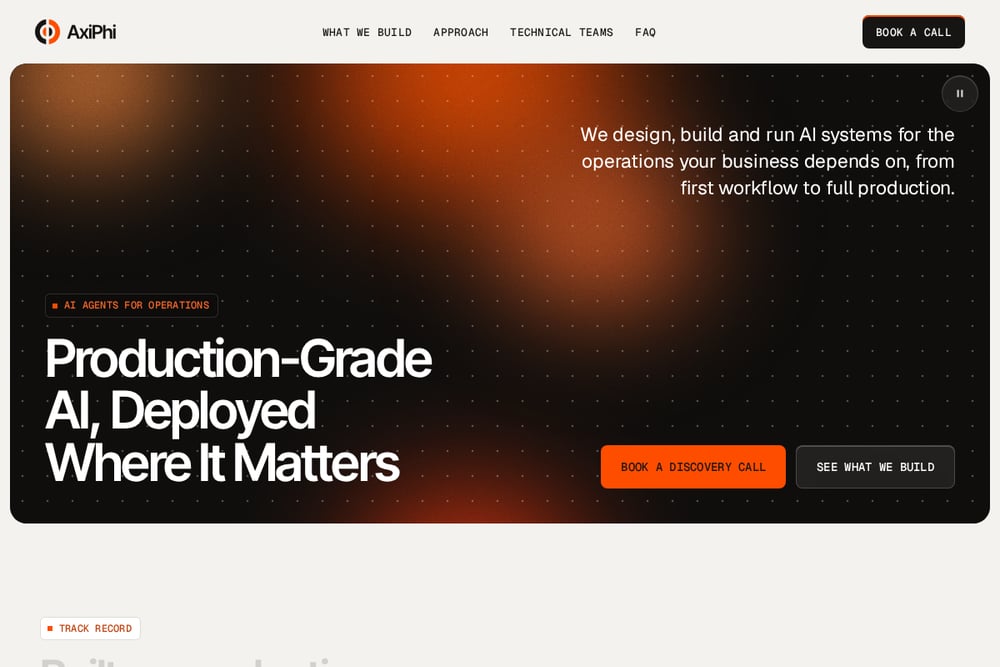 A screenshot of the AxiPhi website.
AxiPhi is a niche AI service provider that designs, builds, and runs production-grade AI systems for US businesses. Unlike platforms that hand you a tool and wish you luck, AxiPhi focuses on end-to-end deployment: document processing, knowledge assistants, voice agents, and workflow automation. Their founders have built and run AI systems inside large US healthcare and financial services companies, and the numbers from that work are striking: 30x faster document processing (about 10 seconds per document versus 5 minutes by hand), 90% less manual review effort on a high-volume clinical document workflow, and 60% higher agent productivity with a knowledge copilot. They also cut AI evaluation setup effort by 80% across six-plus enterprise applications. If you want a partner who has already operated in regulated, high-stakes environments, AxiPhi is worth a close look.
#3 Templafy
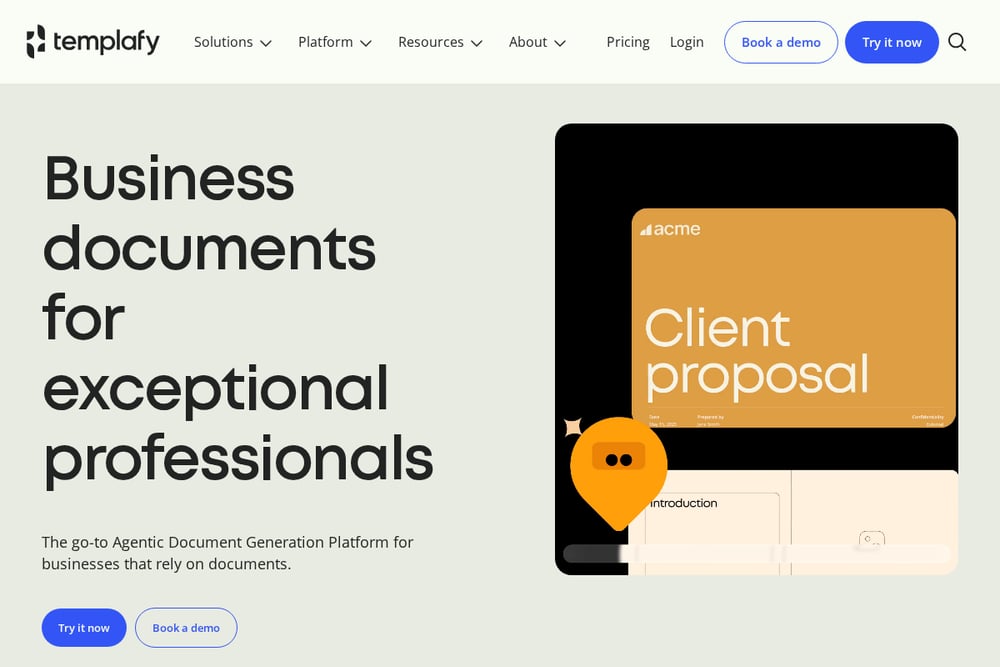 A screenshot of the Templafy website.
Templafy approaches document automation from the content generation and compliance angle. Its agentic document automation tools help you create on-brand, compliant documents from scratch using your internal data, brand assets, and legal content. That's a different flavor than pure data extraction: it's about producing client-ready documents faster while keeping quality and brand consistency high. Templafy cites stats like 70% of organizations piloting automation and nearly 90% planning to scale enterprise-wide within 2-3 years. If your pain point is document creation rather than document processing, Templafy is a strong fit. It's particularly popular in finance, sales, IT, and marketing teams.
#4 ThinkAutomation
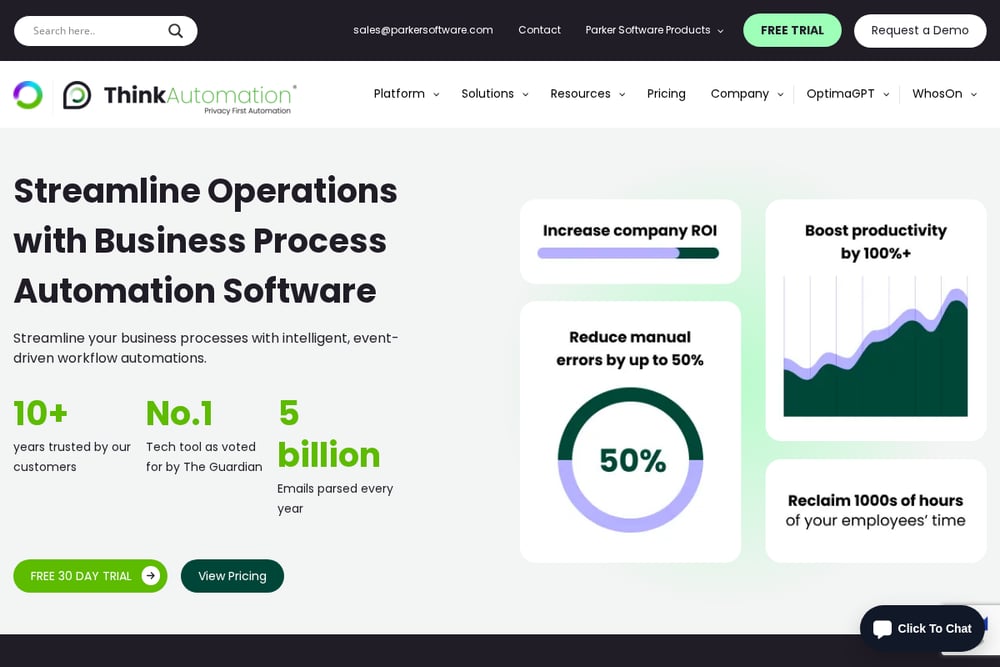 A screenshot of the ThinkAutomation website.
ThinkAutomation, from Parker Software, is a flexible workflow automation platform with a strong focus on on-premises and private cloud deployments. That matters if you have data privacy or regulatory requirements that rule out public cloud AI. They offer an on-premises AI server called OptimaGPT that provides OpenAI-compatible API access to open-source LLMs, so you can keep sensitive data inside your walls. Their document automation capabilities include intelligent document processing, email classification, and web form automation. They serve industries like public sector, finance, healthcare, and legal. If you need control over where your data lives, ThinkAutomation is a practical option.
#5 Artsyl
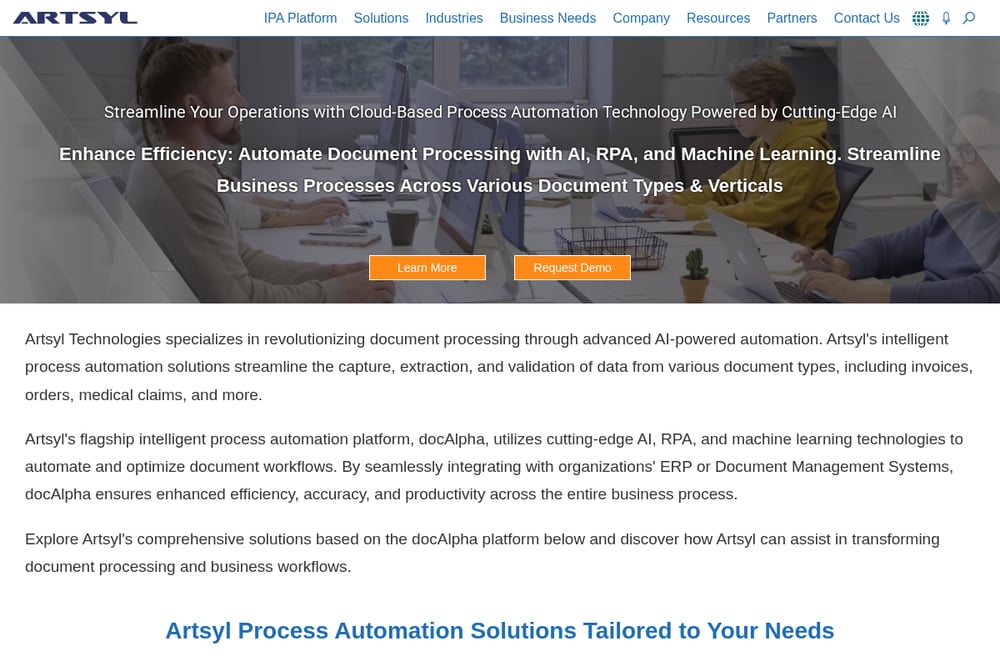 A screenshot of the Artsyl website.
Artsyl specializes in intelligent process automation with deep integration into ERP systems like Acumatica, Microsoft Dynamics, NetSuite, QuickBooks, and SAP Business One. Their docAlpha platform handles document classification, OCR, data capture, and machine learning for workflows like invoice processing, sales order capture, and medical claims automation. If your document workflows feed directly into an ERP, Artsyl's pre-built connectors can save you significant integration effort. They serve shared service organizations, healthcare, financial services, manufacturing, and more. The focus is on transactional document processes where accuracy and speed directly impact your bottom line.
How to Choose the Right Partner
Start by mapping your most painful workflow. Is it document extraction, document generation, or something else? If you're in healthcare or finance and need a partner who has already run AI in production, look for proven outcomes. If you need a broad platform to automate many processes, consider the larger players. If data residency is a concern, prioritize on-premises options. If your documents flow into an ERP, check for pre-built connectors. And always ask for references in your industry. The right choice is the one that fits your stack, your compliance needs, and your team's capacity to implement.
What Automation Looks Like in Practice
Imagine a document arrives in your inbox. Instead of a staff member opening it, reading it, and typing data into your system, an AI agent extracts the key fields in seconds. It validates the data against your rules, then either posts it directly to your ERP or routes it to a human for review if something looks off. Meanwhile, a knowledge copilot answers common questions for your support team, and a voice agent handles routine reminder calls. That's the end-to-end workflow these providers enable. The goal isn't to replace people; it's to free them from repetitive work so they can focus on exceptions and higher-value tasks.
The Bottom Line
AI document workflow automation is no longer experimental. The technology works, the market is maturing, and the providers are specializing. Whether you need a full platform, a niche production partner, a document generation tool, an on-premises solution, or deep ERP integration, there's an option for you. Start with one workflow, measure the results, and scale from there. The five providers here each bring something different to the table. Your job is to find the one that matches your reality.